The big picture
The laws of ritual cleanness now address suspicious marks on skin and fabric. God gives Moses, Israel's leader, and Aaron, the chief priest, detailed instructions for inspection. Israel, the community around the sanctuary, depends on these decisions for access to ordinary camp life and worship. The word leprosy here covers conditions broader than the disease now bearing that name. Priests examine signs, wait when needed, and declare a person or object clean or unclean.
In this chapter
- A Skin Mark Requires Careful Inspection Leviticus 13:1-8
A swelling, scab, or bright spot is brought to a priest for examination.
- Raw Flesh Changes the Decision Leviticus 13:9-17
The priest examines a longstanding condition with white swelling, white hair, and exposed raw flesh.
- Old Boils and Burns Are Rechecked Leviticus 13:18-28
A healed boil can leave a pale or reddish mark that needs examination.
- Scalp Changes Are Not All Alike Leviticus 13:29-44
The priest also examines sores on the head or beard.
- The Unclean Person Lives Outside Camp Leviticus 13:45-46
A person declared to have the condition must tear their clothes, leave the head uncovered, cover the upper lip, and announce their uncleanness.
- Damaged Fabric Is Examined Too Leviticus 13:47-59
Greenish or reddish marks in wool, linen, or leather are also brought to the priest.
Central truth
Priests must examine visible signs carefully, distinguishing harmless changes from conditions that require separation or destruction of affected materials.
Scripture beside the summary
Leviticus · King James Version · 59Leviticus 13:1-8
A Skin Mark Requires Careful Inspection
A swelling, scab, or bright spot is brought to a priest for examination. He looks for white hair and whether the mark appears deeper than the skin. Clear signs lead to a declaration of uncleanness. Uncertain cases require seven days apart, sometimes followed by another seven. A fading mark that does not spread permits cleansing and washed clothes. A mark that later spreads must be examined again. The priest is not told to treat every unusual patch as the same condition.

In everyday life
The school nurse examines a child's rash and records its edges before arranging another check. She does not announce a firm answer from an uncertain first glance. The later change matters to her decision. Leviticus gives priests rules for ritual status; it does not equip them with modern medical diagnosis.
Notice
Leviticus 13:6 A fading spot that has not spread can be declared clean. The waiting period allows observation to protect against a hasty permanent judgment.
Leviticus 13:1-8
King James Version1And the LORD spake unto Moses and Aaron, saying,
2When a man shall have in the skin of his flesh a rising, a scab, or bright spot, and it be in the skin of his flesh like the plague of leprosy; then he shall be brought unto Aaron the priest, or unto one of his sons the priests:
3And the priest shall look on the plague in the skin of the flesh: and when the hair in the plague is turned white, and the plague in sight be deeper than the skin of his flesh, it is a plague of leprosy: and the priest shall look on him, and pronounce him unclean.
4If the bright spot be white in the skin of his flesh, and in sight be not deeper than the skin, and the hair thereof be not turned white; then the priest shall shut up him that hath the plague seven days:
5And the priest shall look on him the seventh day: and, behold, if the plague in his sight be at a stay, and the plague spread not in the skin; then the priest shall shut him up seven days more:
6And the priest shall look on him again the seventh day: and, behold, if the plague be somewhat dark, and the plague spread not in the skin, the priest shall pronounce him clean: it is but a scab: and he shall wash his clothes, and be clean.
7But if the scab spread much abroad in the skin, after that he hath been seen of the priest for his cleansing, he shall be seen of the priest again:
8And if the priest see that, behold, the scab spreadeth in the skin, then the priest shall pronounce him unclean: it is a leprosy.
Leviticus 13:9-17
Raw Flesh Changes the Decision
The priest examines a longstanding condition with white swelling, white hair, and exposed raw flesh. Those signs lead directly to a declaration of uncleanness, without another period of observation. Yet skin that has turned white all over, without raw flesh, can be declared clean. If raw flesh appears again, the judgment changes. If it turns white again, the person returns for inspection. The rules depend on particular visible signs, not on how extensive or alarming the appearance seems to a bystander.

In everyday life
A building surveyor studies a pale wall and points to the damp patch rather than the old stain covering most of it. The active sign changes her assessment more than the larger harmless mark. She records what is present now. The priest decides sacred cleanness through given signs, not structural safety.
Notice
Leviticus 13:13 Skin turned entirely white can be declared clean. This surprising rule shows why the priest must follow the stated signs rather than judge by appearance alone.
Leviticus 13:9-17
King James Version9When the plague of leprosy is in a man, then he shall be brought unto the priest;
10And the priest shall see him: and, behold, if the rising be white in the skin, and it have turned the hair white, and there be quick raw flesh in the rising;
11It is an old leprosy in the skin of his flesh, and the priest shall pronounce him unclean, and shall not shut him up: for he is unclean.
12And if a leprosy break out abroad in the skin, and the leprosy cover all the skin of him that hath the plague from his head even to his foot, wheresoever the priest looketh;
13Then the priest shall consider: and, behold, if the leprosy have covered all his flesh, he shall pronounce him clean that hath the plague: it is all turned white: he is clean.
14But when raw flesh appeareth in him, he shall be unclean.
15And the priest shall see the raw flesh, and pronounce him to be unclean: for the raw flesh is unclean: it is a leprosy.
16Or if the raw flesh turn again, and be changed unto white, he shall come unto the priest;
17And the priest shall see him: and, behold, if the plague be turned into white; then the priest shall pronounce him clean that hath the plague: he is clean.
Leviticus 13:18-28
Old Boils and Burns Are Rechecked
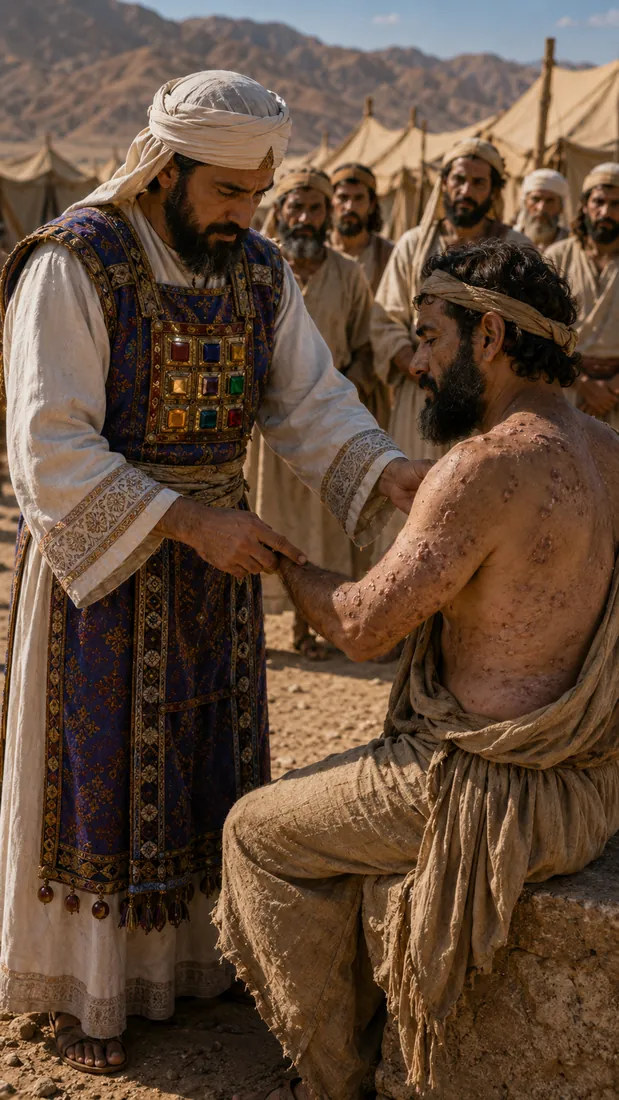
A healed boil can leave a pale or reddish mark that needs examination. The priest looks for depth, white hair, and later spreading. An uncertain mark is observed for seven days. If it stays in place, it can be identified as a scar and declared clean. A mark left by a burn follows a similar process. The law distinguishes a lingering mark from a spreading condition. A previous injury does not by itself settle whether the person is clean.
In everyday life
A mechanic checks an old weld after a new line appears beside it. She cleans the surface and watches whether the line extends under testing before deciding what repair is needed. An old repair and a new fault are different questions. Skin inspection here determines ritual status rather than mechanical soundness.
Notice
Leviticus 13:23 A mark that remains in place can be treated as the result of the old boil. Change over time helps distinguish it from the spreading condition.
Leviticus 13:18-28
King James Version18The flesh also, in which, even in the skin thereof, was a boil, and is healed,
19And in the place of the boil there be a white rising, or a bright spot, white, and somewhat reddish, and it be shewed to the priest;
20And if, when the priest seeth it, behold, it be in sight lower than the skin, and the hair thereof be turned white; the priest shall pronounce him unclean: it is a plague of leprosy broken out of the boil.
21But if the priest look on it, and, behold, there be no white hairs therein, and if it be not lower than the skin, but be somewhat dark; then the priest shall shut him up seven days:
22And if it spread much abroad in the skin, then the priest shall pronounce him unclean: it is a plague.
23But if the bright spot stay in his place, and spread not, it is a burning boil; and the priest shall pronounce him clean.
24Or if there be any flesh, in the skin whereof there is a hot burning, and the quick flesh that burneth have a white bright spot, somewhat reddish, or white;
25Then the priest shall look upon it: and, behold, if the hair in the bright spot be turned white, and it be in sight deeper than the skin; it is a leprosy broken out of the burning: wherefore the priest shall pronounce him unclean: it is the plague of leprosy.
26But if the priest look on it, and, behold, there be no white hair in the bright spot, and it be no lower than the other skin, but be somewhat dark; then the priest shall shut him up seven days:
27And the priest shall look upon him the seventh day: and if it be spread much abroad in the skin, then the priest shall pronounce him unclean: it is the plague of leprosy.
28And if the bright spot stay in his place, and spread not in the skin, but it be somewhat dark; it is a rising of the burning, and the priest shall pronounce him clean: for it is an inflammation of the burning.
Leviticus 13:29-44
Scalp Changes Are Not All Alike
The priest also examines sores on the head or beard. Depth, thin yellow hair, spreading, and later healthy dark hair affect the decision. Uncertain cases involve waiting and shaving around the affected place while leaving the sore itself untouched. Pale spots and ordinary baldness do not make someone unclean. A reddish sore on a bald area still requires inspection. The law separates loss of hair from a harmful condition, so baldness alone is not grounds for exclusion.
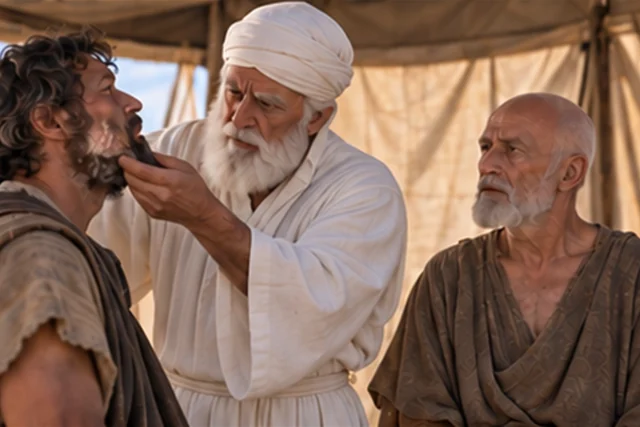
In everyday life
A barber notices a customer's thinning hair and treats it as ordinary baldness, then pauses when he sees a separate sore. He distinguishes a common change from something that needs another person's attention. Appearance alone does not settle every question. The priest has authority to declare ritual cleanness, which a barber lacks.
Notice
Leviticus 13:40 Baldness is explicitly called clean. The law rules out treating a common bodily change as a reason to bar someone from the community.
Leviticus 13:29-44
King James Version29If a man or woman have a plague upon the head or the beard;
30Then the priest shall see the plague: and, behold, if it be in sight deeper than the skin; and there be in it a yellow thin hair; then the priest shall pronounce him unclean: it is a dry scall, even a leprosy upon the head or beard.
31And if the priest look on the plague of the scall, and, behold, it be not in sight deeper than the skin, and that there is no black hair in it; then the priest shall shut up him that hath the plague of the scall seven days:
32And in the seventh day the priest shall look on the plague: and, behold, if the scall spread not, and there be in it no yellow hair, and the scall be not in sight deeper than the skin;
33He shall be shaven, but the scall shall he not shave; and the priest shall shut up him that hath the scall seven days more:
34And in the seventh day the priest shall look on the scall: and, behold, if the scall be not spread in the skin, nor be in sight deeper than the skin; then the priest shall pronounce him clean: and he shall wash his clothes, and be clean.
35But if the scall spread much in the skin after his cleansing;
36Then the priest shall look on him: and, behold, if the scall be spread in the skin, the priest shall not seek for yellow hair; he is unclean.
37But if the scall be in his sight at a stay, and that there is black hair grown up therein; the scall is healed, he is clean: and the priest shall pronounce him clean.
38If a man also or a woman have in the skin of their flesh bright spots, even white bright spots;
39Then the priest shall look: and, behold, if the bright spots in the skin of their flesh be darkish white; it is a freckled spot that groweth in the skin; he is clean.
40And the man whose hair is fallen off his head, he is bald; yet is he clean.
41And he that hath his hair fallen off from the part of his head toward his face, he is forehead bald: yet is he clean.
42And if there be in the bald head, or bald forehead, a white reddish sore; it is a leprosy sprung up in his bald head, or his bald forehead.
43Then the priest shall look upon it: and, behold, if the rising of the sore be white reddish in his bald head, or in his bald forehead, as the leprosy appeareth in the skin of the flesh;
44He is a leprous man, he is unclean: the priest shall pronounce him utterly unclean; his plague is in his head.
Leviticus 13:45-46
The Unclean Person Lives Outside Camp
A person declared to have the condition must tear their clothes, leave the head uncovered, cover the upper lip, and announce their uncleanness. They must live apart outside the camp for as long as the condition remains. These requirements make their status visible and audible to others. The cost is severe: ordinary life within the camp is interrupted. The account states the separation plainly but does not say that every affected person has committed a particular moral wrong.
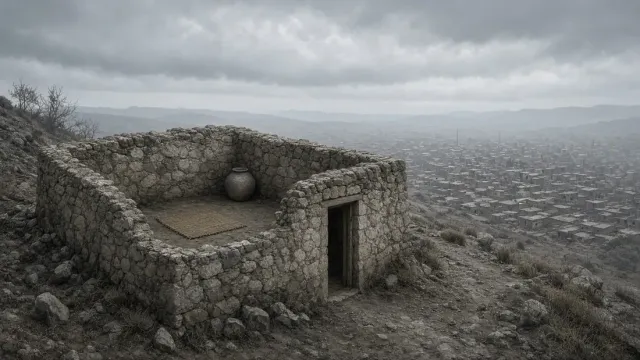
In everyday life
A traveller waits alone in a designated isolation room while a health restriction prevents joining the family outside. He speaks through the closed doorway and watches their bags leave without him. The separation affects ordinary company as well as movement. Israel's exclusion lasts under sacred law, without the modern room's medical support.
Notice
Leviticus 13:46 The separation lasts while the condition remains. The rule describes an ongoing status, not an automatic lifelong sentence for every person once declared unclean.
Leviticus 13:45-46
King James Version45And the leper in whom the plague is, his clothes shall be rent, and his head bare, and he shall put a covering upon his upper lip, and shall cry, Unclean, unclean.
46All the days wherein the plague shall be in him he shall be defiled; he is unclean: he shall dwell alone; without the camp shall his habitation be.
Leviticus 13:47-59
Damaged Fabric Is Examined Too
Greenish or reddish marks in wool, linen, or leather are also brought to the priest. The material is set aside for seven days. Spreading damage requires burning. If the mark does not spread, the material is washed and examined after another week. Persistent damage can still require burning, while a fading patch can be cut out. Material cleared of the mark is washed again. The same broad word used for skin conditions is applied to damage in cloth and leather.
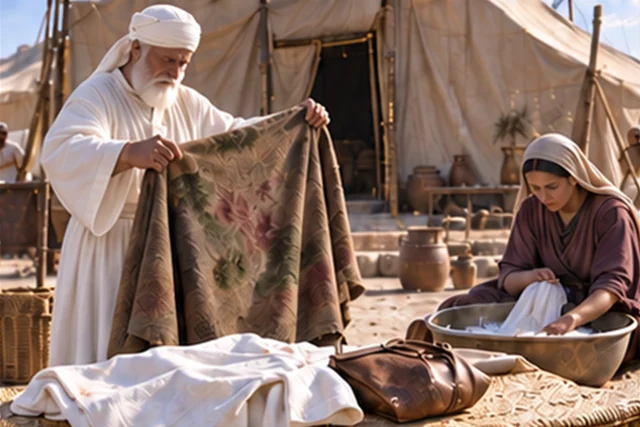
In everyday life
A costume keeper finds a spreading patch on a stored coat and separates it from the wardrobe. She cleans and checks it again before deciding whether to remove a panel or discard the whole garment. A valuable costume does not escape inspection. The priest's verdict includes sacred cleanness rather than preservation alone.
Notice
Leviticus 13:59 The same law names wool, linen, and leather. Its use of leprosy cannot refer only to the modern human disease, because objects also receive that description.
Leviticus 13:47-59
King James Version47The garment also that the plague of leprosy is in, whether it be a woollen garment, or a linen garment;
48Whether it be in the warp, or woof; of linen, or of woollen; whether in a skin, or in any thing made of skin;
49And if the plague be greenish or reddish in the garment, or in the skin, either in the warp, or in the woof, or in any thing of skin; it is a plague of leprosy, and shall be shewed unto the priest:
50And the priest shall look upon the plague, and shut up it that hath the plague seven days:
51And he shall look on the plague on the seventh day: if the plague be spread in the garment, either in the warp, or in the woof, or in a skin, or in any work that is made of skin; the plague is a fretting leprosy; it is unclean.
52He shall therefore burn that garment, whether warp or woof, in woollen or in linen, or any thing of skin, wherein the plague is: for it is a fretting leprosy; it shall be burnt in the fire.
53And if the priest shall look, and, behold, the plague be not spread in the garment, either in the warp, or in the woof, or in any thing of skin;
54Then the priest shall command that they wash the thing wherein the plague is, and he shall shut it up seven days more:
55And the priest shall look on the plague, after that it is washed: and, behold, if the plague have not changed his colour, and the plague be not spread; it is unclean; thou shalt burn it in the fire; it is fret inward, whether it be bare within or without.
56And if the priest look, and, behold, the plague be somewhat dark after the washing of it; then he shall rend it out of the garment, or out of the skin, or out of the warp, or out of the woof:
57And if it appear still in the garment, either in the warp, or in the woof, or in any thing of skin; it is a spreading plague: thou shalt burn that wherein the plague is with fire.
58And the garment, either warp, or woof, or whatsoever thing of skin it be, which thou shalt wash, if the plague be departed from them, then it shall be washed the second time, and shall be clean.
59This is the law of the plague of leprosy in a garment of woollen or linen, either in the warp, or woof, or any thing of skins, to pronounce it clean, or to pronounce it unclean.
Details worth noticing
The opening image
Leviticus 13:1 begins with “And the LORD spake unto Moses and Aaron, saying,”
Where the chapter turns
Leviticus 13:30 forms a natural hinge: “Then the priest shall see the plague: and, behold, if it be in sight deeper than the skin; and there be in it a yellow thin hair; then the priest shall…”
The final note
Leviticus 13:59 leaves the reader with “This is the law of the plague of leprosy in a garment of woollen or linen, either in the warp, or woof, or any thing of skins, to pronounce it clean, or to…”
A word trail through the chapter
The words priest, plague, skin, leprosy, unclean, white help reveal the chapter’s repeated concerns.
KJV words made clear
- quick raw flesh
- Living exposed flesh, rather than flesh covered by skin.
- scall
- A scaly condition affecting the head or beard here.
Music and video connected to the passage
Related media appears when its Scripture reference overlaps this study. Music and video can illuminate a theme while the biblical text remains the foundation.