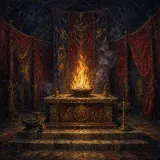
The big picture
The laws now move from hidden wrongs to dishonest dealings and the daily work at the altar. Moses, Israel's leader, receives instructions for both the people and the priests. Israel, the worshipping community, must repay what it steals or withholds. Aaron and his sons, the priests who handle the offerings, must keep the fire burning and treat sacred food carefully. Forgiveness, repair, and regular service all have practical requirements.
In this chapter
- The Dishonest Must Restore the Loss Leviticus 6:1-7
God names several ways people wrong their neighbours: keeping entrusted property, taking by force, cheating, or lying about a lost item they found.
- The Altar Fire Must Keep Burning Leviticus 6:8-13
Moses must instruct Aaron and his sons about the burnt offering.
- Priestly Grain Offerings Are Wholly Burned Leviticus 6:14-23
The priests burn a handful from the people's grain offerings with all the incense.
- Sin Offerings Require Careful Handling Leviticus 6:24-30
The sin offering is killed where the burnt offering is killed.
Central truth
God joins forgiveness with repayment for dishonesty and gives priests clear duties for fire, food, and sacred handling.

Scripture beside the summary
Leviticus · King James Version · 30Leviticus 6:1-7
The Dishonest Must Restore the Loss
God names several ways people wrong their neighbours: keeping entrusted property, taking by force, cheating, or lying about a lost item they found. False oaths do not protect the wrongdoer. The guilty person must return what was taken and add one fifth of its value. Repayment goes to the rightful owner on the day of the guilt offering. An unblemished ram is also brought to the priest. Forgiveness before God includes dealing honestly with the neighbour's actual loss.

In everyday life
A tenant returns the power tools he claimed were lost and pays for the hire costs his neighbour incurred. He places both the tools and payment on the doorstep before asking forgiveness. His apology now addresses the loss he caused. Israel also requires an offering to God for this wrong.
Notice
Leviticus 6:2 God calls deception against a neighbour a trespass against himself. The law does not separate religious guilt from the way entrusted property is handled.
Leviticus 6:1-7
King James Version1And the LORD spake unto Moses, saying,
2If a soul sin, and commit a trespass against the LORD, and lie unto his neighbour in that which was delivered him to keep, or in fellowship, or in a thing taken away by violence, or hath deceived his neighbour;
3Or have found that which was lost, and lieth concerning it, and sweareth falsely; in any of all these that a man doeth, sinning therein:
4Then it shall be, because he hath sinned, and is guilty, that he shall restore that which he took violently away, or the thing which he hath deceitfully gotten, or that which was delivered him to keep, or the lost thing which he found,
5Or all that about which he hath sworn falsely; he shall even restore it in the principal, and shall add the fifth part more thereto, and give it unto him to whom it appertaineth, in the day of his trespass offering.
6And he shall bring his trespass offering unto the LORD, a ram without blemish out of the flock, with thy estimation, for a trespass offering, unto the priest:
7And the priest shall make an atonement for him before the LORD: and it shall be forgiven him for any thing of all that he hath done in trespassing therein.
Leviticus 6:8-13
The Altar Fire Must Keep Burning
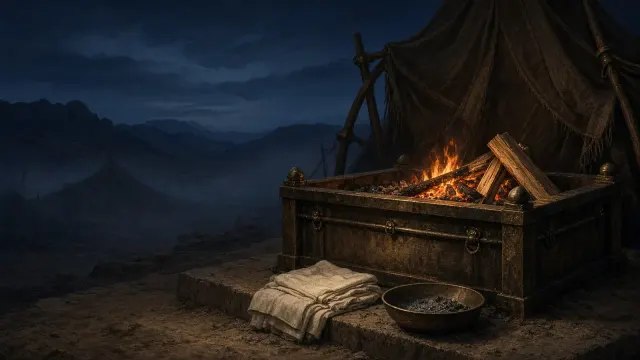
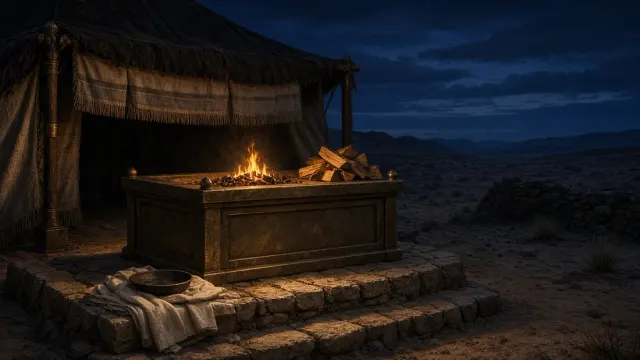
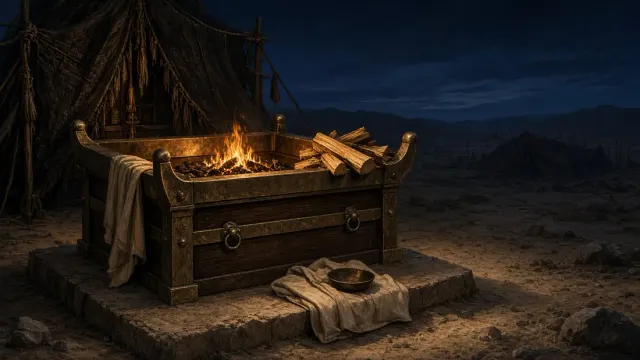
Moses must instruct Aaron and his sons about the burnt offering. It remains on the altar through the night, and the fire must not go out. A priest in linen clothing removes the ashes, then changes clothes before taking them to a clean place outside the camp. Fresh wood is added each morning, and offerings are arranged on the fire. The continuing flame depends on repeated, ordinary tasks carried out with care at the appointed place.
In everyday life
A furnace attendant takes over the night shift, checks the fuel, and clears the ash without letting the heat fail. The morning worker receives a fire already maintained through the dark hours. Repeated care keeps the work possible. The altar fire has no industrial output; its continuing purpose is worship.
Notice
Leviticus 6:11 The priest changes clothes before carrying ashes outside the camp. Even clearing waste has a defined procedure, distinguishing work at the altar from the task beyond it.
Leviticus 6:8-13
King James Version8And the LORD spake unto Moses, saying,
9Command Aaron and his sons, saying, This is the law of the burnt offering: It is the burnt offering, because of the burning upon the altar all night unto the morning, and the fire of the altar shall be burning in it.
10And the priest shall put on his linen garment, and his linen breeches shall he put upon his flesh, and take up the ashes which the fire hath consumed with the burnt offering on the altar, and he shall put them beside the altar.
11And he shall put off his garments, and put on other garments, and carry forth the ashes without the camp unto a clean place.
12And the fire upon the altar shall be burning in it; it shall not be put out: and the priest shall burn wood on it every morning, and lay the burnt offering in order upon it; and he shall burn thereon the fat of the peace offerings.
13The fire shall ever be burning upon the altar; it shall never go out.
Leviticus 6:14-23
Priestly Grain Offerings Are Wholly Burned
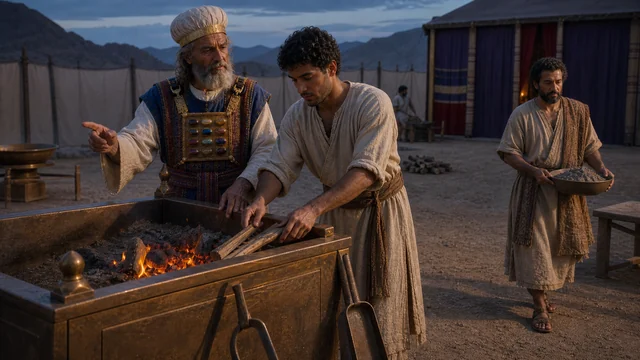
The priests burn a handful from the people's grain offerings with all the incense. The remaining portion is eaten without yeast in the sacred courtyard by male members of Aaron's family. It must not become ordinary food. A different rule applies to the priest's own grain offering. Prepared with oil and offered morning and evening, it is burned entirely. The priest does not keep a share of his own gift. The rules distinguish receiving support from consuming what he offers himself.
In everyday life
A scholarship trustee awards grants to students but pays her own promised contribution in full. She does not subtract an amount for herself from the gift she has pledged. Her role as distributor does not turn her own offering into income. Priestly food is sacred, not scholarship money.
Notice
Leviticus 6:23 No part of a priest's own grain offering is eaten. The man who receives food from others' offerings must give his own without retaining a meal.
Leviticus 6:14-23
King James Version14And this is the law of the meat offering: the sons of Aaron shall offer it before the LORD, before the altar.
15And he shall take of it his handful, of the flour of the meat offering, and of the oil thereof, and all the frankincense which is upon the meat offering, and shall burn it upon the altar for a sweet savour, even the memorial of it, unto the LORD.
16And the remainder thereof shall Aaron and his sons eat: with unleavened bread shall it be eaten in the holy place; in the court of the tabernacle of the congregation they shall eat it.
17It shall not be baken with leaven. I have given it unto them for their portion of my offerings made by fire; it is most holy, as is the sin offering, and as the trespass offering.
18All the males among the children of Aaron shall eat of it. It shall be a statute for ever in your generations concerning the offerings of the LORD made by fire: every one that toucheth them shall be holy.
19And the LORD spake unto Moses, saying,
20This is the offering of Aaron and of his sons, which they shall offer unto the LORD in the day when he is anointed; the tenth part of an ephah of fine flour for a meat offering perpetual, half of it in the morning, and half thereof at night.
21In a pan it shall be made with oil; and when it is baken, thou shalt bring it in: and the baken pieces of the meat offering shalt thou offer for a sweet savour unto the LORD.
22And the priest of his sons that is anointed in his stead shall offer it: it is a statute for ever unto the LORD; it shall be wholly burnt.
23For every meat offering for the priest shall be wholly burnt: it shall not be eaten.
Leviticus 6:24-30
Sin Offerings Require Careful Handling
The sin offering is killed where the burnt offering is killed. Its meat is most holy and is eaten by the priests in the sacred courtyard. Blood splashed on clothing must be washed out there. A clay cooking pot must be broken; a metal pot can be scoured and rinsed. These details keep sacred material from being treated casually. If an offering's blood was taken inside the tent for atonement, its meat must be burned instead of eaten.
In everyday life
A chip-factory technician notices residue on her sleeve and stops before leaving the controlled room. She follows the cleaning procedure and separates reusable tools from disposable containers. Care extends to every object touched by the material. Sacredness is the concern here, not a modern factory's risk of contamination.
Notice
Leviticus 6:30 Blood taken inside the tent changes what happens to the meat. The priest cannot assume that every sin offering provides food for him.
Leviticus 6:24-30
King James Version24And the LORD spake unto Moses, saying,
25Speak unto Aaron and to his sons, saying, This is the law of the sin offering: In the place where the burnt offering is killed shall the sin offering be killed before the LORD: it is most holy.
26The priest that offereth it for sin shall eat it: in the holy place shall it be eaten, in the court of the tabernacle of the congregation.
27Whatsoever shall touch the flesh thereof shall be holy: and when there is sprinkled of the blood thereof upon any garment, thou shalt wash that whereon it was sprinkled in the holy place.
28But the earthen vessel wherein it is sodden shall be broken: and if it be sodden in a brasen pot, it shall be both scoured, and rinsed in water.
29All the males among the priests shall eat thereof: it is most holy.
30And no sin offering, whereof any of the blood is brought into the tabernacle of the congregation to reconcile withal in the holy place, shall be eaten: it shall be burnt in the fire.
Details worth noticing
The opening image
Leviticus 6:1 begins with “And the LORD spake unto Moses, saying,”
Where the chapter turns
Leviticus 6:4 forms a natural hinge: “Then it shall be, because he hath sinned, and is guilty, that he shall restore that which he took violently away, or the thing which he hath deceitfully…”
The final note
Leviticus 6:30 leaves the reader with “And no sin offering, whereof any of the blood is brought into the tabernacle of the congregation to reconcile withal in the holy place, shall be eaten: it…”
A word trail through the chapter
The words offering, LORD, holy, altar, burnt, fire help reveal the chapter’s repeated concerns.
KJV words made clear
- principal
- The original amount owed, before any added payment.
- sodden
- Boiled or cooked in liquid inside a vessel.
Music and video connected to the passage
Related media appears when its Scripture reference overlaps this study. Music and video can illuminate a theme while the biblical text remains the foundation.