

The big picture
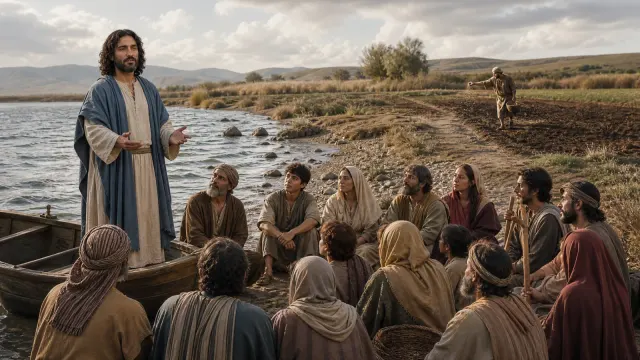
A crowd listens from the shore as Jesus teaches from a boat. He is the teacher announcing God's kingdom. He teaches through parables, short pictures drawn from familiar life. Seeds, weeds, dough, treasure, and a fishing net show how the kingdom is received and where it leads. His disciples, the followers learning from him, ask for explanations. The chapter ends in his own home region, where people who know his family struggle to receive him. Familiarity proves no guarantee of faith.
In this chapter
- Scattered Seed Meets Four Kinds of Ground Matthew 13:1-9
Jesus teaches from a boat because so many people have gathered on the shore.
- Hearing Becomes Fruitful Through Real Understanding Matthew 13:10-23
The disciples ask why Jesus uses parables.
- The Kingdom Grows Towards Its Appointed Harvest Matthew 13:24-35
A field of good grain becomes the next picture of the kingdom.
- The Harvest Belongs to the Son of Man Matthew 13:36-43
Inside the house, the disciples ask about the weeds.
- Treasure and a Full Net Call for Response Matthew 13:44-52
A man finds treasure in a field and gladly sells everything to buy it.
- His Home Region Stumbles Over Familiarity Matthew 13:53-58
Jesus leaves after the parables and teaches in the worship gathering of his own region.
Central truth
God’s kingdom is a gift of surpassing worth whose growth and final judgement call for understanding and a response deeper than passing interest.

Scripture beside the summary
Matthew · King James Version · 58Matthew 13:1-9
Scattered Seed Meets Four Kinds of Ground
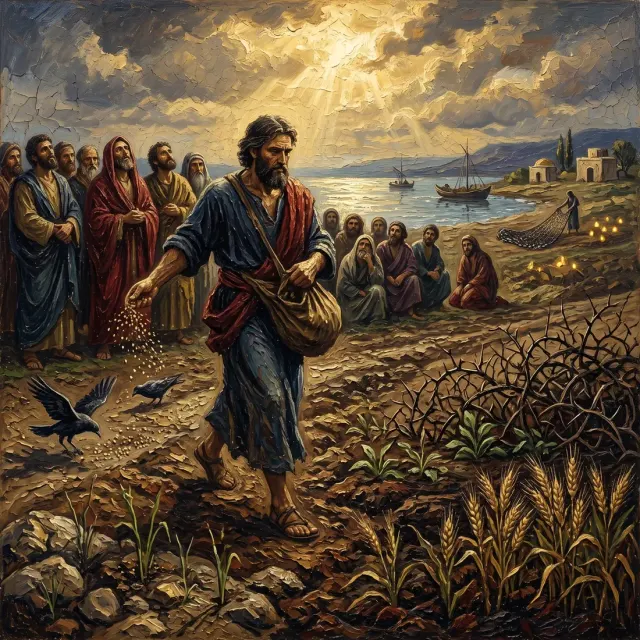
Jesus teaches from a boat because so many people have gathered on the shore. A farmer sows seed across ground with different conditions. Birds eat what lands on the path. Seed on shallow rocky ground shoots up quickly but scorches because it has no deep root. Thorns grow around another part and choke it. Good soil produces crops of different sizes, all far exceeding the seed planted. Jesus calls those with ears to listen. The picture does not yet explain each detail, but it makes one fact clear: the same sowing meets very different outcomes according to where the seed is received.
In everyday life
An adult-education tutor gives the same clear lesson to a group, then sees different results over the following weeks. Some forget it, some stop at the first difficulty, and others use it steadily. Initial attendance has not settled what takes root. Jesus describes receiving the kingdom's word, not learning a skill whose value is measured only by practical use.
Notice
Matthew 13:8 The good ground produces several sizes of harvest. Fruitfulness is not restricted to one identical yield, even though all these plants share a sound reception of the seed.
Matthew 13:1-9
King James Version1The same day went Jesus out of the house, and sat by the sea side.
2And great multitudes were gathered together unto him, so that he went into a ship, and sat; and the whole multitude stood on the shore.
3And he spake many things unto them in parables, saying, Behold, a sower went forth to sow;
4And when he sowed, some seeds fell by the way side, and the fowls came and devoured them up:
5Some fell upon stony places, where they had not much earth: and forthwith they sprung up, because they had no deepness of earth:
6And when the sun was up, they were scorched; and because they had no root, they withered away.
7And some fell among thorns; and the thorns sprung up, and choked them:
8But other fell into good ground, and brought forth fruit, some an hundredfold, some sixtyfold, some thirtyfold.
9Who hath ears to hear, let him hear.
Matthew 13:10-23
Hearing Becomes Fruitful Through Real Understanding
The disciples ask why Jesus uses parables. He says knowledge of the kingdom's hidden things is given to them, while others hear without grasping. He recalls Esaias, a prophet who described shut eyes and dull hearts. The disciples see what earlier faithful people longed to see. Jesus then explains the soils. The evil one snatches an ungrasped word; shallow joy fails under trouble; worry and the lure of wealth choke growth. The good hearer understands and bears fruit. Christians differ over the relation of divine giving and human refusal, but the account names both rather than making hearing a neutral act.
In everyday life
A language learner repeats a new phrase brightly in class but drops the course when practice becomes awkward. Another keeps working until the words serve real conversation. The same first enthusiasm has led to different results. Jesus explains response to God's kingdom amid evil, persecution, and wealth's lure, not a measure of language-learning persistence.
Notice
Matthew 13:22 The thorny ground does receive the word, but other concerns grow around it. Failure can come through crowded loyalties, not only through an initial refusal to listen.
Matthew 13:10-23
King James Version10And the disciples came, and said unto him, Why speakest thou unto them in parables?
11He answered and said unto them, Because it is given unto you to know the mysteries of the kingdom of heaven, but to them it is not given.
12For whosoever hath, to him shall be given, and he shall have more abundance: but whosoever hath not, from him shall be taken away even that he hath.
13Therefore speak I to them in parables: because they seeing see not; and hearing they hear not, neither do they understand.
14And in them is fulfilled the prophecy of Esaias, which saith, By hearing ye shall hear, and shall not understand; and seeing ye shall see, and shall not perceive:
15For this people’s heart is waxed gross, and their ears are dull of hearing, and their eyes they have closed; lest at any time they should see with their eyes, and hear with their ears, and should understand with their heart, and should be converted, and I should heal them.
16But blessed are your eyes, for they see: and your ears, for they hear.
17For verily I say unto you, That many prophets and righteous men have desired to see those things which ye see, and have not seen them; and to hear those things which ye hear, and have not heard them.
18Hear ye therefore the parable of the sower.
19When any one heareth the word of the kingdom, and understandeth it not, then cometh the wicked one, and catcheth away that which was sown in his heart. This is he which received seed by the way side.
20But he that received the seed into stony places, the same is he that heareth the word, and anon with joy receiveth it;
21Yet hath he not root in himself, but dureth for a while: for when tribulation or persecution ariseth because of the word, by and by he is offended.
22He also that received seed among the thorns is he that heareth the word; and the care of this world, and the deceitfulness of riches, choke the word, and he becometh unfruitful.
23But he that received seed into the good ground is he that heareth the word, and understandeth it; which also beareth fruit, and bringeth forth, some an hundredfold, some sixty, some thirty.
Matthew 13:24-35
The Kingdom Grows Towards Its Appointed Harvest
A field of good grain becomes the next picture of the kingdom. An enemy sows weeds in it. The owner refuses an immediate pulling that would damage the wheat. Both remain until harvest, when separation will come. A mustard seed gives another picture: tiny at planting, it becomes a large garden plant with room for birds. A woman's leaven works through a whole batch of flour. These pictures join patience with confidence in growth that is not fully visible at first. Matthew says Jesus' use of parables fulfils a prophetic word about bringing hidden things to speech.
In everyday life
A seed-bed keeper stops an eager helper from pulling closely tangled shoots before they can be separated safely. The delay protects the crop rather than approving the weeds. She marks the bed for careful work at the right time. Jesus speaks of God's kingdom and final separation, not a gardener deciding when plants are ready to handle.
Notice
Matthew 13:29 The owner's refusal to pull the weeds gives a reason: wheat would be uprooted too. Delay serves the good crop and does not erase the promised harvest.
Matthew 13:24-35
King James Version24Another parable put he forth unto them, saying, The kingdom of heaven is likened unto a man which sowed good seed in his field:
25But while men slept, his enemy came and sowed tares among the wheat, and went his way.
26But when the blade was sprung up, and brought forth fruit, then appeared the tares also.
27So the servants of the householder came and said unto him, Sir, didst not thou sow good seed in thy field? from whence then hath it tares?
28He said unto them, An enemy hath done this. The servants said unto him, Wilt thou then that we go and gather them up?
29But he said, Nay; lest while ye gather up the tares, ye root up also the wheat with them.
30Let both grow together until the harvest: and in the time of harvest I will say to the reapers, Gather ye together first the tares, and bind them in bundles to burn them: but gather the wheat into my barn.
31Another parable put he forth unto them, saying, The kingdom of heaven is like to a grain of mustard seed, which a man took, and sowed in his field:
32Which indeed is the least of all seeds: but when it is grown, it is the greatest among herbs, and becometh a tree, so that the birds of the air come and lodge in the branches thereof.
33Another parable spake he unto them; The kingdom of heaven is like unto leaven, which a woman took, and hid in three measures of meal, till the whole was leavened.
34All these things spake Jesus unto the multitude in parables; and without a parable spake he not unto them:
35That it might be fulfilled which was spoken by the prophet, saying, I will open my mouth in parables; I will utter things which have been kept secret from the foundation of the world.
Matthew 13:36-43
The Harvest Belongs to the Son of Man
Inside the house, the disciples ask about the weeds. Jesus identifies the sower as the Son of man, his title for himself, and the field as the world. Good seed represents the kingdom's people, while the weeds belong to the evil one. The devil is the enemy, the harvest is the world's end, and angels are the reapers. Jesus will send them to remove causes of sin and those practising evil. They face fiery judgement and grief. Those doing right will shine in their Father's kingdom. The explanation places final sorting in Jesus' hands rather than authorising listeners to destroy suspected weeds themselves.

In everyday life
A hearing assistant protects mixed records until the appointed judge can review them, refusing a bystander's demand to destroy files he dislikes. Waiting preserves both evidence and the right authority to decide. She does not call every record sound. Jesus assigns final judgement to himself and his angels, not a legal process with human limits.
Notice
Matthew 13:41 The Son of man sends angels to do the gathering. The earlier servants' restraint does not mean judgement is absent; it identifies who will carry it out.
Matthew 13:36-43
King James Version36Then Jesus sent the multitude away, and went into the house: and his disciples came unto him, saying, Declare unto us the parable of the tares of the field.
37He answered and said unto them, He that soweth the good seed is the Son of man;
38The field is the world; the good seed are the children of the kingdom; but the tares are the children of the wicked one;
39The enemy that sowed them is the devil; the harvest is the end of the world; and the reapers are the angels.
40As therefore the tares are gathered and burned in the fire; so shall it be in the end of this world.
41The Son of man shall send forth his angels, and they shall gather out of his kingdom all things that offend, and them which do iniquity;
42And shall cast them into a furnace of fire: there shall be wailing and gnashing of teeth.
43Then shall the righteous shine forth as the sun in the kingdom of their Father. Who hath ears to hear, let him hear.
Matthew 13:44-52
Treasure and a Full Net Call for Response
A man finds treasure in a field and gladly sells everything to buy it. A merchant does the same for a pearl of exceptional worth. Jesus then compares the kingdom to a net gathering many kinds of fish, later sorted on shore. Angels will separate the wicked from those doing right at the end, with the same severe warning of fire. Asked whether they understand, the disciples say yes. Jesus likens a teacher trained for the kingdom to a householder bringing out both new and old treasures. Understanding is meant to become a rich resource for teaching, not merely a claim to have heard.

In everyday life
A violin maker finds a rare instrument of remarkable quality. He sells his spare stock to buy it. The cost is large, but the value makes the choice glad rather than grudging. He knows why he lets the other goods go. Jesus joins the kingdom's surpassing worth with final judgement, not a purchase measured by market value.
Notice
Matthew 13:44 Joy comes before the sale of everything else. The cost is understood through the value discovered, rather than presented as loss with no reason to welcome it.
Matthew 13:44-52
King James Version44Again, the kingdom of heaven is like unto treasure hid in a field; the which when a man hath found, he hideth, and for joy thereof goeth and selleth all that he hath, and buyeth that field.
45Again, the kingdom of heaven is like unto a merchant man, seeking goodly pearls:
46Who, when he had found one pearl of great price, went and sold all that he had, and bought it.
47Again, the kingdom of heaven is like unto a net, that was cast into the sea, and gathered of every kind:
48Which, when it was full, they drew to shore, and sat down, and gathered the good into vessels, but cast the bad away.
49So shall it be at the end of the world: the angels shall come forth, and sever the wicked from among the just,
50And shall cast them into the furnace of fire: there shall be wailing and gnashing of teeth.
51Jesus saith unto them, Have ye understood all these things? They say unto him, Yea, Lord.
52Then said he unto them, Therefore every scribe which is instructed unto the kingdom of heaven is like unto a man that is an householder, which bringeth forth out of his treasure things new and old.
Matthew 13:53-58
His Home Region Stumbles Over Familiarity
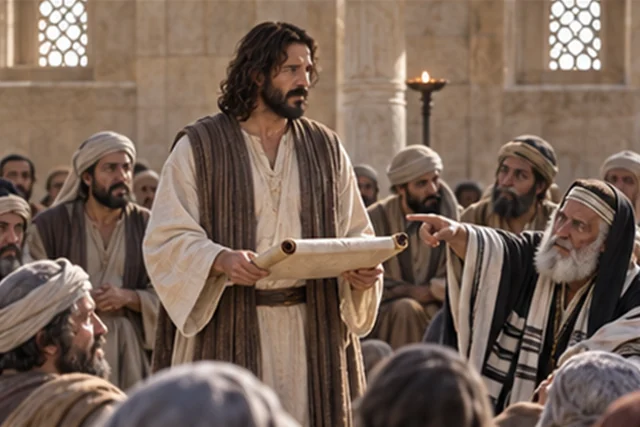
Jesus leaves after the parables and teaches in the worship gathering of his own region. People are amazed by his wisdom and works but point to his familiar family. They know Mary, his mother, his brothers, and his sisters, and call him the carpenter's son. That familiarity becomes a reason to take offence instead of hear him. Jesus says a prophet lacks honour especially at home and among his own household. He does few mighty works there because of their unbelief. Knowing where he grew up has not brought them to understand who stands before them.
In everyday life
A village musician returns with a new work, and former neighbours dismiss it before listening because they remember her childhood lessons. Their old knowledge is real but incomplete. Familiar names become an excuse to refuse what is now being offered. Jesus faces unbelief concerning his divine authority, not an artist asking for a fresh assessment of skill.
Notice
Matthew 13:58 The small number of mighty works is linked to unbelief. The crowd's familiarity does not function as the trust seen in people who approached him from elsewhere.
Matthew 13:53-58
King James Version53And it came to pass, that when Jesus had finished these parables, he departed thence.
54And when he was come into his own country, he taught them in their synagogue, insomuch that they were astonished, and said, Whence hath this man this wisdom, and these mighty works?
55Is not this the carpenter’s son? is not his mother called Mary? and his brethren, James, and Joses, and Simon, and Judas?
56And his sisters, are they not all with us? Whence then hath this man all these things?
57And they were offended in him. But Jesus said unto them, A prophet is not without honour, save in his own country, and in his own house.
58And he did not many mighty works there because of their unbelief.
Details worth noticing
The opening image
Matthew 13:1 begins with “The same day went Jesus out of the house, and sat by the sea side.”
Where the chapter turns
Matthew 13:29 forms a natural hinge: “But he said, Nay; lest while ye gather up the tares, ye root up also the wheat with them.”
The final note
Matthew 13:58 leaves the reader with “And he did not many mighty works there because of their unbelief.”
A word trail through the chapter
The words kingdom, hear, seed, some, heaven, tares help reveal the chapter’s repeated concerns.
KJV words made clear
- tares
- Weeds growing among grain, pictured as harmful plants sown by an enemy.
- anon
- Immediately or soon after, here describing an eager first response.
- leaven
- A fermenting ingredient that spreads through dough and makes it rise.
Music and video connected to the passage
Related media appears when its Scripture reference overlaps this study. Music and video can illuminate a theme while the biblical text remains the foundation.
 Watch and Be ReadyMatthew 24-25; Mark 13; Luke 21:5-38Listen to related music →The Sower Went Forth to SowMatthew 13:1-52Listen to related music →
 This Do in RemembranceMatthew 26:17-35; Mark 14:12-31; Luke 22:7-38; John 13-17Listen to related music →Matthew, Part OneMatthew 1:1-13:58Listen to related music →