The big picture
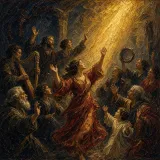
A new song begins among God's faithful people. Israel, the people he made his own, rejoices. Zion, Jerusalem's holy hill, names the community celebrating its king. Dance and instruments express delight because God favours his people and gives rescue to the humble. The song then joins praise with swords, bound rulers, and punishment of nations. This severe ending describes carrying out a written judgement, not merely a peaceful gathering whose language can be reduced to music.
In this chapter
- The Humble Receive Rescue and Joy Psalms 149:1-4
The faithful are called to sing a new song together.
- Praise and a Sword Appear Together Psalms 149:5-6
Even on their beds, the faithful are to sing and rejoice in honour.
- Written Judgement Is Carried Out on Rulers Psalms 149:7-9
The sword serves vengeance against nations and punishment against peoples.
Central truth
God's people rejoice in their maker and king, then receive the severe role of carrying out his written judgement on nations and rulers.

Scripture beside the summary
Psalms · King James Version · 9Psalms 149:1-4
The Humble Receive Rescue and Joy
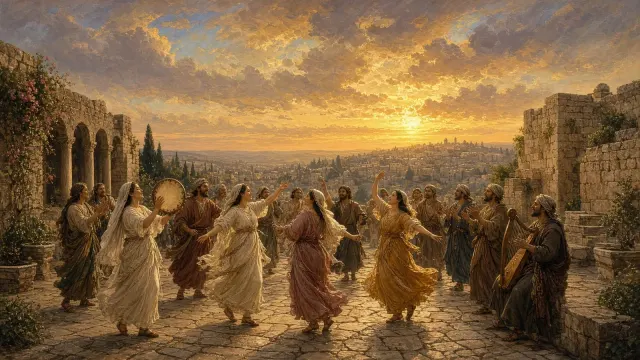
The faithful are called to sing a new song together. They rejoice in the God who made them his people and celebrate him as king. Dance, a hand drum, and harp give praise a bodily and musical form. The reason is that the Lord takes pleasure in his people. He will adorn the humble with salvation, turning their low place into one marked by rescue. The song begins with delight received and returned. Their praise answers God's favour rather than attempting to manufacture a king by their own applause.
In everyday life
A folk-dance tutor starts a new piece with residents who have recently found stable housing. They learn the steps together, then clap for the quietest dancer when she joins the circle. Relief has found a bodily expression in the room. The welcome gives joy a place to grow. The psalm celebrates the Lord as maker, king, and rescuer.
Notice
Psalms 149:4 Salvation is pictured as clothing or adornment for the humble. The honour comes from God's rescue, not from their ability to display rank.
Psalms 149:1-4
King James Version1Praise ye the LORD. Sing unto the LORD a new song, and his praise in the congregation of saints.
2Let Israel rejoice in him that made him: let the children of Zion be joyful in their King.
3Let them praise his name in the dance: let them sing praises unto him with the timbrel and harp.
4For the LORD taketh pleasure in his people: he will beautify the meek with salvation.
Psalms 149:5-6
Praise and a Sword Appear Together
Even on their beds, the faithful are to sing and rejoice in honour. Praise is not confined to the public assembly. Yet the next image puts high praise in their mouths and a two-edged sword in their hands. Joy and armed readiness are held together, leading towards the punishment described next. The sword must not be silently changed into a harmless musical image. The song gives the people a role in judgement as well as worship. Its celebration has a severe edge that the next lines make explicit.
In everyday life
A security officer hears the final thanks at a ceremony, then checks the equipment required for the difficult duty that follows. The room's gladness does not remove the seriousness of the assigned work. She stands quietly while the instructions are read. Celebration and responsibility occupy the same moment. The psalm specifically joins praise with a sword for judgement.
Notice
Psalms 149:6 Mouth and hand carry different things: praise and a sword. The pairing prepares for actual punishment in the following verses, rather than ending with music alone.
Psalms 149:5-6
King James Version5Let the saints be joyful in glory: let them sing aloud upon their beds.
6Let the high praises of God be in their mouth, and a twoedged sword in their hand;
Psalms 149:7-9
Written Judgement Is Carried Out on Rulers
The sword serves vengeance against nations and punishment against peoples. Kings are bound with chains and nobles with iron restraints. Their rank does not keep them free from the judgement. The final line calls the task an honour shared by God's faithful people and describes it as carrying out what is written. The song ends with praise while keeping this violent role in view. It does not name a modern enemy or give a fresh judgement for readers to invent. The stated task belongs to the divine sentence being celebrated here.
In everyday life
A court archivist reads the signed ruling before officers begin enforcing it. The names include people with titles who expected their standing to protect them. She checks each page against the authorised order rather than treating anger as sufficient grounds to act. The room is solemn. The psalm gives God's faithful people a role in judgement against nations.
Notice
Psalms 149:9 The judgement is described as written. The claimed honour is carrying out that sentence, not inventing punishment according to personal resentment.
Psalms 149:7-9
King James Version7To execute vengeance upon the heathen, and punishments upon the people;
8To bind their kings with chains, and their nobles with fetters of iron;
9To execute upon them the judgment written: this honour have all his saints. Praise ye the LORD.
Details worth noticing
The opening image
Psalms 149:1 begins with “Praise ye the LORD. Sing unto the LORD a new song, and his praise in the congregation of saints.”
Where the chapter turns
Psalms 149:5 forms a natural hinge: “Let the saints be joyful in glory: let them sing aloud upon their beds.”
The final note
Psalms 149:9 leaves the reader with “To execute upon them the judgment written: this honour have all his saints. Praise ye the LORD.”
A word trail through the chapter
The words LORD, praise, saints, sing, execute, joyful help reveal the chapter’s repeated concerns.
KJV words made clear
- timbrel
- A small hand drum used to accompany music and dancing.
- fetters
- Metal restraints placed on prisoners to prevent free movement.
Music and video connected to the passage
Related media appears when its Scripture reference overlaps this study. Music and video can illuminate a theme while the biblical text remains the foundation.