The big picture
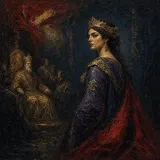
Esther acts on the decision made in the previous chapter. Dressed in royal apparel, she enters the inner court, is seen by Ahasuerus, and receives the extended sceptre that allows her to approach. The king offers extravagant generosity, but Esther’s immediate request is simply that he and Haman attend a banquet she has already prepared. At the meal, Ahasuerus asks again for her petition, and she answers with another invitation, promising to speak the next day. The Book of Esther does not explain her private reason for delaying, but the interval creates the night on which the central reversal will begin. Haman meanwhile leaves delighted, then sees Mordecai still refusing him honour. At home he lists his wealth, children, promotion, and exclusive invitations, only to declare that all of it means nothing while Mordecai remains. His household answers with a towering execution structure, and Haman approves.
In this chapter
- The Sceptre Moves Before the Petition Is Heard Esther 5:1-5
On the third day Esther moves from preparation to exposure.
- The Answer Contains Another Invitation Esther 5:6-8
At the banquet of wine, Ahasuerus repeats the paired language of petition and request, making clear that he knows Esther’s dangerous approach was not merely about serving a meal.
- An Inventory of Honours That Adds Up to Nothing Esther 5:9-14
Haman leaves Esther’s first banquet joyful, and the sight of Mordecai at the gate destroys that satisfaction almost instantly.

Scripture beside the summary
Esther · King James Version · 14Esther 5:1-5
The Sceptre Moves Before the Petition Is Heard
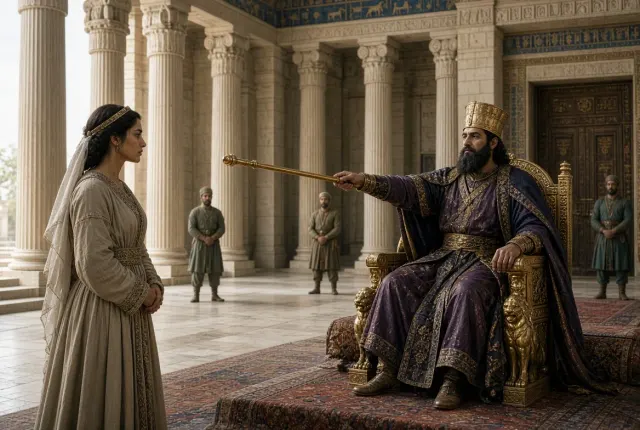
On the third day Esther moves from preparation to exposure. She dresses in royal apparel and stands in the inner court where Ahasuerus can see her from his throne. The geography matters because the previous chapter established exactly what entering that space without a summons could cost. The crisis is resolved not by ignoring the rule but by the king extending the golden sceptre, allowing Esther to approach and touch it. His offer of up to half the kingdom sounds enormous before he knows what she wants. Esther answers with something modest in immediate form: she asks Ahasuerus and Haman to attend a banquet she has already prepared. The preparation shows that this request was not invented in panic after the sceptre moved. Haman, the man whose decree threatens Esther’s people, is invited into a setting arranged by the queen while still unaware of her identity or the petition waiting behind the meal.
Deep dive
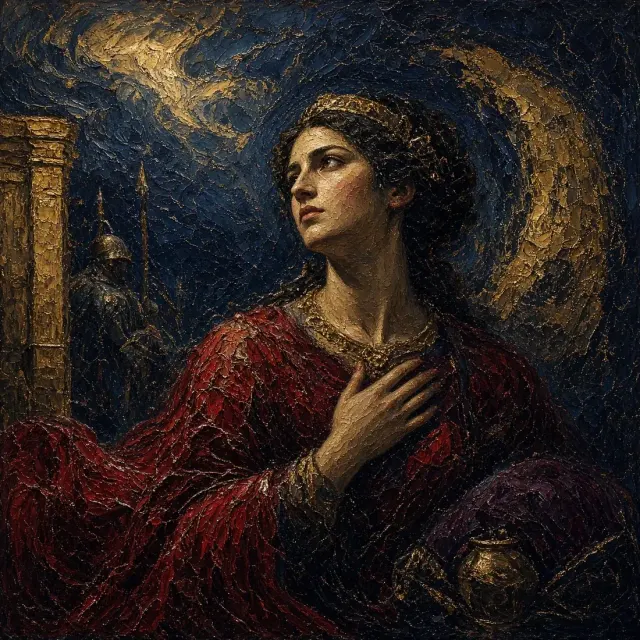
The account gives attention to positions and visibility: Esther stands in the inner court, the king sits opposite the entrance, and he sees her. The scene answers the rule described in chapter 4 by showing the decisive exception taking place. The extended sceptre permits her to draw near and touch it. Her royal clothing belongs to the setting, but the text identifies the king’s favourable response, not a garment’s independent power, as the reason the encounter does not end in punishment.
The offer of up to half the kingdom expresses expansive willingness before the king knows the request. Esther responds with something much smaller in immediate appearance: attendance at a banquet already prepared. That preparation matters. The invitation is not depicted as an improvised subject discovered only after she reaches the throne. Haman’s inclusion brings the person behind the decree into a setting arranged by the person endangered by it. At this point only Esther knows what she intends to ask there. The court’s second most honoured man enters the next scene with considerably less understanding than his invitation might suggest.
Words to trace: Esther, king, house, Haman, royal, banquet
Verse-by-verse path
- Esther 5:1
“Put on her royal apparel” is literally “clothed herself in royalty”, vattilbash malkhut, the word for kingdom. The third day is often the day of turning in Hebrew narrative, as when Abraham lifted his eyes and saw Moriah (Genesis 22:4). The throne faces the entrance, so she is seen before she speaks.
- Esther 5:2
“Obtained favour” is the idiom of 2:15 and 2:17, where favour came to Esther without her asking. Touching the top of the sceptre acknowledges the king’s grant of audience and accepts his protection. The law of 4:11 has been kept, not broken: the sceptre went out.
- Esther 5:3
“To the half of the kingdom” is the formula of royal generosity; Herod made the same promise to his stepdaughter (Mark 6:23). Herodotus (9.109) tells of Xerxes promising a woman of his court anything she asked, and being trapped when she asked for his own robe.
- Esther 5:4
Jewish tradition noticed that the first letters of four Hebrew words in Esther’s invitation, “let the king and Haman come this day”, spell the divine name, and some manuscripts write them large. In a book that never names God, readers went looking for him in the letters.
- Esther 5:5
“Cause Haman to make haste” is a summons more than an invitation. The man with the king’s ring hurries at the queen’s word, and the king comes to a table Esther had already set.
Esther 5:1-5
King James Version1Now it came to pass on the third day, that Esther put on her royal apparel, and stood in the inner court of the king’s house, over against the king’s house: and the king sat upon his royal throne in the royal house, over against the gate of the house.
2And it was so, when the king saw Esther the queen standing in the court, that she obtained favour in his sight: and the king held out to Esther the golden sceptre that was in his hand. So Esther drew near, and touched the top of the sceptre.
3Then said the king unto her, What wilt thou, queen Esther? and what is thy request? it shall be even given thee to the half of the kingdom.
4And Esther answered, If it seem good unto the king, let the king and Haman come this day unto the banquet that I have prepared for him.
5Then the king said, Cause Haman to make haste, that he may do as Esther hath said. So the king and Haman came to the banquet that Esther had prepared.
Esther 5:6-8
The Answer Contains Another Invitation
At the banquet of wine, Ahasuerus repeats the paired language of petition and request, making clear that he knows Esther’s dangerous approach was not merely about serving a meal. Yet Esther still does not disclose the matter. She asks the king and Haman to come to another banquet the next day and promises that she will then answer as the king has asked. The Book of Esther never opens Esther’s private reasoning to explain the delay, so confidence about her psychology would go beyond the passage. What the account does show is the effect of one more night. That interval will contain Ahasuerus’s sleeplessness, the reading of the chronicles, the discovery of Mordecai’s unrewarded service, and Haman’s humiliating role in honouring him. The silence at the first banquet therefore becomes structurally decisive without needing an invented motive. The petition remains pending while events rearrange the positions of everyone who will attend the second meal.
Deep dive
The repeated pairing of petition and request keeps the unanswered matter audible. The king knows that the banquet itself cannot be the full reason for Esther’s dangerous approach, yet her response leads to another banquet rather than the disclosure. Esther attaches the next invitation to his willingness to grant her request and promises an answer tomorrow. That makes the second gathering more than a casual social occasion: the king has again voiced his readiness to listen, and an explanation is now explicitly pending.
The book does not state why Esther delays. Careful timing, the need to establish favourable circumstances, and hesitation have all been proposed, but no private explanation is supplied. The effect of the delay is clearer than its psychology. It creates the night during which the king will lose sleep and Mordecai’s unrecognized service will come to light. Reading that sequence as providential is an interpretation of its remarkable coordination; Esther does not insert a direct announcement of divine causation. The suspense depends on allowing the gap to remain a gap until the events occupying it are disclosed.
Words to trace: king, petition, request, banquet, Esther, favour
Verse-by-verse path
- Esther 5:6
The “banquet of wine” is the drinking after the meal. Herodotus (1.133) says Persians debated serious matters while drunk and then reconsidered them sober the next day. The king asks his question at exactly the stage of the evening when Persians decided things.
- Esther 5:7
Esther starts to answer, “My petition and my request is”, and the sentence breaks off. The Hebrew leaves it hanging before she begins again with conditions in the next verse.
- Esther 5:8
Four conditions before the request: if I have found favour, if it please the king, to grant, to perform. And then the request is only another banquet. “I will do to morrow as the king hath said” binds her to name her petition next time; she has made a promise to the king.
Esther 5:6-8
King James Version6And the king said unto Esther at the banquet of wine, What is thy petition? and it shall be granted thee: and what is thy request? even to the half of the kingdom it shall be performed.
7Then answered Esther, and said, My petition and my request is;
8If I have found favour in the sight of the king, and if it please the king to grant my petition, and to perform my request, let the king and Haman come to the banquet that I shall prepare for them, and I will do to morrow as the king hath said.
Esther 5:9-14
An Inventory of Honours That Adds Up to Nothing
Haman leaves Esther’s first banquet joyful, and the sight of Mordecai at the gate destroys that satisfaction almost instantly. Mordecai still will not stand or move for him. Haman contains himself long enough to go home, summon Zeresh and his friends, and recite an impressive inventory: riches, many children, promotion above the princes, and the exceptional privilege of joining the king at Esther’s banquets. His conclusion turns the whole list hollow. None of it satisfies him while Mordecai remains seated at the gate. The Book of Esther does not have to infer obsession from outside evidence; Haman measures his own abundance against one man’s refusal and declares abundance worthless. His household proposes a fifty-cubit execution structure and assumes royal permission can be secured the next morning before another pleasant banquet. Haman likes the plan and has it built. The object meant to settle his resentment is ready before he understands what Esther’s invitation is actually for.
Deep dive
Haman leaves with joy that the text expressly names, and Mordecai’s refusal to rise immediately changes it to indignation. His subsequent self-restraint does not remove the anger; it carries it home. There he rehearses the evidence of his importance before his wife and friends: wealth, sons, promotion, precedence, and access to the queen’s banquets. The list is full, and his conclusion empties it. One man at the gate is enough to make the whole catalogue count for nothing in his estimation.
The household’s solution assumes that royal permission can be secured the next morning and that a killing will clear the way for a pleasant meal. The fifty-cubit height makes the proposed humiliation conspicuous; the text gives no engineering plan for the structure. Its significance is not merely that Haman wishes Mordecai dead, since the empire-wide decree already shows that. He now wants a particular death brought forward and publicly displayed. Esther’s invitation, which he treats as a guarantee of belonging at the top, becomes the occasion for preparing the object that will soon bear his own punishment. His confidence has run ahead of his information.
Words to trace: Haman, king, Mordecai, banquet, friends, gallows
Verse-by-verse path
- Esther 5:9
“With a glad heart” is tov lev, the phrase used of the king “merry with wine” in 1:10. Mordecai “stood not up, nor moved”, and the word for moved is za, to tremble: he does not rise and he does not shake.
- Esther 5:10
“Refrained himself” is hit’appaq, the word used of Joseph holding back his tears before his brothers (Genesis 43:31; 45:1). Haman controls himself until he is among his own. Zeresh may be a Persian name meaning golden.
- Esther 5:11
Herodotus (1.136) says that after bravery in battle a Persian’s highest merit was to have many sons, and that the king sent yearly gifts to the man with the most. Haman had ten (9:7–10). His list goes riches, sons, promotion: the Persian scale of a successful life.
- Esther 5:12
The last item on Haman’s list and, to him, the best: the queen invites no one but the king and himself. The Hebrew stresses “only me”. The honour he boasts of most is the one that will bring him down.
- Esther 5:13
“Availeth me nothing” is literally “is not worth it to me”, using shoveh, the word Haman used to the king in 3:8, that it was not “for the king’s profit” to let the Jews live. Haman measures everything by worth, and one seated man cancels all his wealth.
- Esther 5:14
Fifty cubits is about seventy five feet, far taller than any house and visible from far off. The advice comes from his wife and friends, and Haman, like his king in 1:21, accepts: “the thing pleased Haman”. The ets, the tree or stake, is ready before morning.
Esther 5:9-14
King James Version9Then went Haman forth that day joyful and with a glad heart: but when Haman saw Mordecai in the king’s gate, that he stood not up, nor moved for him, he was full of indignation against Mordecai.
10Nevertheless Haman refrained himself: and when he came home, he sent and called for his friends, and Zeresh his wife.
11And Haman told them of the glory of his riches, and the multitude of his children, and all the things wherein the king had promoted him, and how he had advanced him above the princes and servants of the king.
12Haman said moreover, Yea, Esther the queen did let no man come in with the king unto the banquet that she had prepared but myself; and to morrow am I invited unto her also with the king.
13Yet all this availeth me nothing, so long as I see Mordecai the Jew sitting at the king’s gate.
14Then said Zeresh his wife and all his friends unto him, Let a gallows be made of fifty cubits high, and to morrow speak thou unto the king that Mordecai may be hanged thereon: then go thou in merrily with the king unto the banquet. And the thing pleased Haman; and he caused the gallows to be made.
Questions to keep in mind while reading
- Track who acts, who speaks, who is affected, and what changes.
- Notice repeated promises, failures, rescues, and consequences.
- Do not assume the account approves every action that is reported.
Text first
Where readers differ
The chapter summary begins with what the passage says and how its parts fit together. It does not assume one denomination has already settled every question. Where a conclusion depends on a tradition, literary theory, or historical reconstruction, that dependence is named openly.
The KJV text is presented first. Interpretive conclusions are labeled, and differences are introduced only when they help a reader understand why serious communities do not always reach the same answer.
Comparative interpretive notes for this chapter are in preparation. Until reviewed notes are ready, this page separates the KJV text from summary and application without claiming that serious readers agree on every question.
Questions beneath the surface
- What account of God, human freedom, responsibility, and the good life emerges from Esther 5?
- Which tension does the chapter refuse to resolve quickly?
- What changes when the chapter is read as part of the whole canon rather than as an isolated moral lesson?
- Where might a sincere reader confuse a familiar tradition with something the text states directly?
Questions for serious personal contemplation
These open-ended questions make room for tension, honest response, prayer, and conclusions that remain accountable to the chapter.
Observe without rushing
What part of Esther 5 makes you stop, feel unsettled, or feel surprised, and why?
Which detail in the passage would be easiest to overlook? How does that detail change your understanding?
Where do you see tension between what happens and this focus: Esther standing uninvited in the inner court as the king extends the golden scepter?
What important question does the passage leave open instead of resolving quickly?
Examine your inner life honestly
Which person, response, fear, or desire in the passage feels most like your own life right now?
What assumption about God, other people, or yourself does this text challenge?
Which part would you rather soften, avoid, or explain away too quickly? What might that reaction reveal?
If this Scripture could ask you one direct question, what do you think it would ask?
Respond with wisdom and courage
What do you need to remember, confess, grieve, thank God for, or trust after reading this passage?
How might another faithful person read this situation differently without ignoring the text?
What obedient response would be costly, uncomfortable, or slow, yet still faithful to Scripture?
What question will you carry into prayer this week, and which verses will you keep in front of you?
Music and video connected to the passage
Related media appears when its Scripture reference overlaps this study. Music and video can illuminate a theme while the biblical text remains the foundation.