The big picture
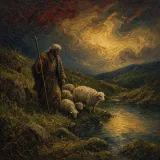
Psalm 23 in the Book of Psalms does not build confidence by pretending the landscape stays pleasant. The shepherd who gives pasture, water, restoration, and right paths is the same one addressed directly when the route enters the "valley of the shadow of death." That small turn from speaking about God to speaking to him gives the danger a new intimacy without making it disappear. Then the picture changes from shepherding to hospitality. A table is prepared, oil is given, and the cup overflows while enemies remain in view. The ending does not hand the last motion to those enemies. Goodness and mercy become the companions that follow the speaker through his days, and the house of the Lord becomes the destination of a life already carried through both rest and threat.
In this chapter
- Provision Takes the Form of Guidance Psalms 23:1-3
"I shall not want" is immediately explained by movement, not luxury.
- In the Valley, the Pronoun Changes Psalms 23:4
The valley changes one word and, with it, the feel of the whole poem.
- A Table with the Enemies Still in View Psalms 23:5-6
The image turns from flock to feast without changing the host.

Scripture beside the summary
Psalms · King James Version · 6Psalms 23:1-3
Provision Takes the Form of Guidance
"I shall not want" is immediately explained by movement, not luxury. The shepherd makes rest possible, leads beside still water, restores life, and then gets the sheep moving again on right paths. The Book of Psalms keeps the initiative with the shepherd throughout this opening. No praise is given to the sheep for finding pasture, choosing the water, or discovering the route. Even restoration belongs to the one who leads. That makes "for his name's sake" more than a decorative ending. The guidance rests on the shepherd's own character and reputation. Rest and direction are therefore not competing gifts. The same care knows when to make the flock lie down and when to lead it forward. The calm scenery matters because a trustworthy shepherd brought the speaker there, which means the ground of confidence is already relational before the next verse removes the calm scenery altogether.

Deep dive
"I shall not want" speaks of lacking what is needed, not of having no desires. The following images explain the claim through provision: pasture, water, restored life, and guidance. The shepherd's work includes both stopping and moving. Rest does not become permanent inactivity, because the same care that makes lying down possible also leads along paths.
The verbs keep the initiative with the shepherd. The sheep is not praised for discovering an unusually good patch of grass. Restoration is likewise more than the repair of an inward religious feeling; within this picture it concerns the renewal of the life being led. "Paths of righteousness" joins right conduct to the image of a route rightly taken, and "for his name's sake" locates that guidance in the shepherd's own character and reputation.
The opening is therefore not a list of pleasant surroundings detached from relationship. Green pasture and still water matter because a trustworthy shepherd brings the speaker there. That prepares for the valley: the grounds of confidence will remain when the scenery no longer looks like rest.
Words to trace: leadeth, green, LORD, maketh, name’s, pastures
Verse-by-verse path
- Psalms 23:1
The covenant name, the LORD, appears in this psalm only twice, in the first verse and the last, framing the whole. In the ancient Near East kings were routinely called shepherds of their people, and Ezekiel 34 indicts Israel’s rulers as shepherds who fed themselves. David himself kept his father’s sheep (1 Samuel 16:11).
- Psalms 23:2
Sheep do not lie down hungry or frightened, so the first picture is of an animal that is fed and unafraid. “Green pastures” is deshe, the tender new grass of Genesis 1:11. “Still waters” is literally “waters of rests”, water a sheep can drink from without being swept away.
- Psalms 23:3
“Restoreth” is shuv, bring back, the verb used for returning a stray. “Paths” is a word for well-worn tracks, even wheel ruts. The righteous path is not a new trail but a road many have trodden.
Psalms 23:1-3
King James Version1The LORD is my shepherd; I shall not want.
2He maketh me to lie down in green pastures: he leadeth me beside the still waters.
3He restoreth my soul: he leadeth me in the paths of righteousness for his name’s sake.
Psalms 23:4
In the Valley, the Pronoun Changes
The valley changes one word and, with it, the feel of the whole poem. The speaker has been saying "he" makes, leads, and restores; in danger, the language becomes "thou art with me." The Book of Psalms places its most direct address to the shepherd exactly where an inventory of pleasant conditions would fail. The valley is still a valley, and the shadow is still dangerous. Neither rod nor staff edits the threatening terrain out of the route. They are working tools of rule and protection, so their comfort comes from competent presence, not softness. The speaker also walks through the valley rather than being promised a map around it. What steadies him is not advance knowledge of every turn. It is the presence of the shepherd inside the part of the journey where the surroundings themselves can no longer serve as proof that all is well.

Deep dive
Until this point, the speaker has said what the Lord does: he makes, leads, and restores. In the valley, the language becomes "thou art with me". The shift is small enough to pass unnoticed and large enough to alter the intimacy of the poem. The shepherd is no longer being described at a distance; he is being addressed in the place of danger.
The valley is traversed, not denied. Neither the rod nor the staff removes the existence of threatening terrain from the psalm. They signify the shepherd's active equipment for governing and protecting the flock, so their comfort comes from capable presence rather than from softness alone. The familiar expression "shadow of death" retains its force in the KJV; the underlying Hebrew is also discussed as deep darkness. Either way, the scene is genuinely perilous.
The central assurance is not that the speaker knows the entire route. It is that he does not take this part of it alone. The poem places its most direct address to God at precisely the point where an account of agreeable conditions would no longer be adequate.
Words to trace: comfort, death, evil, fear, shadow, staff
Verse-by-verse path
- Psalms 23:4
Counted in Hebrew, “for thou art with me” falls near the exact centre of the psalm, with roughly the same number of words on either side. The rod was a club carried at the belt against predators, the kind David used against lion and bear (1 Samuel 17:34–35); the staff was for leaning on and for guiding.
Psalms 23:4
King James Version4Yea, though I walk through the valley of the shadow of death, I will fear no evil: for thou art with me; thy rod and thy staff they comfort me.
Psalms 23:5-6
A Table with the Enemies Still in View
The image turns from flock to feast without changing the host. A prepared table, oil on the head, and an overflowing cup move the Book of Psalms into the language of welcome, honor, and abundance. The striking detail is not that the enemies have vanished. They are still "in the presence" of the meal, close enough to see hospitality being given to the person they oppose. The poem therefore makes a more precise claim than an untouched life. Hostility remains visible, but it no longer controls the meaning of the scene. Then goodness and mercy take over the final movement. They follow the speaker through "all the days" of life, while the house of the Lord supplies the destination. The psalm travels from open pasture through deep darkness into secure belonging, and it leaves the enemies present but decisively unable to write the ending.

Deep dive
A prepared table, oil on the head, and an overflowing cup make the Lord a generous host. The poem has changed its picture without changing its subject. Attempts to make every item another detail of sheep management miss the ease with which the language moves into welcome and honor. The speaker is not merely kept alive outside danger; he is received with abundance.
The enemies remain "in the presence" of the meal. Their existence is not the last fact, but neither has it been erased. The table makes hospitality visible where hostility is still visible. That is a more exact claim than a general promise of an untroubled life.
Goodness and mercy then become the continuing companions of the speaker's days. The last movement belongs to them, not to the enemies. The Lord's house supplies the destination toward which the whole poem has been traveling, from open pasture through dark passage to secure belonging. The KJV's "for ever" gives the ending its breadth, while "all the days of my life" keeps that confidence firmly connected to the life being lived, not merely to a scene after death.
Words to trace: anointest, days, dwell, enemies, follow, goodness
Verse-by-verse path
- Psalms 23:5
“Preparest” is arak, to set in order, the same verb used for drawing up a battle line (1 Samuel 17:8). A host anointing a guest’s head with oil was a mark of honour, as Jesus reminds Simon the Pharisee in Luke 7:46.
- Psalms 23:6
“Follow” is radaph, pursue, usually the verb for enemies giving chase. “Mercy” is chesed, loyal covenant love. The Hebrew text reads “I will return to the house of the LORD”; the ancient Greek translation, like the King James, reads “dwell”, and “for ever” is literally “for length of days”.
Psalms 23:5-6
King James Version5Thou preparest a table before me in the presence of mine enemies: thou anointest my head with oil; my cup runneth over.
6Surely goodness and mercy shall follow me all the days of my life: and I will dwell in the house of the LORD for ever.
Questions to keep in mind while reading
- Follow the speaker, images, parallel lines, questions, and emotional movement.
- Notice where tension or suffering resists an easy answer.
- Read a saying as wisdom for faithful discernment, not as a mechanical promise detached from context.
Text first
Where readers differ
The chapter summary begins with what the passage says and how its parts fit together. It does not assume one denomination has already settled every question. Where a conclusion depends on a tradition, literary theory, or historical reconstruction, that dependence is named openly.
The KJV text is presented first. Interpretive conclusions are labeled, and differences are introduced only when they help a reader understand why serious communities do not always reach the same answer.
Comparative interpretive notes for this chapter are in preparation. Until reviewed notes are ready, this page separates the KJV text from summary and application without claiming that serious readers agree on every question.
Questions beneath the surface
- What account of God, human freedom, responsibility, and the good life emerges from Psalms 23?
- Which tension does the chapter refuse to resolve quickly?
- What changes when the chapter is read as part of the whole canon rather than as an isolated moral lesson?
- Where might a sincere reader confuse a familiar tradition with something the text states directly?
Questions for serious personal contemplation
These open-ended questions make room for tension, honest response, prayer, and conclusions that remain accountable to the chapter.
Observe without rushing
What part of Psalms 23 makes you stop, feel unsettled, or feel surprised, and why?
Which detail in the passage would be easiest to overlook? How does that detail change your understanding?
Where do you see tension between what happens and this focus: A shepherd guiding sheep through green pasture, dark ravine, danger, and a place of provision?
What important question does the passage leave open instead of resolving quickly?
Examine your inner life honestly
Which person, response, fear, or desire in the passage feels most like your own life right now?
What assumption about God, other people, or yourself does this text challenge?
Which part would you rather soften, avoid, or explain away too quickly? What might that reaction reveal?
If this Scripture could ask you one direct question, what do you think it would ask?
Respond with wisdom and courage
What do you need to remember, confess, grieve, thank God for, or trust after reading this passage?
How might another faithful person read this situation differently without ignoring the text?
What obedient response would be costly, uncomfortable, or slow, yet still faithful to Scripture?
What question will you carry into prayer this week, and which verses will you keep in front of you?
Music and video connected to the passage
Related media appears when its Scripture reference overlaps this study. Music and video can illuminate a theme while the biblical text remains the foundation.