The big picture
Ezekiel 36 begins by speaking to the mountains that enemies had mocked and claimed, then moves inward until the real restoration reaches the human heart. The land will be cultivated, populated, and made fruitful again, but the chapter refuses to base that future on a flattering account of Israel's past. Bloodshed and idols defiled the land, exile was judgment, and the LORD says plainly that he acts for his holy name. Gathering is therefore joined to cleansing. A stony heart is removed, a living heart is given, and God's Spirit is placed within the people so that renewed obedience grows from renewed persons. Material abundance follows rather than replacing this inward work. Ruined cities are rebuilt, fields yield again, and a land once described as devouring its inhabitants becomes able to hold them. Restoration remembers exactly why restoration was necessary.
Central truth
The Lord promises to restore Israel’s devastated land and cleanse its people, giving them a new heart and his Spirit for the sake of his profaned holy name.

The study notes have a page of their own
The movement by movement analysis, the words to trace, the verse by verse notes and where readers differ are written for someone studying alone. They are on the Deep Personal Reflections page for this chapter. This page is the lesson.
A chapter-specific teaching brief
These anchors come from this chapter itself. They help a teacher use the Level 1 overview, the Level 2 study, and the Scripture text as one lesson.
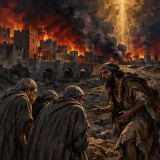
Open with the chapter’s first image
Ezekiel 36:1: “Also, thou son of man, prophesy unto the mountains of Israel, and say, Ye mountains of Israel, hear the word of the LORD:”
Slow down at the turning point
Ezekiel 36:21: “But I had pity for mine holy name, which the house of Israel had profaned among the heathen, whither they went.”
Keep this word trail visible
LORD, heathen, Israel, land, desolate, house
What to explain, in order
Teach the passage in this order. Each step names the verses it rests on, so every point can be shown in the text before it is applied.
Ezekiel 36:1-7
The mountains bear the shame
Start where 35 ends. Edom claimed the land; now God speaks to the land itself. Read 36:2-7 and point to the enemy's "Aha" and the phrase "ye have borne the shame of the heathen" (36:6). Explain "heathen" as the surrounding nations. Teach this first so the class feels what the land had become, a byword and a prey, and so that God's oath in 36:7, "Surely the heathen that are about you, they shall bear their shame", is heard as justice for the humiliated.
Ezekiel 36:8-15
Tilled and sown
Read 36:8-12 slowly. Count the promises: branches, fruit, tilled, sown, men multiplied, cities inhabited, wastes built, man and beast increased. Point to 36:11, "will do better unto you than at your beginnings". Explain 36:13-15: the land had a reputation for devouring its people, and God will end that. Teach this step before the inner renewal so the class sees that God's restoration includes soil, harvest and towns. It is not only spiritual.
Ezekiel 36:16-23
For mine holy name's sake
This is the reason for everything. Read 36:17-21. Handle the comparison in 36:17 briefly: "a removed woman" refers to the ritual uncleanness of Leviticus 15, a picture of separation, not a moral charge against women. Then read 36:22-23 aloud with emphasis on "I do not this for your sakes, O house of Israel, but for mine holy name's sake". Explain "sanctify my great name" as showing it to be holy before the nations. Teach this step at the centre, because restoration is grounded in God's character, not in Israel's improvement.
Ezekiel 36:24-28
Clean water, new heart, my spirit
Read 36:24-28 and have the class count the "I will" clauses. Explain the clean water against Numbers 19, where water of purification cleansed from defilement. Explain the new heart and spirit beside 11:19-20 and Jeremiah 31:33. Point out that 36:27 joins God's Spirit to obedience: the Spirit causes them to walk in his statutes. Many Christian readers hear in 36:25-27 the new birth of John 3:5 and the gift of the Spirit; present that as a reading the New Testament invites, while keeping the verse's own setting in Israel's return.
Ezekiel 36:29-32
Remember and be ashamed
Read 36:29-32 and explain "corn" as grain in general. Then slow down on 36:31. The people remember after the gifts, not before. Explain "lothe yourselves" as being sickened by what they did, now that they see it from God's side. Read 36:32 and its repetition of "Not for your sakes". Teach this here because it guards against two errors: thinking restoration was earned, and thinking forgiveness makes sin trivial. Be pastorally careful: the shame here is healthy grief, not a permanent identity.
Ezekiel 36:33-38
Ruined places built
End with the rebuilt cities and the comparison to Eden (36:35). Read 36:36: the nations recognise God as the builder. Then read 36:37 and point out the surprise: after refusing to be enquired of (14:3; 20:3), God now says he will be enquired of. Prayer returns. Read 36:38 and explain the picture of crowds at Jerusalem's feasts, so many sacrificial flocks that the streets fill. Teach this last because it shows the full scope of restoration: inward hearts, outward cities, renewed prayer and worship.
Where learners get stuck
The misreadings this passage tends to produce, and how to answer each from the text.
"God restored Israel because they finally became good enough."
God says the opposite twice: "I do not this for your sakes, O house of Israel, but for mine holy name's sake" (36:22), and "Not for your sakes do I this" (36:32). The cleansing and new heart come before their obedience (36:25-27), and they remember their sins afterward (36:31). Restoration is grace grounded in God's name. This is good news for anyone who thinks they must earn their way back, and a warning to anyone who takes credit for their own renewal.
"The new heart means I will never struggle with sin again."
The promise of 36:26-27 is God's work of renewal, and it is real. But the same chapter says the people will remember: "Then shall ye remember your own evil ways" (36:31), and the wider Bible shows God's people still struggling after they receive his Spirit (Galatians 5:16-17). Traditions describe the Christian's ongoing fight with sin differently. Teach the promise with confidence and the struggle with honesty, so that learners who still fight sin do not conclude that God has failed them.
"The clean water in 36:25 is a direct prophecy of Christian baptism."
The verse says, "Then will I sprinkle clean water upon you, and ye shall be clean: from all your filthiness, and from all your idols, will I cleanse you." In its setting it draws on Israel's rites of purification (Numbers 19:17-19). Many Christians connect it with baptism and with Jesus' words about being "born of water and of the Spirit" (John 3:5). Traditions differ on how close the link is. Present the verse's own meaning first, cleansing from idols, and the Christian reading as a reading.
"These promises mean God will make me rich if I trust him."
The grain, fruit and rebuilt cities of 36:29-38 are promised to the restored people of Israel, as the sign before the nations that God has kept his word. They are not a contract that guarantees any individual prosperity. Learners who are poor are not less faithful. Teach the promises as God's care for whole communities, land and people together, and let them shape hope without turning into a formula.
Learning objectives
- Contrast the mountains’ present shame with their promised fruitfulness.
- Explain how Israel’s conduct and exile profaned the Lord’s name.
- Trace the Lord’s actions in gathering, cleansing, and renewing his people.
- Distinguish a heart of flesh from the stony heart it replaces.
- Connect inward renewal with obedience and restored communal life.
- Explain why the promised restoration excludes boasting about Israel’s merit.
Teacher preparation
- Read chapter 35 before 36:1–15; set Edom’s claim to the land beside the Lord’s contrary promise.
- Explain that “corn” in 36:29 means grain, not specifically maize, and that “heathen” names the surrounding nations.
- Prepare a four-part outline: land restored, name profaned, people renewed, cities rebuilt; keep the famous heart verses within that movement.
- Handle the ritual uncleanness comparison in 36:17 briefly; do not imply that menstruation is personal wrongdoing.
- Plan to distinguish repentance in 36:31–32 from teaching self-hatred as a person’s permanent identity; read the cleansing promises alongside it.
Evidence and interpretation checks
Explicit
Locate the stated motive in 36:22–23 and 32, the new heart and Spirit in 36:26–27, and rebuilt cities in 36:33–38.
Scripture-supported
Compare Ezekiel 11:19–20 and Jeremiah 31:33 with 36:26–27; all connect inward renewal with a people living in covenant with God.
Strong inference
Infer that restoration is not merely relocation: 36:24–27 joins return to the land with cleansing, a changed heart, and Spirit-enabled obedience.
Possible or traditional reading
Present baptismal readings of the clean water in 36:25 as Christian interpretations; the verse itself specifies cleansing from filthiness and idols, not a named church rite.
Limit
Do not make the crops and cities in 36:29–38 an individual prosperity contract or claim that these verses alone settle every question about restoration’s timing.
Discussion with answer guidance
1. Why are the mountains addressed as though they can hear?
What a good answer contains
Because the land itself has suffered, and God answers its shame. The enemy said, "Aha, even the ancient high places are ours in possession" (36:2), and the mountains became "a prey and derision to the residue of the heathen" (36:4). So God speaks to them directly: "ye shall shoot forth your branches, and yield your fruit to my people of Israel; for they are at hand to come" (36:8), and "ye shall be tilled and sown" (36:9). A good answer sees the land as the stage of judgment and of restoration, and names the people who will return to it: "all the house of Israel" (36:10). A weak answer treats the address as mere poetry.
Show teacher guidance
Read 36:1–12: the land bears the enemy’s taunts and becomes the setting of renewed cultivation and habitation; identify the people who will return.
2. How has Israel profaned the Lord’s name beyond its own borders?
What a good answer contains
By being scattered for their sin. They defiled the land "by their own way and by their doings" (36:17), with bloodshed and idols (36:18). God scattered them (36:19), and among the nations people said, "These are the people of the LORD, and are gone forth out of his land" (36:20). Their exile made God look weak or unfaithful. A good answer sees that profaning the name means damaging God's reputation, here by sin that led to exile. A weak answer reduces it to swearing or careless speech.
Show teacher guidance
Use 36:17–23: wrongdoing brought exile, and the nations associate the displaced people with their God; do not reduce profaning to verbal profanity.
3. Who performs the actions in the chain of promises from 36:24 to 27?
What a good answer contains
God, in every clause. "I will take you", "gather you", "bring you into your own land" (36:24); "will I sprinkle clean water upon you", "will I cleanse you" (36:25); "A new heart also will I give you, and a new spirit will I put within you", "I will take away the stony heart", "I will give you an heart of flesh" (36:26); "I will put my spirit within you, and cause you to walk in my statutes" (36:27). A good answer counts the repeated I will and notices that even the walking in God's ways is something he causes. Only then does the human response, "ye shall keep my judgments, and do them", follow. A weak answer starts with what the people must do.
Show teacher guidance
List gathering, bringing, sprinkling, cleansing, giving, removing, and putting; notice the repeated divine subject before discussing human response.
4. Why is a heart of flesh desirable here?
What a good answer contains
Because flesh here means alive and responsive. "I will take away the stony heart out of your flesh, and I will give you an heart of flesh" (36:26). Stone is cold and unmoved; flesh feels and responds. The new heart leads somewhere specific: "cause you to walk in my statutes, and ye shall keep my judgments, and do them" (36:27). A good answer keeps the contrast with stone and the link to obedience. A weak answer imports Paul's use of flesh as sinful nature (Galatians 5:17), which is a different use of the word.
Show teacher guidance
Contrast it with stone in 36:26 and connect it with walking in God’s statutes in verse 27; do not import a negative meaning of “flesh” from another passage.
5. Why does remembered wrongdoing appear after the promises of cleansing?
What a good answer contains
Because grace does not erase memory; it changes what memory does. After the cleansing, the grain and the fruit (36:29-30), "Then shall ye remember your own evil ways, and your doings that were not good, and shall lothe yourselves in your own sight for your iniquities" (36:31). And 36:32 repeats, "Not for your sakes do I this". A good answer sees that the people remember their sin as forgiven people, which ends all boasting. A weak answer either skips the verse or turns it into lifelong self-hatred, which the chapter does not teach.
Show teacher guidance
Read 36:29–32: restoration does not turn earlier evil into innocence or reward earned merit; avoid asking anyone to catalogue personal failures.
6. What do rebuilt cities and prayer add to the new-heart promise?
What a good answer contains
They make the renewal public and lasting. Cities are inhabited and "the wastes shall be builded" (36:33); people say, "This land that was desolate is become like the garden of Eden" (36:35). The nations "shall know that I the LORD build the ruined places" (36:36). And God says, "I will yet for this be enquired of by the house of Israel, to do it for them" (36:37), so prayer is part of the gift. A good answer keeps inward renewal and outward rebuilding together. A weak answer keeps only the new heart and ignores the cities.
Show teacher guidance
Use 36:33–38 for inhabited communities, cultivated ground, recognition among nations, and Israel enquiring of God; keep inward and public renewal together.
Responsible application
Heart and habits
Ask learners to compare two fictional accounts of reform: cosmetic image management and changed conduct; test them against cleansing and obedience in 36:25–27.
Relationships and community
Draft a third-person description of a restored community that includes repaired wrongdoing and renewed shared life, not attractive buildings alone.
Hope without boasting
Have pairs revise a fictional victory speech that credits restoration entirely to the community’s goodness; retain gratitude and responsibility using 36:22–32.
Session plans
Two timings of the same lesson. The shorter keeps the reading, the central discussion and one response; the longer gives the confusions and the application their own time.
45 minutes
The shamed mountains
Read 36:1-7 and take question one in part.
Tilled and sown
Read 36:8-12 and finish question one.
The holy name
Read 36:16-23. Take question two and confusion one.
New heart
Read 36:24-28 twice. Count the I will clauses and take questions three and four, with confusion two.
Remember and rebuild
Read 36:29-38. Take questions five and six.
Handout
Read the key verse together and give out the sheet.
90 minutes
A heart of stone
Ask the group what a hard heart looks like in daily life. Keep a few answers.
Mountains and enemies
Read 35:15 and 36:1-12. Take question one.
Profaned name
Read 36:16-23. Take question two and confusion one.
The great promise
Read 36:24-28 with 11:19-20 and Jeremiah 31:31-34. Take questions three and four, and confusions two and three.
Healthy shame
Read 36:29-32. Take question five with pastoral care.
Cities and prayer
Read 36:33-38. Take question six and confusion four.
Application
Work the application comparing cosmetic reform with changed conduct, against 36:25-27.
Handout and prayer
Read the key verse together and pray it for one another.
Adapting the lesson
Children
Show a stone and a soft piece of fruit or a sponge. Explain that a stone heart does not care, but God promised to give his people a soft heart that loves him. Sprinkle a little water on your hands and say God promised to make his people clean. Then draw ruined houses being rebuilt and fields growing again. Leave out the ritual comparison of 36:17.
Youth
Start with the question of whether people can really change. Read 36:26-27 and ask who does the changing. Talk about the difference between trying harder and being given a new heart. Read 36:22 and 36:32 and discuss why God does it for his name. Be honest that struggle continues, and offer a written question for anything personal.
Adults
Give time to the structure of the chapter, land, name, heart, cities, and to the theology of 36:22-32. Compare 11:19-20, 18:31 and Jeremiah 31:31-34. Discuss the Christian readings of 36:25-27 and their limits. Handle 36:17 and 36:31 with care so no one leaves with a distorted view of the body or of shame. Discuss what restoration looks like for whole communities.
One to one
Read 36:25-27 slowly together and ask which line the person most needs. If they feel their heart has grown hard, pray 36:26 over them. If they carry shame, read 36:31-32 and explain that remembering sin as forgiven is different from being defined by it. Ask what one area of life they would like God's Spirit to change.
Song and video learning lab
A song or video may interpret, compress, or dramatize the text. Its value becomes clearer when its choices are compared with Scripture.
- Before the media: the exact passage and its central movement.
- During the media: the words, people, events, and emotions the artist emphasizes.
- After the media: what it clarifies, what it leaves out, and what belongs back in the biblical text.
Handout
One page for learners to take home. The print button prints this section alone.
Ezekiel 36:1–38
The passage in brief
God told the ruined mountains of Israel that they would bear fruit again and be filled with people. His people had dishonoured his name by their sins, and their exile made the nations mock him. So, for the sake of his holy name, God promised to bring them home, wash them clean, give them a new heart and a new spirit, put his own Spirit in them, and help them walk in his ways. Their cities would be rebuilt, and the land would become like Eden.
A verse to keep
A new heart also will I give you, and a new spirit will I put within you: and I will take away the stony heart out of your flesh, and I will give you an heart of flesh. And I will put my spirit within you, and cause you to walk in my statutes, and ye shall keep my judgments, and do them.
Ezekiel 36:26-27 · King James Version
Questions to take home
Why does God say he will act in 36:22 and 36:32?
List the things God says "I will" do in 36:24-27.
What is the difference between a heart of stone and a heart of flesh?
This week
Pray Ezekiel 36:26-27 each morning this week and ask God to soften one hard place in your heart.
Music and video connected to the passage
Related media appears when its Scripture reference overlaps this study. Music and video can illuminate a theme while the biblical text remains the foundation.