The big picture
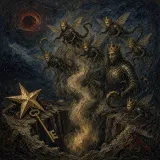
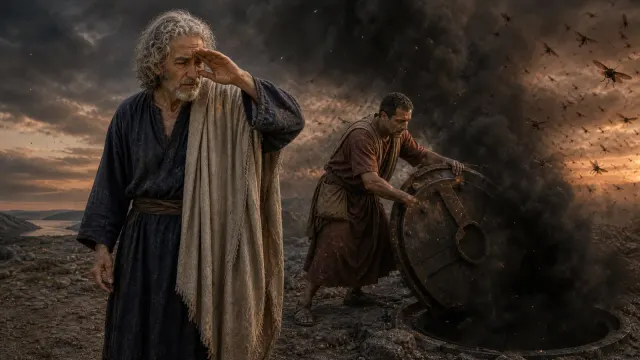
The fifth and sixth trumpets intensify the woes, but the Book of Revelation keeps placing limits beside the terror. A star receives a key to the bottomless pit and releases locustlike creatures whose targets, duration, and power are restricted. They cannot harm vegetation, cannot touch those with God's seal, and cannot kill, though their five months of torment are dreadful. Their composite bodies borrow the language of locusts, scorpions, lions, armored cavalry, and rushing chariots. The sixth trumpet releases four bound angels at an appointed time and an immense mounted force that kills a third of humanity. Yet the chapter does not end by staring at the army. Its closing diagnosis concerns the survivors, who continue worshiping lifeless idols and refuse to repent of murder, sorcery, fornication, and theft. The final emphasis falls on persistent allegiance rather than spectacular destruction.
Central truth
Revelation 9 intensifies the trumpet judgments through the abyss and the Euphrates, yet its darkest verdict is that surviving humanity still refuses to repent of idolatry, violence, sorcery, sexual sin, and theft.
The study notes have a page of their own
The movement by movement analysis, the words to trace, the verse by verse notes and where readers differ are written for someone studying alone. They are on the Deep Personal Reflections page for this chapter. This page is the lesson.
A chapter-specific teaching brief
These anchors come from this chapter itself. They help a teacher use the Level 1 overview, the Level 2 study, and the Scripture text as one lesson.
Open with the chapter’s first image
Revelation 9:1: “And the fifth angel sounded, and I saw a star fall from heaven unto the earth: and to him was given the key of the bottomless pit.”
Slow down at the turning point
Revelation 9:11: “And they had a king over them, which is the angel of the bottomless pit, whose name in the Hebrew tongue is Abaddon, but in the Greek tongue hath his name…”
Keep this word trail visible
smoke, angel, earth, heads, horses, power
What to explain, in order
Teach the passage in this order. Each step names the verses it rests on, so every point can be shown in the text before it is applied.
Revelation 9:1-6
The pit opened, with limits
Begin with the star that falls and is given a key. Explain the "bottomless pit" as the abyss, the place of imprisoned evil powers in Revelation (11:7, 17:8, 20:1-3). Note the key is given; evil is released only by permission. Then read the limits on the locusts carefully: they may not touch the earth's plants, may not touch the sealed, may not kill, and have five months. Point out that the sealing of 7:3 now matters. Teach this step before the description of the locusts, so the group knows the frame before they meet the horror.
Revelation 9:7-12
Locusts like no locusts
Read Joel 2:1-11 first, where a locust swarm becomes the image of an army of judgement, with teeth like lions and a sound like chariots. Revelation takes Joel's picture and makes it stranger. Explain that the repeated "as it were" marks a vision, and that readers have taken these as demonic powers, as invading armies of John's day, as spiritual forces of deception, or as future events. Avoid any reading that turns them into modern weapons; the text does not. End with the king, Abaddon and Apollyon, destroyer in two languages, and the note that one woe is past.
Revelation 9:13-16
From the altar to the Euphrates
The sixth trumpet's command comes from the golden altar, which links it again to the prayers of 8:3-5. Explain the Euphrates as the great river on the eastern edge of the Roman world and the old boundary of Israel's land from which invaders came, as in Isaiah 8:7 and Jeremiah 46:10. The four angels have been bound and are released to the exact hour. Present the number, two hundred million, as an army beyond counting, and say clearly that the text names no nation. Readers differ on whether it is a human or demonic host.
Revelation 9:17-19
Fire, smoke and brimstone
Describe the horses quickly and without dwelling on detail: lion heads, breastplates of fire, jacinth and brimstone, and fire, smoke and brimstone from their mouths. Read Genesis 19:24-28 so the group hears the echo of Sodom. Explain jacinth as a dark blue stone, the colour of smoke. Keep the fraction in view, a third of humanity, and the source of the command. Teachers should not linger here; the chapter itself moves quickly to its real point, which is what people do after the judgement.
Revelation 9:20-21
Still they did not repent
Make this the weight of the lesson. Read the two verses slowly. The survivors keep worshipping demons and lifeless idols, the very thing Psalm 115:4-8 mocks, gods that cannot see or hear or walk. Out of false worship come murders, sorceries, fornication and thefts. Explain sorceries as the use of drugs, spells and magic to manipulate. The judgements were meant to call people to repentance, and they did not. That is the chapter's sobering truth: suffering by itself does not change a heart. Leave room for the gospel, which the next chapter will bring back into view.
Where learners get stuck
The misreadings this passage tends to produce, and how to answer each from the text.
"The locusts are helicopters and the horsemen are a modern army."
This reading has been popular, but the text gives no such key. John describes the locusts with the language of Joel 1 and 2 and says they come out of the abyss under a king called Abaddon (9:3, 9:11). Readers in every century have tried to match these images to the weapons of their own time, and each match has been replaced by the next. Teach the images as Revelation presents them, a destroying power under limits, and leave the modern identifications aside.
"The two hundred million horsemen are the army of a particular country in the east."
Revelation 9:16 gives the number and says John heard it, but names no nation. The Euphrates was the frontier from which invaders threatened in the Old Testament (Isaiah 8:7), and the number is beyond any army of John's day. Readers take it as a demonic host, as a symbol of overwhelming invasion, or as a future human army. None of these readings needs to name a modern country, and teachers must not map this vision onto any nation today.
"If people saw judgements like these, everyone would turn to God."
Revelation 9:20-21 says the opposite: those who survived "yet repented not". Spectacular judgement did not change hearts that were committed to idols, violence and sexual sin. Pharaoh hardened his heart through the plagues in the same way (Exodus 8:15). The lesson is that repentance is a turning of the heart, a gift of God's grace, not the automatic effect of fear. That is why the book will next turn to witness and testimony in chapters 10 and 11.
"Christians will suffer the same torment as everyone else in these plagues."
The locusts are told to hurt "only those men which have not the seal of God in their foreheads" (9:4). The sealing of 7:3 protects God's people from this judgement. That does not mean believers never suffer in Revelation; they face persecution from the beast and the world (13:7). But the judgements of God are aimed at those who refuse him, not at his sealed servants.
Learning objectives
- Describe the fifth trumpet's abyss, locusts, limits, and king.
- Explain who may and may not be harmed.
- Trace the sixth trumpet from altar to Euphrates.
- State the scale and means of the killing.
- List the sins survivors refuse to repent of.
- Separate imagery from modern weapon identifications.
Teacher preparation
- Read Joel 1 and 2 for locust imagery.
- Mark every limit placed on the fifth trumpet.
- Locate the Euphrates without assigning modern nations to the angels.
- Prepare columns for judgment described and repentance refused.
- Do not bolt helicopter rotors onto Revelation's already strange locusts.
Evidence and interpretation checks
Explicit
Verses 1 to 6 describe an opened bottomless pit, darkening smoke, locusts with scorpion-like power, and five months of torment that may not touch those bearing God's seal.
Scripture-supported
Verse 11 names the locusts' king as the angel of the bottomless pit, called Abaddon in Hebrew and Apollyon in Greek.
Strong inference
The elaborate battle-like description in verses 7 to 10 suggests that ordinary agricultural insects are not sufficient to exhaust the image, though the text itself still calls them locusts.
Possible or traditional reading
Interpreters have proposed demons, invading armies, symbolic political forces, and modern military technology for the locusts and horsemen; Revelation 9 never identifies them with a contemporary weapon system.
Limit
The chapter does not name the four Euphrates angels, identify the two hundred million horsemen with a modern nation, or say that spectacular judgment by itself produces repentance.
Discussion with answer guidance
1. What limits are placed on the fifth-trumpet locusts in verses 4 to 6?
What a good answer contains
The locusts are commanded "that they should not hurt the grass of the earth, neither any green thing, neither any tree; but only those men which have not the seal of God in their foreheads" (9:4). They may not kill, only torment, and only for "five months" (9:5). A strong answer collects every limit: not the vegetation, not the sealed, not to death, and a fixed time. It also notices verse 6, where people "seek death, and shall not find it", which shows the suffering is real. A weak answer remembers the torment and forgets the boundaries.
Show teacher guidance
Require the exceptions and boundaries: do not hurt vegetation, do not hurt the sealed, do not kill, torment five months, and produce agony so severe men seek death.
2. Which features of the locusts make the description more than a normal insect plague?
What a good answer contains
Verses 7 to 10 describe locusts shaped "like unto horses prepared unto battle", with crowns like gold, faces "as the faces of men", hair like women's hair, teeth like lions', breastplates like iron, wings that sound like chariots, and scorpion tails with stings. A good answer notices the repeated "as it were" and "like": John is describing something he can only compare. The image starts with Joel 1 and 2, where locusts are an invading army, and grows into something no ordinary plague could be. A weak answer either draws them as insects or treats them as a description of modern machines.
Show teacher guidance
Use verses 7 to 10: horse-like shapes, crowns, human faces, women's hair, lions' teeth, iron-like breastplates, chariot-wing sound, and scorpion tails.
3. What names are given to the king over the locusts?
What a good answer contains
Verse 11 says "they had a king over them, which is the angel of the bottomless pit, whose name in the Hebrew tongue is Abaddon, but in the Greek tongue hath his name Apollyon" (9:11). Both names mean destruction or destroyer. A strong answer lets the verse give the identity: a destroying power from the abyss, ruling the locusts. Readers differ on whether he is Satan himself or a lesser evil power. A good answer notes the irony that a natural locust swarm has no king (Proverbs 30:27), so this is something else.
Show teacher guidance
Verse 11 gives Abaddon and Apollyon and identifies him as the angel of the bottomless pit; let the verse answer before discussing proposed identities.
4. What releases the sixth-trumpet judgment in verses 13 to 15?
What a good answer contains
"I heard a voice from the four horns of the golden altar which is before God" (9:13), the same altar where the prayers rose in 8:3. It commands, "Loose the four angels which are bound in the great river Euphrates" (9:14). They "were prepared for an hour, and a day, and a month, and a year" (9:15). A good answer notices that the voice comes from the altar of prayer, that the angels were bound until released, and that the timing is set to the hour. Nothing here happens outside God's appointment.
Show teacher guidance
Follow the voice from the golden altar, the command to loose four bound angels at Euphrates, and their preparation for the appointed hour, day, month, and year.
5. What three means of destruction come from the mounted force in verses 17 and 18?
What a good answer contains
"By these three was the third part of men killed, by the fire, and by the smoke, and by the brimstone, which issued out of their mouths" (9:18). Fire, smoke and brimstone recall the judgement of Sodom in Genesis 19:24-28. A strong answer keeps the triad and notices that the power of the horses is "in their mouth, and in their tails" (9:19). It also keeps the fraction, a third, as in the earlier trumpets. A weak answer turns the horses into weapons and loses the Old Testament echo.
Show teacher guidance
The third part of men is killed by fire, smoke, and brimstone proceeding from the horses' mouths; keep the stated triad intact.
6. After all of this, what do the survivors refuse to stop doing?
What a good answer contains
Verse 20 says "the rest of the men which were not killed by these plagues yet repented not of the works of their hands" (9:20). They kept worshipping "devils, and idols of gold, and silver, and brass, and stone, and of wood: which neither can see, nor hear, nor walk". "Neither repented they of their murders, nor of their sorceries, nor of their fornication, nor of their thefts" (9:21). A good answer reads the whole list and sees that the chapter ends not with the plague but with the human heart: false worship and the wrongs that come from it. The purpose of the warnings was repentance.
Show teacher guidance
Read verses 20 and 21 in full: idolatry, murders, sorceries, fornication, and thefts form the chapter's final and morally decisive list.
Responsible application
Do not confuse pain with repentance
Use verses 20 to 21 to distinguish suffering consequences from turning away from sin.
Name powerless idols plainly
Use verse 20 to expose objects of devotion that cannot see, hear, or walk.
Keep imagery under textual control
Write the verse's description first and proposed interpretations second, clearly labeled.
Session plans
Two timings of the same lesson. The shorter keeps the reading, the central discussion and one response; the longer gives the confusions and the application their own time.
45 minutes
Key and pit
Read 9:1-3 and point out that the key is given. Recall the seal of 7:3.
Torment with limits
Read 9:4-6. Ask question one and list the limits. Take the confusion about Christians suffering the plagues.
Joel's locusts
Read 9:7-12 with Joel 2:4-5. Ask questions two and three, and take the helicopter confusion briefly.
The sixth trumpet
Read 9:13-19. Ask questions four and five, and state plainly that no nation is named.
They did not repent
Read 9:20-21. Ask question six and take the confusion about judgement producing repentance. Read the key verse, give out the handout and pray.
90 minutes
What changes a heart
Ask the group what they think would make someone turn to God. List the answers and return to them at the end.
Key and pit
Read 9:1-6. Ask question one and look up 20:1-3 for the abyss. Take the confusion about Christians and the plagues.
Joel's army
Read Joel 2:1-11, then 9:7-12. Ask questions two and three, and take the confusion about modern weapons.
The Euphrates
Read 9:13-16 with Isaiah 8:7. Ask question four and take the confusion about an eastern nation.
Fire, smoke and brimstone
Read 9:17-19 with Genesis 19:24-28 and ask question five.
Idols that cannot walk
Read 9:20-21 with Psalm 115:4-8. Ask question six and take the confusion about judgement producing repentance.
Back to the list
Return to the opening list. Choose one application, read the key verse, give out the handout and pray for people who are far from God.
Adapting the lesson
Children
Do not describe the locusts or horsemen in detail. Tell the children that John saw God sending warnings so that people would stop doing wrong, and that God kept his own people safe. Then read 9:20 and show a picture of an idol made of wood, and ask whether it can see, hear or walk. Teach that only the living God can help us.
Youth
Many will find this chapter strange or frightening. Read Joel 2 first so they see where the imagery comes from. Spend most of the time on 9:20-21 and ask what idols people serve today and what wrongs flow from them. Firmly set aside any matching of the horsemen to modern countries or weapons.
Adults
Work through Joel 1 and 2, Genesis 19, Exodus 8 and Psalm 115. Present the range of readings without attaching any to current events. Discuss the hard truth of 9:20-21, that suffering alone does not bring repentance, and what that means for how Christians speak about disasters.
One to one
If the person finds this chapter frightening, read 9:4 and show that God's sealed people are protected from this judgement. Then read 9:20-21 together and ask what false gods people trust. Keep the conversation gentle and end with the hope that the book still calls people to repent.
Song and video learning lab
A song or video may interpret, compress, or dramatize the text. Its value becomes clearer when its choices are compared with Scripture.
- Before the media: the exact passage and its central movement.
- During the media: the words, people, events, and emotions the artist emphasizes.
- After the media: what it clarifies, what it leaves out, and what belongs back in the biblical text.
Handout
One page for learners to take home. The print button prints this section alone.
Revelation 9
The passage in brief
In Revelation 9 the fifth trumpet opens the abyss, and strange locusts come out to torment for five months those without God's seal, but they may not kill. The sixth trumpet releases four angels bound at the Euphrates and a vast army that kills a third of humankind. Yet the people who survive still do not turn from worshipping idols, or from murder, sorcery, sexual sin and theft. Suffering alone does not change a heart.
A verse to keep
And the rest of the men which were not killed by these plagues yet repented not of the works of their hands, that they should not worship devils, and idols of gold, and silver, and brass, and stone, and of wood: which neither can see, nor hear, nor walk:
Revelation 9:20 · King James Version
Questions to take home
Who are the locusts not allowed to hurt (9:4)?
Where does the command for the sixth trumpet come from (9:13)?
What did the survivors refuse to turn away from (9:20-21)?
This week
Name one thing you are tempted to trust instead of God, and turn from it in prayer each day this week.
Music and video connected to the passage
Related media appears when its Scripture reference overlaps this study. Music and video can illuminate a theme while the biblical text remains the foundation.