New · FreePlay The Witnesses The in-depth puzzle battle quest through Bible history

Places of the Bible

Sodom and Gomorrah

Two cities on good land, argued over by one man who got the number down to ten and still lost.

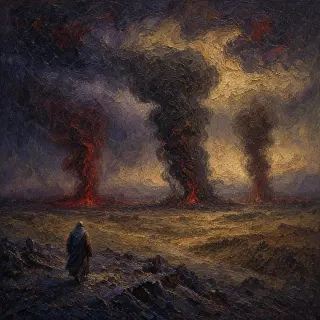
The plain of Jordan is introduced as well watered every where, even as the garden of the LORD, which is why Lot chooses it. The comparison is deliberate and it is followed immediately by the note that the men of Sodom were wicked and sinners before the LORD exceedingly. Everything about the place is a contrast between what the ground can grow and what the town has become, and the account keeps both halves of that in view.

Where it appearsGenesis 18 to 19

Scroll down to the account

The movements, in the order the text gives them.

The Account of Sodom and Gomorrah

  1. 01

    Genesis 13:10-13

    Well watered every where

    Lot lifts up his eyes and picks the better ground. The Book of Genesis adds the character of the town in the next sentence, before anything goes wrong.

    The pasture is genuinely good. The Book of Genesis does not suggest that Lot has mistaken barren ground for fertile country. It compares the region to the garden of the LORD and to Egypt, two enormous measures of watered abundance. The trouble is not that his eyes fail to recognize productive land. The trouble belongs to a category that green fields cannot measure.

    That is why verse 13 arrives with such force. The landscape receives one description; the men of Sodom receive another. Well watered every where stands beside wicked and sinners before the LORD exceedingly. Neither statement cancels the other. A place can support flourishing herds and still contain a community whose conduct is grievously wrong.

    The account also places the destruction in the sentence before Lot makes his choice. This is not suspense about whether the region will survive. Its end is already stated, so the fertility is seen under the weight of its loss. Lot's decision is recorded without an invented speech about money, ambition, or contempt for Abram. The contrast is sharper without one. He chooses the watered plain. The Book of Genesis makes sure the character of its inhabitants is not mistaken for another feature of its scenery.

    Verse by verse

    1. 13:10

      Before the LORD destroyed supplies the later outcome inside the description of the fertile land. The passage is not hiding that outcome.

    2. 13:12

      Toward Sodom describes the orientation of Lot's encampment here; Genesis 14:12 later explicitly places his dwelling in Sodom.

    3. 13:13

      The moral judgment is stated by the Book of Genesis itself, not inferred merely from the subsequent disaster.

    Genesis 13:10-13

    King James Version · 4 verses

    13:10And Lot lifted up his eyes, and beheld all the plain of Jordan, that it was well watered every where, before the LORD destroyed Sodom and Gomorrah, even as the garden of the LORD, like the land of Egypt, as thou comest unto Zoar.

    13:11Then Lot chose him all the plain of Jordan; and Lot journeyed east: and they separated themselves the one from the other.

    13:12Abram dwelled in the land of Canaan, and Lot dwelled in the cities of the plain, and pitched his tent toward Sodom.

    13:13But the men of Sodom were wicked and sinners before the LORD exceedingly.

    Genesis 13:10-13: Well watered every where
  2. 02

    Genesis 18:23-33

    Wilt thou also destroy the righteous with the wicked

    Six times he lowers the number and six times he is answered. He stops at ten, and the LORD went his way as soon as he had left communing.

    There is no refusal in this conversation. Fifty, forty-five, forty, thirty, twenty, ten: every proposed number receives an affirmative answer. Sodom's later destruction must not be inserted into the dialogue as though God eventually tells Abraham that he has pushed too far. The last answer is still a promise to spare.

    Abraham's argument also reaches further than extracting innocent people from danger. He asks that the whole place be spared for their sake. The distinction matters. He is pleading for the presence of the righteous to preserve a community that includes the wicked, while insisting that the Judge of all the earth cannot erase the difference between them.

    The speech keeps boldness and creaturely smallness in the same mouth. Dust and ashes does not prevent another request; another request does not make Abraham forget whom he addresses. The repeated qualifications are not meaningless padding around the arithmetic. They are the sound of a man continuing to speak with full awareness of the scale of the encounter. He stops at ten; the passage does not say why. Genesis 19:29 later states that God remembered Abraham when Lot was brought out. The city is destroyed, but the intercession is not treated as forgotten speech.

    Verse by verse

    1. 18:24

      Abraham asks for the place itself to be spared for the sake of the righteous, not only for those individuals to be removed.

    2. 18:27

      Dust and ashes is Abraham's own description of his smallness before the Lord; it does not end his appeal.

    3. 18:32

      The proposed number stops at ten. Neither a reason for that stopping point nor a refusal to consider a lower number is supplied.

    4. 18:33

      Genesis 19:29 connects Lot's rescue with God remembering Abraham, even though the city is not spared.

    Genesis 18:23-33

    King James Version · 11 verses

    18:23And Abraham drew near, and said, Wilt thou also destroy the righteous with the wicked?

    18:24Peradventure there be fifty righteous within the city: wilt thou also destroy and not spare the place for the fifty righteous that are therein?

    18:25That be far from thee to do after this manner, to slay the righteous with the wicked: and that the righteous should be as the wicked, that be far from thee: Shall not the Judge of all the earth do right?

    18:26And the LORD said, If I find in Sodom fifty righteous within the city, then I will spare all the place for their sakes.

    18:27And Abraham answered and said, Behold now, I have taken upon me to speak unto the Lord, which am but dust and ashes:

    18:28Peradventure there shall lack five of the fifty righteous: wilt thou destroy all the city for lack of five? And he said, If I find there forty and five, I will not destroy it.

    18:29And he spake unto him yet again, and said, Peradventure there shall be forty found there. And he said, I will not do it for forty’s sake.

    18:30And he said unto him, Oh let not the Lord be angry, and I will speak: Peradventure there shall thirty be found there. And he said, I will not do it, if I find thirty there.

    18:31And he said, Behold now, I have taken upon me to speak unto the Lord: Peradventure there shall be twenty found there. And he said, I will not destroy it for twenty’s sake.

    18:32And he said, Oh let not the Lord be angry, and I will speak yet but this once: Peradventure ten shall be found there. And he said, I will not destroy it for ten’s sake.

    18:33And the LORD went his way, as soon as he had left communing with Abraham: and Abraham returned unto his place.

  3. 03

    Genesis 19:1-11

    The men of the city compassed the house

    The visitors are received by the one man at the gate and besieged by everyone else. The blindness that ends the scene is a mercy and a verdict at once.

    The guests end up rescuing their host. That reversal is built around a door: Lot closes it behind him to confront the crowd, and the visitors pull him back through it before closing it against them. The man who has offered shelter cannot secure his own safety outside his house.

    The welcome initially echoes Abraham's in the preceding chapter: meeting visitors, bowing, washing feet, and providing food. Outside that hospitality, the city's men assemble to demand sexual access to the guests. Know is not an innocent request for introductions in this context. Lot's reference to daughters who have not known man makes the sexual meaning unmistakable, and the surrounding threats make the intended act violent.

    Lot offers those daughters to the crowd. The account records this without giving their response and without making the offer acceptable because he invokes the protection of his roof. His attempt to prevent one assault places other people in its path. Meanwhile, the crowd calls him an outsider who presumes to judge, despite his residence among them. Their hostility broadens from the guests to their host. The door holds because the visitors intervene, not because the crowd accepts a moral argument. Even blindness does not end the attempt to find it.

    Verse by verse

    1. 19:1

      The visitors are identified as angels from the beginning of the chapter, though the account also describes their visible appearance as men.

    2. 19:5

      Know has a sexual sense in this context, reinforced by the same expression about Lot's daughters in verse 8.

    3. 19:8

      Lot offers his daughters to the crowd. The passage does not record their consent or justify the offer as harmless.

    4. 19:9

      The charge that Lot came to sojourn identifies his outsider status; the crowd uses it to reject his objection.

    5. 19:11

      The men continue searching for the door after being struck with blindness. No repentance by the crowd is recorded here.

    Genesis 19:1-11

    King James Version · 11 verses

    19:1And there came two angels to Sodom at even; and Lot sat in the gate of Sodom: and Lot seeing them rose up to meet them; and he bowed himself with his face toward the ground;

    19:2And he said, Behold now, my lords, turn in, I pray you, into your servant’s house, and tarry all night, and wash your feet, and ye shall rise up early, and go on your ways. And they said, Nay; but we will abide in the street all night.

    19:3And he pressed upon them greatly; and they turned in unto him, and entered into his house; and he made them a feast, and did bake unleavened bread, and they did eat.

    19:4But before they lay down, the men of the city, even the men of Sodom, compassed the house round, both old and young, all the people from every quarter:

    19:5And they called unto Lot, and said unto him, Where are the men which came in to thee this night? bring them out unto us, that we may know them.

    19:6And Lot went out at the door unto them, and shut the door after him,

    19:7And said, I pray you, brethren, do not so wickedly.

    19:8Behold now, I have two daughters which have not known man; let me, I pray you, bring them out unto you, and do ye to them as is good in your eyes: only unto these men do nothing; for therefore came they under the shadow of my roof.

    19:9And they said, Stand back. And they said again, This one fellow came in to sojourn, and he will needs be a judge: now will we deal worse with thee, than with them. And they pressed sore upon the man, even Lot, and came near to break the door.

    19:10But the men put forth their hand, and pulled Lot into the house to them, and shut to the door.

    19:11And they smote the men that were at the door of the house with blindness, both small and great: so that they wearied themselves to find the door.

  4. 04

    Genesis 19:15-26

    Look not behind thee

    The angels take hold of their hands because he lingers. One instruction is given and one member of the party does not keep it.

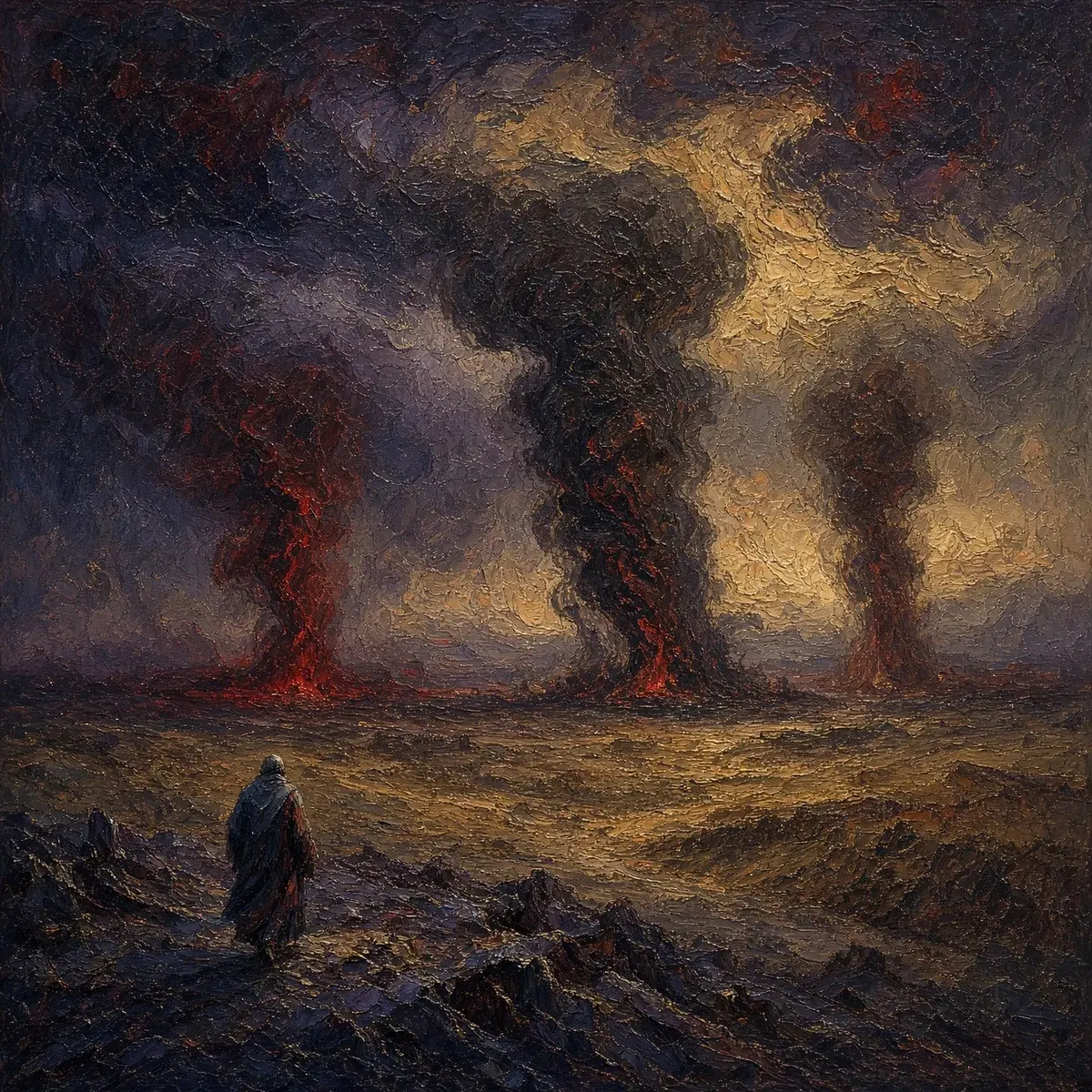
    Mercy takes hold of a hand. The chapter could have said merely that Lot escaped, but it gives the mechanics of the rescue: he lingers, the visitors seize him and his family, and they place them outside the city. The explanation is supplied beside the action: the LORD being merciful unto him. Lot's speed is not what saves him.

    Even after that, the escape includes a request to change the destination. The mountain appears too dangerous to Lot, who says so explicitly. His appeal for the little city is accepted, and its preservation is tied to his request. The movement from Abraham's intercession to Lot's plea is striking: Sodom is not spared, but a city within the threatened region is spared for the sake of the escaping man.

    The last verse permits much less explanation than it often receives. Lot's wife looks back and becomes a pillar of salt. Her name, her spoken thoughts, and the object of any supposed longing are not given. The command was explicit; so is the act that violates it. The Book of Genesis leaves the report short. After hands grasped, a city left behind, and safety reached at sunrise, one sentence records a loss that the account does not soften.

    Verse by verse

    1. 19:16

      The text explains the rescue by the LORD's mercy and explicitly says that Lot lingered.

    2. 19:20-22

      The account connects Zoar's name with Lot's description of it as a little city. Its preservation is granted in response to his appeal.

    3. 19:24

      Brimstone is sulfur. The verse attributes the destruction to the LORD; it does not supply a geological mechanism.

    4. 19:26

      No personal name or motive for Lot's wife is stated here. Luke 17:32 also refers to her by her relationship to Lot.

    Genesis 19:15-26

    King James Version · 12 verses

    19:15And when the morning arose, then the angels hastened Lot, saying, Arise, take thy wife, and thy two daughters, which are here; lest thou be consumed in the iniquity of the city.

    19:16And while he lingered, the men laid hold upon his hand, and upon the hand of his wife, and upon the hand of his two daughters; the LORD being merciful unto him: and they brought him forth, and set him without the city.

    19:17And it came to pass, when they had brought them forth abroad, that he said, Escape for thy life; look not behind thee, neither stay thou in all the plain; escape to the mountain, lest thou be consumed.

    19:18And Lot said unto them, Oh, not so, my Lord:

    19:19Behold now, thy servant hath found grace in thy sight, and thou hast magnified thy mercy, which thou hast shewed unto me in saving my life; and I cannot escape to the mountain, lest some evil take me, and I die:

    19:20Behold now, this city is near to flee unto, and it is a little one: Oh, let me escape thither, (is it not a little one?) and my soul shall live.

    19:21And he said unto him, See, I have accepted thee concerning this thing also, that I will not overthrow this city, for the which thou hast spoken.

    19:22Haste thee, escape thither; for I cannot do any thing till thou be come thither. Therefore the name of the city was called Zoar.

    19:23The sun was risen upon the earth when Lot entered into Zoar.

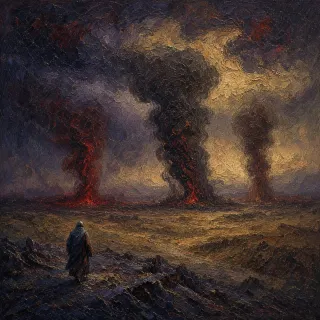
    19:24Then the LORD rained upon Sodom and upon Gomorrah brimstone and fire from the LORD out of heaven;

    19:25And he overthrew those cities, and all the plain, and all the inhabitants of the cities, and that which grew upon the ground.

    19:26But his wife looked back from behind him, and she became a pillar of salt.

  5. 05

    Ezekiel 16:49-50

    This was the iniquity of thy sister Sodom

    The prophets name the charge in full centuries later, and it starts with pride and fulness of bread and ends with the poor.

    Sodom had enough bread. That is not a minor detail beside the accusation; it is part of the accusation's force. The city possessed abundance and ease while the poor and needy went unsupported. The failure described is not simply being unable to help. Fullness stands beside a hand that was not strengthened.

    The Book of Ezekiel is speaking to Jerusalem, not giving a detached catalogue of another city's faults. Sodom is called her sister, and the surrounding verses say that Jerusalem has surpassed the sisters she despises. The comparison removes the comfortable distance between the city listening and the ruined city being named. Sodom is not being rehabilitated. Jerusalem is being indicted.

    The two verses also resist being shortened into a single preferred explanation. Pride, abundance, ease, neglect of the vulnerable, haughtiness, and abomination all remain in the text. The social charge must not be erased because Genesis 19 records sexual violence; the word abomination must not be erased to make Ezekiel cancel that earlier account. These are different passages exposing related dimensions of a city's corruption. Here the emphasis falls on a prosperous community whose resources did not become support for the weak. There was plenty. It did not reach the people who needed it.

    Verse by verse

    1. 16:49

      Thy sister addresses Jerusalem, as established in Ezekiel 16:2 and 16:46. The comparison is directed at the city receiving the prophecy.

    2. 16:49

      Daughters belongs to the chapter's personification of cities and their associated communities, not to a list of Sodom's individual female children.

    3. 16:49

      Abundance of idleness conveys secure, undisturbed ease in the Hebrew expression. It is linked here to pride and failure to aid the needy.

    4. 16:50

      Abomination remains part of the indictment. These two verses do not specify every act included under that term.

    Ezekiel 16:49-50

    King James Version · 2 verses

    16:49Behold, this was the iniquity of thy sister Sodom, pride, fulness of bread, and abundance of idleness was in her and in her daughters, neither did she strengthen the hand of the poor and needy.

    16:50And they were haughty, and committed abomination before me: therefore I took them away as I saw good.

    Ezekiel 16:49-50: This was the iniquity of thy sister Sodom

Why it matters

The long scene is the negotiation. Abraham stands before the LORD and asks whether the judge of all the earth will destroy the righteous with the wicked, and works the number down from fifty to forty five to forty to thirty to twenty to ten, and is never refused once. The conversation simply ends. What the cities are actually charged with is given plainly in Ezekiel: pride, fulness of bread, and abundance of idleness, neither did she strengthen the hand of the poor and needy.

3 songs

The music

Every song in the catalogue whose passage falls inside these chapters.

  1. Genesis 18:1-19:38

    Smoke over the Plain

  2. Genesis 18:16-19:29

    Smoke Rose Like a Furnace

  3. Genesis 18-19

    Sodom and Gomorrah

Nearby

All the places

Report an error on this page