[Intro]
I bathed those boys when they were small.
Today their uncle did.
[Verse 1]
Moses called the whole camp in
and we crowded to the door.
My husband stood out in the open
like he'd never stood before.
Moses poured the water over him
and over all four sons.
I'd scrubbed those necks a thousand times.
This was a different one.
[Verse 2]
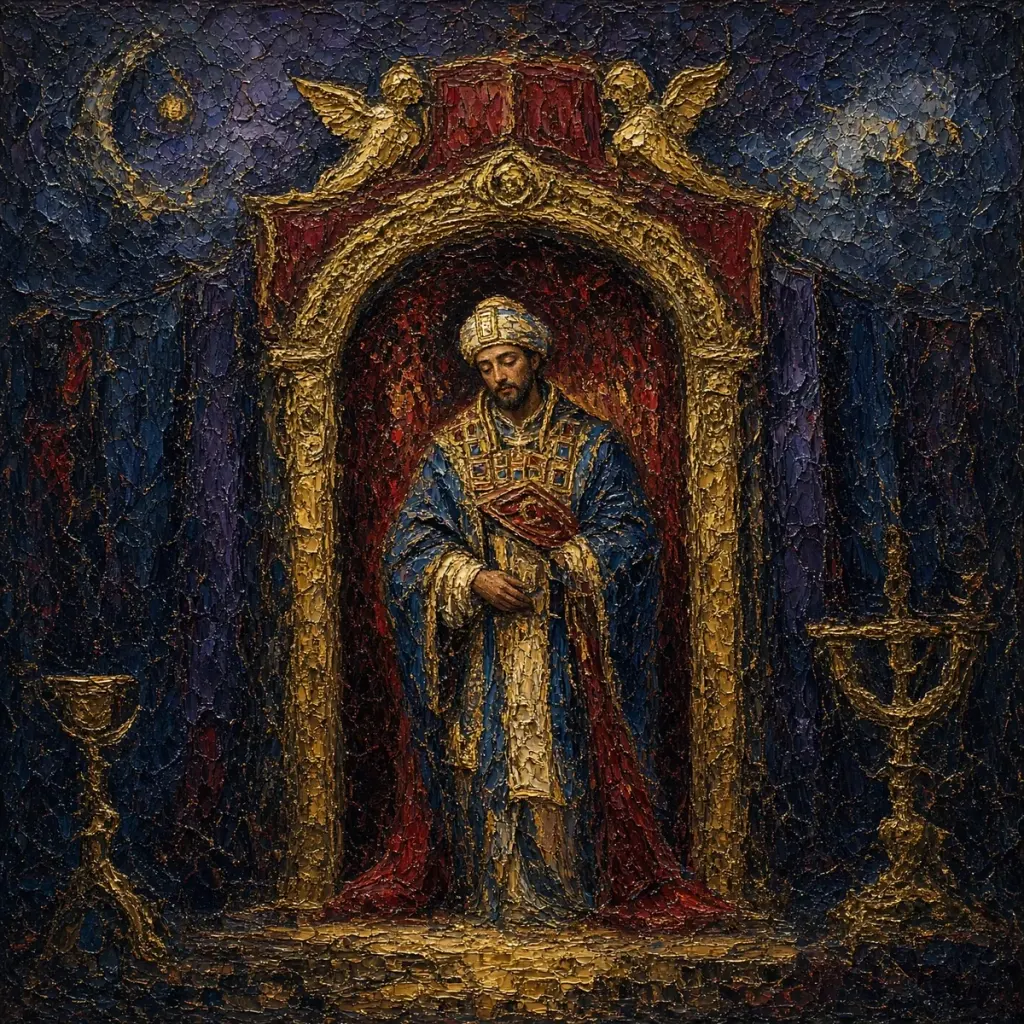
Then the coat, the sash, the robe of blue,
the ephod bound in gold,
the breastplate with the stones in rows,
the gold plate, as he was told.
Then Moses took the anointing oil
and poured it on his head.
It ran down into his beard.
I thought about the day we wed.
[Pre-Chorus]
Then the second ram went down.
Moses dipped his finger red.
He went to Aaron first, then each of mine,
and I could not lift my head.
[Chorus]
Set apart at the door,
they are not mine anymore.
Blood on the ear, blood on the hand,
blood on the foot where they stand.
Seven nights, and they don't come home.
Set apart at the door.
[Verse 3]
He sprinkled blood and oil together
on their garments and their heads.
They boiled the meat there at the doorway
and ate it with the bread.
What's left at dawn, the fire takes.
Nothing comes home to me.
They sleep there at the tent door
where I'm not meant to be.
[Chorus]
Set apart at the door,
they are not mine anymore.
Blood on the ear, blood on the hand,
blood on the foot where they stand.
Seven nights, and they don't come home.
Set apart at the door.
[Bridge]
Keep the charge, the LORD told them,
keep it so you do not die.
So I don't call their names out,
and I don't let them see me cry.
Seven nights I set four places.
Seven nights the bowls stay dry.
[Final Chorus]
Set apart at the door,
they are not mine anymore.
Blood on the ear, blood on the hand,
blood on the foot where they stand.
Seven nights, and they don't come home.
Set apart at the door.
Four sons and the man I married,
set apart at the door.
[Outro]
I bathed those boys when they were small.
They belong to Him now.
Leviticus 8: The priests are consecrated in public
The regulations now become a public installation. Moses gathers the congregation, washes and clothes Aaron and his sons, anoints both sanctuary and priesthood, and performs sacrifices on their behalf. Aaron is not yet the officiant over every action because this is the ceremony that authorizes his office. Blood from the ram of consecration reaches right ear, thumb, and great toe, while designated food is placed in priestly hands before being offered. The ceremony is physical, visible, and slow. It does not end with one impressive moment. Aaron and his sons remain at the tabernacle entrance for seven days, eating what is prescribed, burning leftovers, and keeping the charge given to them. Office begins under command, not personal ownership. The seven days make clear that consecration is a process of sustained obedience, not a single ceremonial flash.