New · FreePlay The Witnesses The in-depth puzzle battle quest through Bible history

Objects of the Bible

The bronze basin

Made out of mirrors, and the only furnishing whose measurements are never given.

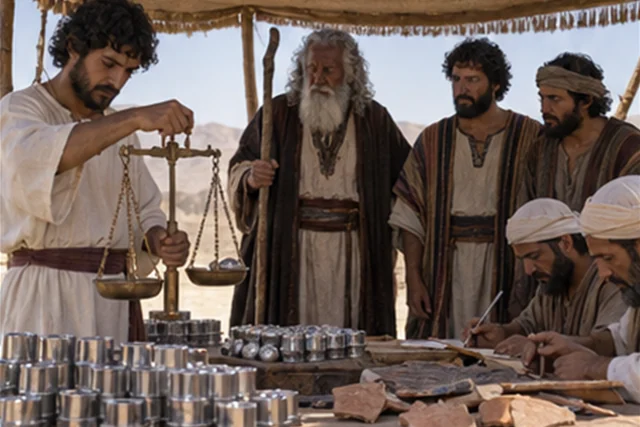
Every other item in the tent comes with dimensions to the half cubit. This one does not. What is given instead is what it was made of, and the detail is startling: he made the laver of brass, and the foot of it of brass, of the looking glasses of the women assembling, which assembled at the door of the tabernacle. Polished bronze mirrors, donated, melted down into a bowl for washing.

Where it appearsExodus 30 · Exodus 38

Scroll down to the account
The bronze basin

The movements, in the order the text gives them.

The Account of The bronze basin

  1. 01

    Exodus 30:17-19

    Thou shalt also make a laver of brass

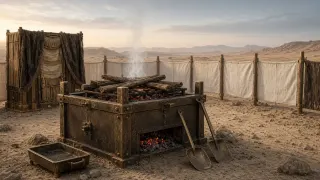
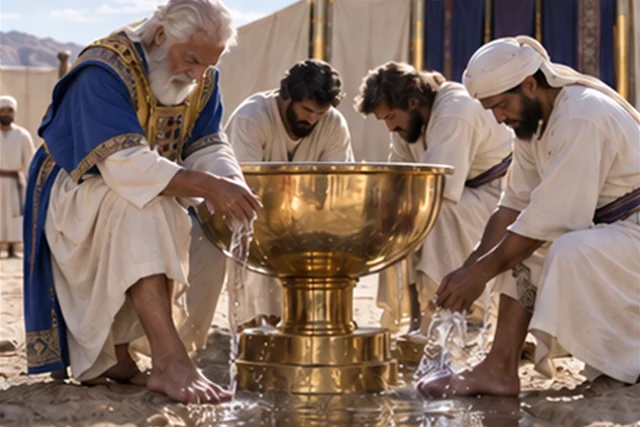
    It is set between the tent of the congregation and the altar, and water is put in it. No dimensions follow.

    Exodus becomes unusually quiet about measurements here. The ark, the table and both altars arrive with dimensions; the basin arrives with a location, a purpose and the names of its users. No height, diameter or capacity is supplied. The silence is not permission to assign a mystical meaning to an imaginary size. It is a shift in emphasis: the important measurement here is not how much water the vessel holds, but what the priests must do with it.

    Between the altar and the tent, the basin belongs to the working arrangement of approach. Aaron and his sons do not merely possess holy clothing and then proceed wherever they please. Their hands and feet must be washed. The parts of the body that perform the service and carry its servants into the sanctuary are specifically named; the passage does not prescribe a bath every time. Even the instruction to put water therein matters. A beautifully made empty basin would satisfy the eye and fail the command. This furnishing has not been commissioned to look useful. It has work to do.

    Verse by verse

    1. 30:18

      The foot is the basin's base or stand, not another washing vessel.

    2. 30:18

      Neither this prescription nor the construction report in Exodus 38:8 supplies dimensions.

    3. 30:19

      Hands and feet are expressly named. The text does not describe taps, the method of drawing water, or immersion in the basin.
    Exodus 30:17-19

    King James Version · 3 verses

    30:17And the LORD spake unto Moses, saying,

    30:18Thou shalt also make a laver of brass, and his foot also of brass, to wash withal: and thou shalt put it between the tabernacle of the congregation and the altar, and thou shalt put water therein.

    30:19For Aaron and his sons shall wash their hands and their feet thereat:

    Exodus 30:17-19: Thou shalt also make a laver of brass
  2. 02

    Exodus 30:20-21

    That they die not

    The consequence is stated twice in two verses, once for entering the tent and once for approaching the altar.

    Twice in two verses, that they die not. The warning is attached to washing hands and feet, an action so ordinary that its severity can be easy to miss. Exodus refuses to let priestly work become ordinary merely because the priests perform it repeatedly. The altar is not less holy on the hundredth approach than on the first, and Aaron's family connection is a qualification for service, not an exemption from its conditions.

    The command covers two movements: entering the tent and approaching the altar to minister. Washing belongs to both. It is not a special precaution reserved for the annual entry beyond the veil, and the instruction does not wait for a priest to report a particular stain. This is prescribed preparation for service. Nor does the text explain the death warning through a hidden lesson in germs or modern sanitation. Its stated concern is the terms of approach to the LORD. The water is practical, but the requirement is not merely practical. The same law that warns of death supplies an action by which the priests may continue their work alive. The basin stands beside a boundary, and it also makes obedience possible.

    Verse by verse

    1. 30:20

      The two occasions are entry into the tent and approach to the altar for service.

    2. 30:20-21

      That they die not occurs in both verses. The text treats the command as a condition of holy service, not as optional cleanliness.

    3. 30:21

      The requirement continues through Aaron's descendants; inherited office does not cancel it.

    Exodus 30:20-21

    King James Version · 2 verses

    30:20When they go into the tabernacle of the congregation, they shall wash with water, that they die not; or when they come near to the altar to minister, to burn offering made by fire unto the LORD:

    30:21So they shall wash their hands and their feet, that they die not: and it shall be a statute for ever to them, even to him and to his seed throughout their generations.

    Exodus 30:20-21: That they die not
  3. 03

    Exodus 38:8

    Of the lookingglasses of the women

    The material has a history. Mirrors given by women who served at the door become the vessel priests have to look into before going in.

    The metal has a previous life. Before it becomes a basin and its stand, it belongs to mirrors, and Exodus pauses to identify the women associated with them. Their names are not supplied, but their contribution is not allowed to disappear into an anonymous total of bronze. A furnishing used by the priests is made from material supplied by women gathered at the entrance. The priesthood does not produce the whole sanctuary by itself.

    Nothing in the verse scolds those women for having mirrors. The familiar move from reflection to vanity may produce a convenient lesson, but it is not the judgment Exodus makes. The text records the transfer of material into sanctuary service, not the rehabilitation of a sinful household object. The Hebrew description of the women is also stronger than a casual crowd happening to stand nearby: it uses language of assembling or serving, although the precise activity is not explained. Their presence has a connection with the meeting place. What the chapter preserves is wonderfully concrete. Objects once used to see faces become the material of the vessel used to wash hands and feet. No imagined rebuke is needed. The change of use already has character.

    Verse by verse

    1. 38:8

      The lookingglasses supply metal, not panes of modern mirror glass. Job 37:18 also speaks of a molten looking glass.

    2. 38:8

      The basin and its base are both included in the description of what was made from the mirrors.

    3. 38:8

      The women's precise activity at the entrance is not described, and the verse does not call them priestesses.

    Exodus 38:8

    King James Version · 1 verse

    38:8And he made the laver of brass, and the foot of it of brass, of the lookingglasses of the women assembling, which assembled at the door of the tabernacle of the congregation.

    Exodus 38:8: Of the lookingglasses of the women
  4. 04

    Exodus 40:30-32

    Moses and Aaron and his sons washed

    When the tent is finally raised the washing starts immediately, and the account records the first people to use it by name.

    Moses is the first name at the water. That small inclusion keeps the scene from becoming a picture of the lawgiver standing aside while everyone else obeys. The man who receives the instructions also washes his hands and feet. His role in setting up the sanctuary does not place him outside its requirements. Exodus does not need to supply a speech about humility; it puts his name into the same sentence as Aaron and his sons.

    The surrounding verses have the same practical insistence. The table receives bread, the lamps are lit, incense is burned, offerings are presented, and now the basin receives water and is used. The tabernacle is not complete as a collection of unused objects. Its appointed service has begun. After the washing comes the familiar seal, as the LORD commanded Moses, and then the finishing of the court. The glory that fills the tent in the next verses does not erase the careful bodily actions just recorded. Nor does the washing entitle Moses to walk through that glory at will: verse 35 says he cannot enter. Preparation is required, but access is still governed by the presence, not owned by the prepared man.

    Verse by verse

    1. 40:30

      The position and the addition of water fulfill the earlier instructions of Exodus 30:18 and 40:7.

    2. 40:31

      Moses is expressly included among those who wash; the verse is not limited to Aaron and his descendants.

    3. 40:32

      Hebrews 10:22 also places bodily washing in a discussion of priestly access, although it does not name this basin.

    4. 40:32

      Exodus 40:35 subsequently says Moses could not enter because the cloud and glory filled the tent; washing does not grant unrestricted access.

    Exodus 40:30-32

    King James Version · 3 verses

    40:30And he set the laver between the tent of the congregation and the altar, and put water there, to wash withal.

    40:31And Moses and Aaron and his sons washed their hands and their feet thereat:

    40:32When they went into the tent of the congregation, and when they came near unto the altar, they washed; as the LORD commanded Moses.

    Exodus 40:30-32: Moses and Aaron and his sons washed

Why it matters

The rule attached to it is short and absolute. Aaron and his sons wash their hands and their feet there when they go into the tent and when they come near the altar, that they die not. It is between the altar and the door, so nobody passes from the sacrifice to the sanctuary without stopping. Washing is not a preliminary here, it is a condition, and it is repeated: so they shall wash their hands and their feet, that they die not.

The music

The music

Every song in the catalogue whose passage falls inside these chapters.

No song in the catalogue reaches these chapters yet.

Nearby

All the objects

Report an error on this page