
New · FreePlay The Witnesses The in-depth puzzle battle quest through Bible history

People of the Bible

Ananias of Damascus

Argued with the vision, went anyway, and called the man who had come to arrest him brother.

He is a certain disciple at Damascus, described elsewhere as a devout man according to the law with a good report of all the Jews there. He has heard of Saul, and what he has heard is accurate: how much evil he has done to the saints at Jerusalem, and that he has authority from the chief priests to bind everyone here who calls on the name. So when the Lord calls him in a vision and tells him the street, the house and the man, he does the reasonable thing and objects.

Where he appearsActs 9

Scroll down to the account
Ananias of Damascus

The movements, in the order the text gives them.

The Account of Ananias of Damascus

  1. 01

    Acts 9:10-12

    Behold, I am here, Lord

    The instructions are precise to the street and the house. Saul is already praying and has already seen Ananias coming in a vision of his own.

    Saul has already seen Ananias coming before Ananias has agreed to go. The two visions fit together with remarkable precision: a named visitor, a particular house, a hand laid on a blind man. Neither participant arranges the meeting. The Lord knows both sides of the door.

    The directions are almost disarmingly practical. Straight Street. Judas's house. Saul, the man from Tarsus. A revelation that reaches from heaven still gives an address, because Ananias must walk to an actual person in an actual room. The decisive piece of information is not Saul's location, however. It is his present activity: behold, he prayeth. That does not mean a man trained in Jewish devotion has never prayed before. It tells Ananias what the persecutor is doing now, beyond the reports of what he has done.

    Ananias receives no impressive introduction. A certain disciple is all the title the Book of Acts supplies. In Paul's later account, Acts 22:12, he is a devout observer of the law with a good local reputation. The man entrusted with this encounter is not presented as an enemy of Israel's faith. He is one of its devout sons, sent to another.

    Verse by verse

    1. 9:10

      The passage identifies Ananias as a disciple, without naming an apostolic office or describing an earlier public ministry.

    2. 9:11

      Judas is the householder in Damascus. Nothing here identifies him with Judas Iscariot or supplies a biography.

    3. 9:12

      Saul's vision includes Ananias by name and the action by which his sight will return; it is more specific than a general expectation of help.
    Acts 9:10-12

    King James Version · 3 verses

    9:10And there was a certain disciple at Damascus, named Ananias; and to him said the Lord in a vision, Ananias. And he said, Behold, I am here, Lord.

    9:11And the Lord said unto him, Arise, and go into the street which is called Straight, and enquire in the house of Judas for one called Saul, of Tarsus: for, behold, he prayeth,

    9:12And hath seen in a vision a man named Ananias coming in, and putting his hand on him, that he might receive his sight.

    Acts 9:10-12: Behold, I am here, Lord
  2. 02

    Acts 9:13-14

    Lord, I have heard by many of this man

    He states the case against going, and every word of it is true. The record of the objection is left in the text rather than tidied away.

    Ananias supplies the Lord with a report on the man the Lord has just named. There is a quiet human directness about it. Saul is not simply unpopular. Many people have reported the harm he has done, and he has arrived with authority to continue doing it. Ananias has not mistaken an awkward social visit for a dangerous assignment. The opening verses of the chapter confirm his information.

    His wording also refuses to make the victims disappear. Thy saints. All that call on thy name. These are people who belong to the very Lord now sending him into the persecutor's lodging. The objection is not merely that Saul might be unpleasant company. The proposed recipient of help has been binding the people who invoke Jesus.

    Two authorities stand opposite each other in these sentences. The chief priests have authorized Saul to arrest; the Lord has instructed Ananias to visit. Ananias states that collision plainly, without receiving a rebuke for inventing the danger. The answer in the following verses does not correct his account of Saul's past. It discloses a purpose that his information could not supply.

    Verse by verse

    1. 9:13

      Saints translates the Greek hagioi, holy ones, here the living believers Saul has harmed rather than a later category of formally recognized individuals.

    2. 9:14

      The authority to bind is consistent with Saul's request for letters in Acts 9:1-2. Ananias's warning is grounded in the danger already described.

    Acts 9:13-14

    King James Version · 2 verses

    9:13Then Ananias answered, Lord, I have heard by many of this man, how much evil he hath done to thy saints at Jerusalem:

    9:14And here he hath authority from the chief priests to bind all that call on thy name.

    Acts 9:13-14: Lord, I have heard by many of this man
  3. 03

    Acts 9:15-16

    He is a chosen vessel unto me

    The answer does not deny the danger, it adds to it. The chosen vessel is told in advance how much he will suffer.

    The name Saul has been trying to silence is the name he is appointed to carry. That reversal holds these two verses together. Ananias has described a man bearing authority from the chief priests; the Lord describes a man bearing his name before nations, rulers, and Israel. The persecutor's commission is being replaced, not merely softened.

    A chosen vessel is not a compliment on Saul's moral record. The choice belongs to the Lord, and the vessel has a purpose. The Greek expression, skeuos ekloges, describes an instrument of choice, something selected for use. Ananias is not asked to discover an admirable quality hidden beneath the arrests. He is told whose decision governs the appointment.

    Then comes the sentence that prevents election from sounding like a promise of ease. Saul will suffer for that name. The victims' suffering has just been stated without qualification; the commissioned man's suffering is now stated with equal clarity. The passage does not supply a calculation by which pain repays old debts. It names the cost attached to his future witness. Gentiles do not replace Israel in the list, either. The field grows wider, and the commission grows heavier.

    Verse by verse

    1. 9:15

      The three named audiences are Gentiles, kings, and the children of Israel. A mission to the nations does not remove Israel from the commission.

    2. 9:16

      For my name's sake identifies the connection between suffering and witness. The verse does not list particular injuries or quantify how much suffering is required.

    Acts 9:15-16

    King James Version · 2 verses

    9:15But the Lord said unto him, Go thy way: for he is a chosen vessel unto me, to bear my name before the Gentiles, and kings, and the children of Israel:

    9:16For I will shew him how great things he must suffer for my name’s sake.

    Acts 9:15-16: He is a chosen vessel unto me
  4. 04

    Acts 9:17-19

    Brother Saul

    The first word spoken to the church’s worst enemy by the church is a family word. Sight comes back, he is baptized, and he eats.

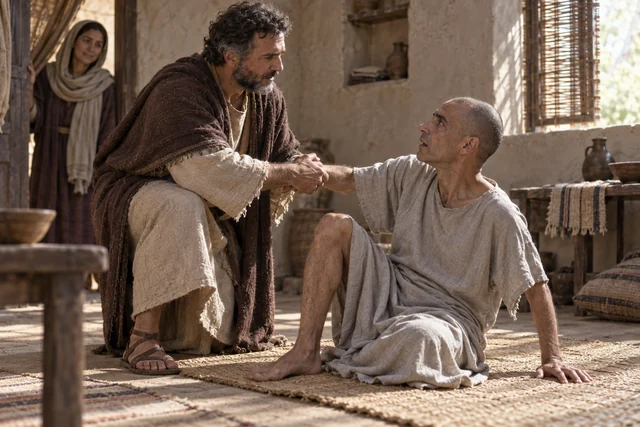
    Brother Saul comes before the scales fall. Ananias does not wait for a visible recovery before addressing the blind man as a brother. The word can be used between fellow Jews as well as fellow disciples, but here it accompanies something unmistakably concrete: he enters, puts his hands on Saul, and identifies Jesus as the one who sent him. The visit answers the objection without pretending the objection never existed.

    The hands matter. Saul had come to bind disciples; a disciple now touches him to bring healing. The Book of Acts does not decorate the moment with an embrace, tears, or a conversation about forgiveness. Those additions would be easier to imagine than to verify. The actual greeting is strong enough without them.

    Then the passage gives room to an ordinary necessity. Saul eats and is strengthened. Three days without food or drink do not cease to matter because a revelation has occurred. Restored sight, baptism, food, time among the disciples: the man whose arrival threatened this community is now received within it. Ananias does not become a permanent companion in the account, but Paul's later testimony remembers his name and words. A brief appearance is not a small part.

    Verse by verse

    1. 9:17

      Brother Saul is spoken before the healing is reported. Ananias also explicitly identifies the Lord who sent him as Jesus, the one Saul encountered on the road.

    2. 9:18

      As it had been scales is a comparison describing what fell from Saul's eyes, not a named medical diagnosis.

    3. 9:19

      Meat means food here, not necessarily animal flesh. The renewed strength follows the three-day fast described in Acts 9:9.

    Acts 9:17-19

    King James Version · 3 verses

    9:17And Ananias went his way, and entered into the house; and putting his hands on him said, Brother Saul, the Lord, even Jesus, that appeared unto thee in the way as thou camest, hath sent me, that thou mightest receive thy sight, and be filled with the Holy Ghost.

    9:18And immediately there fell from his eyes as it had been scales: and he received sight forthwith, and arose, and was baptized.

    9:19And when he had received meat, he was strengthened. Then was Saul certain days with the disciples which were at Damascus.

    Acts 9:17-19: Brother Saul

Why it matters

The objection is answered rather than overruled, which is worth noticing. Go thy way, for he is a chosen vessel unto me, and I will show him how great things he must suffer for my name’s sake. Then Ananias walks into the house where the most dangerous man in Judea is sitting blind, puts his hands on him, and opens with a word: brother Saul. Scales fall, sight returns, and the man who would write half the New Testament is baptized by someone the book never mentions again.

2 songs

The music

Every song in the catalogue whose passage falls inside these chapters.

  1. Acts 9:1-31

    Saul, Saul

  2. Acts 9:1-31

    Saul, Saul, Why Persecutest Thou Me?

Nearby

All the people

Report an error on this page