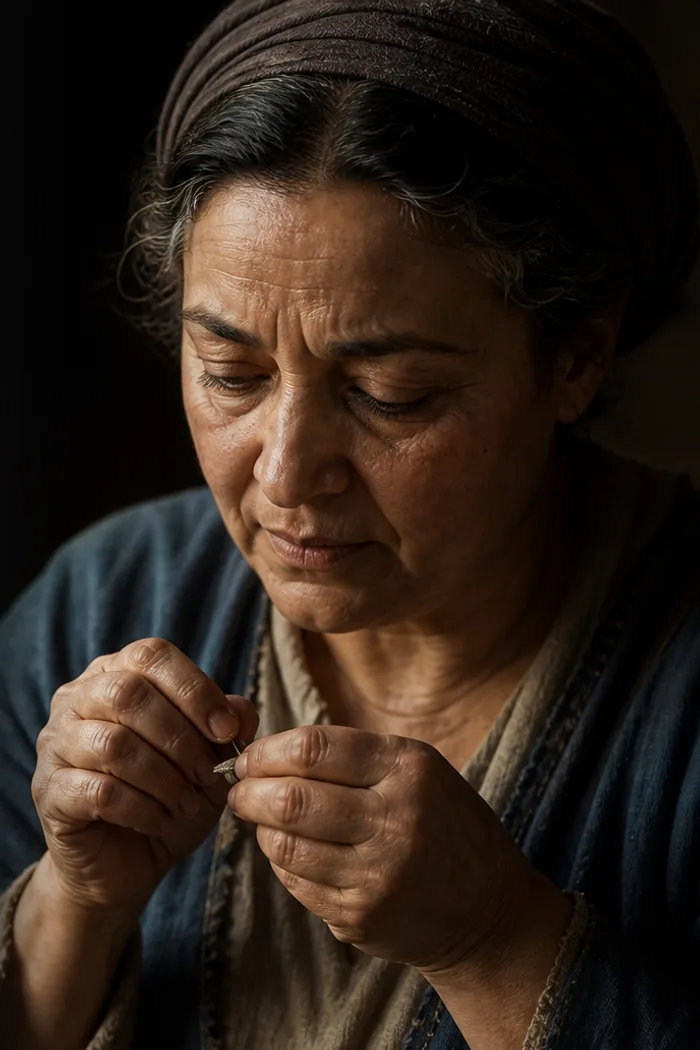
New · FreePlay The Witnesses The in-depth puzzle battle quest through Bible history

People of the Bible

Dorcas

The evidence brought to her funeral was the clothes she had made, held up by the women wearing them.

Also called Tabitha

She lives at Joppa and the text gives her two names, the Aramaic Tabitha and the Greek Dorcas, both meaning gazelle, which suggests a woman known in both communities of a port town. She is called a disciple, and the word is in its feminine form, the only time in the New Testament that happens. What is said about her is a single clause: this woman was full of good works and almsdeeds which she did. Then she falls sick and dies.

Where she appearsActs 9

Scroll down to the account
Dorcas

The movements, in the order the text gives them.

The Account of Dorcas

  1. 01

    Acts 9:36

    Full of good works and almsdeeds

    The introduction is one sentence long and it is entirely about what she did for other people. The feminine word for disciple is used only here.

    The first description is disciple, not dressmaker. Before any garment appears, Tabitha is identified by her relationship to the faith. Her work is then given as the texture of that life: good works and almsdeeds which she did. The last three words keep the praise from becoming an attractive inscription with nothing beneath it. These were acts, not intentions.

    The two names also deserve their place. Tabitha is Aramaic; Dorcas is its Greek equivalent. Both mean gazelle. The Book of Acts translates the name rather than presenting a conversion in which one identity has been discarded for another. The woman is the same under both names, and the chapter uses both.

    Full is the generous word in the description. It presents sustained abundance, not a single memorable donation. Yet the verse supplies no sum of money, household arrangement, age, or marital status. It is unnecessary to turn her into either a wealthy patron or a destitute seamstress to give the sentence force. What fills the introduction is what she did for others. Her social biography remains brief; her active goodness does not.

    Verse by verse

    1. 9:36

      Tabitha and Dorcas both mean gazelle, in Aramaic and Greek respectively. The verse describes a translation of the name, not a change of name.

    2. 9:36

      Almsdeeds are acts of charitable assistance. The verse does not give a monetary total or restrict her help to money.

    3. 9:36

      The passage does not say that Dorcas herself was a widow. The widows named in verse 39 are people mourning her.
    Acts 9:36

    King James Version · 1 verse

    9:36Now there was at Joppa a certain disciple named Tabitha, which by interpretation is called Dorcas: this woman was full of good works and almsdeeds which she did.

    Acts 9:36: Full of good works and almsdeeds
  2. 02

    Acts 9:37-38

    They laid her in an upper chamber

    Lydda is near and two men are sent to ask Peter to come without delay. The request is made before anybody says what they expect.

    Before the messengers are mentioned, the body has been washed. The Book of Acts establishes the death through both its direct statement and the community's treatment of the body. The upper room is not introduced as a sickroom in which an uncertain diagnosis waits to be corrected. Tabitha has died, and those around her are caring for her remains.

    The movement toward Peter begins with geography and information. Lydda is near Joppa; the disciples have heard that he is there; two men are sent. The request is urgent but remarkably spare. They ask him to come without delay. The passage does not quote a demand for resurrection or explain exactly what they expect him to do.

    That reserve leaves the loss intact. It also gives the surrounding disciples real work: washing, laying out the body, carrying a message, and seeking Peter's presence. The woman introduced through her care for others is now herself being cared for. The account has changed from her good works to the hands and journeys of the people around her. Their actions cannot make the death less real. They show that she is not being left alone in it.

    Verse by verse

    1. 9:37

      Washed describes care for the body after the stated death. The passage gives neither the illness nor its duration.

    2. 9:38

      The nearness of Lydda explains why the disciples can seek Peter there. No exact distance or travel time is stated.

    3. 9:38

      The recorded request concerns Peter's prompt arrival. A specific request to raise Dorcas from the dead is not quoted.

    Acts 9:37-38

    King James Version · 2 verses

    9:37And it came to pass in those days, that she was sick, and died: whom when they had washed, they laid her in an upper chamber.

    9:38And forasmuch as Lydda was nigh to Joppa, and the disciples had heard that Peter was there, they sent unto him two men, desiring him that he would not delay to come to them.

    Acts 9:37-38: They laid her in an upper chamber
  3. 03

    Acts 9:39

    Showing the coats and garments

    The widows do not describe her, they display her work and they are wearing it. It is the plainest obituary in Scripture.

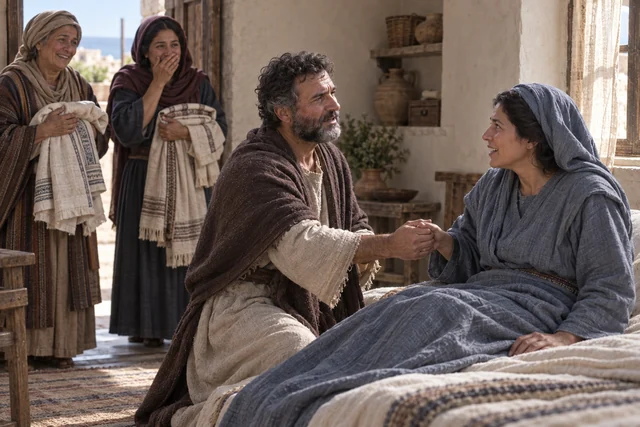
    The widows bring evidence that can be held in the hands. Their testimony is not a polished description of Dorcas's character. It is coats and garments, the actual work of a woman whose absence they are feeling together. The tears are stated, and the objects give those tears a particular history.

    While she was with them is the phrase that makes the room smaller. The clothes remain; the person who made them is no longer among the women displaying them. Her work has outlasted her presence, but it has not replaced it. The passage does not turn usefulness into a substitute for the woman herself.

    This also brings the opening description down to its most concrete form. Full of good works could remain a broad commendation; verse 39 puts material examples beside it. No fabric, color, price, or professional title is supplied, and the verse does not explicitly say that the widows are wearing every garment they show. Those details are unnecessary. Peter is being shown what her hands produced while she was with them. Good works has seams.

    Verse by verse

    1. 9:39

      The women are identified as widows, but their individual names and household circumstances are not given.

    2. 9:39

      Shewing establishes that the garments are displayed. Whether all the women are wearing the displayed pieces is not explicitly stated.

    3. 9:39

      Which Dorcas made connects the garments directly with her work. The verse does not identify paid employment or a commercial workshop.

    Acts 9:39

    King James Version · 1 verse

    9:39Then Peter arose and went with them. When he was come, they brought him into the upper chamber: and all the widows stood by him weeping, and shewing the coats and garments which Dorcas made, while she was with them.

    Acts 9:39: Showing the coats and garments
  4. 04

    Acts 9:40-41

    Tabitha, arise

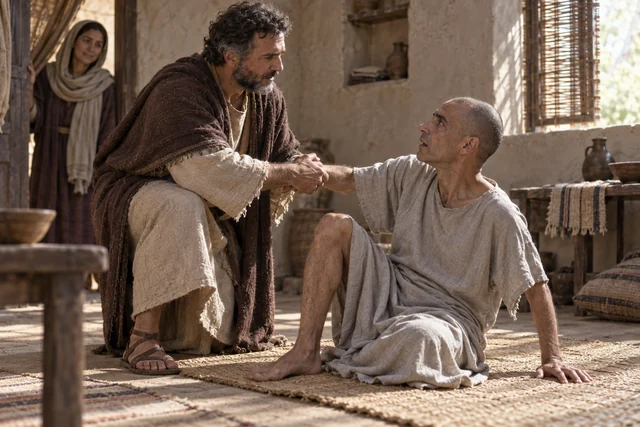
    He puts them all out and kneels, which is the pattern of an earlier room in Galilee. He gives her his hand and calls the saints and widows back in.

    Before Peter speaks to Tabitha, he kneels. That order prevents the short command from being detached from its setting and treated as a technique. The prayer is not transcribed, but it stands between the departure of the mourners and the words spoken to the body. Peter's dependence is visible before his authority is heard.

    The movement that follows is deliberately physical: eyes open, she sees Peter, she sits up, and he gives her his hand. The account does not stop at an announcement that something spiritual has occurred. It describes the woman responding and rising, then places her before the people who had mourned her. Presented her alive is the public completion of what happened without the crowd in the room.

    The widows are named again at that return. They were not merely there to provide tears at the beginning of a miracle. They are among those to whom Tabitha is restored. Her life is not reduced to evidence of Peter's power; it is returned to a community in which her absence had a particular weight. The hand that lifts her belongs to Peter. The person being lifted is Tabitha.

    Verse by verse

    1. 9:40

      Peter's prayer is reported but not quoted. No exact wording or required ritual can be recovered from the verse.

    2. 9:40

      Tabitha is the Aramaic name introduced in verse 36. Peter addresses the same woman whom verse 39 calls Dorcas.

    3. 9:41

      The saints and widows are called back and see her alive. The wording does not require the widows to be excluded from the wider group of believers.

    Acts 9:40-41

    King James Version · 2 verses

    9:40But Peter put them all forth, and kneeled down, and prayed; and turning him to the body said, Tabitha, arise. And she opened her eyes: and when she saw Peter, she sat up.

    9:41And he gave her his hand, and lifted her up, and when he had called the saints and widows, presented her alive.

    Acts 9:40-41: Tabitha, arise
  5. 05

    Acts 9:42-43

    He tarried many days in Joppa

    The news spreads through the town and many believe. Peter stays on with Simon a tanner, in the house where the next chapter finds him.

    The final sentence about the miracle names the Lord as the object of belief, not Peter or Dorcas. Many believed in the Lord. The distinction is simple and essential. The news spreads through Joppa, but the response the Book of Acts records is more than curiosity about an extraordinary event or admiration for its human participants.

    Then the account ends with lodging. After the upper chamber and the restored life comes the house of a man identified by his trade. Peter stays many days with Simon a tanner. The change of scale is characteristic of this passage: a life is restored, a city hears, and the apostle still needs somewhere to stay. A household becomes part of the movement of the gospel without receiving a speech of its own.

    Acts 10:5-6 returns to this address when Cornelius is told where to send for Peter. Dorcas is not mentioned there, and her later activities are not supplied. Her place in the account is already substantial: her work, her community's grief, her restored life, and the belief that follows. The chapter leaves her alive, not turned into an invented biography.

    Verse by verse

    1. 9:42

      Many believed is not a claim that every person in Joppa believed. The stated object of their faith is the Lord.

    2. 9:43

      A tanner prepares animal hides for leather. The verse identifies Simon by his work but does not state that every aspect of his household is ritually unclean.

    3. 9:43

      Many days gives a sustained stay without a numerical duration. Acts 10:6 identifies the same host's house as being by the sea.

    Acts 9:42-43

    King James Version · 2 verses

    9:42And it was known throughout all Joppa; and many believed in the Lord.

    9:43And it came to pass, that he tarried many days in Joppa with one Simon a tanner.

    Acts 9:42-43: He tarried many days in Joppa

Why it matters

The washing and the upper room are ordinary preparations for burial. What is not ordinary is the exhibit. When Peter arrives, all the widows stand by him weeping and showing the coats and garments which Dorcas made while she was with them. Her life is not summarised, it is worn into the room. Peter puts them all out, kneels, says Tabitha, arise, and gives her his hand. Then he presents her alive, and many believed in the Lord at Joppa.

The music

The music

Every song in the catalogue whose passage falls inside these chapters.

No song in the catalogue reaches these chapters yet.

Nearby

All the people

Report an error on this page