New · FreePlay The Witnesses The in-depth puzzle battle quest through Bible history

People of the Bible

Herod Agrippa

Killed one apostle, arranged the execution of a second, and did not survive his own applause.

He is the grandson of Herod the Great, raised in Rome, and given Judea by emperors he had befriended, which makes him the first Herod in a generation to hold the whole kingdom. Acts introduces him stretching forth his hands to vex certain of the church, and the reason given for the second arrest is entirely political: because he saw it pleased the Jews. The persecution is a popularity measure taken by a man who governs by measuring popularity.

Where he appearsActs 12

Scroll down to the account
Herod Agrippa

The movements, in the order the text gives them.

The Account of Herod Agrippa

  1. 01

    Acts 12:1-2

    He killed James the brother of John with the sword

    One verse for the death of an apostle. The brevity is the point; Acts does not stop, and no other apostle’s death is recorded at all.

    James's death occupies one sentence. Peter's imprisonment and release receive chains, doors, sandals, dialogue, and a street. The difference in space is not a difference in the worth of the two men. It is one of the chapter's hardest features: the same community loses one apostle and receives another back, and the Book of Acts does not explain why their outcomes differ.

    Vex sounds almost mild now. Verse 2 removes any possibility that it means mere irritation. The king's action reaches a named man and ends in execution. James is identified through his brother John, so the loss is both apostolic and familial. No last speech is supplied. No account of his feelings is supplied. The sentence is allowed to remain as stark as the act it records.

    That restraint matters when the passage is read beside Peter's deliverance. James is not described as less faithful, insufficiently prayed for, or somehow less needed. None of those explanations appears. The chapter records an actual death before it records an actual rescue. The rescue does not undo the death.

    Verse by verse

    1. 12:1

      Vex here means to mistreat or harm, not merely to annoy. The next verse specifies the violence.

    2. 12:2

      This James is the brother of John, identified as a son of Zebedee in Mark 10:35. He is not the James whom Peter names later in Acts 12:17.

    3. 12:2

      With the sword names the means of execution. The verse gives no trial proceedings or final words.

    Acts 12:1-2

    King James Version · 2 verses

    12:1Now about that time Herod the king stretched forth his hands to vex certain of the church.

    12:2And he killed James the brother of John with the sword.

    Acts 12:1-2: He killed James the brother of John with the sword
  2. 02

    Acts 12:3-4

    Because he saw it pleased the Jews

    The stated motive is approval. Peter is taken during the days of unleavened bread and held for a public trial after the feast.

    The reason for the second arrest is stated with uncomfortable clarity: Herod saw that the first killing pleased people. The Book of Acts does not require a reconstructed private conversation to explain the decision. It explicitly connects the response to James's death with the move against Peter. Approval has become part of the machinery of persecution.

    The calendar is equally pointed. The days of unleavened bread locate the arrest within Israel's season of remembered deliverance. Peter is being held while that festival is observed. The KJV's Easter represents the Greek pascha here, so the setting is the Jewish Passover period, not a separate Christian holiday imposed on the scene.

    Then comes the quantity of protection around one prisoner: four quaternions, four groups of four soldiers. Verse 6 distinguishes the men beside Peter from the guards at the door; it does not put all sixteen into his sleeping space. Herod's arrangements are concrete, counted, and tied to a public appearance after the festival. The chapter records the plans carefully. It does not confuse the ability to make them with the ability to guarantee their outcome.

    Verse by verse

    1. 12:3

      The verse identifies the approval Herod encountered. It does not state that every Jewish person agreed with the persecution.

    2. 12:4

      Tetradion means a group of four. Four such groups total sixteen soldiers; verse 6 describes the immediate guard around Peter.

    3. 12:4

      Bring him forth to the people specifies a planned public action after the festival. These verses do not provide the wording of a formal charge.

    Acts 12:3-4

    King James Version · 2 verses

    12:3And because he saw it pleased the Jews, he proceeded further to take Peter also. (Then were the days of unleavened bread.)

    12:4And when he had apprehended him, he put him in prison, and delivered him to four quaternions of soldiers to keep him; intending after Easter to bring him forth to the people.

    Acts 12:3-4: Because he saw it pleased the Jews
  3. 03

    Acts 12:5-11

    Prayer was made without ceasing

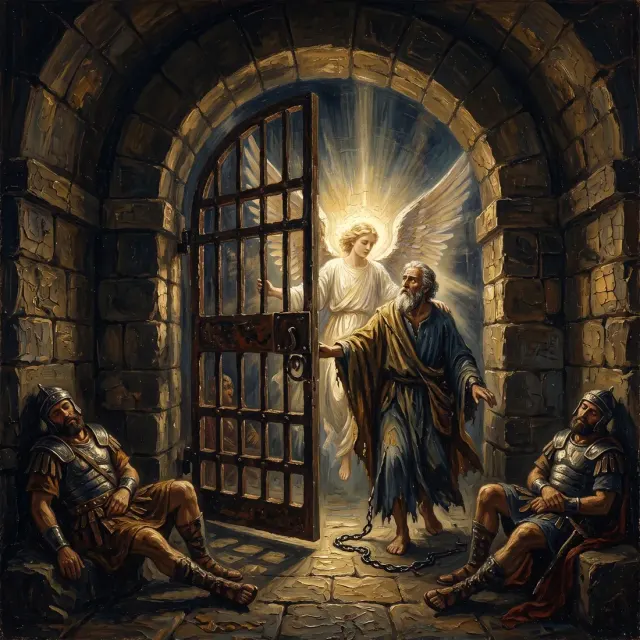
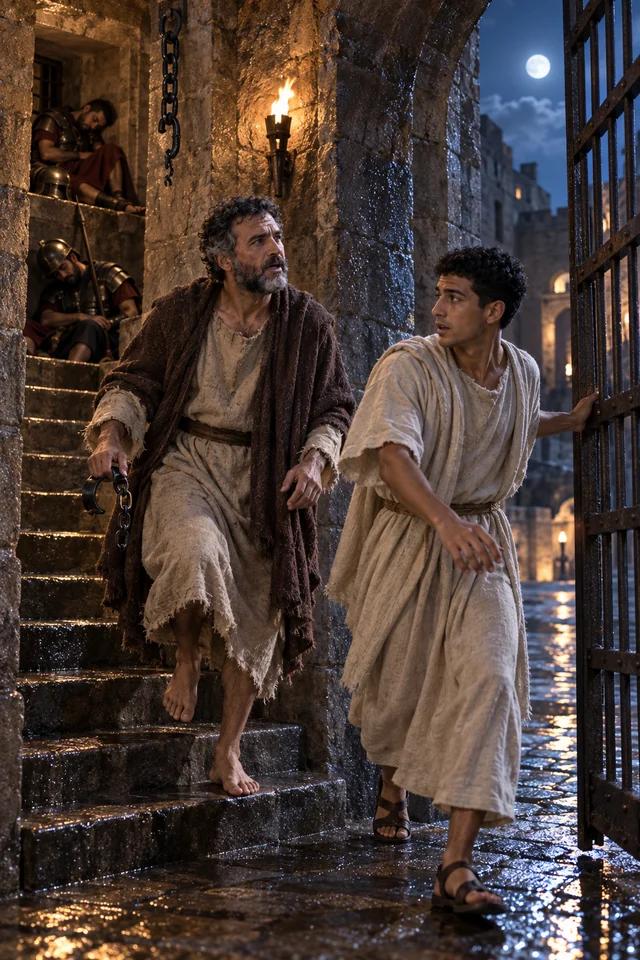
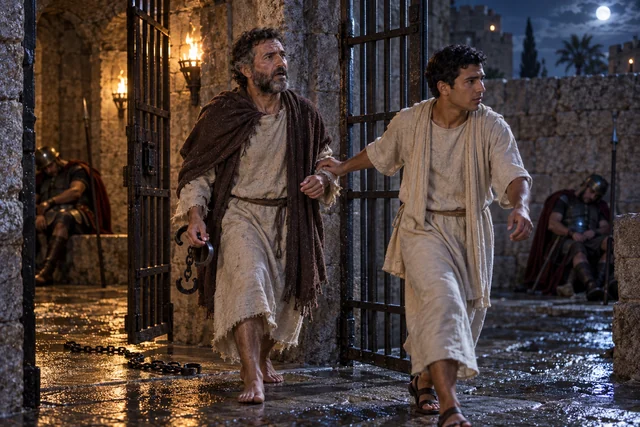
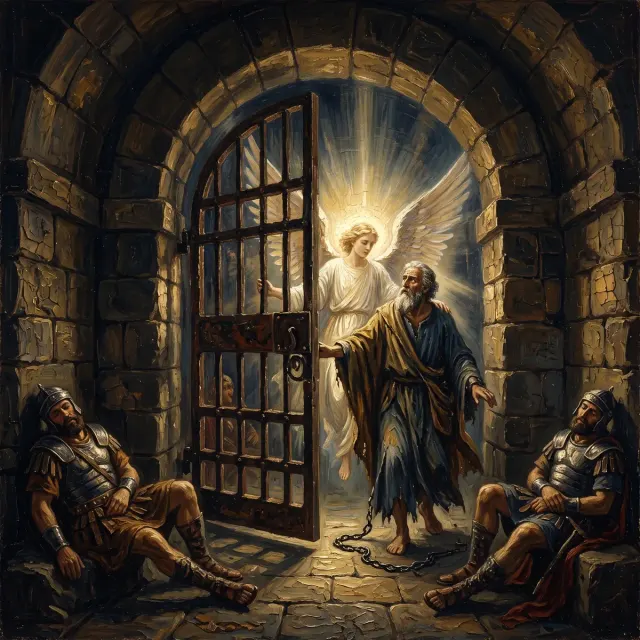
    Sixteen soldiers, two chains, an iron gate that opens of its own accord, and an angel who has to tell him to put his sandals on.

    Peter's understanding arrives after his feet have already carried him out. He follows the angel while thinking he sees a vision; only in the street, after the angel leaves, does he recognize what has happened. The Book of Acts is unusually precise about that delay. It does not make perfect comprehension a condition of this rescue.

    Nor does the miracle float above ordinary physical life. The chains fall, but the sandals still need fastening. The angel tells Peter to dress, put on his outer garment, and follow. Divine intervention and the small requirements of leaving a room occupy the same paragraph. The iron gate opens by itself; Peter still walks through it.

    Across the passage, keeping and praying stand beside one another. The authorities keep Peter in prison, and the church continues in prayer to God. These are not two equivalent security systems competing for efficiency. The release is attributed to the Lord's angel, not to superior human planning. Peter finally names that source himself. His sleep is reported, but its inner cause is not explained. The passage gives the sleeping body, the startled obedience, and the eventual certainty. It does not invent a speech of fearless confidence for the night before.

    Verse by verse

    1. 12:5

      The prayer is specifically offered to God for Peter. No formula, number of participants, or promise of a particular outcome is quoted.

    2. 12:8

      Gird thyself concerns arranging or fastening clothing for movement. The verse also distinguishes sandals and an outer garment.

    3. 12:9

      Peter himself thinks the event is a vision at this point. The Book of Acts distinguishes that impression from the actual release.

    4. 12:10-11

      The angel leaves after one street, and Peter then recognizes the deliverance. The text does not say that the angel escorts him all the way to Mary's house.

    Acts 12:5-11

    King James Version · 7 verses

    12:5Peter therefore was kept in prison: but prayer was made without ceasing of the church unto God for him.

    12:6And when Herod would have brought him forth, the same night Peter was sleeping between two soldiers, bound with two chains: and the keepers before the door kept the prison.

    12:7And, behold, the angel of the Lord came upon him, and a light shined in the prison: and he smote Peter on the side, and raised him up, saying, Arise up quickly. And his chains fell off from his hands.

    12:8And the angel said unto him, Gird thyself, and bind on thy sandals. And so he did. And he saith unto him, Cast thy garment about thee, and follow me.

    12:9And he went out, and followed him; and wist not that it was true which was done by the angel; but thought he saw a vision.

    12:10When they were past the first and the second ward, they came unto the iron gate that leadeth unto the city; which opened to them of his own accord: and they went out, and passed on through one street; and forthwith the angel departed from him.

    12:11And when Peter was come to himself, he said, Now I know of a surety, that the Lord hath sent his angel, and hath delivered me out of the hand of Herod, and from all the expectation of the people of the Jews.


    Acts 12:5-11: Prayer was made without ceasing
  4. 04

    Acts 12:13-17

    Thou art mad

    Rhoda leaves Peter standing at the gate in her excitement, and the praying church tells her she is out of her mind. It is the funniest scene in the book.

    The iron gate opens, but the prayer meeting's gate takes longer. That contrast is already in the passage; it needs no invented joke. Rhoda recognizes Peter's voice, becomes so glad that she leaves him outside, and announces his arrival to people who decide that her accurate report cannot be right. Peter, meanwhile, continues knocking.

    The Book of Acts does not conceal the awkwardness. The people gathered in prayer are astonished when they finally see him. Rhoda's gladness is explicitly stated, so the warmth belongs to the text rather than to a guessed inner life. Her insistence also matters. The person dismissed by the others has identified the situation correctly before they have.

    Their alternative, It is his angel, is recorded as their explanation, not endorsed as a lesson about what angels look like. Peter settles the argument by being present. Then his hand calls for quiet, and the report turns from astonishment to communication: James and the other believers must hear what the Lord has done. The passage ends with another place, not a named destination. There is plenty here without giving Peter an itinerary the verse does not supply.

    Verse by verse

    1. 12:13

      Damsel here identifies a female servant. The verse gives her name, not a precise age.

    2. 12:15

      It is his angel is the gathered believers' proposed explanation. The passage does not confirm their proposal as a description of the figure at the gate.

    3. 12:17

      James here is not the brother of John executed in verse 2. He is commonly identified with James the Lord's brother, prominent in Acts 15.

    4. 12:17

      Another place leaves Peter's destination unspecified. It does not establish a journey to Rome.

    Acts 12:13-17

    King James Version · 5 verses

    12:13And as Peter knocked at the door of the gate, a damsel came to hearken, named Rhoda.

    12:14And when she knew Peter’s voice, she opened not the gate for gladness, but ran in, and told how Peter stood before the gate.

    12:15And they said unto her, Thou art mad. But she constantly affirmed that it was even so. Then said they, It is his angel.

    12:16But Peter continued knocking: and when they had opened the door, and saw him, they were astonished.

    12:17But he, beckoning unto them with the hand to hold their peace, declared unto them how the Lord had brought him out of the prison. And he said, Go shew these things unto James, and to the brethren. And he departed, and went into another place.

    Acts 12:13-17: Thou art mad
  5. 05

    Acts 12:21-23

    He gave not God the glory

    Arrayed in royal apparel on the throne, he takes the crowd’s verdict about his own voice. The chapter ends with the word of God growing instead.

    The crowd's claim is about a voice; the account's answer is about a body. Royal clothing, a throne, and an address create the public scene in which Herod is acclaimed as more than a man. The Book of Acts then records his death in uncompromising physical terms. The contrast is between the divine status announced by the crowd and the mortality the king cannot escape.

    The reason is also stated, not left for a commentator to diagnose: because he gave not God the glory. The passage does not quote Herod declaring himself divine. It places the crowd's acclamation beside his failure to give the glory to God. That distinction keeps the accusation at the point the text actually makes.

    Verse 20 adds a material setting: the delegation from Tyre and Sidon seeks peace because its country depends on the king's country for food. The acclamation occurs amid unequal dependence, not in an empty ceremonial room. Yet the chapter's final contrast is larger than the audience. Herod dies, but in verse 24 the word of God grows and multiplies. The Book of Acts closes his part in the chapter without closing the church's work.

    Verse by verse

    1. 12:21

      Acts says royal apparel but does not identify its material. The silver garment belongs to Josephus's parallel account.

    2. 12:22

      The people pronounce the divine acclamation. No corresponding speech of self-deification by Herod is quoted.

    3. 12:23

      The Book of Acts explicitly attributes the judgment to Herod's failure to give God the glory. Eaten of worms should not be converted into a confidently named modern disease.

    Acts 12:21-23

    King James Version · 3 verses

    12:21And upon a set day Herod, arrayed in royal apparel, sat upon his throne, and made an oration unto them.

    12:22And the people gave a shout, saying, It is the voice of a god, and not of a man.

    12:23And immediately the angel of the Lord smote him, because he gave not God the glory: and he was eaten of worms, and gave up the ghost.

Why it matters

James the brother of John is killed with the sword, the only apostle whose death the New Testament records. Peter is taken next, kept by four quaternions of soldiers, and the church holds a prayer meeting that does not believe its own answer when Rhoda reports it at the door. Then the chapter turns on Herod himself. At Caesarea, in royal apparel, he makes an oration and the people shout that it is the voice of a god and not of a man, and he does not give God the glory.

1 song

The music

Every song in the catalogue whose passage falls inside these chapters.

  1. Acts 12:1-19

    The Iron Gate Opened

Nearby

All the people

Report an error on this page