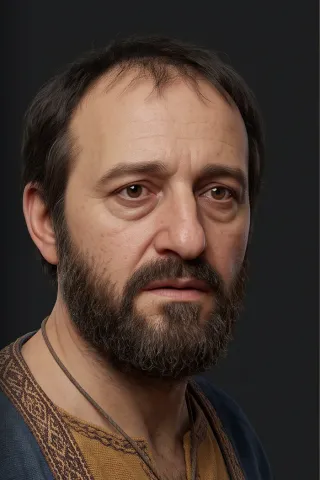
New · FreePlay The Witnesses The in-depth puzzle battle quest through Bible history

People of the Bible

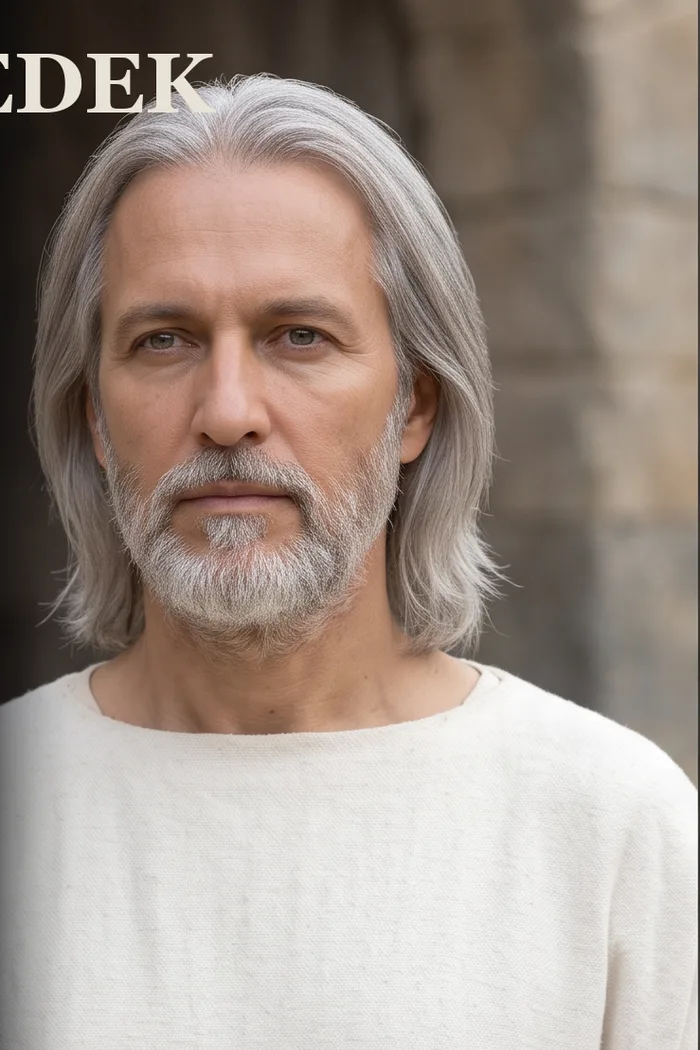
Melchizedek

Three verses in Genesis, one in a psalm, and a whole argument in Hebrews about a priest with no beginning.

Also called King of Salem, priest of the most high God; in Hebrews, Melchisedec

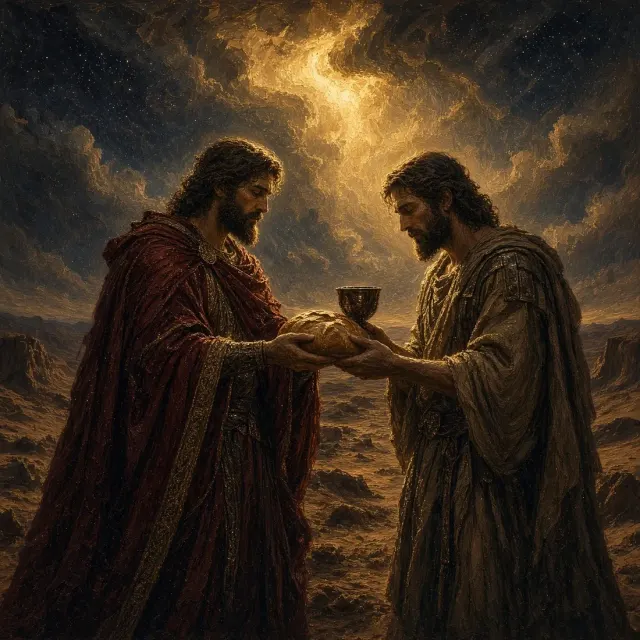
Melchizedek appears once, in the valley outside Salem, as Abram returns from defeating the four kings who had carried off Lot. He is king of Salem and priest of the most high God, and he brings out bread and wine and blesses Abram, and blesses the most high God who has delivered Abram's enemies into his hand. Abram gives him a tenth of everything. Then he is gone. Genesis does not say where he came from, who his parents were, or what became of him.

A thousand years later a psalm of David swears by the LORD that the king it addresses is a priest for ever after the order of Melchizedek. And a thousand years after that, the letter to the Hebrews builds its account of Jesus as high priest on those two texts. Melchizedek's name means king of righteousness, his city means peace, and the silence of Genesis about his birth and death is read as a picture of a priesthood that does not depend on descent and does not end. Abraham paid him tithes, so Levi, still in Abraham's loins, paid them too, and the priest of a greater order was there before the law that made priests.

Where he appearsGenesis 14

Scroll down to the account
Melchizedek

The movements, in the order the text gives them.

The Account of Melchizedek

  1. 01

    Genesis 14:17-18

    The king who came out to meet him

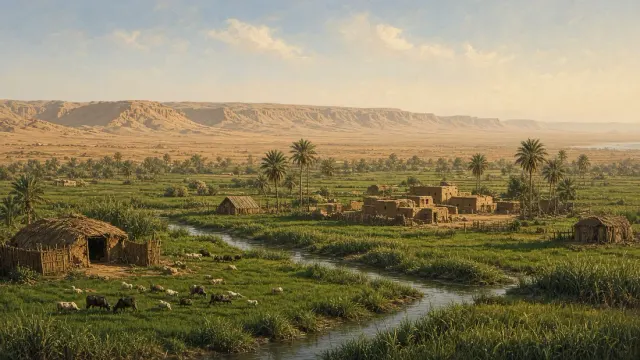
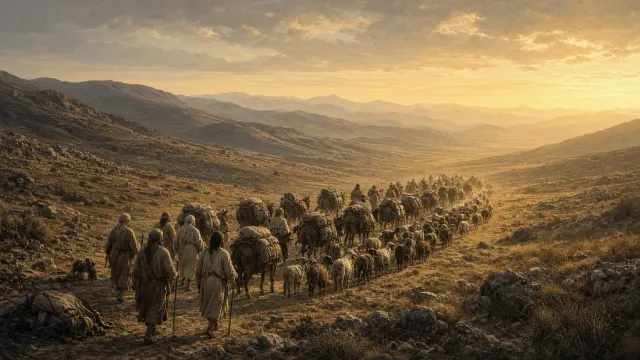
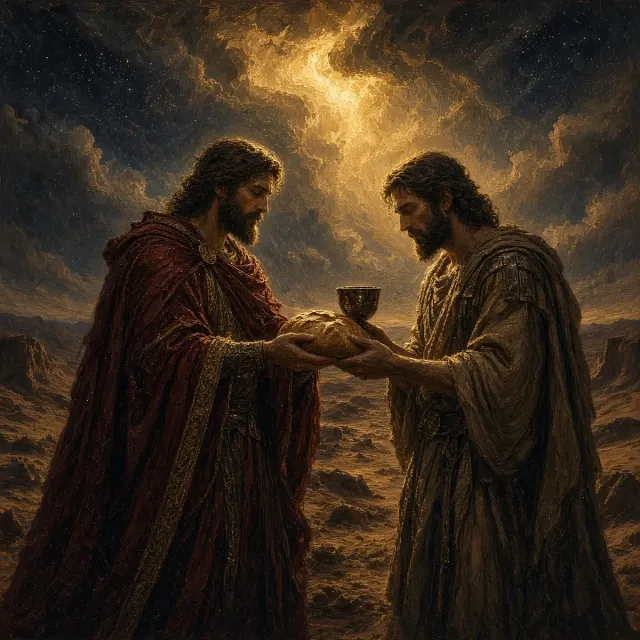
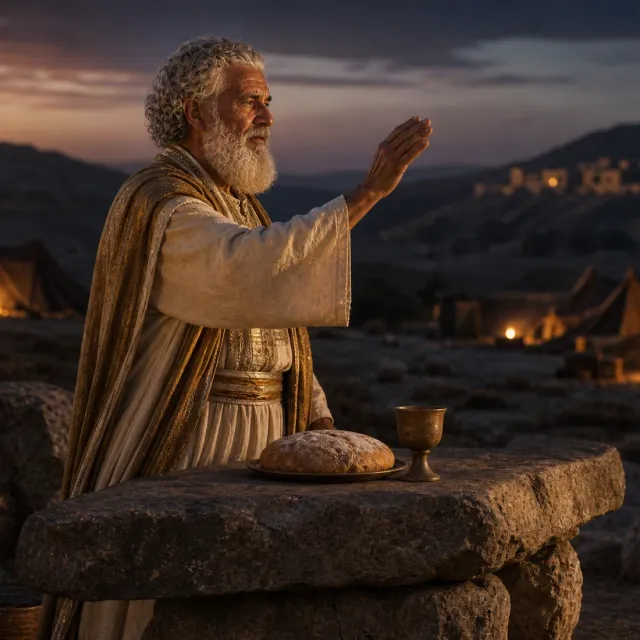
    As Abram returns from the slaughter of Chedorlaomer and the kings with him, the king of Sodom goes out to meet him in the valley of Shaveh, the king's dale. Melchizedek king of Salem brings out bread and wine; he is the priest of the most high God.

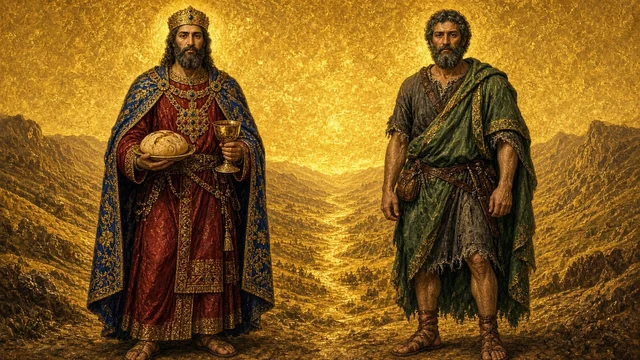
    Two kings come out to meet Abram on the same road, and the Book of Genesis sets them side by side on purpose. The king of Sodom comes to bargain. Melchizedek king of Salem brought forth bread and wine. He arrives with provision rather than a proposal, and the verse adds the detail everything else depends on: he was the priest of the most high God. This is the first priest named in the Bible, and he is not an Israelite, not a descendant of Abram, and not part of any covenant yet made. Salem is almost certainly Jerusalem, which Psalm 76:2 names in the same short form. A Canaanite city already has a priest who serves the God Abram serves, and Abram meets him without surprise.

    Verse by verse

    1. 14:17

      The king's dale: near Jerusalem, where Absalom later sets up his pillar, 2 Samuel 18:18. The two kings meet Abram in the same valley.

    2. 14:18

      Melchizedek: king of righteousness. Salem: peace, and the short form of Jerusalem used in Psalm 76:2.

    3. 14:18

      Bread and wine: a meal for returning soldiers. Christian readers have seen more in it since the earliest centuries; the verse itself says only what it says.

    4. 14:18

      The most high God: El Elyon. Abram uses the same title back in verse 22, joined to the covenant name, the LORD.

    Genesis 14:17-18

    King James Version · 2 verses

    14:17And the king of Sodom went out to meet him after his return from the slaughter of Chedorlaomer, and of the kings that were with him, at the valley of Shaveh, which is the king’s dale.

    14:18And Melchizedek king of Salem brought forth bread and wine: and he was the priest of the most high God.

    Genesis 14:17-18: The king who came out to meet him
  2. 02

    Genesis 14:19-20

    The blessing and the tenth

    He blesses Abram: blessed be Abram of the most high God, possessor of heaven and earth, and blessed be the most high God, who has delivered your enemies into your hand. And Abram gives him a tenth of all.

    The blessing runs in two directions, and both matter. Blessed be Abram of the most high God, possessor of heaven and earth, and then blessed be the most high God, which hath delivered thine enemies into thy hand. Melchizedek blesses the man and credits the victory to God in the same breath, so the blessing is not flattery of a returning general. Then four words with no explanation attached: and he gave him tithes of all. A tenth, given by Abram to this priest, four hundred years before the law that will command tithes and centuries before a Levite exists. Genesis does not tell us why Abram did it. It simply records that he did, and the writer of Hebrews will build an argument on it.

    Verse by verse

    1. 14:19

      Possessor of heaven and earth: the title claims everything, which is why Abram can afford to refuse Sodom in verse 23.

    2. 14:20

      He gave him tithes of all: the first tithe in Scripture, given freely and before any law required it. Jacob promises one in 28:22.

    Genesis 14:19-20

    King James Version · 2 verses

    14:19And he blessed him, and said, Blessed be Abram of the most high God, possessor of heaven and earth:

    14:20And blessed be the most high God, which hath delivered thine enemies into thy hand. And he gave him tithes of all.

    Genesis 14:19-20: The blessing and the tenth
  3. 03

    Genesis 14:21-24

    Set against the king of Sodom

    The king of Sodom offers Abram the goods if he may keep the people. Abram swears by the LORD, the most high God, possessor of heaven and earth, using Melchizedek's title, that he will not take so much as a thread, lest the king say he made Abram rich. One king he tithed to; the other he refused.

    The two kings are answered differently, and the contrast is the point of the scene. Sodom offers a deal, keep the goods and give me the people. Abram refuses everything down to a thread and a shoelatchet, and gives his reason: lest thou shouldest say, I have made Abram rich. He has just sworn by the LORD, the most high God, the possessor of heaven and earth, which is Melchizedek's own title for God picked up and joined to the covenant name. Abram takes nothing from the king who has something to gain by giving, and gives a tenth to the priest who asked for nothing. He is careful to protect his men's share while refusing his own, which keeps the refusal from costing anyone but himself.

    Verse by verse

    1. 14:22

      I have lift up mine hand: the gesture of an oath. Abram borrows Melchizedek's title for God and adds the covenant name to it.

    2. 14:23

      From a thread even to a shoelatchet: the smallest things a man could carry off, named so the refusal cannot be argued with.

    3. 14:24

      Let them take their portion: Aner, Eshcol and Mamre are not bound by Abram's vow. He refuses for himself only.

    Genesis 14:21-24

    King James Version · 4 verses

    14:21And the king of Sodom said unto Abram, Give me the persons, and take the goods to thyself.

    14:22And Abram said to the king of Sodom, I have lift up mine hand unto the LORD, the most high God, the possessor of heaven and earth,

    14:23That I will not take from a thread even to a shoelatchet, and that I will not take any thing that is thine, lest thou shouldest say, I have made Abram rich:

    14:24Save only that which the young men have eaten, and the portion of the men which went with me, Aner, Eshcol, and Mamre; let them take their portion.

    Genesis 14:21-24: Set against the king of Sodom
  4. 04

    Psalm 110:4

    A priest for ever

    In a psalm of David the LORD says to David's lord, sit at my right hand, and then swears and will not repent: thou art a priest for ever after the order of Melchizedek. A king of David's line is promised a priesthood that is not Aaron's.

    A thousand years later one verse in a psalm of David pulls this forgotten priest back into the centre of Scripture. The LORD hath sworn, and will not repent, Thou art a priest for ever after the order of Melchizedek. The psalm is addressed to a king, and it promises him a priesthood, which under the law was impossible: kings came from Judah and priests from Levi, and the two offices were kept apart so firmly that Uzziah was struck with leprosy for crossing the line. So the verse points past every king David knew. It is sworn rather than merely said, and it says for ever, and it names an order older than Aaron's and outside Israel altogether. This single verse is quoted or alluded to more often in the New Testament than almost any other.

    Verse by verse

    1. 110:4

      The LORD hath sworn, and will not repent: an oath, which Hebrews 7:20-21 makes the whole weight of its argument.

    2. 110:4

      Priest and king together: forbidden under the law. 2 Chronicles 26:16-21 shows what happened when Uzziah tried it.

    3. 110:4

      After the order of: in the manner of, not descended from. Melchizedek has no successors to belong to.

    Psalm 110:4

    King James Version · 1 verse

    110:4The LORD hath sworn, and will not repent, Thou art a priest for ever after the order of Melchizedek.

    Psalm 110:4: A priest for ever
  5. 05

    Hebrews 5:5-10

    Called of God, as was Aaron

    Christ did not glorify himself to be made high priest, but was called, as the psalm says: thou art a priest for ever after the order of Melchisedec. Having learned obedience by suffering, he became the author of eternal salvation, called of God a high priest after that order.

    The letter has been arguing that a high priest does not appoint himself, and it applies that to Christ first: so also Christ glorified not himself to be made an high priest. The appointment is quoted from two psalms, Psalm 2 for the sonship and Psalm 110 for the priesthood, and the two are set beside each other as one calling. Then the letter does something a reader can miss in an argument about offices: it describes the man. In the days of his flesh, prayers and supplications with strong crying and tears, and was heard in that he feared. Though he were a Son, yet learned he obedience by the things which he suffered. The priesthood being claimed is not a title held at a distance. It was learned in the place where the people it serves live.

    Verse by verse

    1. 5:5

      Thou art my Son: Psalm 2:7. The sonship and the priesthood are quoted together as one appointment.

    2. 5:7

      Strong crying and tears: Gethsemane, and the whole of a life lived under pressure. Heard in that he feared: heard because of his reverence.

    3. 5:8

      Learned he obedience: not learned to be obedient, but learned what obedience costs, by paying it.

    4. 5:10

      Called of God: the same word used of Aaron in verse 4. The office is given, never taken.

    Hebrews 5:5-10

    King James Version · 6 verses

    5:5So also Christ glorified not himself to be made an high priest; but he that said unto him, Thou art my Son, to day have I begotten thee.

    5:6As he saith also in another place, Thou art a priest for ever after the order of Melchisedec.

    5:7Who in the days of his flesh, when he had offered up prayers and supplications with strong crying and tears unto him that was able to save him from death, and was heard in that he feared;

    5:8Though he were a Son, yet learned he obedience by the things which he suffered;

    5:9And being made perfect, he became the author of eternal salvation unto all them that obey him;

    5:10Called of God an high priest after the order of Melchisedec.

    Hebrews 5:5-10: Called of God, as was Aaron
  6. 06

    Hebrews 7:1-3

    Without father, without mother

    The writer retells Genesis 14 and interprets the name and the city: king of righteousness, king of peace. Then the silence: without father, without mother, without descent, having neither beginning of days nor end of life, but made like unto the Son of God, he abides a priest continually.

    The letter reads the Genesis account closely, and part of its reading is about what Genesis does not say. First being by interpretation King of righteousness, and after that also King of Salem, which is, King of peace: the names are translated, because in Hebrew they mean those things. Then the famous line: without father, without mother, without descent, having neither beginning of days, nor end of life. In a book that records genealogies for nearly everyone, Melchizedek appears with none. No parents, no tribe, no birth, no death. The letter is arguing from the silence of the record, not claiming that a man walked the earth without parents, and that is how the earliest readers understood it. The silence makes him a fitting picture: made like unto the Son of God, abideth a priest continually.

    Verse by verse

    1. 7:2

      King of righteousness, King of peace: the Hebrew meaning of his name and his city, in that order, which is also the order of the gospel.

    2. 7:3

      Without descent: without a recorded genealogy. Genesis gives lineages for almost everyone and gives him none.

    3. 7:3

      Made like unto the Son of God: the resemblance runs this way round. Melchizedek is the picture, not the original.

    Hebrews 7:1-3

    King James Version · 3 verses

    7:1For this Melchisedec, king of Salem, priest of the most high God, who met Abraham returning from the slaughter of the kings, and blessed him;

    7:2To whom also Abraham gave a tenth part of all; first being by interpretation King of righteousness, and after that also King of Salem, which is, King of peace;

    7:3Without father, without mother, without descent, having neither beginning of days, nor end of life; but made like unto the Son of God; abideth a priest continually.

    Hebrews 7:1-3: Without father, without mother
  7. 07

    Hebrews 7:4-10

    Levi paid tithes in Abraham

    Consider how great this man was, to whom the patriarch Abraham gave a tenth. The lesser is blessed by the greater. Levi, who receives tithes, paid tithes through Abraham, being yet in the loins of his father when Melchizedek met him.

    Now consider how great this man was. The argument is built on two ordinary customs. First, the lesser is blessed by the greater, and Melchizedek blessed Abraham, who held the promises. Second, tithes are paid to a superior, and Abraham paid them. Then the step that decides everything: Levi also, who receiveth tithes, payed tithes in Abraham, for he was yet in the loins of his father when Melchisedec met him. The priestly tribe, not yet born, is counted as present in its ancestor, which is how the Bible ordinarily thinks about a family. If Levi paid, then the priesthood Levi would found is the junior of the two. The writer even flags his own move, and as I may so say, because he knows how much weight he is putting on it.

    Verse by verse

    1. 7:5

      Sons of Levi take tithes of their brethren: within the family, from equals. Melchizedek took from outside it.

    2. 7:7

      The less is blessed of the better: the rule everyone accepted, applied to a scene everyone knew.

    3. 7:8

      Of whom it is witnessed that he liveth: the record reports no death, and the argument uses the silence.

    4. 7:9

      As I may so say: the writer marks this as a way of speaking, aware that it is an argument and not a proof.

    Hebrews 7:4-10

    King James Version · 7 verses

    7:4Now consider how great this man was, unto whom even the patriarch Abraham gave the tenth of the spoils.

    7:5And verily they that are of the sons of Levi, who receive the office of the priesthood, have a commandment to take tithes of the people according to the law, that is, of their brethren, though they come out of the loins of Abraham:

    7:6But he whose descent is not counted from them received tithes of Abraham, and blessed him that had the promises.

    7:7And without all contradiction the less is blessed of the better.

    7:8And here men that die receive tithes; but there he receiveth them, of whom it is witnessed that he liveth.

    7:9And as I may so say, Levi also, who receiveth tithes, payed tithes in Abraham.

    7:10For he was yet in the loins of his father, when Melchisedec met him.

    Hebrews 7:4-10: Levi paid tithes in Abraham
  8. 08

    Hebrews 7:11-28

    The power of an endless life

    If perfection came by the Levitical priesthood, why another priest after the order of Melchizedek? The priesthood changed, so the law changed. Our Lord sprang from Judah, of which Moses said nothing about priests. He is made a priest not by the law of a carnal commandment but by the power of an endless life, with an oath, and because he continues for ever he has an unchangeable priesthood and is able to save to the uttermost.

    The conclusion follows from the oath. If perfection were by the Levitical priesthood, no second order would have been needed, and Psalm 110 would not have been written. Since it was, the priesthood has changed, and there is made of necessity a change also of the law, because the two were issued together. The objection that Jesus came from Judah, of which tribe Moses spake nothing concerning priesthood, is answered by the same psalm: this priest is made not after the law of a carnal commandment, but after the power of an endless life. Death is what limited the old priests, and they truly were many priests, because they were not suffered to continue by reason of death. This one continueth ever, and the practical result closes the chapter. He is able to save them to the uttermost that come unto God by him, seeing he ever liveth to make intercession for them. The sacrifice is offered once, and the priest who offered it does not have to be replaced.

    Verse by verse

    1. 7:12

      The priesthood being changed: law and priesthood came as one system, so altering one alters the other. This is the letter's boldest claim.

    2. 7:14

      Our Lord sprang out of Juda: the tribe of kings, not priests. Melchizedek is what makes the combination lawful.

    3. 7:16

      The power of an endless life: the qualification is life itself rather than descent, which is why no genealogy is needed.

    4. 7:25

      Save them to the uttermost: completely, and to the end. The reason given is not the sacrifice but that he ever liveth.

    5. 7:27

      Once, when he offered up himself: the priest and the offering are the same person, which no Levite could be.

    Hebrews 7:11-28: The power of an endless life

    Hebrews 7:11-28

    King James Version · 18 verses

    7:11If therefore perfection were by the Levitical priesthood, (for under it the people received the law,) what further need was there that another priest should rise after the order of Melchisedec, and not be called after the order of Aaron?

    7:12For the priesthood being changed, there is made of necessity a change also of the law.

    7:13For he of whom these things are spoken pertaineth to another tribe, of which no man gave attendance at the altar.

    7:14For it is evident that our Lord sprang out of Juda; of which tribe Moses spake nothing concerning priesthood.

    7:15And it is yet far more evident: for that after the similitude of Melchisedec there ariseth another priest,

    7:16Who is made, not after the law of a carnal commandment, but after the power of an endless life.

    7:17For he testifieth, Thou art a priest for ever after the order of Melchisedec.

    7:18For there is verily a disannulling of the commandment going before for the weakness and unprofitableness thereof.

    7:19For the law made nothing perfect, but the bringing in of a better hope did; by the which we draw nigh unto God.

    7:20And inasmuch as not without an oath he was made priest:

    7:21(For those priests were made without an oath; but this with an oath by him that said unto him, The Lord sware and will not repent, Thou art a priest for ever after the order of Melchisedec:)

    7:22By so much was Jesus made a surety of a better testament.

    7:23And they truly were many priests, because they were not suffered to continue by reason of death:

    7:24But this man, because he continueth ever, hath an unchangeable priesthood.

    7:25Wherefore he is able also to save them to the uttermost that come unto God by him, seeing he ever liveth to make intercession for them.

    7:26For such an high priest became us, who is holy, harmless, undefiled, separate from sinners, and made higher than the heavens;

    7:27Who needeth not daily, as those high priests, to offer up sacrifice, first for his own sins, and then for the people’s: for this he did once, when he offered up himself.

    7:28For the law maketh men high priests which have infirmity; but the word of the oath, which was since the law, maketh the Son, who is consecrated for evermore.

The people, the places and the rest of Scripture.

Reading Melchizedek closely

The people he dealt with

He deals with one man, Abram, and the meeting is over in four verses. He comes out of his city with bread and wine, which is either provision for a tired army or a sacred meal, and readers have taken it both ways. He blesses Abram in the name of the most high God, El Elyon, possessor of heaven and earth, and blesses that God for the victory, and Abram accepts both the blessing and the priesthood behind it by giving him a tenth of all the spoil.

The scene is built as a contrast. Two kings meet Abram in the valley. The king of Sodom, whom Abram has just rescued, offers a deal and is refused with an oath sworn in Melchizedek's own words for God. The king of Salem offers a blessing and is given a tithe. Abram's next act, in Genesis 15, is to ask God what he can be given when he has no heir, and God's answer begins the covenant. Melchizedek's blessing stands at the door of that chapter.

His other relationships are with people he never met. Levi, according to Hebrews, paid him tithes while still in Abraham's body. David's lord is made a priest after his order. And the Son of God, the letter says, is made like unto him, or rather he is made like unto the Son, a priest continually.

Genesis 14

Who he was

Genesis gives him a name, a city, a title and a God, and nothing else. Salem is almost certainly Jerusalem, which Psalm 76 calls Salem, so that the first priest of the most high God in Scripture is king of the city where the temple will stand. His God, the most high God, possessor of heaven and earth, is identified by Abram in the next breath with the LORD, so the text presents him as a true worshipper outside the line of promise, a Canaanite king who knew God.

Jewish tradition identified him with Shem, Noah's son, who by the numbers of Genesis was still alive in Abraham's day. Others have taken him as an angel or as a pre-incarnate appearance of Christ, reading Hebrews 7:3 literally. The letter itself is careful: he was made like unto the Son of God, which is a likeness rather than an identity, and the likeness lies in what the text does not say. Genesis records a father, a birth and a death for everyone who matters, and for Melchizedek records none, so that on the page he simply is, and remains, a priest.

What came before and what followed

Before him there is no priesthood in the Bible. Noah builds an altar and Abram builds altars, but no one is called a priest until Melchizedek. He precedes the covenant with Abraham, the law of Moses, the tribe of Levi and the house of Aaron, and that order is the whole of Hebrews' argument: a priesthood that came first and was sworn by oath outranks one that came later and was given by law.

After him the name sleeps for a thousand years and wakes in Psalm 110, where a king of Judah is told he is a priest of Melchizedek's order. The kings of Judah never served at the altar, and Uzziah was struck with leprosy for trying, so the psalm was read as a promise about the coming king. Hebrews takes it as fulfilled in Jesus, who has passed into the heavens as a forerunner, made a high priest for ever after the order of Melchizedek.

Where the rest of Scripture reaches back

Psalm 110 is quoted in the New Testament more than any other psalm, by Jesus about himself, by Peter at Pentecost, and by Paul, and its fourth verse is the ground of Hebrews. The letter names Melchizedek nine times across chapters 5, 6 and 7 and nowhere else in the New Testament is he mentioned.

The argument runs in steps. Christ was called a priest after Melchizedek's order, not Aaron's. Melchizedek was greater than Abraham, since Abraham paid him tithes and was blessed by him, and therefore greater than Levi, Abraham's descendant. A priesthood after his order was promised by oath after the law was given, so the law's priesthood was never final. Christ, from Judah, holds this priesthood by an endless life, and so, unlike the many priests who died, he has an unchangeable priesthood and ever lives to make intercession. The whole doctrine of Christ as priest rests on a king who came out of Salem with bread and wine.

Why it matters

Melchizedek is the Bible's way of saying that God had a priest before he had a people. He worships the most high God, possessor of heaven and earth, outside Abraham's family and before any covenant, and Abraham recognises him and pays him a tenth. In Genesis he is the first priest named in Scripture and the first person to bless Abraham.

His lasting importance is in Psalm 110 and Hebrews. The psalm attaches to David's line a priesthood older than Aaron's and sealed by God's oath, and Hebrews 5 to 7 uses that to explain how Jesus, from Judah rather than Levi, can be a priest at all: not by the law of a carnal commandment, but by the power of an endless life. Every point the letter makes about Christ's priesthood, that it is superior, permanent, royal, and confirmed by oath, is drawn from a man who is on the page for three verses and brings bread and wine.

1 song

The music

Every song in the catalogue whose passage falls inside these chapters.

  1. Genesis 14:1-24

    Blessed Be Abram of the Most High God

Nearby

All the people

Report an error on this page