New · FreePlay The Witnesses The in-depth puzzle battle quest through Bible history

People of the Bible

Philip the evangelist

Took the message to the people Jerusalem would not speak to, then left a crowd to meet one man on a desert road.

Also called One of the seven

He is not the apostle Philip. This is one of the seven chosen with Stephen to handle the food distribution, and the persecution that follows Stephen’s death is what puts him on the road. He goes down to the city of Samaria, which is the last place a Jerusalem believer would choose, and preaches Christ there. The response is a revival: unclean spirits crying out, palsied and lame people healed, and great joy in that city.

Where he appearsActs 8 · Acts 21

Scroll down to the account
Philip the evangelist

The movements, in the order the text gives them.

The Account of Philip the evangelist

  1. 01

    Acts 8:5-8

    He preached Christ unto them

    Scattered by the persecution, he goes to Samaria rather than away from trouble. The city that Jews had no dealings with receives the word with great joy.

    Jerusalem's persecution has sent a preacher into Samaria, not silenced him. That is the geographical force of these four verses. Acts 1:8 named Samaria as a field of witness; Acts 8 places Philip there through the scattering that followed Stephen's death. The movement is real, but it does not make the persecution harmless. The same chapter can contain devastated households in Jerusalem and great joy in another city.

    Philip preaches Christ, not his own unusual career. The people attend to what he says while hearing and seeing the signs, so speech and healing belong together rather than competing for the crowd. The cries of departing unclean spirits and the restoration of disabled people give the concluding joy its physical setting. It is not merely a change in public opinion. Bodies that carried suffering are being relieved. Nor does the account require Jerusalem's apostles to be present before Philip can begin. Peter and John arrive afterward in 8:14, responding to news that Samaria has received the word. The message has crossed the boundary before the delegation crosses it.

    Verse by verse

    1. 8:5

      Acts 21:8 identifies this Philip as one of the seven appointed in Acts 6, distinguishing him from the apostle of the same name.

    2. 8:6

      The passage links attention to Philip's words with hearing and seeing the signs. It does not describe healing as a substitute for proclamation.

    3. 8:8

      The city's joy is repeated on an individual scale when the Ethiopian traveler continues rejoicing in Acts 8:39.
    Acts 8:5-8

    King James Version · 4 verses

    8:5Then Philip went down to the city of Samaria, and preached Christ unto them.

    8:6And the people with one accord gave heed unto those things which Philip spake, hearing and seeing the miracles which he did.

    8:7For unclean spirits, crying with loud voice, came out of many that were possessed with them: and many taken with palsies, and that were lame, were healed.

    8:8And there was great joy in that city.

    Acts 8:5-8: He preached Christ unto them
  2. 02

    Acts 8:26-29

    Go toward the south, which is desert

    He is pulled out of a successful mission and sent to an empty road. The instruction gives no reason and he goes.

    The instructions give Philip a road before they give him a person. Nothing in the angel's message announces a royal official, an open passage of Isaiah, or a baptism. Philip receives the next movement, makes it, and only then receives the direction to join the chariot. The encounter is arranged in stages. An impressive destination is not offered as the inducement to go.

    The traveler arrives with enough description to establish both importance and distance: Ethiopian, eunuch, holder of great authority, keeper of the queen's treasure, returning from worship in Jerusalem. Yet his personal name is not supplied. His position can command a treasury and a vehicle; it cannot make the page explain itself. The mention of Isaiah prepares a different kind of authority from the one he exercises at court. Philip, meanwhile, has been speaking to crowds, but this instruction concerns a single chariot. Acts does not rank the solitary meeting below the citywide response. It places both under divine direction. The scale changes sharply. The subject of the message does not.

    Verse by verse

    1. 8:26

      "Which is desert" has been understood of the road or the locality. The verse does not identify an exact modern meeting point.

    2. 8:27

      The official's name is not recorded. Candace is associated with the queen in the sentence, not presented as the eunuch's name.

    3. 8:29

      The angel directs Philip toward the road in 8:26; the Spirit directs him toward this chariot in 8:29. The text distinguishes the two instructions.

    Acts 8:26-29

    King James Version · 4 verses

    8:26And the angel of the Lord spake unto Philip, saying, Arise, and go toward the south unto the way that goeth down from Jerusalem unto Gaza, which is desert.

    8:27And he arose and went: and, behold, a man of Ethiopia, an eunuch of great authority under Candace queen of the Ethiopians, who had the charge of all her treasure, and had come to Jerusalem for to worship,

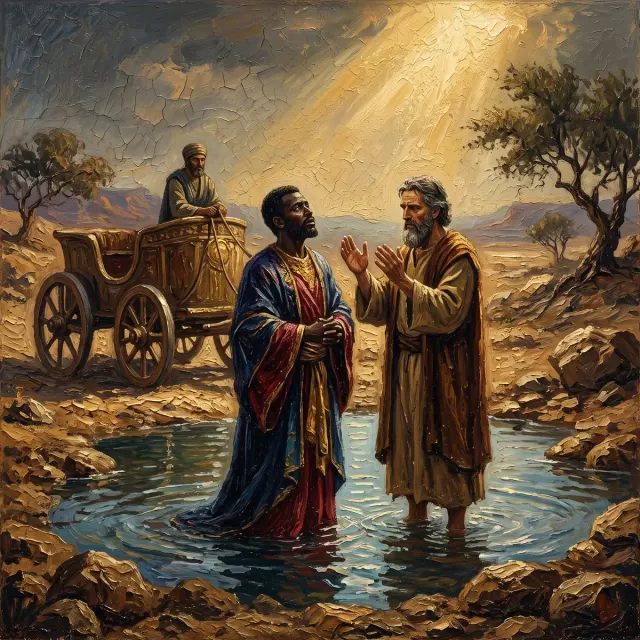
    8:28Was returning, and sitting in his chariot read Esaias the prophet.

    8:29Then the Spirit said unto Philip, Go near, and join thyself to this chariot.

    Acts 8:26-29: Go toward the south, which is desert
  3. 03

    Acts 8:30-35

    Understandest thou what thou readest

    The man is reading about a lamb before its shearers and asks whether the prophet means himself or another. Philip begins at the same Scripture and preaches Jesus.

    The man with the treasury is willing to admit that he needs a guide. His difficulty is not sounding out the words. Philip hears him reading, and the question concerns their meaning. The exchange separates possession of a sacred text from understanding its subject without making the reader foolish. He asks the right question: the identity of the person undergoing the suffering. That is exactly where Philip begins.

    The quoted passage leaves the sufferer silent before those who destroy him. Philip opens his mouth to explain that silence, an unobtrusive but powerful change of voice. He begins at the same scripture and preaches Jesus, so the explanation grows from the passage rather than abandoning it for an unrelated message. The Book of Acts preserves the starting point and the conclusion, not the intervening lesson word for word. That restraint matters. It permits the claim that Philip identified the suffering figure with Jesus; it does not permit reconstructing every cross-reference he used. A court official and a displaced preacher sit beside the same text. Rank supplies neither the question's answer nor an obstacle to receiving one.

    Verse by verse

    1. 8:30

      The Greek places related words for knowing and reading together: ginoskeis and anaginoskeis. The question distinguishes reading the words from grasping them.

    2. 8:32-33

      The quotation follows the Greek form of Isaiah 53:7-8, which explains differences from the wording of Isaiah in the KJV. It is not a careless quotation of the KJV's English.

    3. 8:34

      The eunuch asks whether the prophet speaks about himself or another person. Acts records a genuine interpretive question, not ignorance of which book he is reading.

    4. 8:35

      "Began at the same scripture" identifies Philip's point of departure. Acts does not preserve a complete transcript of his explanation.

    Acts 8:30-35

    King James Version · 6 verses

    8:30And Philip ran thither to him, and heard him read the prophet Esaias, and said, Understandest thou what thou readest?

    8:31And he said, How can I, except some man should guide me? And he desired Philip that he would come up and sit with him.

    8:32The place of the scripture which he read was this, He was led as a sheep to the slaughter; and like a lamb dumb before his shearer, so opened he not his mouth:

    8:33In his humiliation his judgment was taken away: and who shall declare his generation? for his life is taken from the earth.

    8:34And the eunuch answered Philip, and said, I pray thee, of whom speaketh the prophet this? of himself, or of some other man?

    8:35Then Philip opened his mouth, and began at the same scripture, and preached unto him Jesus.

    Acts 8:30-35: Understandest thou what thou readest
  4. 04

    Acts 8:36-39

    See, here is water

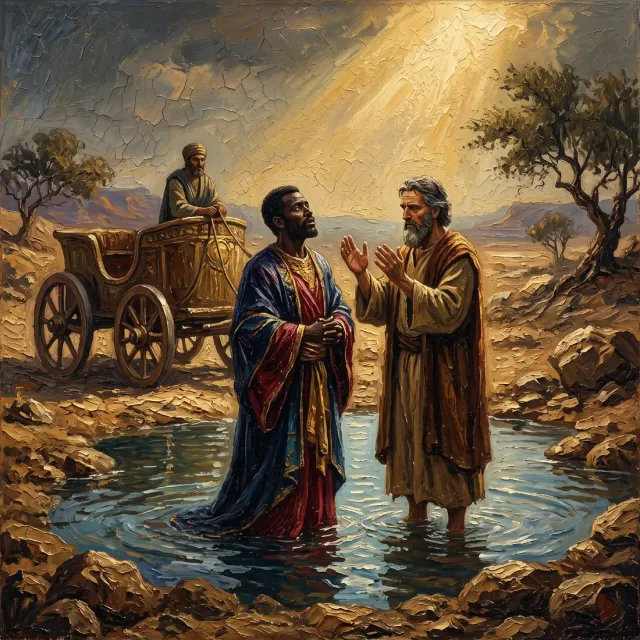
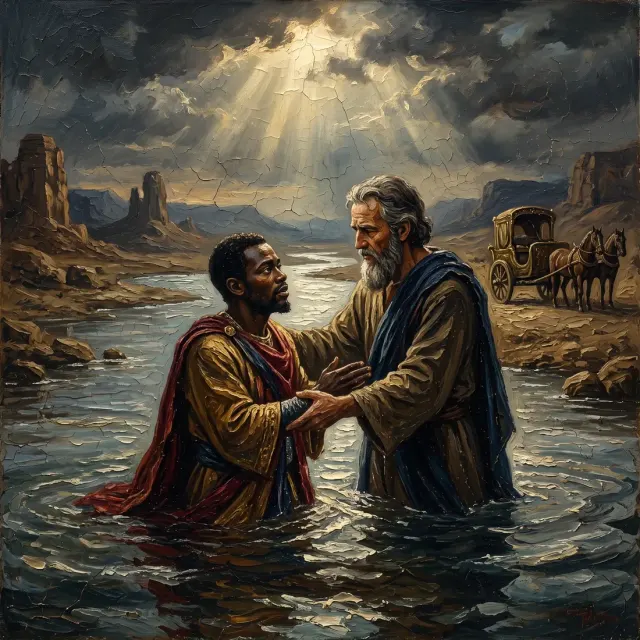
    The question comes from the man in the chariot, not from Philip. They go down into the water, and then the Spirit catches Philip away.

    The request for baptism comes from the traveler. Philip has explained Jesus, and the man now sees water as an opportunity for a response rather than another feature of the road. In the KJV's wording, his confession names Jesus Christ as the Son of God. The answer to the question about Isaiah's sufferer has become a confession about Jesus' identity. The passage does not treat understanding as merely the successful completion of a reading exercise.

    Both men go down into the water. The emphasis on both makes the action concrete without supplying the full physical procedure, and the account names Philip as the one who baptizes. Then the Spirit takes Philip away. The departure is abrupt, but it does not leave the traveler described as bereft or searching for his teacher. He continues rejoicing. The same chapter that gave a whole Samaritan city joy gives this unnamed man the same closing note. Philip's presence has served its purpose without becoming the object of attachment. The man continues his journey with the message, although the messenger is gone.

    Verse by verse

    1. 8:36

      The traveler raises baptism after Philip's explanation of Jesus. Acts does not record the entire explanation or how baptism entered it.

    2. 8:37

      This verse is retained in the KJV and its Textus Receptus base, but omitted in several critical Greek editions. The supplied KJV text preserves it unchanged.

    3. 8:38

      Both Philip and the eunuch enter the water. The verse explicitly identifies the baptizer and recipient without describing every movement of the rite.

    4. 8:39

      The Spirit's removal of Philip and the eunuch's continuing joy are both stated. Acts 8:40 next places Philip at Azotus; it does not trace the eunuch's later career.

    Acts 8:36-39

    King James Version · 4 verses

    8:36And as they went on their way, they came unto a certain water: and the eunuch said, See, here is water; what doth hinder me to be baptized?

    8:37And Philip said, If thou believest with all thine heart, thou mayest. And he answered and said, I believe that Jesus Christ is the Son of God.

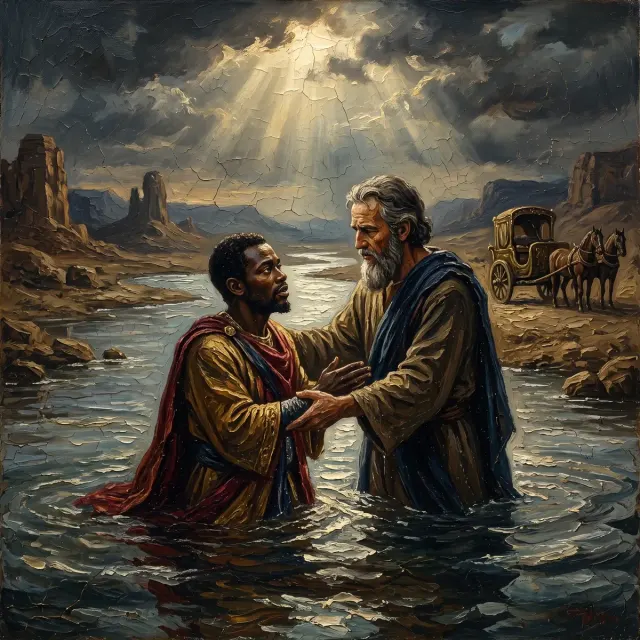
    8:38And he commanded the chariot to stand still: and they went down both into the water, both Philip and the eunuch; and he baptized him.

    8:39And when they were come up out of the water, the Spirit of the Lord caught away Philip, that the eunuch saw him no more: and he went on his way rejoicing.

    Acts 8:36-39: See, here is water
  5. 05

    Acts 21:8-9

    Philip the evangelist, one of the seven

    Twenty years later Luke stays in his house at Caesarea and gives him a title and four daughters who prophesied. He is still where the road left him.

    The householder in Caesarea is still identified by a decision made in Jerusalem years earlier: one of the seven. Acts has not traded that original service for a more impressive identity. Evangelist is added; the seven are not erased. The short notice joins the man who served a vulnerable community, preached in Samaria, and met a traveler on the road to the host who now gives Paul's company a place to stay.

    That guest list carries its own weight. Saul's persecution stood behind the scattering in Acts 8, and Paul now lodges in Philip's house. The text supplies no private conversation about Stephen, no account of their first meeting, and no speech of reconciliation. The hospitality itself is recorded. Four unmarried daughters also prophesy in this household. Their gift is stated plainly rather than explained away, but no particular prophecy of theirs is preserved here. The named warning about Paul's future belongs to Agabus in the following verses. These two verses are small in space, not in reach: an old appointment, continuing proclamation, hospitality across a transformed history, and prophetic speech in the next generation.

    Verse by verse

    1. 21:8

      The phrase "one of the seven" points back to Acts 6:5. It keeps this Philip distinct from the member of the Twelve bearing the same name.

    2. 21:9

      Acts 2:17 names daughters among those who will prophesy, echoing Joel. Acts 21:9 records the gift in Philip's daughters but provides neither their names nor the words of their prophecies.

    Acts 21:8-9

    King James Version · 2 verses

    21:8And the next day we that were of Paul’s company departed, and came unto Cæsarea: and we entered into the house of Philip the evangelist, which was one of the seven; and abode with him.

    21:9And the same man had four daughters, virgins, which did prophesy.

    Acts 21:8-9: Philip the evangelist, one of the seven

Why it matters

Then the angel sends him away from it. Arise and go toward the south, unto the way that goes down from Jerusalem unto Gaza, which is desert. He finds one man in a chariot, an Ethiopian official reading Isaiah 53 aloud and getting nowhere, and runs alongside to ask whether he understands. The conversation begins at that Scripture and ends at water by the roadside. Then the Spirit takes Philip away and the eunuch sees him no more, and goes on his way rejoicing.

2 songs

The music

Every song in the catalogue whose passage falls inside these chapters.

  1. Acts 8:26-40

    What Doth Hinder Me to Be Baptized?

  2. Acts 8:26-40

    What Hindereth Me?

Nearby

All the people

Report an error on this page