New · FreePlay The Witnesses The in-depth puzzle battle quest through Bible history

People of the Bible

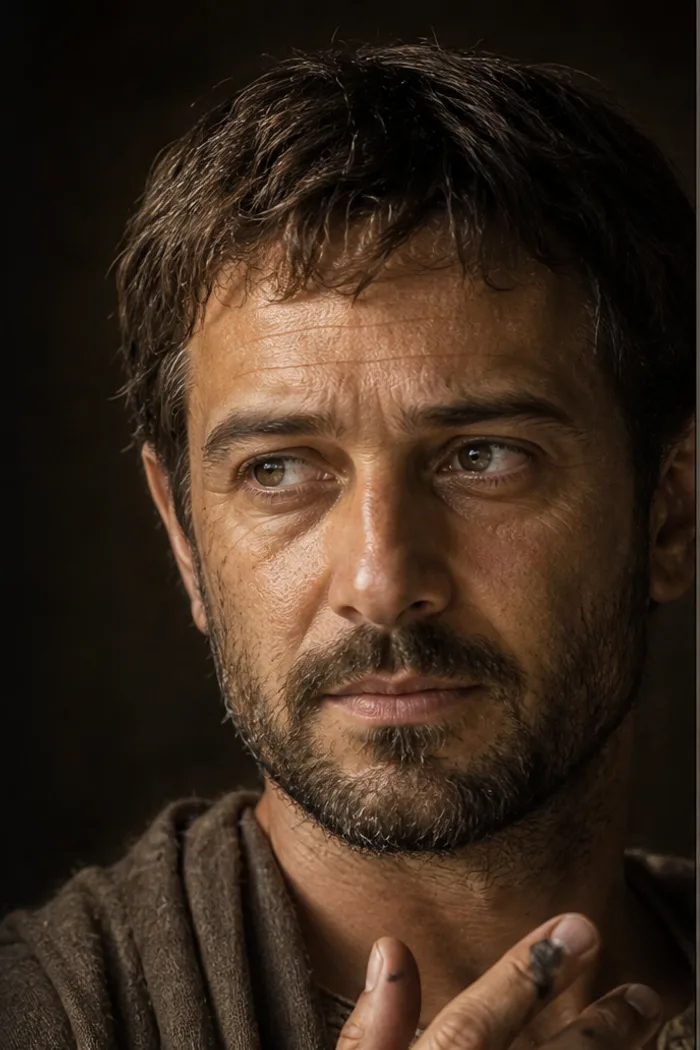
Philip

Answered an impossible question with a budget, and asked for the one thing he had been looking at for three years.

Philip is from Bethsaida, the same town as Andrew and Peter, and he is found rather than finding. The day after he is called he goes to Nathanael with a summary of the whole Old Testament and a town name that ruins it, and when the objection comes he does not argue. He appears three more times in John and each one is a question. He is the practical one, the man who counts, and the gospel uses him to ask what everyone is thinking.

Where he appearsJohn 1 · John 6 · John 12 · John 14

Scroll down to the account
Philip

The movements, in the order the text gives them.

The Account of Philip

  1. 01

    John 1:43-46

    Come and see

    He finds Nathanael and names Moses and the prophets and then says Jesus of Nazareth, the son of Joseph. The objection about Nazareth is met with three words rather than a defence.

    Philip announces a discovery, but the Gospel has already supplied the other side of it: Jesus found Philip first. His enthusiastic claim is not dismissed; it is placed inside a larger action. The man who has been found immediately finds Nathanael. The movement is wonderfully ordinary: one person tells another, and the news is large enough to send both back through Moses and the prophets.

    Then Nazareth lands in the sentence, and Nathanael's enthusiasm fails to arrive. Philip does not attempt a complete defense of the town. Come and see is both shorter and more appropriate than winning an argument about its reputation. He is inviting Nathanael to encounter a person, not asking him to revise a municipal ranking. The invitation also leaves room for examination. Philip does not demand that his own first description of Jesus settle every question. He knows enough to bring someone to him, even though the Gospel will show how much Philip himself still has to learn. His usefulness begins before his understanding is finished.

    Verse by verse

    1. 1:43

      Jesus gives Philip the direct summons "Follow me." No occupation or earlier meeting is supplied here.

    2. 1:44

      The apostle appears again in Acts 1:13. Acts 21:8 identifies Philip the evangelist as one of the seven, distinguishing that figure from this member of the Twelve.

    3. 1:45-46

      "Son of Joseph" is Philip's identification of Jesus by his known household. The invitation brings Nathanael to Jesus rather than claiming that this description is exhaustive.

    John 1:43-46

    King James Version · 4 verses

    1:43The day following Jesus would go forth into Galilee, and findeth Philip, and saith unto him, Follow me.

    1:44Now Philip was of Bethsaida, the city of Andrew and Peter.

    1:45Philip findeth Nathanael, and saith unto him, We have found him, of whom Moses in the law, and the prophets, did write, Jesus of Nazareth, the son of Joseph.

    1:46And Nathanael said unto him, Can there any good thing come out of Nazareth? Philip saith unto him, Come and see.

    John 1:43-46: Come and see
  2. 02

    John 6:5-7

    Two hundred pennyworth is not sufficient

    Asked where they shall buy bread, he answers with the cost rather than the source. John notes that the question was asked to prove him, and that Jesus knew what he would do.

    Jesus asks where bread can be bought; Philip answers with the size of the bill. The shift is revealing. Before identifying a bakery, he has established that even a large sum would not give everyone more than a little. His arithmetic is not the problem. It accurately exposes the inadequacy of the resources he is considering. Philip has priced the shortage very competently.

    The sentence in the middle prevents the conversation from being mistaken for an emergency planning meeting. Jesus already knows what he will do. To prove him means to test him, so the question uncovers Philip's understanding rather than supplying Jesus with missing information. That distinction gives the exchange its quiet irony: one participant is calculating the limits, while the other has already decided on the provision. The later contrast is exact, not merely decorative. Philip speaks of everyone taking a little; John 6:11-12 describes people receiving as much as they want and being filled. The small ration in the estimate is set beside the fullness of the meal.

    Verse by verse

    1. 6:5

      John 6:4 places the event near Passover. The later discussion in the chapter explicitly connects the bread with Moses and manna.

    2. 6:6

      Greek peirazo means test in this context. The statement that Jesus already knew his action rules out a request for information he lacked.

    3. 6:7

      The two hundred denarii are Philip's estimate of what would still be insufficient. The verse does not say that this sum was actually in the common purse.

    John 6:5-7

    King James Version · 3 verses

    6:5When Jesus then lifted up his eyes, and saw a great company come unto him, he saith unto Philip, Whence shall we buy bread, that these may eat?

    6:6And this he said to prove him: for he himself knew what he would do.

    6:7Philip answered him, Two hundred pennyworth of bread is not sufficient for them, that every one of them may take a little.

    John 6:5-7: Two hundred pennyworth is not sufficient
  3. 03

    John 12:20-22

    The Greeks who asked for him

    They come to Philip, probably because of his Greek name. He does not take them straight in; he tells Andrew, and the two go together.

    The visitors ask for Jesus, and Philip brings the request to Andrew. The Gospel does not explain the extra step. It does not say Philip is frightened, that Andrew outranks him, or that a language problem must be solved. What it records is cooperation: the two take the request together. Philip, who once brought Nathanael toward Jesus, is again involved when someone seeks access to him.

    The placement makes these three verses much larger than a detail about introductions. Just before the Greeks appear, the Pharisees complain that the world has gone after Jesus. The next people in view are not another local delegation. Then Jesus answers by announcing that his hour has come and speaking of grain that dies to bear much fruit. The Gospel does not pause to describe a private interview with the visitors; their arrival becomes the setting for words about death and its widening result. Philip stands at that junction without a speech of his own. A short message delivered with another disciple becomes part of a passage whose horizon reaches far beyond Galilee.

    Verse by verse

    1. 12:20

      The Greek word is Hellenes, "Greeks." The passage says they came to worship but does not specify whether they were fully converted proselytes.

    2. 12:21

      Philip's connection to Bethsaida is repeated from John 1:44. His Greek name does not establish what languages he spoke.

    3. 12:22

      The account records delivery of the request, not a completed private meeting. The following response begins with the arrival of Jesus' hour.

    John 12:20-22

    King James Version · 3 verses

    12:20And there were certain Greeks among them that came up to worship at the feast:

    12:21The same came therefore to Philip, which was of Bethsaida of Galilee, and desired him, saying, Sir, we would see Jesus.

    12:22Philip cometh and telleth Andrew: and again Andrew and Philip tell Jesus.

    John 12:20-22: The Greeks who asked for him
  4. 04

    John 14:8-11

    Show us the Father

    He asks for one more thing and says it will be enough. The answer is that he that has seen me has seen the Father, and the question folded into it is about how long they have been together.

    Philip asks for one thing that will be enough: a sight of the Father. The request sounds final and satisfying. Jesus' answer exposes the difficulty in it. Philip is treating the revelation of the Father as something still missing from his long companionship with the Son. The reply names him personally. This is not an abstract correction delivered over the disciples' heads; it reaches a man who has listened, traveled, and watched, yet has not understood what those experiences disclose.

    Jesus does not answer by producing a second figure beside himself. He directs attention to his words and works, and to the Father dwelling in him. Seeing the Father here is not simply comparing two faces. It is recognizing the Father's self-disclosure in the Son. At the same time, the language preserves their relation: the Son speaks, the Father dwells and works in him. The passage is stronger than the claim that Jesus is merely a helpful illustration of God, and more careful than saying Father and Son are interchangeable names with no distinction. Philip asks for an additional revelation. Jesus points to the revelation already standing before him.

    Verse by verse

    1. 14:8

      The request follows Jesus' statement in John 14:7 that knowing him means knowing the Father. Philip asks for a demonstration beyond that claim.

    2. 14:9

      "So long time" does not give an exact number of years. A precise duration should not be inserted into the verse.

    3. 14:10-11

      Words and works are offered as evidence of the Father's presence in the Son. The passage distinguishes their relationship while insisting on its unity.

    John 14:8-11

    King James Version · 4 verses

    14:8Philip saith unto him, Lord, shew us the Father, and it sufficeth us.

    14:9Jesus saith unto him, Have I been so long time with you, and yet hast thou not known me, Philip? he that hath seen me hath seen the Father; and how sayest thou then, Shew us the Father?

    14:10Believest thou not that I am in the Father, and the Father in me? the words that I speak unto you I speak not of myself: but the Father that dwelleth in me, he doeth the works.

    14:11Believe me that I am in the Father, and the Father in me: or else believe me for the very works’ sake.

    John 14:8-11: Show us the Father

Why it matters

John gives him the two most useful wrong answers in the book. Asked where bread can be bought for five thousand, he prices it instead of answering, two hundred pennyworth is not enough that every one may take a little, and the text says the question was a test. And at the last supper he says show us the Father and it suffices us, and the reply is the sentence the whole gospel has been building towards: have I been so long time with you, and yet have you not known me.

9 songs

The music

Every song in the catalogue whose passage falls inside these chapters.

  1. John 1:19-36

    Behold the Lamb of God

    Play here
    Open song pageRead lyrics
  2. John 1:35-51

    Come and See

    Play here
    Open song pageRead lyrics
  3. John 1:1-18

    The Word Was Made Flesh

    Play here
    Open song pageRead lyrics
  4. John 6:1-14

    Five Barley Loaves

    Play here
    Open song pageRead lyrics
  5. John 6:15-21

    IT is I, Be not Afraid

    Play here
    Open song pageRead lyrics
  6. John 6:22-71

    The Bread of Life

    Play here
    Open song pageRead lyrics
  7. John 12:20-36

    Except a Corn of Wheat Fall

    Play here
    Open song pageRead lyrics
  8. John 12:1-11

    Six Days Before Passover

    Play here
    Open song pageRead lyrics
  9. John 14:1-31

    Let Not Your Heart Be Troubled

    Play here
    Open song pageRead lyrics

Nearby

All the people

Report an error on this page