
New · FreePlay The Witnesses The in-depth puzzle battle quest through Bible history

People of the Bible

Zacchaeus

Climbed a tree because he was short, and came down owing four times over to everyone he had cheated.

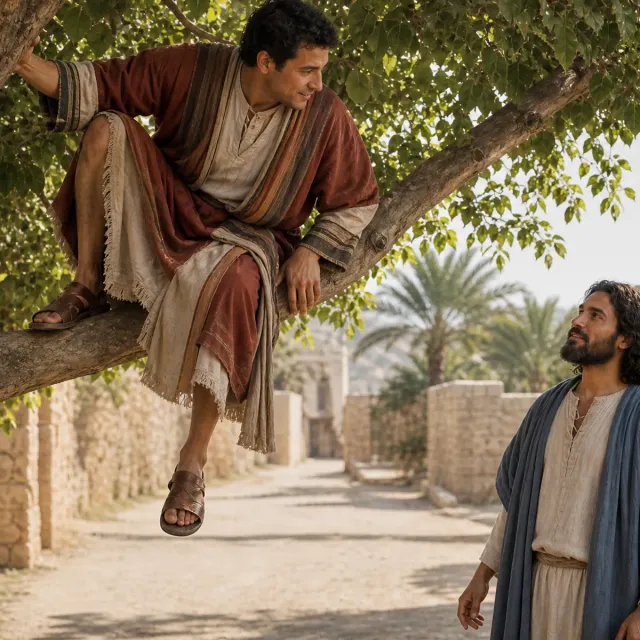
He is chief among the publicans at Jericho, which is a customs post on a rich trade road, and Luke says plainly that he was rich. That combination in that town meant the man had made his money out of his neighbours with Roman backing. He wants to see who Jesus is and cannot, because of the press and because he was little of stature, so he runs ahead and climbs a sycamore, which is not a dignified thing for a wealthy official to do in public.

Where he appearsLuke 19

Scroll down to the account
Zacchaeus

The movements, in the order the text gives them.

The Account of Zacchaeus

  1. 01

    Luke 19:1-4

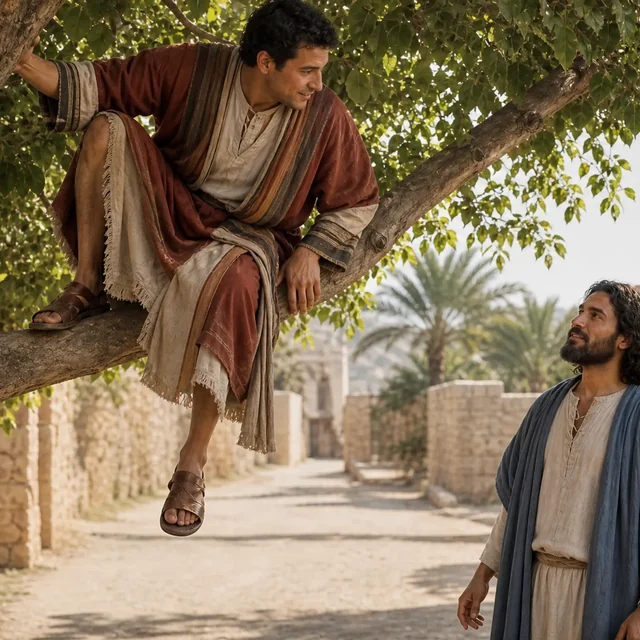
    He climbed up into a sycamore tree

    A rich official runs ahead of a crowd and gets into a tree. Luke gives the reason without softening it: he was little of stature.

    A senior title does not clear a crowded street. Luke gives Zacchaeus rank and wealth, then puts him behind people he cannot see over. Chief among the publicans is an impressive description until the immediate problem is a line of sight. The tree solves the problem his position does not.

    The verbs keep him moving: he sought, ran, and climbed. Luke states the aim plainly, to see Jesus who he was. Curiosity is enough to describe that first movement; the passage does not yet provide a confession, a calculation about restitution, or an account of years of secret longing. Zacchaeus takes a practical route around the crowd and above it.

    The location links him to the blind beggar just before this passage. One man near Jericho cannot see because he is blind; this man cannot see because of the crowd and his stature. Their circumstances and resources are sharply different, but Jesus's passage through the area brings both into view. The crowd that surrounds him does not automatically make access easy. Luke has placed a wealthy official in a tree, but the detail is more than picturesque. It makes the obstacle, the effort, and the meeting visible.

    Verse by verse

    1. 19:2

      Publicans are tax collectors in this context. Chief among them gives Zacchaeus a position distinct from the ordinary collector.

    2. 19:3

      Press means the crowd, not a publication. Luke explicitly connects Zacchaeus's difficulty in seeing with the crowd and his stature.

    3. 19:4

      The Greek tree name denotes a sycomore fig. The KJV spelling in the verse is sycomore, even when a heading uses sycamore.
    Luke 19:1-4

    King James Version · 4 verses

    19:1And Jesus entered and passed through Jericho.

    19:2And, behold, there was a man named Zacchæus, which was the chief among the publicans, and he was rich.

    19:3And he sought to see Jesus who he was; and could not for the press, because he was little of stature.

    19:4And he ran before, and climbed up into a sycomore tree to see him: for he was to pass that way.

    Luke 19:1-4: He climbed up into a sycamore tree
  2. 02

    Luke 19:5-6

    Today I must abide at your house

    The name comes first and the plan is already made. He came down hastily and received him joyfully, which is the whole of his conversion narrated in one line.

    Zacchaeus has arranged to watch a passerby and finds himself named as a host. Jesus does more than acknowledge the man in the branches. He identifies the house where he must stay, and the house belongs to the spectator. The encounter changes direction in a sentence.

    Must is the word that gives the visit its weight. The Greek dei marks necessity, not merely a preference for comfortable accommodation. Luke does not say that Jesus inspected the city's available houses or chose the richest dining room. The statement is about the purpose of his coming, and its connection with salvation becomes explicit in verse 9.

    The response is almost fitted to the command word for word. Make haste receives made haste; come down receives came down. Then Luke adds what the command did not dictate: joy. That feeling belongs to the text itself. There is no need to supply a private monologue to make the welcome warm. The order also matters. Jesus announces his intention to stay before the public declaration about possessions and repayment. Hospitality is not presented as a reward purchased by an impressive financial pledge. The man called by name receives the guest with joy; the disputed house has already been chosen.

    Verse by verse

    1. 19:5

      Luke reports that Jesus uses Zacchaeus's name but does not explain in this passage how he knows it.

    2. 19:5

      Must translates the Greek dei, expressing necessity. The declared purpose is clarified by the statements about salvation in verses 9-10.

    3. 19:6

      The response repeats the command's haste and descent, then explicitly adds joy. The invitation precedes the financial declaration in verse 8.

    Luke 19:5-6

    King James Version · 2 verses

    19:5And when Jesus came to the place, he looked up, and saw him, and said unto him, Zacchæus, make haste, and come down; for to day I must abide at thy house.

    19:6And he made haste, and came down, and received him joyfully.

    Luke 19:5-6: Today I must abide at your house
  3. 03

    Luke 19:7

    Gone to be guest with a man that is a sinner

    They all murmured. The complaint is not about doctrine but about hospitality, and it is the same complaint made over Matthew’s dinner table.

    The objection is not that Zacchaeus has seen Jesus. It is that Jesus has chosen to stay with Zacchaeus. Watching from a tree could leave the usual social arrangements intact. Entering the house does not. The complaint falls on the guest's choice of company.

    Luke gives the crowd one label for the host: sinner. Jesus will give him another: a son of Abraham. That later description does not turn disputed money into clean money by a change of vocabulary; the declaration about restitution remains in the account. It does prevent the crowd's label from being the only identity allowed to stand.

    The murmuring also joins a repeated argument in Luke. Earlier, tax collectors and sinners draw near, and objections arise because Jesus receives them and eats with them. The answer there concerns what is lost being found. Here that same pattern is attached to a named man, a real house, and a welcome already under way. The crowd sees the address and objects. The passage will explain the visit by its purpose. What the onlookers treat as a reason not to enter is precisely the setting in which Jesus declares salvation.

    Verse by verse

    1. 19:7

      They all describes the onlookers in this scene. It should not be expanded into a claim about every inhabitant of Jericho or an entire people.

    2. 19:7

      The complaint concerns Jesus becoming the man's guest, not merely speaking to him in the street. Luke 15:1-2 records a closely related objection.

    Luke 19:7

    King James Version · 1 verse

    19:7And when they saw it, they all murmured, saying, That he was gone to be guest with a man that is a sinner.

    Luke 19:7: Gone to be guest with a man that is a sinner
  4. 04

    Luke 19:8-10

    I restore him fourfold

    The repentance is itemised and expensive. The answer is that salvation has come to this house, forsomuch as he also is a son of Abraham.

    The declaration has arithmetic in it. Half his goods goes to the poor; wrongful taking is answered fourfold. Giving to needy people and repaying injured people are related, but they are not interchangeable. A generous donation cannot by itself be handed to the wronged person as though the account were settled.

    The verbs I give and I restore are present tense in Greek. Readers differ over whether Zacchaeus is announcing a new commitment or defending an existing practice. The usual reading hears a decisive response to Jesus's visit; the alternative takes the present forms as habitual. The tense alone cannot settle the whole question. Either way, Luke gives an explicit public declaration with measurable consequences, not a vague claim to have become a nicer man.

    Jesus's response supplies the account's controlling explanation: salvation, Abrahamic belonging, and the Son of man's mission. The encounter began with Zacchaeus seeking to see Jesus. It ends with Jesus explaining that he has come to seek the lost. The seeker in the tree turns out to be within another search. Luke has not recorded the price of admission to a meal. He has placed possessions, restitution, and belonging inside an encounter Jesus calls salvation.

    Verse by verse

    1. 19:8

      The Greek present forms permit discussion of a pledge made now versus an existing practice. They should not be silently changed into proof of only one interpretation.

    2. 19:8

      The statement distinguishes a gift to the poor from repayment to anyone wronged. Fourfold means four times the amount, not the original plus four additional amounts.

    3. 19:9-10

      Also is important in son of Abraham: the man rejected by the crowd is explicitly included. Seek in verse 10 answers Zacchaeus's seeking in verse 3.

    Luke 19:8-10

    King James Version · 3 verses

    19:8And Zacchæus stood, and said unto the Lord; Behold, Lord, the half of my goods I give to the poor; and if I have taken any thing from any man by false accusation, I restore him fourfold.

    19:9And Jesus said unto him, This day is salvation come to this house, forsomuch as he also is a son of Abraham.

    19:10For the Son of man is come to seek and to save that which was lost.

    Luke 19:8-10: I restore him fourfold

Why it matters

The invitation goes the wrong way. Zacchaeus is not asked to come down and follow; he is told that today I must abide at your house, which puts the guest under the roof of the most resented man in Jericho and starts the murmuring immediately. What he offers is not a religious formula but an account: half of my goods I give to the poor, and if I have taken anything from any man by false accusation I restore him fourfold. The law asked for the principal and a fifth. He offers four times.

2 songs

The music

Every song in the catalogue whose passage falls inside these chapters.

  1. Luke 19:1-10

    Come Down, Zacchaeus

    Play here
    Open song pageRead lyrics
  2. Luke 19:41-44

    He Wept Over Jerusalem

    Play here
    Open song pageRead lyrics

Nearby

All the people

Report an error on this page