Places of the Bible

Philippi

A Roman colony in Macedonia where the first three converts were a businesswoman, a slave girl and a prison officer.

Philippi was a colony, which meant its citizens held Roman citizenship on Greek soil and were proud of it. The magistrates are called praetors, the officers are lictors, and the charge brought against Paul and Silas is framed in exactly those terms: these men, being Jews, do exceedingly trouble our city, and teach customs which are not lawful for us to receive, neither to observe, being Romans. It is a complaint about foreigners, dressed as a complaint about law.

Where it appearsActs 16 · Philippians 2 · Philippians 4

Scroll down to the account
Philippi

The movements, in the order the text gives them.

The Account of Philippi

  1. 01

    Acts 16:13-15

    Whose heart the Lord opened

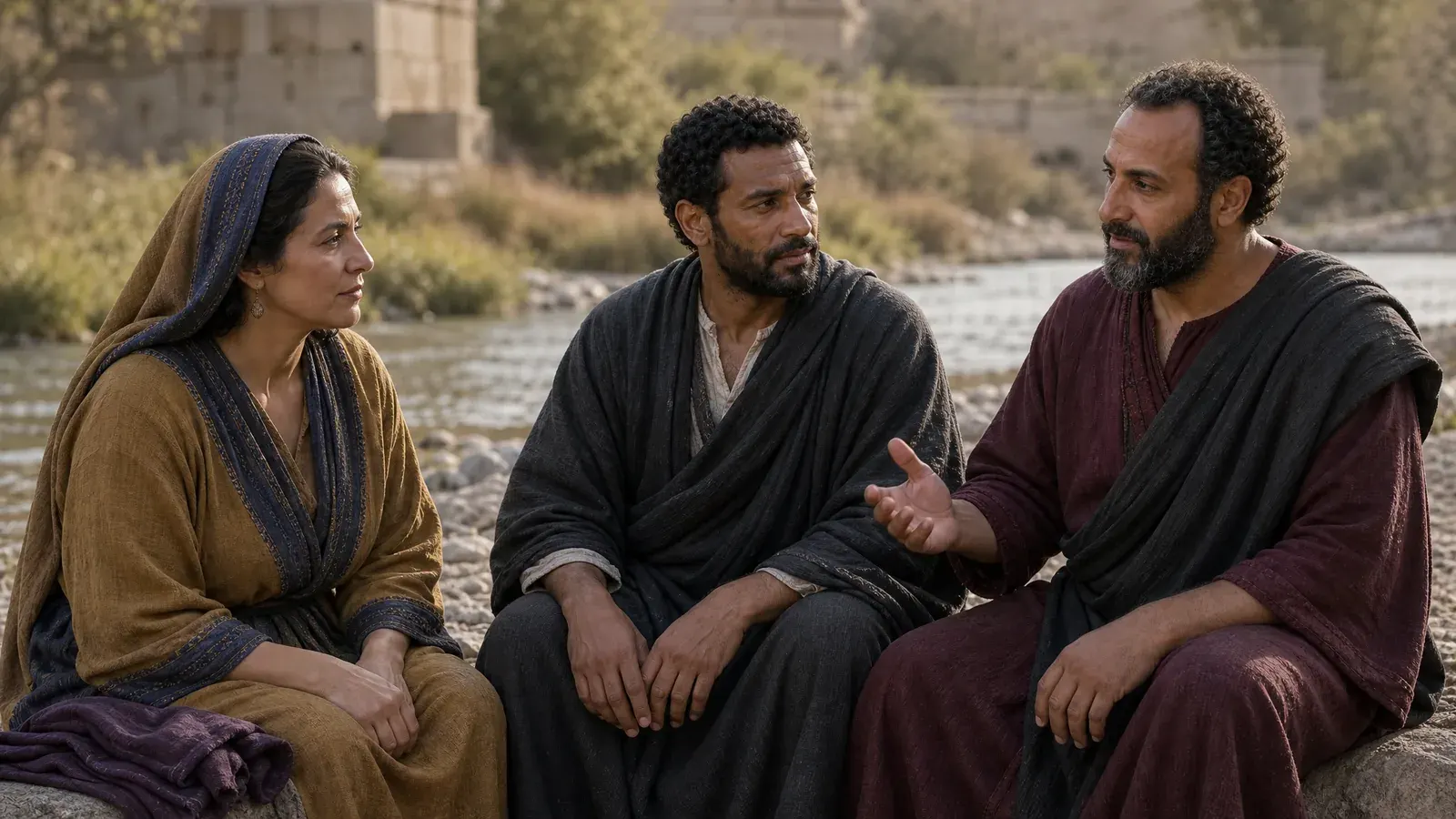
    The church in Europe begins with no building, no synagogue and no men in the account, at a riverside on a sabbath.

    The first named believer in Philippi is not the man in the Macedonian vision. She is a woman from Thyatira, listening beside a river. The contrast is already in the chapter: a man calls for help in the night, and the first recorded conversation in the city takes place among women gathered for prayer. The direction of the journey has not supplied a script for every encounter.

    The Lord opens Lydia's heart so that she attends to Paul's words. The divine action does not bypass the speaking or make the listening irrelevant. It brings the two together. The text is precise about who opens the heart and equally precise about what that opening produces.

    Lydia then becomes the one doing the persuading. Her invitation rests on the missionaries' own recognition of her faithfulness, and she constrained them. The woman who has just received their teaching now presses them to receive her hospitality. At the chapter's end her house is where they meet the believers after leaving prison. An attentive listener has become a substantial host.

    Verse by verse

    1. 16:13

      Wont means customary. The riverside gathering is stated; the text does not explain its location by giving a count of Jewish men in Philippi.

    2. 16:14

      Lydia is identified by her trade and home city. Her marital status and the size of her fortune are not supplied.

    3. 16:15

      The household is baptized, but its members and ages are not listed. The verse alone does not settle later disputes about who was included.
    Acts 16:13-15

    King James Version · 3 verses

    16:13And on the sabbath we went out of the city by a river side, where prayer was wont to be made; and we sat down, and spake unto the women which resorted thither.

    16:14And a certain woman named Lydia, a seller of purple, of the city of Thyatira, which worshipped God, heard us: whose heart the Lord opened, that she attended unto the things which were spoken of Paul.

    16:15And when she was baptized, and her household, she besought us, saying, If ye have judged me to be faithful to the Lord, come into my house, and abide there. And she constrained us.

    Acts 16:13-15: Whose heart the Lord opened
  2. 02

    Acts 16:16-19

    When her masters saw that the hope of their gains was gone

    The exorcism is prosecuted as a property matter. The text names the motive before it names the charge.

    The masters notice the missing income. The girl has been delivered from the spirit, but their response is directed toward a vanished source of gain. The Book of Acts does not need to add a speech about exploitation. It has already placed her release and their balance sheet beside one another.

    Her repeated words about Paul sound favorable, yet Paul does not accept the spirit as a useful publicist. He addresses the spirit in the name of Jesus Christ and commands it to depart. Being grieved is the reaction the text actually gives him; the reason he waits many days is not explained. Adding an elaborate account of his private deliberations would make the passage less exact, not more humane.

    The owners then drag Paul and Silas before the rulers. Their public accusation in the following verses concerns Jewish outsiders and Roman customs, not their lost receipts. The change of subject is worth noticing. The grievance has an economic origin, but it arrives in court dressed as a threat to the city. The girl herself receives no recorded opportunity to speak there.

    Verse by verse

    1. 16:16

      The Greek calls the possessing spirit a spirit of Python, a term associated with divination. Masters is plural, identifying more than one person profiting from her.

    2. 16:18

      The text records her deliverance, not her later conversion or legal emancipation from slavery. Those additional outcomes should not be asserted as facts.

    3. 16:19

      The loss of expected profit prompts the seizure. The accusations given in Acts 16:20-21 present a different public explanation.

    Acts 16:16-19

    King James Version · 4 verses

    16:16And it came to pass, as we went to prayer, a certain damsel possessed with a spirit of divination met us, which brought her masters much gain by soothsaying:

    16:17The same followed Paul and us, and cried, saying, These men are the servants of the most high God, which shew unto us the way of salvation.

    16:18And this did she many days. But Paul, being grieved, turned and said to the spirit, I command thee in the name of Jesus Christ to come out of her. And he came out the same hour.

    16:19And when her masters saw that the hope of their gains was gone, they caught Paul and Silas, and drew them into the marketplace unto the rulers,

    Acts 16:16-19: When her masters saw that the hope of their gains was gone
  3. 03

    Acts 16:25

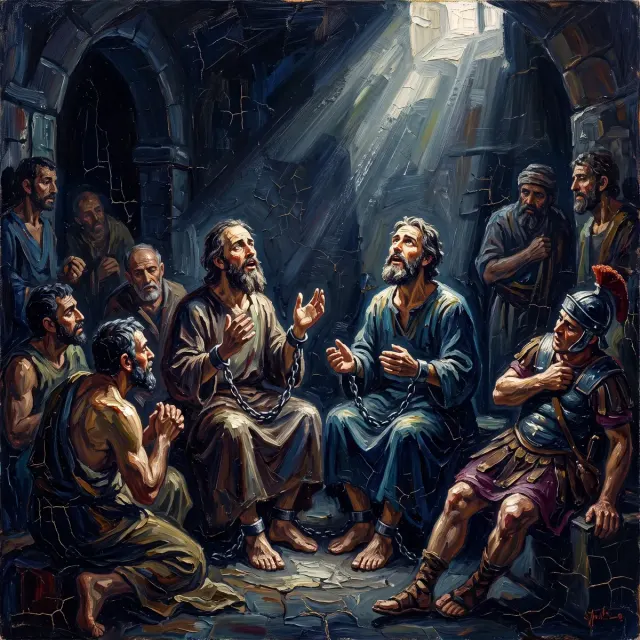
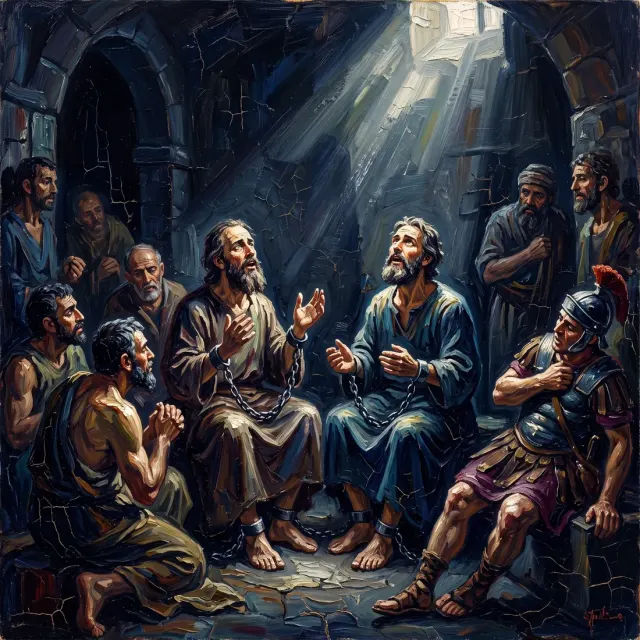
    At midnight Paul and Silas prayed, and sang praises

    The detail the account preserves is that the prisoners heard them. The singing is reported as a public event.

    The singing begins before the doors open. That order carries the weight of the verse. Paul and Silas are not celebrating an escape already accomplished; they have been beaten, placed in the inner prison, and secured in stocks. Their voices are doing something their bodies cannot do: reaching beyond the place where the authorities have fixed them.

    The prisoners heard them is not decorative atmosphere. It makes the prayer audible to people outside the two men's conversation with God. The passage does not provide a song title, a melody, or a claim that the other prisoners joined in. It gives something plainer and more striking: wounded men praising God, and fellow prisoners listening.

    Nor does the sentence turn music into a mechanism for causing earthquakes. The following event is God's intervention, not a technique explained by the singers. The chapter holds praise and pain together without declaring the pain imaginary. Later Philippians will repeatedly speak of joy; this city's account has already located praise somewhere less comfortable than an uninterrupted success.

    Verse by verse

    1. 16:25

      Midnight belongs to the night after the beating and confinement described in Acts 16:22-24. The wounds are still present when the jailer later washes them.

    2. 16:25

      No particular psalm or hymn is identified. The passage records prayer and sung praise without preserving the words or musical form.

    Acts 16:25

    King James Version · 1 verse

    16:25And at midnight Paul and Silas prayed, and sang praises unto God: and the prisoners heard them.

    Acts 16:25: At midnight Paul and Silas prayed, and sang praises
  4. 04

    Acts 16:27-28

    Do thyself no harm: for we are all here

    The doors are open and the whole cellblock stays put. The jailer’s question follows from what did not happen.

    Paul's first words to the jailer preserve his life before the exchange about salvation begins. There is no demand for an apology, no bargain over the prisoners' treatment. The immediate task is to stop a death based on a mistaken conclusion.

    Supposing is the hinge. The jailer has seen open doors and inferred missing prisoners, but the second fact has not followed from the first. Paul answers the supposition with information: everyone is still there. The account does not explain why every prisoner remains, and that silence should not be filled with an invented collective vow or an unseen command. Their presence is enough to overturn the jailer's conclusion.

    The reversal is physical before it becomes a conversation. The man charged with keeping the prisoners secure now depends upon their remaining with him. In the following verses he will wash the wounds of the men he confined and feed them in his house. The open prison does not become the occasion for their revenge. Its keeper survives to become a host.

    Verse by verse

    1. 16:27

      The text identifies the jailer's supposition as the cause of his immediate action. It does not give the exact punishment he expected from his superiors.

    2. 16:28

      All here includes more than Paul and Silas. The passage does not identify the other prisoners or explain each person's decision to remain.

    Acts 16:27-28

    King James Version · 2 verses

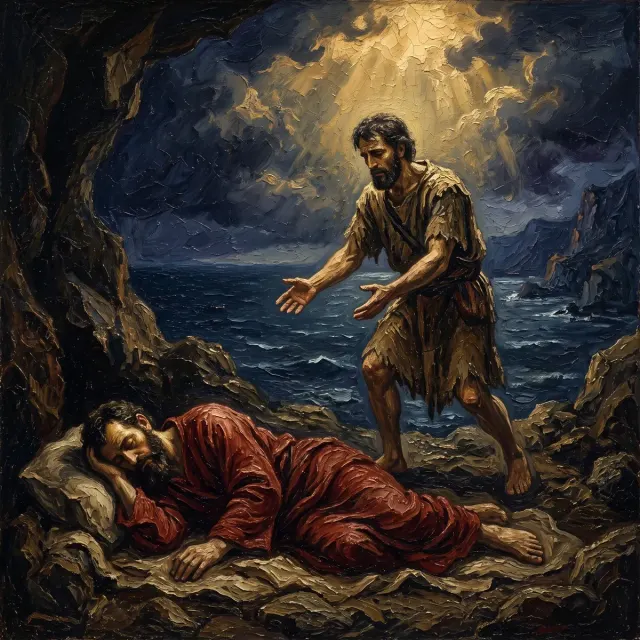
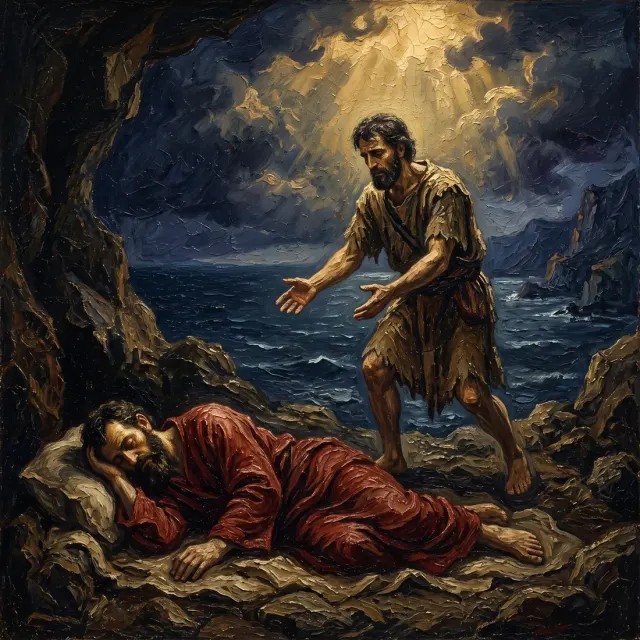
    16:27And the keeper of the prison awaking out of his sleep, and seeing the prison doors open, he drew out his sword, and would have killed himself, supposing that the prisoners had been fled.

    16:28But Paul cried with a loud voice, saying, Do thyself no harm: for we are all here.

    Acts 16:27-28: Do thyself no harm: for we are all here
  5. 05

    Philippians 2:5-8

    He humbled himself, and became obedient unto death

    The letter to this colony, so conscious of its own status, argues from someone who made himself of no reputation.

    The descent is measured in verbs. Christ makes himself of no reputation, takes the form of a servant, becomes human, humbles himself, and obeys to the point of death. The last phrase then goes lower still: even the death of the cross. Death is not left as a dignified abstraction. Its particular manner is named.

    The starting point is just as important as the destination. Paul begins with the form of God, not with an ordinary man trying to climb into divinity. The repeated form in the next verse joins the height and the lowliness without making either a theatrical costume. The servant's condition is genuinely taken. The passage describes the self-emptying through that taking and becoming; it does not supply an inventory of divine attributes discarded along the way.

    This extraordinary account stands inside an appeal about rivalry and the interests of others in verses 3-4. Paul brings the highest claim about Christ directly into the congregation's disputes over self-importance. He does not make Christ smaller to make humility plausible. The force lies in who descends. Nor is the cross the end of the whole movement: the following verses attribute the exaltation to God. The one who takes the lowest place is not engaged in a campaign to seize the highest.

    Verse by verse

    1. 2:5

      This mind refers back to the appeal against rivalry and self-centered concern in Philippians 2:3-4. The description of Christ answers that immediate setting.

    2. 2:6

      Harpagmos has prompted debate over grasping, possession, and advantage; the King James renders it robbery. The debate does not erase the verse's explicit language about equality with God.

    3. 2:7

      Form translates morphe in both verses 6 and 7; servant translates doulos, a slave or bondservant. Made himself of no reputation renders the verb meaning emptied himself.

    4. 2:8

      Even the death of the cross intensifies the manner of the obedience, not merely its duration. Verses 9-11 then describe exaltation by God.

    Philippians 2:5-8

    King James Version · 4 verses

    2:5Let this mind be in you, which was also in Christ Jesus:

    2:6Who, being in the form of God, thought it not robbery to be equal with God:

    2:7But made himself of no reputation, and took upon him the form of a servant, and was made in the likeness of men:

    2:8And being found in fashion as a man, he humbled himself, and became obedient unto death, even the death of the cross.

    Philippians 2:5-8: He humbled himself, and became obedient unto death

Why it matters

There is no synagogue, so the first meeting happens at a riverside where women gathered to pray, and the first convert in Europe is a dealer in purple from Thyatira. The second is a girl whose owners lose an income when she is freed, which is what puts the missionaries in the stocks. What happens at midnight is not an escape. The earthquake opens every door and loosens every band, and nobody leaves, which is why the jailer is still alive to ask his question at all.

4 songs

The music

Every song in the catalogue whose passage falls inside these chapters.

  1. Acts 16:16-40

    At Midnight Paul and Silas Sang

  2. Acts 16

    Come Over and Help Us

  3. Philippians 1:12-2:18

    He Humbled Himself

  4. Philippians 4:1-23

    Rejoice in the Lord Alway

Nearby

All the places

Report an error on this page