
El panorama
Génesis 19 abre con “And there came two angels to Sodom at even; and Lot sat in the gate of Sodom: and Lot…”, cambia cerca del versículo 19 con “Behold now, thy servant hath found grace in thy sight, and thou hast magnified thy…” y termina con “And the younger, she also bare a son, and called his name Ben-ammi: the same is the…”. Estos puntos trazan el movimiento propio del capítulo desde su inicio hasta su conclusión.
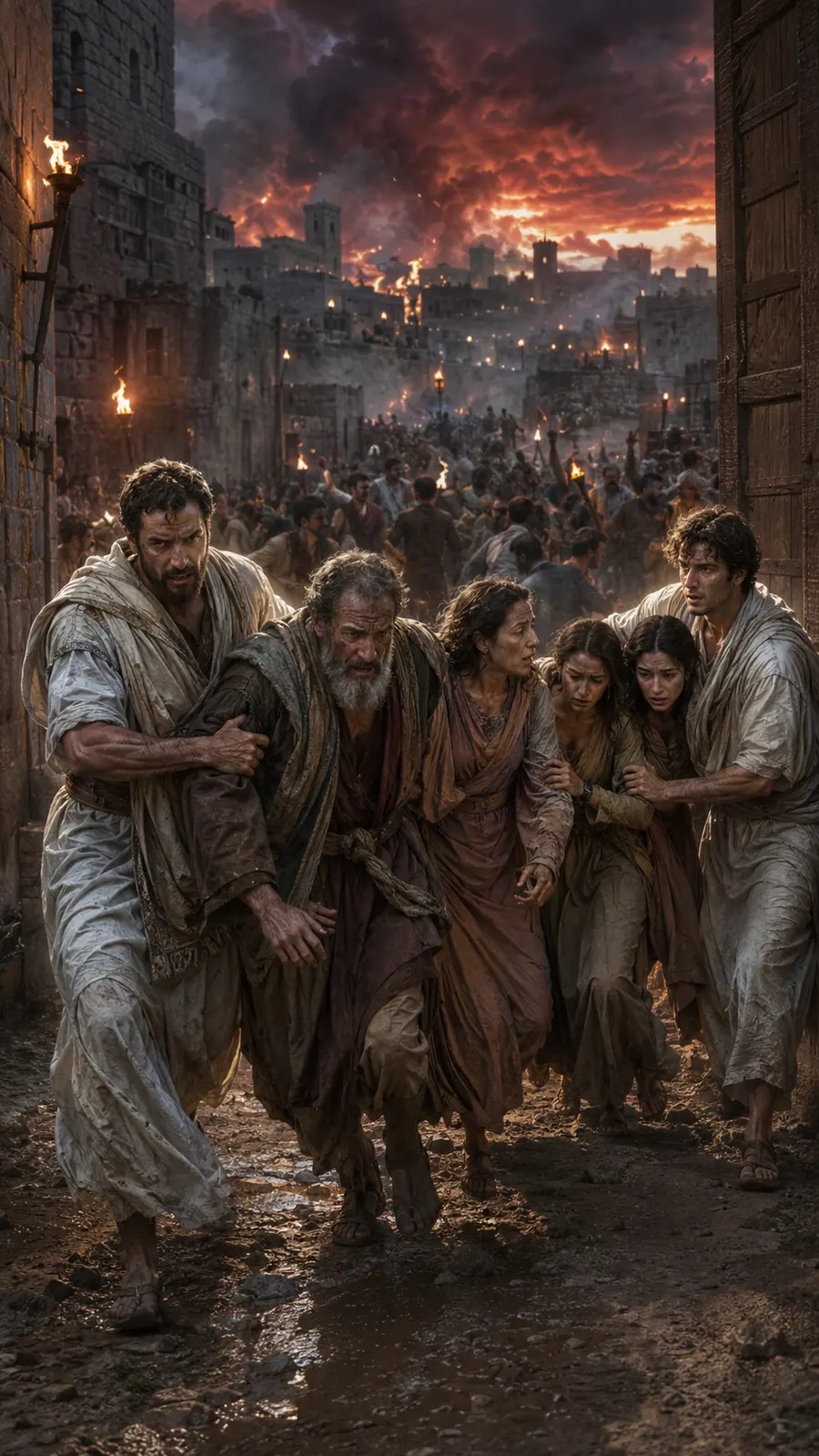
Las Escrituras junto al resumen
Génesis · Versión King James · 38Génesis 19:1-8
Versículos 1–8: There came two angels to Sodom at even; and Lot sat in the gate of…
Génesis 19:1–8 abre con “And there came two angels to Sodom at even; and Lot sat in the gate of Sodom: and Lot seeing…” y llega a “Behold now, I have two daughters which have not known man; let me, I pray you, bring them out…” en su último versículo. Ese recorrido desarrolla Dios llama a Abraham a dejar lo conocido y vivir una historia de fe, pacto, fracaso, rescate y un hijo prometido por medio del cual serían bendecidas las naciones.
Contexto que da vida al pasaje
Este bloque contiene 1 preguntas. No son simple puntuación: muestran dónde una voz busca, desafía, teme o intenta comprender.
“And there came two angels to Sodom at even; and Lot sat in the gate of Sodom: and Lot seeing them rose up to meet…” El número two hace concreto el relato. Antes de decidir su peso, observa si mide tiempo, personas, distancia, repetición o totalidad.
“And he pressed upon them greatly; and they turned in unto him, and entered into his house; and he made them a feast…” Los términos propios de esta línea incluyen bake, bread, entered. Su relación con los versículos 2 y 4 permite comprobar su función dentro del pasaje.
“And they called unto Lot, and said unto him, Where are the men which came in to thee this night? bring them out unto…” La pregunta hace que el pasaje avance con más calma. Observa quién debe responder, qué presupone y si las líneas siguientes ofrecen una respuesta.
Génesis 19:1-8
Versión King James1And there came two angels to Sodom at even; and Lot sat in the gate of Sodom: and Lot seeing them rose up to meet them; and he bowed himself with his face toward the ground;
2And he said, Behold now, my lords, turn in, I pray you, into your servant’s house, and tarry all night, and wash your feet, and ye shall rise up early, and go on your ways. And they said, Nay; but we will abide in the street all night.
3And he pressed upon them greatly; and they turned in unto him, and entered into his house; and he made them a feast, and did bake unleavened bread, and they did eat.
4But before they lay down, the men of the city, even the men of Sodom, compassed the house round, both old and young, all the people from every quarter:
5And they called unto Lot, and said unto him, Where are the men which came in to thee this night? bring them out unto us, that we may know them.
6And Lot went out at the door unto them, and shut the door after him,
7And said, I pray you, brethren, do not so wickedly.
8Behold now, I have two daughters which have not known man; let me, I pray you, bring them out unto you, and do ye to them as is good in your eyes: only unto these men do nothing; for therefore came they under the shadow of my roof.
Génesis 19:9-16
Versículos 9–16: They said, Stand back. And they said again, This one fellow came in to…
Génesis 19:9–16 abre con “And they said, Stand back. And they said again, This one fellow came in to sojourn, and he will…” y llega a “And while he lingered, the men laid hold upon his hand, and upon the hand of his wife, and upon…” en su último versículo. Ese recorrido desarrolla Dios llama a Abraham a dejar lo conocido y vivir una historia de fe, pacto, fracaso, rescate y un hijo prometido por medio del cual serían bendecidas las naciones.
Contexto que da vida al pasaje
Este bloque contiene 1 preguntas. No son simple puntuación: muestran dónde una voz busca, desafía, teme o intenta comprender.
“And they said, Stand back. And they said again, This one fellow came in to sojourn, and he will needs be a judge: now…” El número one hace concreto el relato. Antes de decidir su peso, observa si mide tiempo, personas, distancia, repetición o totalidad.
“And they smote the men that were at the door of the house with blindness, both small and great: so that they wearied…” Los términos propios de esta línea incluyen door, blindness, both. Su relación con los versículos 10 y 12 permite comprobar su función dentro del pasaje.
“For we will destroy this place, because the cry of them is waxen great before the face of the LORD; and the LORD hath…” Esta línea aporta una razón, un resultado o una conclusión. Debe permanecer unida a la afirmación o acción que le da sentido.
Génesis 19:9-16
Versión King James9And they said, Stand back. And they said again, This one fellow came in to sojourn, and he will needs be a judge: now will we deal worse with thee, than with them. And they pressed sore upon the man, even Lot, and came near to break the door.
10But the men put forth their hand, and pulled Lot into the house to them, and shut to the door.
11And they smote the men that were at the door of the house with blindness, both small and great: so that they wearied themselves to find the door.
12And the men said unto Lot, Hast thou here any besides? son in law, and thy sons, and thy daughters, and whatsoever thou hast in the city, bring them out of this place:
13For we will destroy this place, because the cry of them is waxen great before the face of the LORD; and the LORD hath sent us to destroy it.
14And Lot went out, and spake unto his sons in law, which married his daughters, and said, Up, get you out of this place; for the LORD will destroy this city. But he seemed as one that mocked unto his sons in law.
15And when the morning arose, then the angels hastened Lot, saying, Arise, take thy wife, and thy two daughters, which are here; lest thou be consumed in the iniquity of the city.
16And while he lingered, the men laid hold upon his hand, and upon the hand of his wife, and upon the hand of his two daughters; the LORD being merciful unto him: and they brought him forth, and set him without the city.
Génesis 19:17-24
Versículos 17–24: It came to pass, when they had brought them forth abroad, that he said…
Génesis 19:17–24 abre con “And it came to pass, when they had brought them forth abroad, that he said, Escape for thy life…” y llega a “Then the LORD rained upon Sodom and upon Gomorrah brimstone and fire from the LORD out of…” en su último versículo. Ese recorrido desarrolla Dios llama a Abraham a dejar lo conocido y vivir una historia de fe, pacto, fracaso, rescate y un hijo prometido por medio del cual serían bendecidas las naciones.
Contexto que da vida al pasaje
Este bloque contiene 1 preguntas. No son simple puntuación: muestran dónde una voz busca, desafía, teme o intenta comprender.
“And it came to pass, when they had brought them forth abroad, that he said, Escape for thy life; look not behind thee…” Esta señal narrativa conocida hace avanzar el tiempo. Lo que sigue es una nueva escena, consecuencia o respuesta a una tensión anterior.
“Behold now, thy servant hath found grace in thy sight, and thou hast magnified thy mercy, which thou hast shewed unto…” Los términos propios de esta línea incluyen escape, evil, grace. Su relación con los versículos 18 y 20 permite comprobar su función dentro del pasaje.
Génesis 19:17-24
Versión King James17And it came to pass, when they had brought them forth abroad, that he said, Escape for thy life; look not behind thee, neither stay thou in all the plain; escape to the mountain, lest thou be consumed.
18And Lot said unto them, Oh, not so, my Lord:
19Behold now, thy servant hath found grace in thy sight, and thou hast magnified thy mercy, which thou hast shewed unto me in saving my life; and I cannot escape to the mountain, lest some evil take me, and I die:
20Behold now, this city is near to flee unto, and it is a little one: Oh, let me escape thither, (is it not a little one?) and my soul shall live.
21And he said unto him, See, I have accepted thee concerning this thing also, that I will not overthrow this city, for the which thou hast spoken.
22Haste thee, escape thither; for I cannot do any thing till thou be come thither. Therefore the name of the city was called Zoar.
23The sun was risen upon the earth when Lot entered into Zoar.
24Then the LORD rained upon Sodom and upon Gomorrah brimstone and fire from the LORD out of heaven;
Génesis 19:25-32
Versículos 25–32: He overthrew those cities, and all the plain, and all the inhabitants of…
Génesis 19:25–32 abre con “And he overthrew those cities, and all the plain, and all the inhabitants of the cities, and…” y llega a “Come, let us make our father drink wine, and we will lie with him, that we may preserve seed of…” en su último versículo. Ese recorrido desarrolla Dios llama a Abraham a dejar lo conocido y vivir una historia de fe, pacto, fracaso, rescate y un hijo prometido por medio del cual serían bendecidas las naciones.
Contexto que da vida al pasaje
“And he overthrew those cities, and all the plain, and all the inhabitants of the cities, and that which grew upon the…” Los términos propios de esta línea incluyen cities, grew, ground. Su relación con los versículos 26 permite comprobar su función dentro del pasaje.
“And Abraham gat up early in the morning to the place where he stood before the LORD:” Nombrar a Abraham mantiene el relato unido a personas o lugares concretos. Sigue dónde reaparece el nombre y qué cambia a su alrededor.
“And it came to pass, when God destroyed the cities of the plain, that God remembered Abraham, and sent Lot out of the…” Esta señal narrativa conocida hace avanzar el tiempo. Lo que sigue es una nueva escena, consecuencia o respuesta a una tensión anterior.
Génesis 19:25-32
Versión King James25And he overthrew those cities, and all the plain, and all the inhabitants of the cities, and that which grew upon the ground.
26But his wife looked back from behind him, and she became a pillar of salt.
27And Abraham gat up early in the morning to the place where he stood before the LORD:
28And he looked toward Sodom and Gomorrah, and toward all the land of the plain, and beheld, and, lo, the smoke of the country went up as the smoke of a furnace.
29And it came to pass, when God destroyed the cities of the plain, that God remembered Abraham, and sent Lot out of the midst of the overthrow, when he overthrew the cities in the which Lot dwelt.
30And Lot went up out of Zoar, and dwelt in the mountain, and his two daughters with him; for he feared to dwell in Zoar: and he dwelt in a cave, he and his two daughters.
31And the firstborn said unto the younger, Our father is old, and there is not a man in the earth to come in unto us after the manner of all the earth:
32Come, let us make our father drink wine, and we will lie with him, that we may preserve seed of our father.
Génesis 19:33-38
Versículos 33–38: They made their father drink wine that night: and the firstborn went in…
Génesis 19:33–38 abre con “And they made their father drink wine that night: and the firstborn went in, and lay with her…” y llega a “And the younger, she also bare a son, and called his name Ben-ammi: the same is the father of…” en su último versículo. Ese recorrido desarrolla Dios llama a Abraham a dejar lo conocido y vivir una historia de fe, pacto, fracaso, rescate y un hijo prometido por medio del cual serían bendecidas las naciones.
Contexto que da vida al pasaje
“And they made their father drink wine that night: and the firstborn went in, and lay with her father; and he perceived…” Los términos propios de esta línea incluyen father, arose, drink. Su relación con los versículos 34 permite comprobar su función dentro del pasaje.
“And it came to pass on the morrow, that the firstborn said unto the younger, Behold, I lay yesternight with my father…” Esta señal narrativa conocida hace avanzar el tiempo. Lo que sigue es una nueva escena, consecuencia o respuesta a una tensión anterior.
Génesis 19:33-38
Versión King James33And they made their father drink wine that night: and the firstborn went in, and lay with her father; and he perceived not when she lay down, nor when she arose.
34And it came to pass on the morrow, that the firstborn said unto the younger, Behold, I lay yesternight with my father: let us make him drink wine this night also; and go thou in, and lie with him, that we may preserve seed of our father.
35And they made their father drink wine that night also: and the younger arose, and lay with him; and he perceived not when she lay down, nor when she arose.
36Thus were both the daughters of Lot with child by their father.
37And the firstborn bare a son, and called his name Moab: the same is the father of the Moabites unto this day.
38And the younger, she also bare a son, and called his name Ben-ammi: the same is the father of the children of Ammon unto this day.
Detalles que vale la pena notar
La imagen inicial
Genesis 19:1 comienza con “And there came two angels to Sodom at even; and Lot sat in the gate of Sodom: and Lot seeing them rose up to meet them; and he bowed himself with his face…”
Dónde cambia el capítulo
Genesis 19:20 forma un giro natural: “Behold now, this city is near to flee unto, and it is a little one: Oh, let me escape thither, (is it not a little one?) and my soul shall live.”
La nota final
Genesis 19:38 deja al lector con “And the younger, she also bare a son, and called his name Ben-ammi: the same is the father of the children of Ammon unto this day.”
Un recorrido de palabras por el capítulo
Las palabras father, city, daughters, LORD, door, night ayudan a revelar las preocupaciones que se repiten en el capítulo.
Primero el texto
Donde difieren los lectores
El resumen comienza con lo que dice el pasaje y cómo se relacionan sus partes. No supone que una denominación ya haya resuelto cada pregunta. Toda dependencia de una tradición, teoría literaria o reconstrucción histórica se identifica con claridad.
El texto KJV aparece primero. Las conclusiones interpretativas se identifican, y las diferencias se presentan cuando ayudan a explicar por qué las comunidades serias no siempre llegan a la misma respuesta.
¿Por qué es condenada Sodoma?
Génesis 19 presenta una multitud que amenaza con violencia sexual a unos huéspedes. El relato más amplio habla de gran maldad y un clamor; Ezequiel añade orgullo, abundancia sin cuidado de los pobres y abominaciones, y Judas señala pecado sexual. Estos testimonios deben leerse juntos, sin reducirlos a un eslogan político.
Genesis 18:20-21 · Genesis 19:1-11 · Ezekiel 16:49-50 · Jude 7