
O panorama
Gênesis 32 abre com “And Jacob went on his way, and the angels of God met him.”, muda perto do versículo 16 com “And he delivered them into the hand of his servants, every drove by themselves; and said…” e termina com “Therefore the children of Israel eat not of the sinew which shrank, which is upon the…”. Esses pontos traçam o movimento próprio do capítulo, da abertura à conclusão.
A Escritura ao lado do resumo
Gênesis · Versão King James · 32Gênesis 32:1-8
Versículos 1–8: Jacob went on his way, and the angels of God met him.
Gênesis 32:1–8 abre com “And Jacob went on his way, and the angels of God met him.” e chega a “And said, If Esau come to the one company, and smite it, then the other company which is left…” no último versículo. Esse percurso desenvolve Jacó agarra, foge, luta e retorna. Por meio da perda e da graça, o enganador recebe um novo nome e se torna pai de uma nação.
Contexto que dá vida à passagem
“And Jacob went on his way, and the angels of God met him.” Nomear Jacob mantém o relato ligado a pessoas ou lugares concretos. Acompanhe onde o nome retorna e o que muda ao redor dele.
“And Jacob sent messengers before him to Esau his brother unto the land of Seir, the country of Edom.” Nomear Edom e Esau mantém o relato ligado a pessoas ou lugares concretos. Acompanhe onde o nome retorna e o que muda ao redor dele.
Gênesis 32:1-8
Versão King James1And Jacob went on his way, and the angels of God met him.
2And when Jacob saw them, he said, This is God’s host: and he called the name of that place Mahanaim.
3And Jacob sent messengers before him to Esau his brother unto the land of Seir, the country of Edom.
4And he commanded them, saying, Thus shall ye speak unto my lord Esau; Thy servant Jacob saith thus, I have sojourned with Laban, and stayed there until now:
5And I have oxen, and asses, flocks, and menservants, and womenservants: and I have sent to tell my lord, that I may find grace in thy sight.
6And the messengers returned to Jacob, saying, We came to thy brother Esau, and also he cometh to meet thee, and four hundred men with him.
7Then Jacob was greatly afraid and distressed: and he divided the people that was with him, and the flocks, and herds, and the camels, into two bands;
8And said, If Esau come to the one company, and smite it, then the other company which is left shall escape.
Gênesis 32:9-16
Versículos 9–16: Jacob said, O God of my father Abraham, and God of my father Isaac, the…
Gênesis 32:9–16 abre com “And Jacob said, O God of my father Abraham, and God of my father Isaac, the LORD which saidst…” e chega a “And he delivered them into the hand of his servants, every drove by themselves; and said unto…” no último versículo. Esse percurso desenvolve Jacó agarra, foge, luta e retorna. Por meio da perda e da graça, o enganador recebe um novo nome e se torna pai de uma nação.
Contexto que dá vida à passagem
“And Jacob said, O God of my father Abraham, and God of my father Isaac, the LORD which saidst unto me, Return unto thy…” Nomear Abraham mantém o relato ligado a pessoas ou lugares concretos. Acompanhe onde o nome retorna e o que muda ao redor dele.
“Deliver me, I pray thee, from the hand of my brother, from the hand of Esau: for I fear him, lest he will come and…” Nomear Deliver e Esau mantém o relato ligado a pessoas ou lugares concretos. Acompanhe onde o nome retorna e o que muda ao redor dele.
“And he lodged there that same night; and took of that which came to his hand a present for Esau his brother;” Nomear Esau mantém o relato ligado a pessoas ou lugares concretos. Acompanhe onde o nome retorna e o que muda ao redor dele.
Gênesis 32:9-16
Versão King James9And Jacob said, O God of my father Abraham, and God of my father Isaac, the LORD which saidst unto me, Return unto thy country, and to thy kindred, and I will deal well with thee:
10I am not worthy of the least of all the mercies, and of all the truth, which thou hast shewed unto thy servant; for with my staff I passed over this Jordan; and now I am become two bands.
11Deliver me, I pray thee, from the hand of my brother, from the hand of Esau: for I fear him, lest he will come and smite me, and the mother with the children.
12And thou saidst, I will surely do thee good, and make thy seed as the sand of the sea, which cannot be numbered for multitude.
13And he lodged there that same night; and took of that which came to his hand a present for Esau his brother;
14Two hundred she goats, and twenty he goats, two hundred ewes, and twenty rams,
15Thirty milch camels with their colts, forty kine, and ten bulls, twenty she asses, and ten foals.
16And he delivered them into the hand of his servants, every drove by themselves; and said unto his servants, Pass over before me, and put a space betwixt drove and drove.
Gênesis 32:17-24
Versículos 17–24: He commanded the foremost, saying, When Esau my brother meeteth thee…
Gênesis 32:17–24 abre com “And he commanded the foremost, saying, When Esau my brother meeteth thee, and asketh thee…” e chega a “And Jacob was left alone; and there wrestled a man with him until the breaking of the day.” no último versículo. Esse percurso desenvolve Jacó agarra, foge, luta e retorna. Por meio da perda e da graça, o enganador recebe um novo nome e se torna pai de uma nação.
Contexto que dá vida à passagem
Este bloco contém 1 perguntas. Elas não são simples pontuação: mostram onde uma voz procura, desafia, teme ou tenta compreender.
“And he commanded the foremost, saying, When Esau my brother meeteth thee, and asketh thee, saying, Whose art thou? and…” A pergunta desacelera a passagem. Observe quem precisa responder, o que ela pressupõe e se as linhas seguintes apresentam uma resposta.
“And so commanded he the second, and the third, and all that followed the droves, saying, On this manner shall ye speak…” A ordem não pode ser entendida apenas pelo verbo. O destinatário, o propósito e seu lugar na aliança ou argumento definem a responsabilidade.
Gênesis 32:17-24
Versão King James17And he commanded the foremost, saying, When Esau my brother meeteth thee, and asketh thee, saying, Whose art thou? and whither goest thou? and whose are these before thee?
18Then thou shalt say, They be thy servant Jacob’s; it is a present sent unto my lord Esau: and, behold, also he is behind us.
19And so commanded he the second, and the third, and all that followed the droves, saying, On this manner shall ye speak unto Esau, when ye find him.
20And say ye moreover, Behold, thy servant Jacob is behind us. For he said, I will appease him with the present that goeth before me, and afterward I will see his face; peradventure he will accept of me.
21So went the present over before him: and himself lodged that night in the company.
22And he rose up that night, and took his two wives, and his two womenservants, and his eleven sons, and passed over the ford Jabbok.
23And he took them, and sent them over the brook, and sent over that he had.
24And Jacob was left alone; and there wrestled a man with him until the breaking of the day.
Gênesis 32:25-32
Versículos 25–32: When he saw that he prevailed not against him, he touched the hollow of…
Gênesis 32:25–32 abre com “And when he saw that he prevailed not against him, he touched the hollow of his thigh; and the…” e chega a “Therefore the children of Israel eat not of the sinew which shrank, which is upon the hollow of…” no último versículo. Esse percurso desenvolve Jacó agarra, foge, luta e retorna. Por meio da perda e da graça, o enganador recebe um novo nome e se torna pai de uma nação.
Contexto que dá vida à passagem
Este bloco contém 2 perguntas. Elas não são simples pontuação: mostram onde uma voz procura, desafia, teme ou tenta compreender.
“And when he saw that he prevailed not against him, he touched the hollow of his thigh; and the hollow of Jacob’s thigh…” Nomear Jacob mantém o relato ligado a pessoas ou lugares concretos. Acompanhe onde o nome retorna e o que muda ao redor dele.
“And he said unto him, What is thy name? And he said, Jacob.” A pergunta desacelera a passagem. Observe quem precisa responder, o que ela pressupõe e se as linhas seguintes apresentam uma resposta.
Gênesis 32:25-32
Versão King James25And when he saw that he prevailed not against him, he touched the hollow of his thigh; and the hollow of Jacob’s thigh was out of joint, as he wrestled with him.
26And he said, Let me go, for the day breaketh. And he said, I will not let thee go, except thou bless me.
27And he said unto him, What is thy name? And he said, Jacob.
28And he said, Thy name shall be called no more Jacob, but Israel: for as a prince hast thou power with God and with men, and hast prevailed.
29And Jacob asked him, and said, Tell me, I pray thee, thy name. And he said, Wherefore is it that thou dost ask after my name? And he blessed him there.
30And Jacob called the name of the place Peniel: for I have seen God face to face, and my life is preserved.
31And as he passed over Penuel the sun rose upon him, and he halted upon his thigh.
32Therefore the children of Israel eat not of the sinew which shrank, which is upon the hollow of the thigh, unto this day: because he touched the hollow of Jacob’s thigh in the sinew that shrank.
Detalhes que merecem atenção
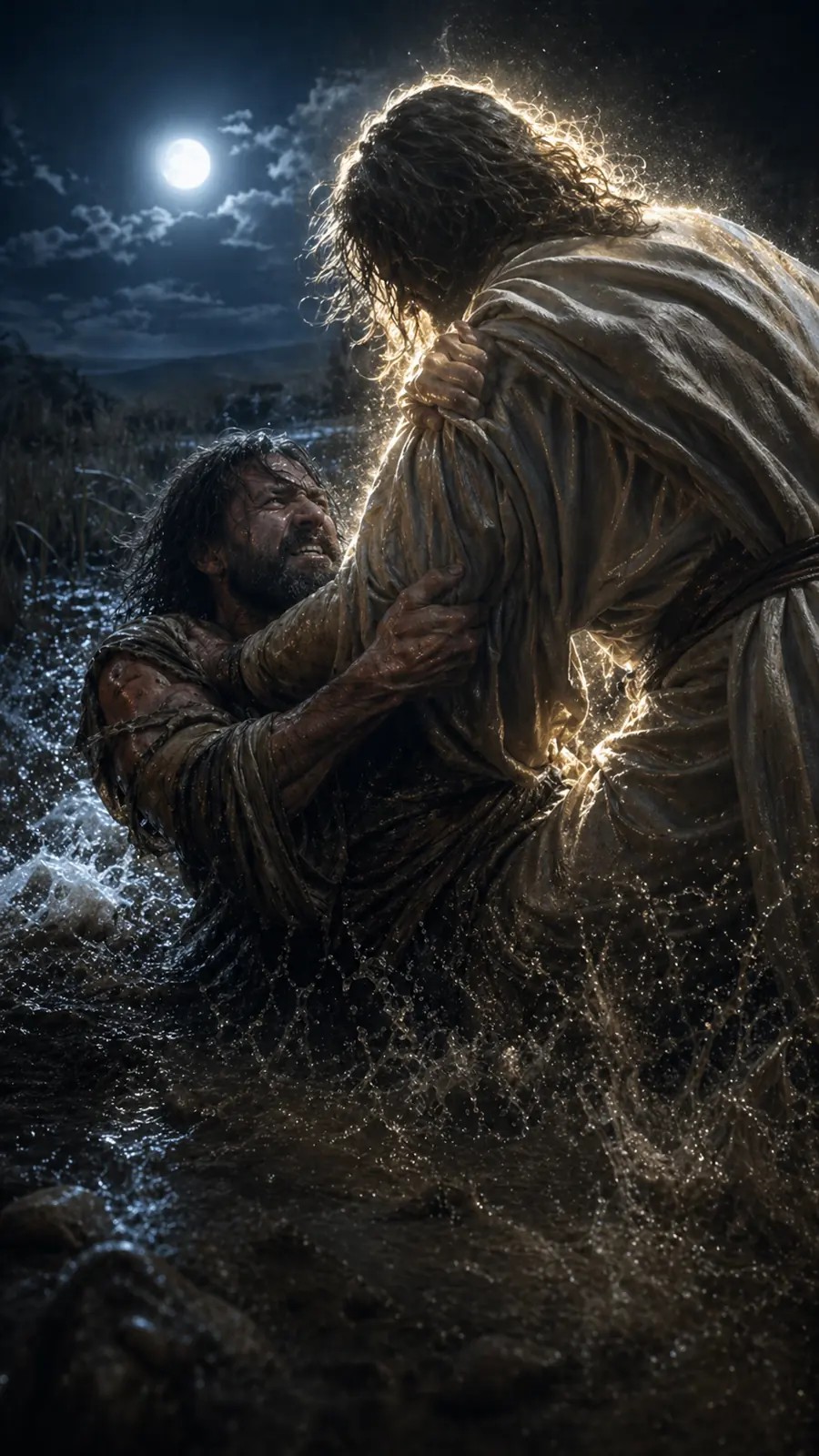
A imagem de abertura
Genesis 32:1 começa com “And Jacob went on his way, and the angels of God met him.”
Onde o capítulo muda
Genesis 32:17 forma uma mudança natural: “And he commanded the foremost, saying, When Esau my brother meeteth thee, and asketh thee, saying, Whose art thou? and whither goest thou? and whose are…”
A nota final
Genesis 32:32 deixa o leitor com “Therefore the children of Israel eat not of the sinew which shrank, which is upon the hollow of the thigh, unto this day: because he touched the hollow of…”
Um caminho de palavras pelo capítulo
As palavras Jacob, Esau, name, brother, thigh, hand ajudam a revelar as preocupações repetidas do capítulo.
Primeiro o texto
Onde os leitores divergem
O resumo começa com o que a passagem diz e como suas partes se relacionam. Ele não presume que uma denominação já resolveu todas as questões. A dependência de uma tradição, teoria literária ou reconstrução histórica é claramente identificada.
O texto KJV aparece primeiro. As conclusões interpretativas são identificadas, e as diferenças surgem quando ajudam a explicar por que comunidades sérias nem sempre chegam à mesma resposta.
As notas interpretativas comparativas deste capítulo estão em preparação. Até que as notas revisadas estejam prontas, esta página separa o texto KJV do resumo e da aplicação sem afirmar que leitores responsáveis concordam em todas as questões.