
Mark 10:13–16
Jesus welcomes the children

Ages 8 to 11
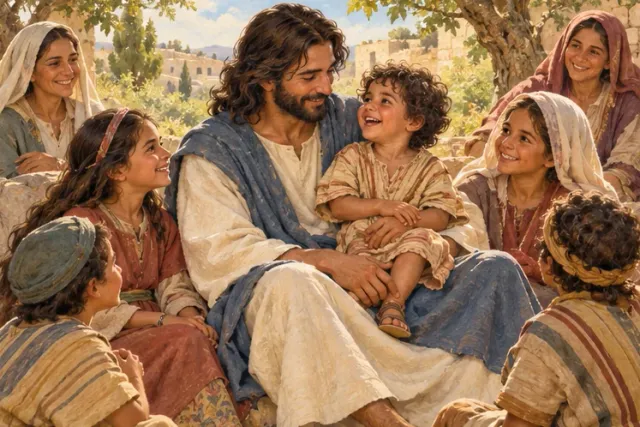
The account
People brought young children to Jesus because they wanted him to touch them. The disciples tried to stop the people and rebuked them.
Jesus saw what was happening, and he was much displeased. He told the disciples to let the little children come to him and not to forbid them. Jesus said that the kingdom of God belongs to such as these.
Then Jesus taught something important. He said that anyone who does not receive the kingdom of God as a little child will not enter it. The passage does not say that children know everything. It shows that Jesus wanted them welcomed, not pushed away.
Jesus did more than allow the children to stand nearby. He took them in his arms. He put his hands on them and blessed them.
It is a short account, but the picture is clear. Adults were bringing children to Jesus. The disciples tried to block the way. Jesus corrected them and welcomed the children himself. The children were not a bother to him. They were brought close, held in his arms, and blessed.
Memory verse
And he took them up in his arms, put his hands upon them, and blessed them.
Mark 10:16
Talk about it:
- Why were people bringing young children to Jesus?
- What did the disciples do when the children were brought?
- What did Jesus do after he told the disciples to let the children come?
Try this:
Draw the scene in three simple pictures: the children being brought to Jesus, the disciples trying to stop them, and Jesus welcoming them. Under each picture, write one short sentence saying what happened.
What can we learn?
A lesson we can draw from this account is that children should not be treated as unimportant. Jesus welcomed them and made room for them.
Ages 12 to 15
The account
People were bringing young children to Jesus so that he would touch them. The disciples rebuked the people who brought them. Mark does not explain why the disciples tried to stop them, so there is no need to guess. What the passage does tell us is how Jesus responded.
When Jesus saw what the disciples were doing, he was much displeased. He told them to allow the little children to come to him and not to forbid them. Then he connected the children standing in front of him with the kingdom of God. He said that the kingdom belongs to such as these.
Jesus went further. He said that whoever does not receive the kingdom of God as a little child will not enter it. The passage does not define every quality of a child that Jesus had in mind. It simply gives the comparison and makes it important. The kingdom is to be received as a little child receives it.
The scene ends in a way that makes Jesus' welcome unmistakable. He took the children up in his arms, put his hands on them, and blessed them. The disciples had tried to keep them back, but Jesus brought them close.
This mattered because the disciples were deciding who should be allowed near Jesus. Jesus did not let their decision stand. He corrected them in front of the situation itself and used the children as part of his teaching about God's kingdom.
Mark gives no speeches from the children and no names for them. He does not tell us what they thought afterward. The focus stays on what people did, what the disciples did, and what Jesus said and did. That is enough to show that the children were welcome in his presence.
The contrast is simple but strong. The people bringing the children wanted Jesus to touch them. The disciples responded by rebuking those people. Jesus responded by telling the disciples not to forbid the children, then personally took the children in his arms and blessed them. Mark leaves no uncertainty about which response Jesus approved. That reversal is the heart of the scene Mark records.
Memory verse
And he took them up in his arms, put his hands upon them, and blessed them.
Mark 10:16
Think about it:
- Why do you think it matters that Jesus corrected the disciples instead of simply letting the children pass quietly?
- What does Jesus' response show about how he regarded the children who were brought to him?
- Why is it important not to add our own list of childlike qualities when the passage itself does not give one?
- What difference do you notice between the disciples' first response and Jesus' response?
Going deeper:
The same event is also recorded in Matthew 19:13-15 and Luke 18:15-17. Across these accounts, the pattern is consistent: children are brought to Jesus, others try to hinder them, and Jesus insists that they be allowed to come. The event also fits a wider pattern in the Gospels in which Jesus pays attention to people whom others might overlook.
What can we learn?
A lesson drawn from this account is that importance in God's kingdom is not measured by how much attention the world gives someone. It also reminds us to be careful about putting barriers in front of people whom Jesus receives.