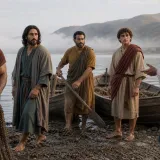
The big picture
Jesus, a teacher and healer, is on the road toward Jerusalem, the city with God's temple. He keeps teaching crowds and his followers. Questions about marriage, children, wealth, and rank reveal what people value. He points toward faithful bonds, trust that receives a gift, and service that costs a life. His followers remain afraid and confused when he names the death ahead. At the chapter's end, a blind beggar asks for sight and then follows him, showing a direct response others have struggled to give.
In this chapter
- Marriage Is More Than a Dismissal Rule Mark 10:1-12
In Judæa, the southern region, near Jordan, the river to its east, Pharisees test Jesus about divorce.
- Children Are Welcomed and Blessed Mark 10:13-16
People bring young children for Jesus to touch, but the followers rebuke them.
- Wealth Blocks a Man’s Response Mark 10:17-27
A man kneels and asks how to inherit lasting life.
- Promised Gain Includes Present Suffering Mark 10:28-34
Peter, a close follower, says they have left everything for Jesus.
- Greatness Means Serving and Giving Life Mark 10:35-45
James and John, brothers whose father is Zebedee, ask Jesus for the seats nearest him in glory.
- A Blind Beggar Follows Jesus Mark 10:46-52
Leaving Jericho, a town on the road to Jerusalem, Jesus passes a blind beggar named Bartimæus.
Central truth
Jesus places faithful love, dependent trust, and costly service above wealth and rank as he walks toward suffering.
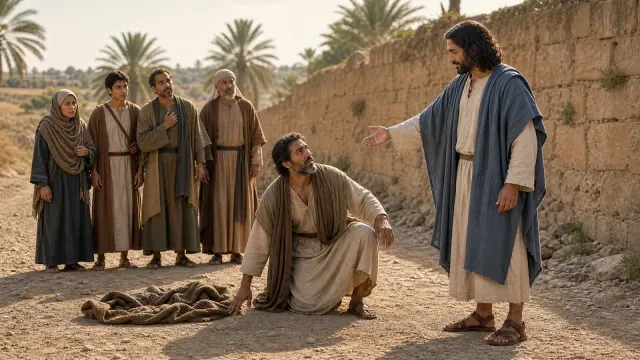

Scripture beside the summary
Mark · King James Version · 52Mark 10:1-12
Marriage Is More Than a Dismissal Rule
In Judæa, the southern region, near Jordan, the river to its east, Pharisees test Jesus about divorce. These strict teachers ask whether a man may dismiss his wife. Jesus asks what Moses, the lawgiver, said. They cite permission for a divorce document. He says this answered hard hearts, then recalls creation: a man and woman become one flesh in marriage. People must not separate what God joins. Privately he says that divorcing a spouse and marrying another commits adultery, whether a man or woman does it. Christians differ on divorce and remarriage in particular cases, but all take this teaching's defence of marriage seriously.
In everyday life
A marriage mediator places the couple's vows beside a stack of forms. One spouse keeps asking which box ends the matter fastest. She asks him to face the shared bond and harm involved, not only the route through paperwork. Jesus grounds marriage in God's act of joining, which a mediator cannot define or undo by procedure.
Notice
Mark 10:5 Jesus distinguishes a rule given because of hard hearts from God's purpose at creation. Legal permission is not his whole account of marriage.
Mark 10:1-12
King James Version1And he arose from thence, and cometh into the coasts of Judæa by the farther side of Jordan: and the people resort unto him again; and, as he was wont, he taught them again.
2And the Pharisees came to him, and asked him, Is it lawful for a man to put away his wife? tempting him.
3And he answered and said unto them, What did Moses command you?
4And they said, Moses suffered to write a bill of divorcement, and to put her away.
5And Jesus answered and said unto them, For the hardness of your heart he wrote you this precept.
6But from the beginning of the creation God made them male and female.
7For this cause shall a man leave his father and mother, and cleave to his wife;
8And they twain shall be one flesh: so then they are no more twain, but one flesh.
9What therefore God hath joined together, let not man put asunder.
10And in the house his disciples asked him again of the same matter.
11And he saith unto them, Whosoever shall put away his wife, and marry another, committeth adultery against her.
12And if a woman shall put away her husband, and be married to another, she committeth adultery.
Mark 10:13-16
Children Are Welcomed and Blessed
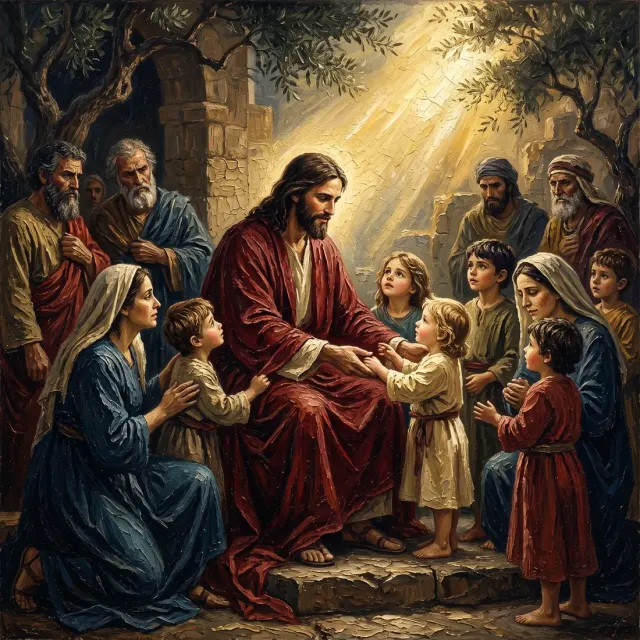
People bring young children for Jesus to touch, but the followers rebuke them. Jesus is deeply displeased. He tells them to let the children come and stop blocking them. God's kingdom belongs to such as these, and anyone who does not receive it as a child will not enter. A child receives care and a gift without first proving rank or earning power. Jesus takes the children in his arms, lays hands on them, and blesses them. His words are matched by direct welcome. The followers' attempt to control access has excluded the very people he uses to explain receiving the kingdom.
In everyday life
A library storyteller moves a chair aside when an assistant tries to send a small child away. She makes space at the front and begins reading without asking the child to earn a place. Welcome comes before any achievement. Jesus blesses children and makes them an example of receiving God's kingdom, not merely joining an open reading group.
Notice
Mark 10:16 The children receive an embrace rather than only distant permission. The welcome is personal after the followers have tried to turn them away.
Mark 10:13-16
King James Version13And they brought young children to him, that he should touch them: and his disciples rebuked those that brought them.
14But when Jesus saw it, he was much displeased, and said unto them, Suffer the little children to come unto me, and forbid them not: for of such is the kingdom of God.
15Verily I say unto you, Whosoever shall not receive the kingdom of God as a little child, he shall not enter therein.
16And he took them up in his arms, put his hands upon them, and blessed them.
Mark 10:17-27
Wealth Blocks a Man’s Response
A man kneels and asks how to inherit lasting life. Jesus directs his use of good toward God, then names commands against harming others. The man says he has kept them since youth. Jesus looks at him with love and tells him to sell his goods, give to poor people, and follow him. He leaves grieving because he owns much. Jesus warns how hard entering God's kingdom is for those who trust riches. A camel passing through a needle's eye pictures the impossibility. The followers ask who can be saved. Jesus answers that what people cannot do remains possible with God.
In everyday life
A wealthy collector stands beside a storage room full of valuable furniture while a neighbour offers him a place in a shared housing project. Joining requires releasing the hoard he has built his life around. He wants the new life but cannot let go. Jesus calls for discipleship and lasting life, not entry into a housing scheme.
Notice
Mark 10:21 Jesus' love precedes the demand that grieves the man. The hard instruction is not contempt for him but a direct challenge to what holds him.
Mark 10:17-27
King James Version17And when he was gone forth into the way, there came one running, and kneeled to him, and asked him, Good Master, what shall I do that I may inherit eternal life?
18And Jesus said unto him, Why callest thou me good? there is none good but one, that is, God.
19Thou knowest the commandments, Do not commit adultery, Do not kill, Do not steal, Do not bear false witness, Defraud not, Honour thy father and mother.
20And he answered and said unto him, Master, all these have I observed from my youth.
21Then Jesus beholding him loved him, and said unto him, One thing thou lackest: go thy way, sell whatsoever thou hast, and give to the poor, and thou shalt have treasure in heaven: and come, take up the cross, and follow me.
22And he was sad at that saying, and went away grieved: for he had great possessions.
23And Jesus looked round about, and saith unto his disciples, How hardly shall they that have riches enter into the kingdom of God!
24And the disciples were astonished at his words. But Jesus answereth again, and saith unto them, Children, how hard is it for them that trust in riches to enter into the kingdom of God!
25It is easier for a camel to go through the eye of a needle, than for a rich man to enter into the kingdom of God.
26And they were astonished out of measure, saying among themselves, Who then can be saved?
27And Jesus looking upon them saith, With men it is impossible, but not with God: for with God all things are possible.
Mark 10:28-34
Promised Gain Includes Present Suffering
Peter, a close follower, says they have left everything for Jesus. Jesus promises a hundredfold return in homes, family bonds, and lands for those who leave for him and the good news. He includes persecution now and eternal life in the age to come. Present gain is not a promise of painless wealth. As they approach Jerusalem, Jesus walks ahead of the amazed and frightened group. He tells the twelve that leaders will condemn him and hand him to Gentiles, non-Jewish people. They will mock, whip, spit on, and kill him. He will rise on the third day. The promise of life does not bypass suffering.

In everyday life
A religious convert carries a bag into a host family's spare room after relatives refuse to house him. The new household shares meals and support, but hostile messages still arrive on his phone. Welcome has grown alongside loss rather than erasing it. Jesus promises eternal life and speaks of his own death and rising, not only replacement shelter.
Notice
Mark 10:30 The promise includes persecution within the present gain. Jesus does not let the larger family and resources become a claim that following him removes danger.
Mark 10:28-34
King James Version28Then Peter began to say unto him, Lo, we have left all, and have followed thee.
29And Jesus answered and said, Verily I say unto you, There is no man that hath left house, or brethren, or sisters, or father, or mother, or wife, or children, or lands, for my sake, and the gospel’s,
30But he shall receive an hundredfold now in this time, houses, and brethren, and sisters, and mothers, and children, and lands, with persecutions; and in the world to come eternal life.
31But many that are first shall be last; and the last first.
32And they were in the way going up to Jerusalem; and Jesus went before them: and they were amazed; and as they followed, they were afraid. And he took again the twelve, and began to tell them what things should happen unto him,
33Saying, Behold, we go up to Jerusalem; and the Son of man shall be delivered unto the chief priests, and unto the scribes; and they shall condemn him to death, and shall deliver him to the Gentiles:
34And they shall mock him, and shall scourge him, and shall spit upon him, and shall kill him: and the third day he shall rise again.
Mark 10:35-45
Greatness Means Serving and Giving Life
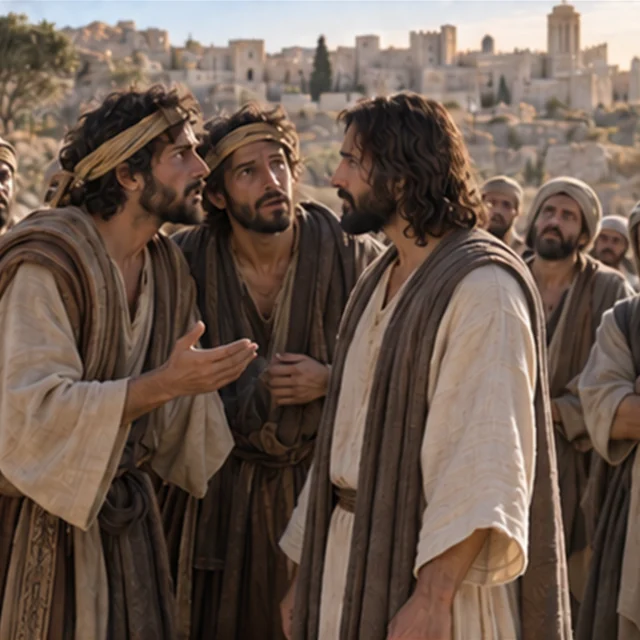
James and John, brothers whose father is Zebedee, ask Jesus for the seats nearest him in glory. He asks whether they can share his cup and baptism, images of the suffering ahead. They say yes. He confirms they will share suffering but says the honoured seats belong to those for whom they are prepared. The other ten resent their request. Jesus contrasts rulers who dominate with greatness among his followers. The greatest must serve, and the first must become servant to all. He gives himself as the reason: the Son of man, his title for himself, came to serve and give his life to free many.
In everyday life
A fire-crew candidate asks the leader which post brings the most respect. The leader hands her the kit for supporting exhausted crews and asks whether she is ready for unseen work. Rank in this team requires serving others through cost. Jesus gives his life as a ransom, not only an example of demanding service.
Notice
Mark 10:45 Jesus connects his service with giving his life for many. The answer to their ambition reaches past good manners to the purpose of his death.
Mark 10:35-45
King James Version35And James and John, the sons of Zebedee, come unto him, saying, Master, we would that thou shouldest do for us whatsoever we shall desire.
36And he said unto them, What would ye that I should do for you?
37They said unto him, Grant unto us that we may sit, one on thy right hand, and the other on thy left hand, in thy glory.
38But Jesus said unto them, Ye know not what ye ask: can ye drink of the cup that I drink of? and be baptized with the baptism that I am baptized with?
39And they said unto him, We can. And Jesus said unto them, Ye shall indeed drink of the cup that I drink of; and with the baptism that I am baptized withal shall ye be baptized:
40But to sit on my right hand and on my left hand is not mine to give; but it shall be given to them for whom it is prepared.
41And when the ten heard it, they began to be much displeased with James and John.
42But Jesus called them to him, and saith unto them, Ye know that they which are accounted to rule over the Gentiles exercise lordship over them; and their great ones exercise authority upon them.
43But so shall it not be among you: but whosoever will be great among you, shall be your minister:
44And whosoever of you will be the chiefest, shall be servant of all.
45For even the Son of man came not to be ministered unto, but to minister, and to give his life a ransom for many.
Mark 10:46-52
A Blind Beggar Follows Jesus
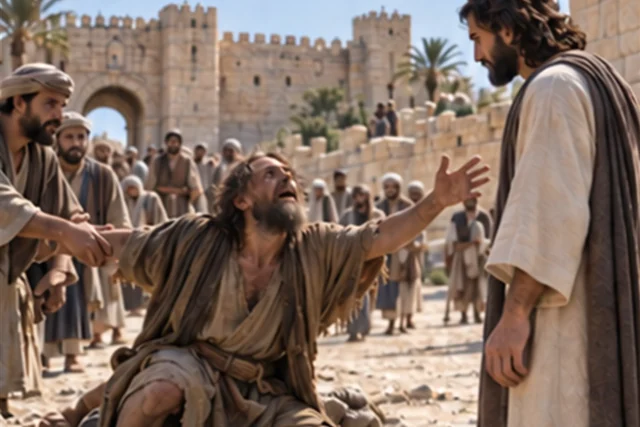
Leaving Jericho, a town on the road to Jerusalem, Jesus passes a blind beggar named Bartimæus. He hears that Jesus of Nazareth, his home town, is near and calls him Son of David. That title links Jesus to the promised king from David's family. The crowd tells him to be quiet, but he cries more loudly for mercy. Jesus stops and calls him. Throwing aside his outer garment, he comes and asks to see. Jesus says his faith has made him well. Sight returns at once, and he follows Jesus along the road. The person the crowd tried to silence becomes a follower.
In everyday life
A station-access volunteer hears a traveller call repeatedly while people hurry past. She stops the flow long enough to ask what help he wants, rather than assuming his need or silencing him. His own request guides her response. Jesus restores Bartimæus' sight immediately; the volunteer helps someone travel with the limits they still have.
Notice
Mark 10:51 Jesus asks Bartimæus to name his request. The man is allowed to speak for himself after others have tried to keep his voice out.
Mark 10:46-52
King James Version46And they came to Jericho: and as he went out of Jericho with his disciples and a great number of people, blind Bartimæus, the son of Timæus, sat by the highway side begging.
47And when he heard that it was Jesus of Nazareth, he began to cry out, and say, Jesus, thou Son of David, have mercy on me.
48And many charged him that he should hold his peace: but he cried the more a great deal, Thou Son of David, have mercy on me.
49And Jesus stood still, and commanded him to be called. And they call the blind man, saying unto him, Be of good comfort, rise; he calleth thee.
50And he, casting away his garment, rose, and came to Jesus.
51And Jesus answered and said unto him, What wilt thou that I should do unto thee? The blind man said unto him, Lord, that I might receive my sight.
52And Jesus said unto him, Go thy way; thy faith hath made thee whole. And immediately he received his sight, and followed Jesus in the way.
Details worth noticing
The opening image
Mark 10:1 begins with “And he arose from thence, and cometh into the coasts of Judæa by the farther side of Jordan: and the people resort unto him again; and, as he was wont, he…”
Where the chapter turns
Mark 10:26 forms a natural hinge: “And they were astonished out of measure, saying among themselves, Who then can be saved?”
The final note
Mark 10:52 leaves the reader with “And Jesus said unto him, Go thy way; thy faith hath made thee whole. And immediately he received his sight, and followed Jesus in the way.”
A word trail through the chapter
The words Jesus, children, disciples, kingdom, baptized, began help reveal the chapter’s repeated concerns.
KJV words made clear
- bill of divorcement
- A written document declaring that a marriage has been ended.
- ransom
- A price paid to release someone from captivity or bondage.
Music and video connected to the passage
Related media appears when its Scripture reference overlaps this study. Music and video can illuminate a theme while the biblical text remains the foundation.