The big picture
After warning of his coming death, the teacher Jesus takes three followers up a mountain. They glimpse his glory but still struggle to understand his words. Below, a father needs help for a suffering son, and the other followers have failed to free him. Jesus again speaks about death and rising, while they argue over rank. He answers with a child in his arms and severe warnings about sin. The chapter joins his greatness with humble care and the need for trust.
In this chapter
- Three Followers See Jesus in Glory Mark 9:1-8
Jesus says some present will see God's kingdom come with might before they die.
- The Road Still Includes Suffering Mark 9:9-13
As they descend, Jesus orders the three not to report what they saw until he has risen from death.
- A Father Asks for Help with Unbelief Mark 9:14-29
A crowd surrounds the remaining followers and arguing scribes.
- A Child Answers an Argument About Rank Mark 9:30-37
Travelling privately through Galilee, the northern region, Jesus teaches about his approaching betrayal, death, and rising after three days.
- Help Is Welcomed and Harm Condemned Mark 9:38-42
John tells Jesus that they stopped a man driving out devils in his name because he did not travel with them.
- Sin Demands a Decisive Break Mark 9:43-50
Jesus uses severe images of removing a hand, foot, or eye that leads into sin.
Central truth
Jesus reveals his glory while teaching followers to depend on God, serve the lowly, and take sin's harm seriously.

Scripture beside the summary
Mark · King James Version · 50Mark 9:1-8
Three Followers See Jesus in Glory
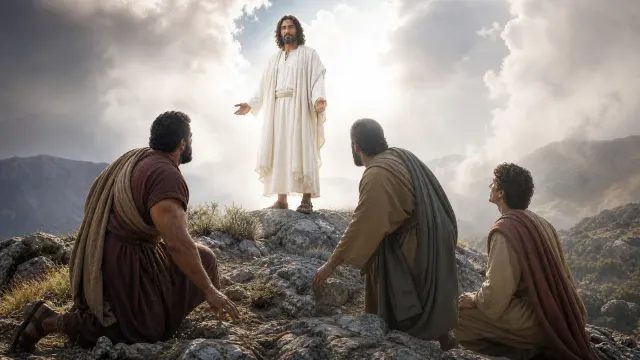
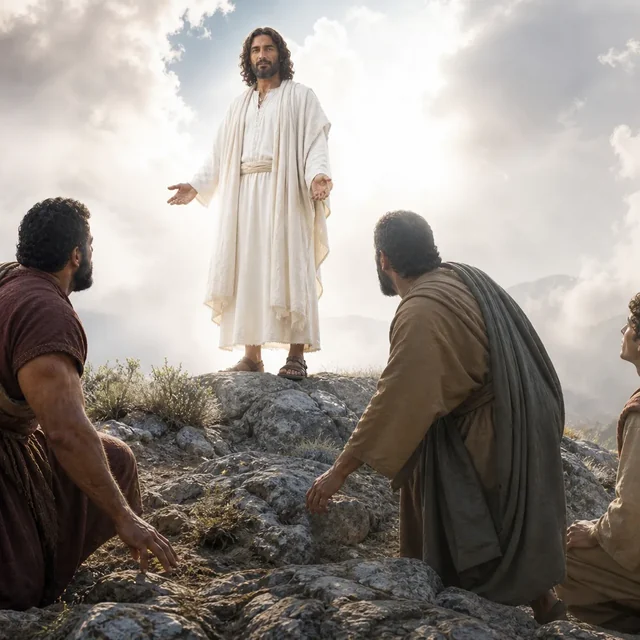
Jesus says some present will see God's kingdom come with might before they die. Six days later he leads Peter, James, and John, three close followers, up a high mountain. His appearance changes, and his clothes shine brighter than any earthly cleaner can make them. Elias, an earlier prophet, and Moses, the lawgiver, appear and speak with him. Frightened and unsure what to say, Peter proposes three shelters. A cloud covers them, and a voice names Jesus as God's loved Son and commands them to listen to him. Suddenly only Jesus remains with them. The sight points them toward his unique standing.

In everyday life
A junior archivist enters a sealed display room and sees a familiar document beside records that reveal its royal origin. What looked ordinary on her desk now carries a weight she had not understood. She listens closely as its place is explained. Jesus' glory and the heavenly voice reveal a person, not the provenance of an object.
Notice
Mark 9:7 The voice directs the followers to listen to Jesus. Peter's attempt to arrange three shelters gives way to a command centred on one Son.
Mark 9:1-8
King James Version1And he said unto them, Verily I say unto you, That there be some of them that stand here, which shall not taste of death, till they have seen the kingdom of God come with power.
2And after six days Jesus taketh with him Peter, and James, and John, and leadeth them up into an high mountain apart by themselves: and he was transfigured before them.
3And his raiment became shining, exceeding white as snow; so as no fuller on earth can white them.
4And there appeared unto them Elias with Moses: and they were talking with Jesus.
5And Peter answered and said to Jesus, Master, it is good for us to be here: and let us make three tabernacles; one for thee, and one for Moses, and one for Elias.
6For he wist not what to say; for they were sore afraid.
7And there was a cloud that overshadowed them: and a voice came out of the cloud, saying, This is my beloved Son: hear him.
8And suddenly, when they had looked round about, they saw no man any more, save Jesus only with themselves.
Mark 9:9-13
The Road Still Includes Suffering
As they descend, Jesus orders the three not to report what they saw until he has risen from death. He calls himself the Son of man. They keep the matter private but puzzle over what rising means. They ask why scribes, teachers of the law, say Elias must come first. Jesus agrees that Elias comes to restore things, then brings them back to Scripture about his own suffering and rejection. He says Elias has already come and been treated as people wished. The earlier messenger's mistreatment and Jesus' coming suffering belong together. The mountain's glory does not remove the hard road below.

In everyday life
A restoration apprentice leaves a ceremony praising the project and asks why the lead worker still speaks of months of damage repair. The honour was real, but it did not finish the work or remove its cost. She must hold both facts together. Jesus speaks of rejected messengers and rising from death, not a difficult restoration schedule.
Notice
Mark 9:10 The three keep Jesus' instruction even while they do not understand it. Their private questions show that obedience and incomplete grasp can exist together.
Mark 9:9-13
King James Version9And as they came down from the mountain, he charged them that they should tell no man what things they had seen, till the Son of man were risen from the dead.
10And they kept that saying with themselves, questioning one with another what the rising from the dead should mean.
11And they asked him, saying, Why say the scribes that Elias must first come?
12And he answered and told them, Elias verily cometh first, and restoreth all things; and how it is written of the Son of man, that he must suffer many things, and be set at nought.
13But I say unto you, That Elias is indeed come, and they have done unto him whatsoever they listed, as it is written of him.
Mark 9:14-29
A Father Asks for Help with Unbelief
A crowd surrounds the remaining followers and arguing scribes. A father says a spirit has harmed his son since childhood and kept him from speaking. The followers could not expel it. The spirit convulses the boy before Jesus. The father pleads for help, admitting both belief and unbelief. Jesus orders the spirit out and forbids its return. After a violent cry the boy lies so still that people think he has died. Jesus takes his hand and lifts him to his feet. Later the followers ask why they failed. Jesus says this kind requires prayer and fasting, going without food while seeking God.

In everyday life
A parent-support counsellor listens as a father says he trusts the care team but still feels overwhelmed by fear. She lets him name both feelings without forcing a brave answer. His request for help does not wait until every doubt is gone. Jesus expels an evil spirit; the counsellor helps a parent speak honestly during care.
Notice
Mark 9:24 The father's plea includes trust and a request for help with its weakness. Jesus does not demand that he pretend to possess confidence he lacks.
Mark 9:14-29
King James Version14And when he came to his disciples, he saw a great multitude about them, and the scribes questioning with them.
15And straightway all the people, when they beheld him, were greatly amazed, and running to him saluted him.
16And he asked the scribes, What question ye with them?
17And one of the multitude answered and said, Master, I have brought unto thee my son, which hath a dumb spirit;
18And wheresoever he taketh him, he teareth him: and he foameth, and gnasheth with his teeth, and pineth away: and I spake to thy disciples that they should cast him out; and they could not.
19He answereth him, and saith, O faithless generation, how long shall I be with you? how long shall I suffer you? bring him unto me.
20And they brought him unto him: and when he saw him, straightway the spirit tare him; and he fell on the ground, and wallowed foaming.
21And he asked his father, How long is it ago since this came unto him? And he said, Of a child.
22And ofttimes it hath cast him into the fire, and into the waters, to destroy him: but if thou canst do any thing, have compassion on us, and help us.
23Jesus said unto him, If thou canst believe, all things are possible to him that believeth.
24And straightway the father of the child cried out, and said with tears, Lord, I believe; help thou mine unbelief.
25When Jesus saw that the people came running together, he rebuked the foul spirit, saying unto him, Thou dumb and deaf spirit, I charge thee, come out of him, and enter no more into him.
26And the spirit cried, and rent him sore, and came out of him: and he was as one dead; insomuch that many said, He is dead.
27But Jesus took him by the hand, and lifted him up; and he arose.
28And when he was come into the house, his disciples asked him privately, Why could not we cast him out?
29And he said unto them, This kind can come forth by nothing, but by prayer and fasting.
Mark 9:30-37
A Child Answers an Argument About Rank
Travelling privately through Galilee, the northern region, Jesus teaches about his approaching betrayal, death, and rising after three days. The followers do not understand and fear asking. In Capernaum, a lakeside town, he asks what they argued about on the road. They stay silent because they debated who was greatest. Jesus says that anyone seeking first place must become last and serve everyone. He places a child among them and takes the child in his arms. Welcoming such a child in his name means welcoming him and the God who sent him. Greatness takes shape in care for someone with little social rank.


In everyday life
A senior camp leader kneels to help the youngest camper tie muddy shoes while other leaders debate whose name belongs first on the noticeboard. The child needs patient help, not a ranking list. The senior leader gives that need her attention. Jesus identifies welcome for a child with welcome for himself and God, not only good camp leadership.
Notice
Mark 9:36 Rather than only pointing, Jesus holds the child. His embrace makes the welcome he describes visible to those seeking rank.
Mark 9:30-37
King James Version30And they departed thence, and passed through Galilee; and he would not that any man should know it.
31For he taught his disciples, and said unto them, The Son of man is delivered into the hands of men, and they shall kill him; and after that he is killed, he shall rise the third day.
32But they understood not that saying, and were afraid to ask him.
33And he came to Capernaum: and being in the house he asked them, What was it that ye disputed among yourselves by the way?
34But they held their peace: for by the way they had disputed among themselves, who should be the greatest.
35And he sat down, and called the twelve, and saith unto them, If any man desire to be first, the same shall be last of all, and servant of all.
36And he took a child, and set him in the midst of them: and when he had taken him in his arms, he said unto them,
37Whosoever shall receive one of such children in my name, receiveth me: and whosoever shall receive me, receiveth not me, but him that sent me.
Mark 9:38-42
Help Is Welcomed and Harm Condemned
John tells Jesus that they stopped a man driving out devils in his name because he did not travel with them. Jesus says not to stop him. Someone acting with such trust in his name is not readily going to speak against him. A person who gives the followers water because they belong to Christ, God's chosen king, will receive a reward. Then Jesus warns about leading a little believer into sin. Being drowned with a heavy millstone would be preferable to causing that harm. He widens their welcome for helpful outsiders while making care for vulnerable believers an urgent duty.

In everyday life
A cycling-club marshal sees an unaffiliated rider give water to an exhausted entrant. Another marshal wants to stop him for lacking the club badge, but she waves him through and thanks him. The help matters more than membership. Jesus speaks of acts in his name and grave harm to believers, not only cooperation at a race.
Notice
Mark 9:41 The cup of water is small, but Jesus says it will not be overlooked. A helpful act does not need a public role to count.
Mark 9:38-42
King James Version38And John answered him, saying, Master, we saw one casting out devils in thy name, and he followeth not us: and we forbad him, because he followeth not us.
39But Jesus said, Forbid him not: for there is no man which shall do a miracle in my name, that can lightly speak evil of me.
40For he that is not against us is on our part.
41For whosoever shall give you a cup of water to drink in my name, because ye belong to Christ, verily I say unto you, he shall not lose his reward.
42And whosoever shall offend one of these little ones that believe in me, it is better for him that a millstone were hanged about his neck, and he were cast into the sea.
Mark 9:43-50
Sin Demands a Decisive Break
Jesus uses severe images of removing a hand, foot, or eye that leads into sin. The point is the cost of breaking with evil, not an instruction to injure the body. Entering life with loss is better than remaining whole and facing hell, pictured through undying worms and unquenched fire. He then speaks of being salted with fire and of offerings seasoned with salt. The exact meaning of that image is debated. It includes testing and the need to retain what is good. He ends by calling the followers to keep salt within themselves and live at peace with one another.
In everyday life
A gambling-harm client hands a trusted supporter the keys to a device he keeps using to place bets. The loss is costly and inconvenient, but keeping unrestricted access has repeatedly deepened the damage. He chooses a firm barrier over another promise alone. Jesus' bodily images address sin and final judgement, not a prescribed treatment for addiction.
Notice
Mark 9:50 The closing command includes peace with one another. Severe speech about sin does not authorise harsh rivalry among the followers who have argued over rank.
Mark 9:43-50
King James Version43And if thy hand offend thee, cut it off: it is better for thee to enter into life maimed, than having two hands to go into hell, into the fire that never shall be quenched:
44Where their worm dieth not, and the fire is not quenched.
45And if thy foot offend thee, cut it off: it is better for thee to enter halt into life, than having two feet to be cast into hell, into the fire that never shall be quenched:
46Where their worm dieth not, and the fire is not quenched.
47And if thine eye offend thee, pluck it out: it is better for thee to enter into the kingdom of God with one eye, than having two eyes to be cast into hell fire:
48Where their worm dieth not, and the fire is not quenched.
49For every one shall be salted with fire, and every sacrifice shall be salted with salt.
50Salt is good: but if the salt have lost his saltness, wherewith will ye season it? Have salt in yourselves, and have peace one with another.
Details worth noticing
The opening image
Mark 9:1 begins with “And he said unto them, Verily I say unto you, That there be some of them that stand here, which shall not taste of death, till they have seen the kingdom…”
Where the chapter turns
Mark 9:27 forms a natural hinge: “But Jesus took him by the hand, and lifted him up; and he arose.”
The final note
Mark 9:50 leaves the reader with “Salt is good: but if the salt have lost his saltness, wherewith will ye season it? Have salt in yourselves, and have peace one with another.”
A word trail through the chapter
The words fire, Jesus, asked, Elias, quenched, spirit help reveal the chapter’s repeated concerns.
KJV words made clear
- transfigured
- Changed in visible appearance, here revealing Jesus in shining glory.
- fuller
- A worker who cleans and whitens cloth.
- wist
- Knew or understood what was happening or what to do.
Music and video connected to the passage
Related media appears when its Scripture reference overlaps this study. Music and video can illuminate a theme while the biblical text remains the foundation.