The big picture
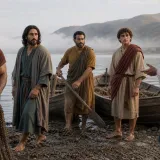
Another hungry crowd gathers around Jesus, the teacher and healer, and he feeds them from a small supply. Yet signs do not produce clear sight in everyone. Opponents demand more proof, and his own followers misunderstand a warning. A blind man receives sight in stages. Then Peter, one of Jesus' close followers, names him as the Christ, God's promised king. Peter still rejects what Jesus says about suffering. The chapter asks what true recognition will mean when the road leads toward death.
In this chapter
- Four Thousand Receive Enough Food Mark 8:1-10
Jesus tells his followers that he feels for the crowd.
- A Warning Is Mistaken for a Bread Problem Mark 8:11-21
The Pharisees, a group strict about religious law, demand a heavenly sign to test Jesus.
- A Blind Man Sees in Stages Mark 8:22-26
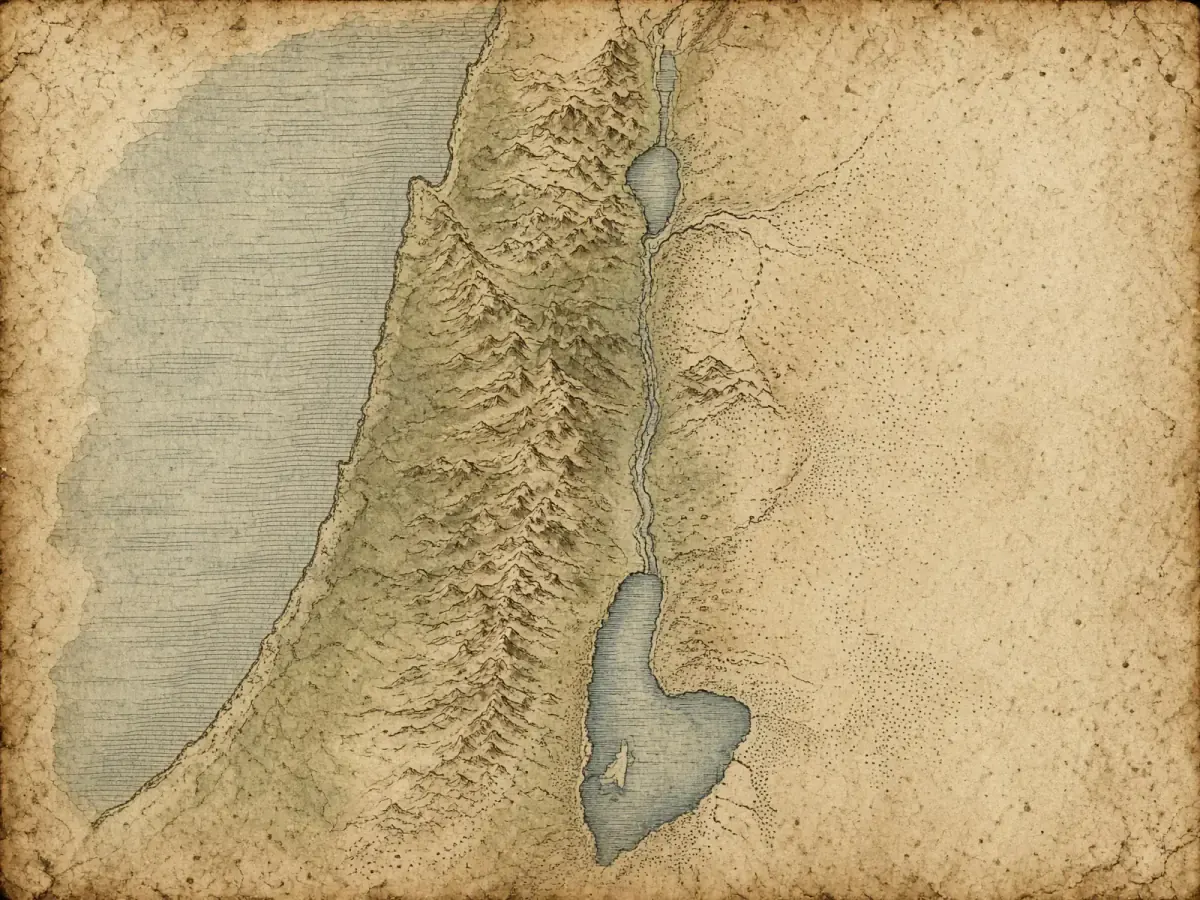
At Bethsaida, a town near the lake, people bring a blind man and ask Jesus to touch him.
- Peter Names Jesus as the Christ Mark 8:27-30
On the way through villages near Cæsarea Philippi, a northern town, Jesus asks what people say about him.
- Peter Resists the Path of Suffering Mark 8:31-33
Jesus speaks openly about what must happen to the Son of man, his name for himself.
- Following Jesus Carries a Cost Mark 8:34-38
Jesus calls both the crowd and his followers to hear what following means.
Central truth
Recognising Jesus as God's king requires more than seeing wonders; it includes accepting his suffering and the cost of following him.

Scripture beside the summary
Mark · King James Version · 38Mark 8:1-10
Four Thousand Receive Enough Food
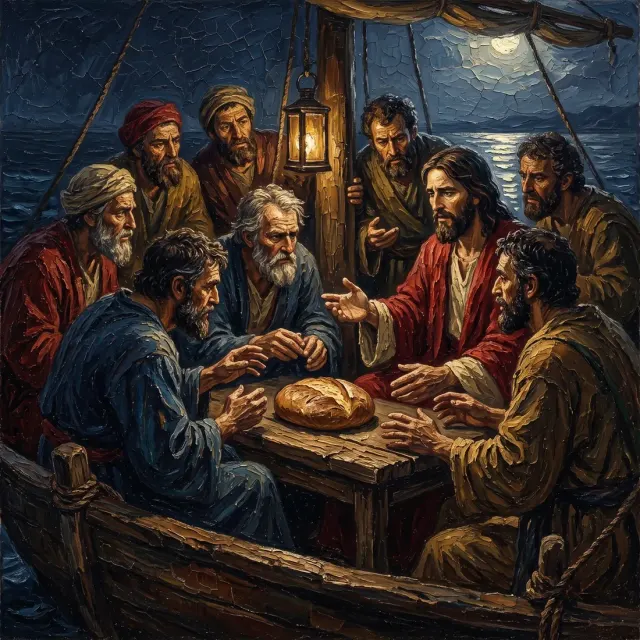
Jesus tells his followers that he feels for the crowd. They have stayed three days and have no food. Some have come far, and he fears they will collapse on the way home. His followers cannot see where bread can be found in such a lonely place. Jesus asks what they have: seven loaves and a few small fish. He seats the crowd, gives thanks, and has the food passed out. About four thousand people eat until satisfied. Seven baskets of leftovers remain. He dismisses them and boards a boat for Dalmanutha, a district by the lake. Compassion leads to food before departure.
In everyday life
A trail warden checks the food left for walkers stranded at a remote rest point. She will not send exhausted people down the long path without a meal. Helpers lay out what is available and serve those waiting. Jesus makes a small supply sufficient for thousands; the warden must obtain the food her group needs.
Notice
Mark 8:3 Jesus considers the trip home as well as the crowd's time with him. His concern reaches to a danger they will face after leaving.
Mark 8:1-10
King James Version1In those days the multitude being very great, and having nothing to eat, Jesus called his disciples unto him, and saith unto them,
2I have compassion on the multitude, because they have now been with me three days, and have nothing to eat:
3And if I send them away fasting to their own houses, they will faint by the way: for divers of them came from far.
4And his disciples answered him, From whence can a man satisfy these men with bread here in the wilderness?
5And he asked them, How many loaves have ye? And they said, Seven.
6And he commanded the people to sit down on the ground: and he took the seven loaves, and gave thanks, and brake, and gave to his disciples to set before them; and they did set them before the people.
7And they had a few small fishes: and he blessed, and commanded to set them also before them.
8So they did eat, and were filled: and they took up of the broken meat that was left seven baskets.
9And they that had eaten were about four thousand: and he sent them away.
10And straightway he entered into a ship with his disciples, and came into the parts of Dalmanutha.
Mark 8:11-21
A Warning Is Mistaken for a Bread Problem
The Pharisees, a group strict about religious law, demand a heavenly sign to test Jesus. He sighs, refuses, and leaves by boat. The followers have brought only one loaf. When he warns against the leaven of the Pharisees and Herod, the regional ruler, they think he means their missing bread. He challenges their dull hearing and sight. Have they forgotten the two great meals and the baskets left afterward? They can recall the numbers but still miss the meaning. He is warning about corrupting influence, not a shortage he has already shown he can meet. Memory of an event is not yet understanding.
In everyday life
A food-safety trainer warns assistants about a rumour spreading through a catering course. They start counting flour bags because she uses the word spread. She asks them to recall the actual problem discussed that morning. Familiar words have pulled them away from her meaning. Jesus exposes spiritual dullness despite miracles, not a classroom misunderstanding alone.
Notice
Mark 8:20 The followers remember seven baskets from the second meal. Their correct answer makes the lack of understanding more striking, since the facts have not been forgotten.
Mark 8:11-21
King James Version11And the Pharisees came forth, and began to question with him, seeking of him a sign from heaven, tempting him.
12And he sighed deeply in his spirit, and saith, Why doth this generation seek after a sign? verily I say unto you, There shall no sign be given unto this generation.
13And he left them, and entering into the ship again departed to the other side.
14Now the disciples had forgotten to take bread, neither had they in the ship with them more than one loaf.
15And he charged them, saying, Take heed, beware of the leaven of the Pharisees, and of the leaven of Herod.
16And they reasoned among themselves, saying, It is because we have no bread.
17And when Jesus knew it, he saith unto them, Why reason ye, because ye have no bread? perceive ye not yet, neither understand? have ye your heart yet hardened?
18Having eyes, see ye not? and having ears, hear ye not? and do ye not remember?
19When I brake the five loaves among five thousand, how many baskets full of fragments took ye up? They say unto him, Twelve.
20And when the seven among four thousand, how many baskets full of fragments took ye up? And they said, Seven.
21And he said unto them, How is it that ye do not understand?
Mark 8:22-26
A Blind Man Sees in Stages
At Bethsaida, a town near the lake, people bring a blind man and ask Jesus to touch him. Jesus takes his hand and leads him outside the town. He puts spit on the man's eyes, lays hands on him, and asks what he sees. The man sees people but cannot make them out clearly; they look like moving trees. Jesus touches his eyes again. Now his sight is clear and complete. Jesus sends him home without returning through the town or spreading the news there. Mark gives this healing in two stages, with partial sight followed by full sight.
In everyday life
A telescope tutor asks a learner what she can see through an unfocused lens. She can detect bright shapes but not distinguish their edges. A further adjustment brings the view into focus, and she describes details that were hidden a moment before. Jesus restores a person's eyes, not the setting of an optical device.
Notice
Mark 8:24 The man honestly reports partial sight rather than claiming the work is complete. Jesus responds with another touch until he can see clearly.
Mark 8:22-26
King James Version22And he cometh to Bethsaida; and they bring a blind man unto him, and besought him to touch him.
23And he took the blind man by the hand, and led him out of the town; and when he had spit on his eyes, and put his hands upon him, he asked him if he saw ought.
24And he looked up, and said, I see men as trees, walking.
25After that he put his hands again upon his eyes, and made him look up: and he was restored, and saw every man clearly.
26And he sent him away to his house, saying, Neither go into the town, nor tell it to any in the town.
Mark 8:27-30
Peter Names Jesus as the Christ
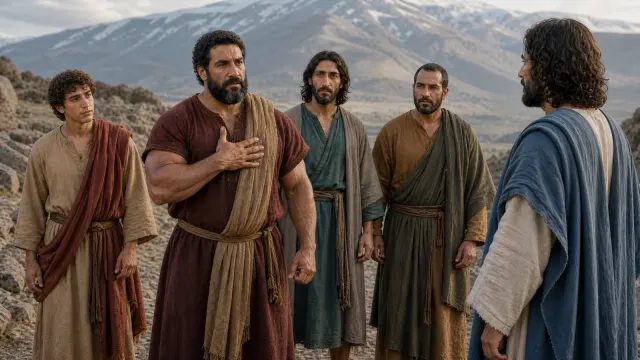
On the way through villages near Cæsarea Philippi, a northern town, Jesus asks what people say about him. The followers report several answers. Some identify him with John the Baptist, the preacher killed by Herod. Others name Elias, an earlier prophet, or one of God's other prophets. Jesus then asks for their own answer. Peter says he is the Christ. This title means God's chosen king, more than another messenger. Jesus firmly tells them not to spread this claim. The answer is true, but the next exchange shows that Peter has not yet understood what kind of path this king must take.
In everyday life
A music student stops repeating other listeners' guesses and names the conductor standing before the class as the composer of the work. She has recognised his role, though she has not yet heard his explanation of the piece. A correct title is a beginning. Peter names God's Christ, whose identity carries a claim far greater than artistic authorship.
Notice
Mark 8:29 Jesus asks what the followers themselves say after hearing the crowd's opinions. Peter's answer commits him to a claim rather than another report of hearsay.
Mark 8:27-30
King James Version27And Jesus went out, and his disciples, into the towns of Cæsarea Philippi: and by the way he asked his disciples, saying unto them, Whom do men say that I am?
28And they answered, John the Baptist: but some say, Elias; and others, One of the prophets.
29And he saith unto them, But whom say ye that I am? And Peter answereth and saith unto him, Thou art the Christ.
30And he charged them that they should tell no man of him.
Mark 8:31-33
Peter Resists the Path of Suffering
Jesus speaks openly about what must happen to the Son of man, his name for himself. Elders, chief priests, and law teachers will reject him. He will suffer, be killed, and rise after three days. Peter takes him aside and starts to correct him. Jesus turns toward the followers and sharply rebukes Peter, calling him Satan, the enemy of God. Peter's thinking sides with human hopes rather than God's purpose. The man who named Jesus rightly now opposes the path Jesus names. A title of honour has not prepared him to accept rejection, death, and rising as part of Jesus' work.
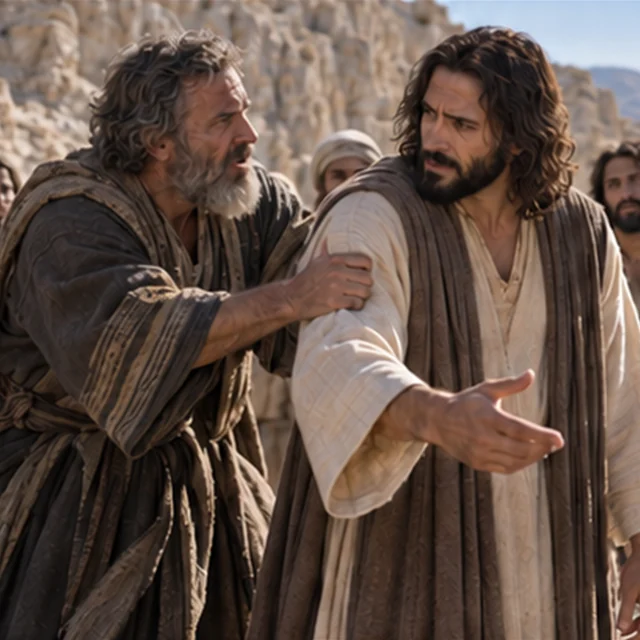
In everyday life
A rescue-plan volunteer pulls the leader aside and urges her to avoid the costly route that will reach the trapped group. He praises her role but wants it without danger. She refuses advice that would abandon the people she came to reach. Jesus describes a necessary death and rising under God's purpose, not one risky rescue option.
Notice
Mark 8:33 Jesus turns to look at the followers before correcting Peter. The error is important for the whole group, not only a private disagreement.
Mark 8:31-33
King James Version31And he began to teach them, that the Son of man must suffer many things, and be rejected of the elders, and of the chief priests, and scribes, and be killed, and after three days rise again.
32And he spake that saying openly. And Peter took him, and began to rebuke him.
33But when he had turned about and looked on his disciples, he rebuked Peter, saying, Get thee behind me, Satan: for thou savourest not the things that be of God, but the things that be of men.
Mark 8:34-38
Following Jesus Carries a Cost
Jesus calls both the crowd and his followers to hear what following means. A person must deny self-rule, carry a cross, and follow him. A cross is an instrument of execution, so this image carries a real threat of death. Trying to preserve life at all costs will lose it, while losing it for Jesus and the good news will save it. Gaining the whole world cannot replace a lost soul. Jesus also warns that being ashamed of him now has consequences when he comes in his Father's glory with angels. His call places lasting life above present safety and approval.
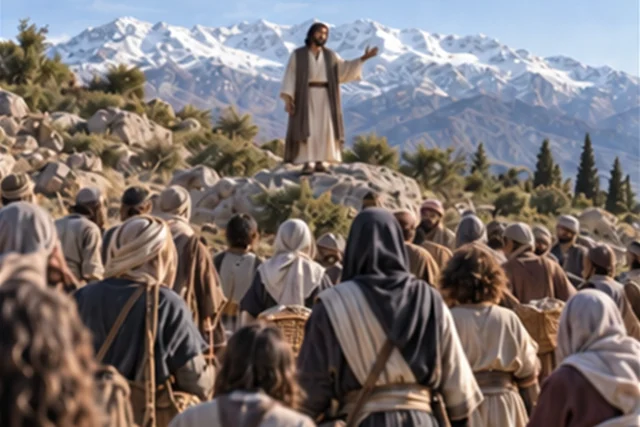
In everyday life
A threatened witness leaves a secure post rather than withdraw evidence that protects vulnerable workers. He packs his desk knowing that keeping his income by silence would cost something he cannot buy back. The choice reaches past immediate gain. Jesus speaks of losing life for him and receiving lasting life, not only preserving personal integrity.
Notice
Mark 8:36 The question about gaining the world gives the largest possible profit and still calls it insufficient. No amount of success can compensate for the loss Jesus names.
Mark 8:34-38
King James Version34And when he had called the people unto him with his disciples also, he said unto them, Whosoever will come after me, let him deny himself, and take up his cross, and follow me.
35For whosoever will save his life shall lose it; but whosoever shall lose his life for my sake and the gospel’s, the same shall save it.
36For what shall it profit a man, if he shall gain the whole world, and lose his own soul?
37Or what shall a man give in exchange for his soul?
38Whosoever therefore shall be ashamed of me and of my words in this adulterous and sinful generation; of him also shall the Son of man be ashamed, when he cometh in the glory of his Father with the holy angels.
Details worth noticing
The opening image
Mark 8:1 begins with “In those days the multitude being very great, and having nothing to eat, Jesus called his disciples unto him, and saith unto them,”
Where the chapter turns
Mark 8:19 forms a natural hinge: “When I brake the five loaves among five thousand, how many baskets full of fragments took ye up? They say unto him, Twelve.”
The final note
Mark 8:38 leaves the reader with “Whosoever therefore shall be ashamed of me and of my words in this adulterous and sinful generation; of him also shall the Son of man be ashamed, when he…”
A word trail through the chapter
The words disciples, took, seven, bread, asked, baskets help reveal the chapter’s repeated concerns.
KJV words made clear
- leaven
- Yeast that spreads through dough, here an image of spreading influence.
- savourest
- Set your mind or desires on a particular thing.
Music and video connected to the passage
Related media appears when its Scripture reference overlaps this study. Music and video can illuminate a theme while the biblical text remains the foundation.