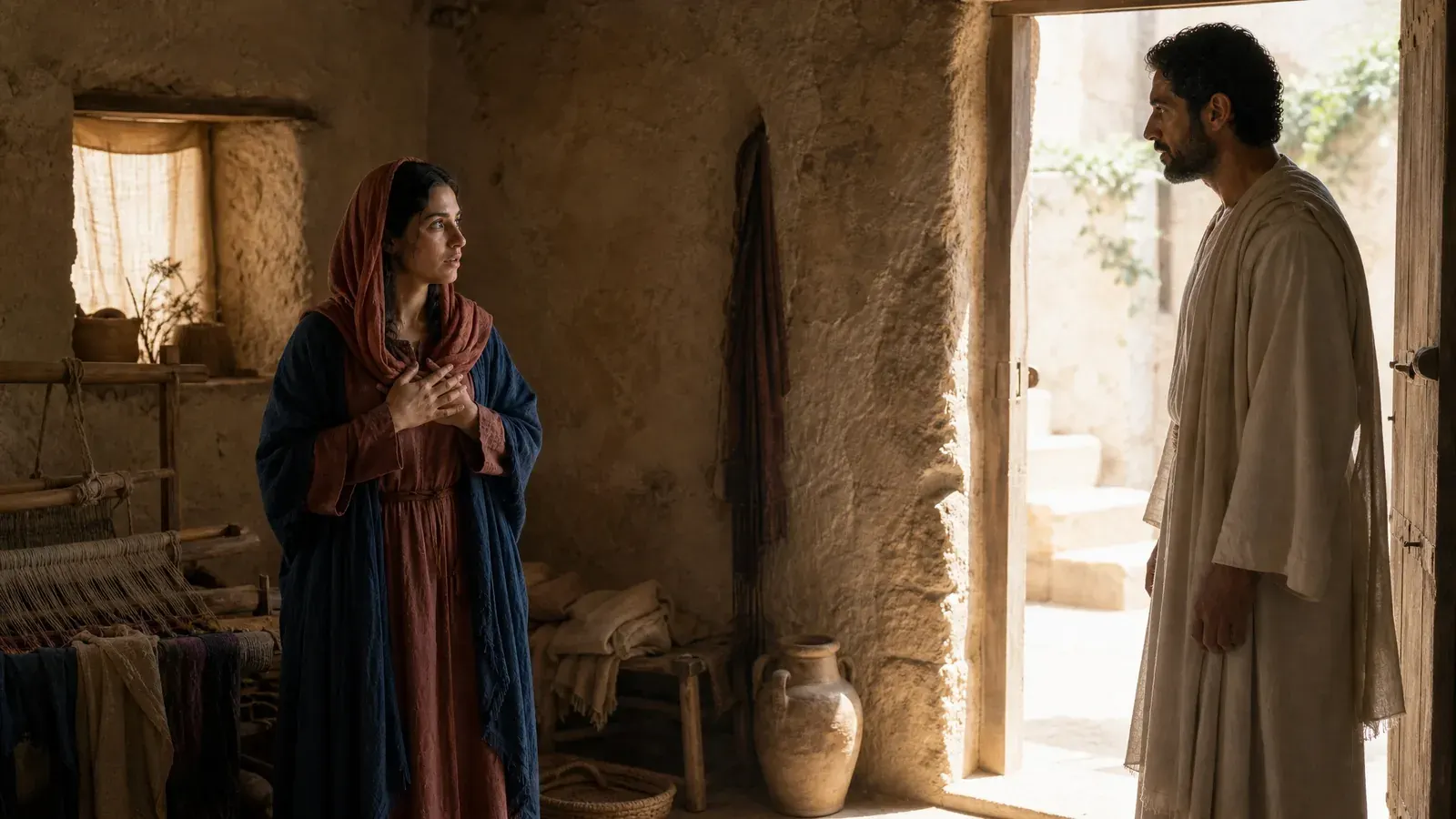
1:26And in the sixth month the angel Gabriel was sent from God unto a city of Galilee, named Nazareth,
1:27To a virgin espoused to a man whose name was Joseph, of the house of David; and the virgin’s name was Mary.
1:28And the angel came in unto her, and said, Hail, thou that art highly favoured, the Lord is with thee: blessed art thou among women.
1:29And when she saw him, she was troubled at his saying, and cast in her mind what manner of salutation this should be.
1:30And the angel said unto her, Fear not, Mary: for thou hast found favour with God.
1:31And, behold, thou shalt conceive in thy womb, and bring forth a son, and shalt call his name JESUS.
1:32He shall be great, and shall be called the Son of the Highest: and the Lord God shall give unto him the throne of his father David:
1:33And he shall reign over the house of Jacob for ever; and of his kingdom there shall be no end.
1:34Then said Mary unto the angel, How shall this be, seeing I know not a man?
1:35And the angel answered and said unto her, The Holy Ghost shall come upon thee, and the power of the Highest shall overshadow thee: therefore also that holy thing which shall be born of thee shall be called the Son of God.
1:36And, behold, thy cousin Elisabeth, she hath also conceived a son in her old age: and this is the sixth month with her, who was called barren.
1:37For with God nothing shall be impossible.
1:38And Mary said, Behold the handmaid of the Lord; be it unto me according to thy word. And the angel departed from her.





Gabriel's previous appointment was beside the incense altar in Jerusalem. This one is in Nazareth, with no priestly office, public ceremony, or crowd waiting outside. The scale of the announcement has increased while the setting has become less imposing. David's throne and an unending kingdom are being discussed with a woman whose town needs introducing by name.
The Book of Luke makes the comparison with Zacharias precise. Both receive an announcement of a son; both ask a question. But Zacharias asks for assurance that the promise will happen, and the angel explicitly identifies his unbelief. Mary asks how conception will occur, and receives an explanation rather than a rebuke. The text does not treat all questions as the same question. Her final answer is willing submission, not a claim to understand the mechanics. Nor is the promised kingdom merely a grand way of saying that the child will become impressive. The throne, the house of Jacob, and the endless reign draw on the covenant with David in 2 Samuel 7:12-16. Nazareth has no throne room. The promise arrives there anyway.