New · FreePlay The Witnesses The in-depth puzzle battle quest through Bible history

Places of the Bible

Jericho

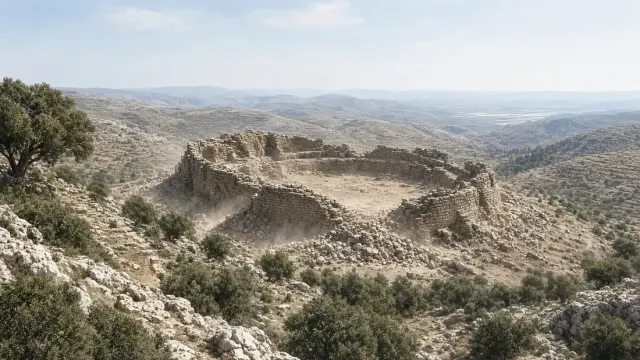
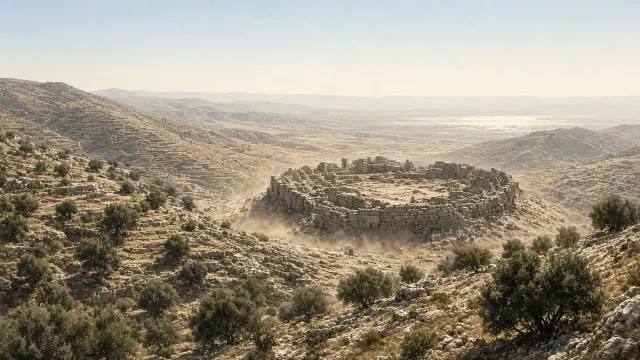
The first city in the land, taken by a plan that involved no fighting until the seventh day.

It is described as straitly shut up because of the children of Israel, none went out and none came in, which means the city knew what was coming. The report Rahab gives the spies explains why: they had heard about the Red Sea forty years earlier and about Sihon and Og, and our hearts did melt. The intelligence the spies bring back is not about walls or gates, it is about morale, and it is delivered by a woman inside the city.

Where it appearsJoshua 2 · Joshua 6 · Luke 19

Scroll down to the account

The movements, in the order the text gives them.

The Account of Jericho

  1. 01

    Joshua 2:8-11

    Our hearts did melt

    Rahab tells the spies what the city has been hearing for forty years. The strongest wall in the account is already down before anyone marches.

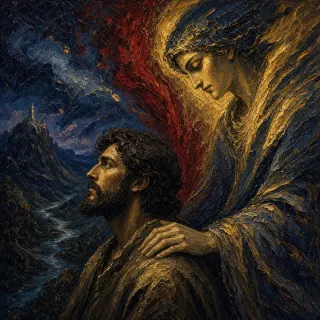
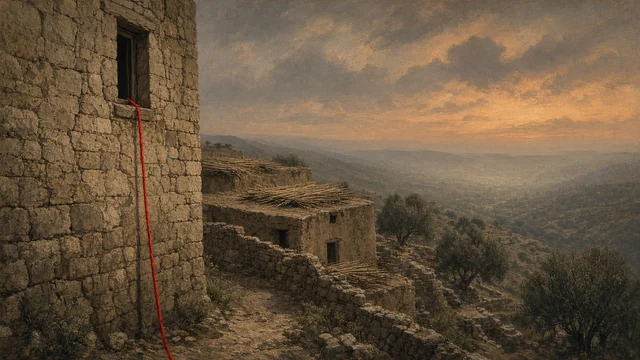
    The strongest declaration of Israel's victory comes from inside the city Israel has not yet entered. Rahab says the LORD hath given you the land while Jericho's walls are still standing. The spies came to discover the condition of the country; a woman on a rooftop tells them that its confidence has already collapsed.

    Her knowledge has a history. The sea crossing is not recent news, but its effect has lasted, and the defeats of Sihon and Og have brought that distant report close to home. Rahab links both events to the same LORD. Her conclusion reaches beyond a frightened admission that Israel has the stronger army: he is God in heaven above, and in earth beneath. The geography of that confession leaves no separate territory for a rival god.

    The chapter does not confuse terror with trust. Rahab reports fear throughout the city, but her own response includes protecting the messengers and seeking an oath for her household. The same news reaches many ears; the text singles out what she does with it. At the end of the chapter the spies return with her assessment almost on their lips. Jericho has supplied the report against itself.

    Verse by verse

    1. 2:9

      Hath given presents the land as already granted, before the Jordan crossing and before Jericho's walls fall.

    2. 2:10

      Sihon and Og were defeated east of the Jordan; their defeats are recorded in Numbers 21:21-35.

    3. 2:11

      The Hebrew ruach behind courage can mean spirit or breath. Here the context concerns the collapse of the inhabitants' resolve.

    Joshua 2:8-11

    King James Version · 4 verses

    2:8And before they were laid down, she came up unto them upon the roof;

    2:9And she said unto the men, I know that the LORD hath given you the land, and that your terror is fallen upon us, and that all the inhabitants of the land faint because of you.

    2:10For we have heard how the LORD dried up the water of the Red sea for you, when ye came out of Egypt; and what ye did unto the two kings of the Amorites, that were on the other side Jordan, Sihon and Og, whom ye utterly destroyed.

    2:11And as soon as we had heard these things, our hearts did melt, neither did there remain any more courage in any man, because of you: for the LORD your God, he is God in heaven above, and in earth beneath.

    Joshua 2:8-11: Our hearts did melt
  2. 02

    Joshua 6:2-5

    Ye shall compass the city

    The orders are about walking, silence and counting. The only weapon named is a trumpet made from a ram’s horn.

    The city is shut, but the promise is already phrased as a gift delivered: I have given. Joshua 6:1 and 6:2 stand next to each other with that deliberate contrast. The gates describe what Israel can see; the declaration describes what the LORD has determined.

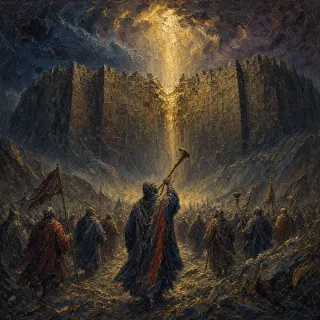
    The instructions are unusually crowded with priests, horns, and sevens for an assault on a fortified city. The ark is not luggage brought along for morale. It occupies the procession's centre of attention, and the military men move within an order governed by it. For six days, the prescribed achievement is to go around the city and return. No battering ram receives a mention.

    The seventh day is different, but it is not uncontrolled noise that brings the plan to its conclusion. A long blast signals a commanded shout, after which the people advance straight ahead. The passage gives the sequence and attributes the city to God's gift; it does not explain a natural acoustic mechanism for collapsing stonework. Turning the horns into ingenious siege technology would miss the point of the instructions. Israel is not being taught a reusable trick for knocking down walls.

    Verse by verse

    1. 6:2

      The gift is announced while the city remains closed in verse 1. The statement precedes the military result.

    2. 6:4

      Seven describes the priests, horns, final day, and final day's circuits. The passage does not identify that day by a weekday name.

    3. 6:5

      Every man straight before him describes direct access after the wall falls. No special breach or single gate is specified.

    Joshua 6:2-5

    King James Version · 4 verses

    6:2And the LORD said unto Joshua, See, I have given into thine hand Jericho, and the king thereof, and the mighty men of valour.

    6:3And ye shall compass the city, all ye men of war, and go round about the city once. Thus shalt thou do six days.

    6:4And seven priests shall bear before the ark seven trumpets of rams’ horns: and the seventh day ye shall compass the city seven times, and the priests shall blow with the trumpets.

    6:5And it shall come to pass, that when they make a long blast with the ram’s horn, and when ye hear the sound of the trumpet, all the people shall shout with a great shout; and the wall of the city shall fall down flat, and the people shall ascend up every man straight before him.

    Joshua 6:2-5: Ye shall compass the city
  3. 03

    Joshua 6:10

    Ye shall not shout

    The hardest part of the instruction is the restraint. Six days of doing something conspicuous while saying nothing at all.

    The march is not silent. The people are. The preceding verse has the priests blowing their trumpets, and verse 13 repeats the detail. Joshua's prohibition concerns the human voice, not every sound in the procession. Leaving out the horns changes the scene.

    The order tightens as it proceeds: no shout, no vocal noise, not a word from the mouth. There is remarkably little room for creative interpretation. Then the same voice that is forbidden becomes required, but only at Joshua's command. The difference is not between sound as bad and silence as good. It is between a controlled signal and a crowd supplying its own timing.

    The chapter also puts God's declaration that the city is given before the eventual shout. The people are not trying to make enough noise to persuade God to act. Their shout belongs inside an action already promised and specifically ordered. The emphasis rests on the timing of obedience, not on the volume of religious enthusiasm. Even the loudest moment has to wait its turn.

    Verse by verse

    1. 6:10

      The words with your voice limit the prohibition. Trumpet sounds are expressly present in the surrounding verses.

    2. 6:10

      Until makes the silence temporary. The same sentence both forbids the premature shout and commands the properly timed one.

    Joshua 6:10

    King James Version · 1 verse

    6:10And Joshua had commanded the people, saying, Ye shall not shout, nor make any noise with your voice, neither shall any word proceed out of your mouth, until the day I bid you shout; then shall ye shout.

    Joshua 6:10: Ye shall not shout
  4. 04

    Joshua 6:20-25

    The wall fell down flat

    The shout comes on the seventh circuit of the seventh day, and the two spies are sent to keep a promise made through a window.

    The verse after the famous falling wall names the people killed. Men and women, young and old: the sentence includes the city's noncombatants. A commentary that stops at the masonry has stopped before the passage's hardest words. The Book of Joshua presents this destruction within the city's devotion to the LORD in 6:17, not as a battle in which only soldiers die.

    Against that comprehensive destruction stands a carefully remembered oath. The two men who accepted Rahab's protection are the men charged with bringing her household out. Their earlier promise is not dissolved by the assault. The account names her family members, then widens the rescue to all her kindred. The city is treated collectively, but this household is not lost inside that collective description.

    There is also movement in Rahab's position: first outside the camp in verse 23, then dwelling in Israel in verse 25. The passage does not describe the intervening admission ceremony, so none should be invented. It does state the result. Rahab is not merely spared and left among the ruins. The woman who confessed Israel's God now has a place among Israel.

    Verse by verse

    1. 6:21

      Utterly destroyed belongs to the language of devoted destruction. The verse explicitly includes women and the young, not only combatants.

    2. 6:23

      Without the camp means outside it. No specific purification procedure is recorded here, though verse 25 subsequently places Rahab in Israel.

    3. 6:25

      Matthew 1:5 names Rachab in the ancestry of Jesus. Joshua's continuing identification of Rahab as a harlot is not replaced with a more respectable occupation.

    Joshua 6:20-25

    King James Version · 6 verses

    6:20So the people shouted when the priests blew with the trumpets: and it came to pass, when the people heard the sound of the trumpet, and the people shouted with a great shout, that the wall fell down flat, so that the people went up into the city, every man straight before him, and they took the city.

    6:21And they utterly destroyed all that was in the city, both man and woman, young and old, and ox, and sheep, and ass, with the edge of the sword.

    6:22But Joshua had said unto the two men that had spied out the country, Go into the harlot’s house, and bring out thence the woman, and all that she hath, as ye sware unto her.

    6:23And the young men that were spies went in, and brought out Rahab, and her father, and her mother, and her brethren, and all that she had; and they brought out all her kindred, and left them without the camp of Israel.

    6:24And they burnt the city with fire, and all that was therein: only the silver, and the gold, and the vessels of brass and of iron, they put into the treasury of the house of the LORD.

    6:25And Joshua saved Rahab the harlot alive, and her father’s household, and all that she had; and she dwelleth in Israel even unto this day; because she hid the messengers, which Joshua sent to spy out Jericho.

    Joshua 6:20-25: The wall fell down flat
  5. 05

    Luke 19:1-10

    Zacchaeus, make haste and come down

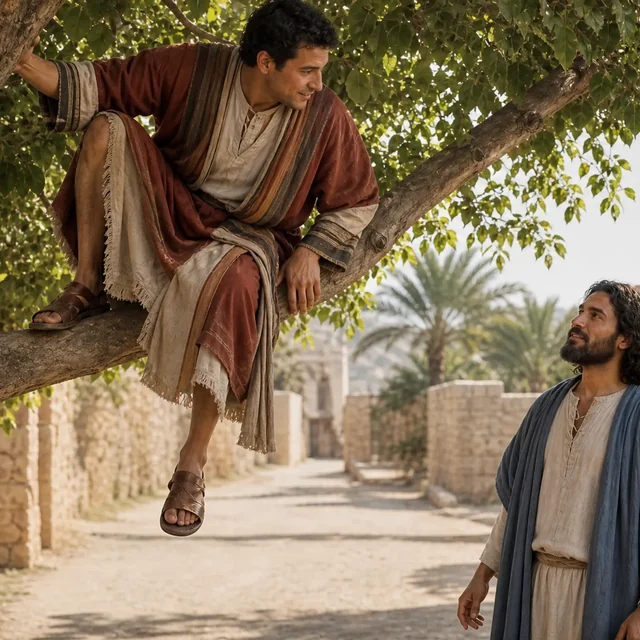
    The last time Jericho appears, a rich man climbs a tree in it and a house that owed the town money starts paying it back fourfold.

    A chief tax collector has climbed a tree because his position in the city cannot get him a view through the crowd. Luke puts rich and little of stature close together, and the contrast supplies its own dry humour. Authority and money have not added an inch.

    The deeper turn is in the direction of the search. Zacchaeus seeks to see Jesus in verse 3; Jesus describes his own purpose as seeking and saving the lost in verse 10. The man looking down from the branches is himself being addressed. Jesus names the house visit before Zacchaeus makes his declaration about money, and the crowd's complaint follows the welcome. Their category is sinner; Jesus' final designation is also a son of Abraham.

    Zacchaeus' words are anything but vague generosity. Half his property concerns the poor, and fourfold repayment concerns anyone wronged through false accusation. Readers differ over whether the present-tense verbs describe an established practice or announce a new commitment, but either reading leaves concrete sums on the table. The passage ends with salvation, not with a paid admission fee. Jericho's tax collector is found, and the consequences reach his household and his accounts.

    Verse by verse

    1. 19:2

      Publicans are tax collectors, not tavern keepers. Luke identifies Zacchaeus as chief among them and explicitly says he was rich.

    2. 19:3

      The press means the crowd. Luke 18:35-43 has just described another encounter near Jericho in which access to sight matters.

    3. 19:8

      The Greek verbs for give and restore are present tense. Their force is disputed between a declaration of practice and a pledge taking effect now.

    4. 19:9

      He also is a son of Abraham answers the social exclusion voiced in verse 7; it does not say that his gift purchases ancestry or salvation.

    Luke 19:1-10

    King James Version · 10 verses

    19:1And Jesus entered and passed through Jericho.

    19:2And, behold, there was a man named Zacchæus, which was the chief among the publicans, and he was rich.

    19:3And he sought to see Jesus who he was; and could not for the press, because he was little of stature.

    19:4And he ran before, and climbed up into a sycomore tree to see him: for he was to pass that way.

    19:5And when Jesus came to the place, he looked up, and saw him, and said unto him, Zacchæus, make haste, and come down; for to day I must abide at thy house.

    19:6And he made haste, and came down, and received him joyfully.

    19:7And when they saw it, they all murmured, saying, That he was gone to be guest with a man that is a sinner.

    19:8And Zacchæus stood, and said unto the Lord; Behold, Lord, the half of my goods I give to the poor; and if I have taken any thing from any man by false accusation, I restore him fourfold.

    19:9And Jesus said unto him, This day is salvation come to this house, forsomuch as he also is a son of Abraham.

    19:10For the Son of man is come to seek and to save that which was lost.

    Luke 19:1-10: Zacchaeus, make haste and come down

Why it matters

The instructions are almost absurd as military orders and that is the point. Compass the city once a day for six days with seven priests bearing seven trumpets of rams’ horns before the ark, and on the seventh day seven times, and the people shall not shout nor make any noise with their voice until the day I bid you shout. Six days of silence and walking. The city is put under a ban, the metal goes into the treasury, and Rahab’s household is fetched out by the two men who had promised.

6 songs

The music

Every song in the catalogue whose passage falls inside these chapters.

  1. Joshua 1:1-2:24

    Be Strong and Very Courageous

  2. Joshua 2

    A Cord of Scarlet

  3. Joshua 5:1-6:27

    The Seventh Circuit

  4. Joshua 5:13-6:27

    The Walls Came Down

  5. Joshua 6

    The Walls Come Down

  6. Luke 19:1-10

    Come Down, Zacchaeus

    Play here
    Open song pageRead lyrics

Nearby

All the places

Report an error on this page