
Acts 9:1–22
Paul meets Jesus on the road

Ages 8 to 11
The account
Saul was trying to stop people who followed Jesus. He went to the high priest and asked for letters that would let him find believers in Damascus and bring them back to Jerusalem as prisoners.
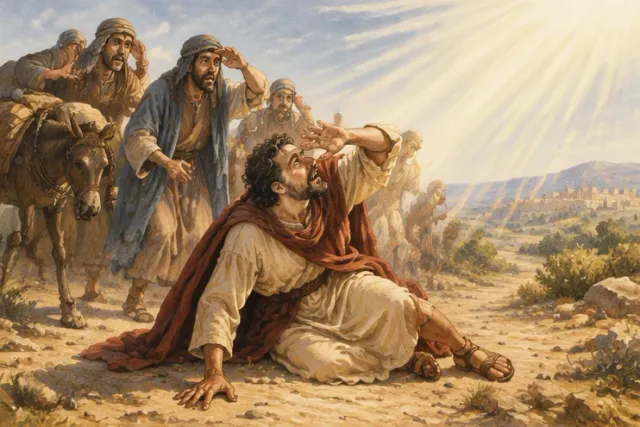
As Saul came near Damascus, a light from heaven suddenly shone around him. He fell to the ground and heard a voice asking why he was persecuting him. Saul asked who was speaking. The voice told him it was Jesus. Jesus told Saul to go into the city and wait to be told what to do.
The men traveling with Saul heard a voice but saw no one. Saul stood up unable to see, so they led him by the hand into Damascus. For three days he was blind and did not eat or drink.
In Damascus, the Lord spoke in a vision to a disciple named Ananias and told him where to find Saul. Ananias knew Saul had harmed believers, but the Lord said Saul was chosen to carry his name before Gentiles, kings and the children of Israel.
Ananias went to Saul and laid his hands on him. He said Jesus had sent him so Saul could receive his sight and be filled with the Holy Ghost. Something like scales fell from Saul's eyes. Saul could see, was baptized, ate and became stronger. Soon he preached in the synagogues that Christ is the Son of God. The people were amazed.
Memory verse
And straightway he preached Christ in the synagogues, that he is the Son of God.
Acts 9:20
Talk about it
- What was Saul planning to do when he traveled toward Damascus?
- What happened to Saul near Damascus?
- What did Ananias do when the Lord sent him to Saul?
Try this
Fold a sheet of paper in half. On one side, draw or list what Saul was doing at the beginning of the account; on the other, draw or list what he was doing at the end.
What can we learn?
This account can help us remember that people can change in ways others do not expect. It also shows the value of obeying God even when a task feels difficult.
Ages 12 to 15
The account
Acts 9 opens with Saul actively opposing the disciples of Jesus. He went to the high priest and asked for letters to the synagogues in Damascus. His purpose was to find people who belonged to this way, men or women, bind them and bring them to Jerusalem. For the believers there, Saul was not an unknown critic. He was coming with authority to arrest them.
As Saul approached Damascus, a light from heaven suddenly shone around him. He fell to the ground and heard a voice ask why he was persecuting him. Saul asked who was speaking, and the answer identified the speaker as Jesus. Saul was told to enter the city, where he would learn what he must do. The men traveling with him stood speechless. They heard a voice but saw no man.
When Saul rose, he could not see. His companions led him by the hand into Damascus. For three days he remained without sight and neither ate nor drank.
Meanwhile, the Lord spoke in a vision to a disciple in Damascus named Ananias. He was told to go to the street called Straight, to the house of Judas, and ask for Saul of Tarsus. Ananias knew Saul's reputation. He answered that he had heard how much harm Saul had done to the saints in Jerusalem and that Saul had authority in Damascus to bind believers. The Lord told Ananias to go, describing Saul as a chosen vessel who would bear his name before Gentiles, kings and the children of Israel, and who would suffer for that name.
Ananias obeyed. He entered the house, laid his hands on Saul and said that Jesus, who had appeared to Saul on the road, had sent him so Saul could receive his sight and be filled with the Holy Ghost. Something like scales fell from Saul's eyes. He could see again, rose and was baptized. After eating, he regained strength.
Saul then spent time with the disciples in Damascus. Almost immediately, he preached Christ in the synagogues, declaring that he is the Son of God. His listeners were amazed because they knew why he had come. Yet Saul grew stronger and confounded the Jews living in Damascus by proving that Jesus is the Christ.
Memory verse
And straightway he preached Christ in the synagogues, that he is the Son of God.
Acts 9:20
Think about it
- Why would Ananias have had a serious reason to hesitate when he was told to visit Saul?
- What does Ananias's response show about obeying God when the situation is difficult?
- Why were the people in the synagogues amazed to hear Saul preaching about Jesus?
- What does the change in Saul's actions show about the difference between his purpose at the start and his purpose at the end?
Going deeper
Earlier in Acts, Saul had approved of Stephen's death and had made havoc of the church (Acts 7:58; 8:1–3). Here, the direction of his life changes sharply. The Lord's words to Ananias also point ahead to the rest of Acts, where Saul, later called Paul, carries the name of Jesus among Gentiles, Israelites and rulers.
What can we learn?
A person's past does not tell us everything about what that person may become. This account also suggests that faithful obedience can mean stepping into a situation that feels risky, as Ananias did, while trusting what God has said.