
2 Samuel
24 Chapters
2 Samuel: The Whole Book, Chapter by Chapter
A Crown Arrives, and David Mourns
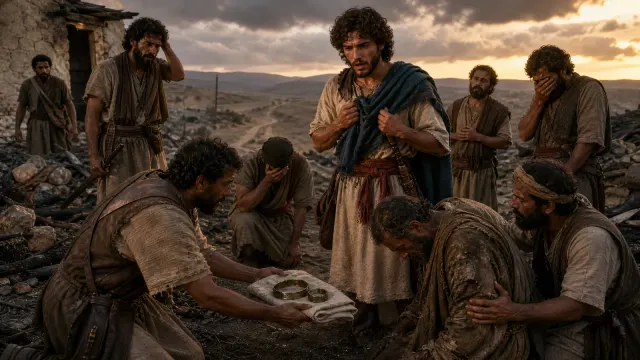
A messenger reaches Ziklag carrying Saul's crown, bracelet, and a claim that he personally ended the wounded king's life. The royal objects establish that Saul is dead, but they do not settle every detail of the man's account, which differs from the closing report of 1 Samuel. David does not seize on the news as the moment his long struggle has finally paid. He and his men tear their clothes, mourn, weep, and fast for Saul, Jonathan, and Israel. Only after grief comes judgment, and the messenger is condemned by the testimony of his own mouth that he killed the LORD's anointed. The chapter then refuses to end on punishment or accession. David composes a lament to be taught in Judah, praises Saul's strength and gifts, names Jonathan as "my brother," and closes with the repeated cry, "How are the mighty fallen!" A crown has arrived, but David's last possession in the chapter is a song of grief.
One complete chapter pageOpen chapter →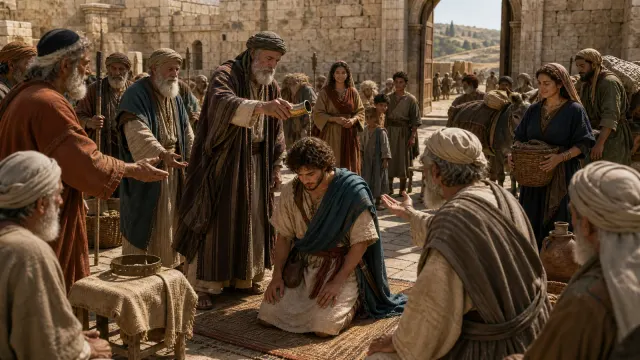
Two Kings, One People, and a Widening Wound
David asks the LORD not only whether he should enter Judah but where, and the answer takes him to Hebron rather than straight to a claim over every tribe. Judah anoints him king, while Abner moves Ishbosheth to Mahanaim and establishes Saul's son over Israel. The divided succession soon takes visible form at the pool of Gibeon. Abner proposes that selected young men "play," Joab agrees, and the equal groups kill one another before the contest spreads into a sore battle. Asahel's remarkable speed then becomes the means by which he refuses to break off pursuit of Abner. Twice warned, he continues and is killed, creating a personal blood claim that will survive the day's fighting. At sunset Abner appeals to the fact that the pursuers and pursued are brethren. Joab sounds the trumpet, yet the unequal casualty count and Asahel's burial make clear that stopping the sword has not healed the division.
One complete chapter pageOpen chapter →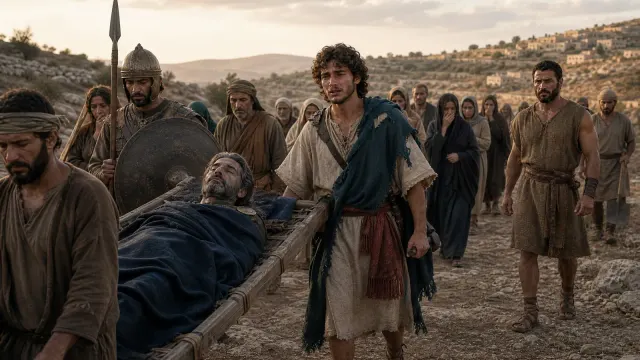
Peace Negotiated, Then Cut Down at the Gate
The long war tilts toward David while his household grows at Hebron, introducing sons whose family relationships will later shape the kingdom's internal conflicts. Within Saul's weakening house, Ishbosheth challenges Abner over Rizpah, and Abner answers by announcing that he will transfer the kingdom to David. His negotiations are political, tribal, and personal at once: Michal is returned to David, Israel's elders and Benjamin are consulted, and Abner comes to Hebron with twenty men. David feasts him and sends him away "in peace." Joab returns after that settlement and refuses its terms. He accuses Abner of spying, recalls him without David's knowledge, and kills him at the gate for Asahel's blood. David responds with public mourning, fasting, lament, and a declaration of innocence. Israel believes him. Yet the chapter refuses a perfectly strong ending. David admits that, although anointed king, the sons of Zeruiah are "too hard for me," exposing the distance between royal authority and actual control of armed men.
One complete chapter pageOpen chapter →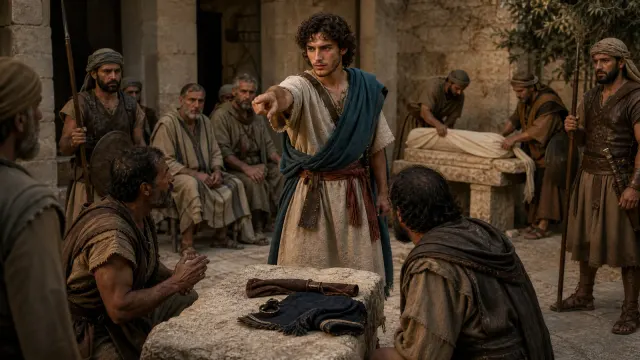
A Severed Head Is Not a Claim to Reward
Abner's death removes the man who had made Ishbosheth's throne possible, and the effect is immediate: Saul's son loses strength and Israel is troubled. Before the murder unfolds, the chapter pauses to preserve another branch of Saul's house by naming Jonathan's son Mephibosheth and explaining the childhood fall that left him lame. Then Rechab and Baanah, captains within Ishbosheth's own structure, enter his house at midday, kill him on his bed, remove his head, and carry it through the night to David. Their speech tries to turn assassination into divine service, claiming the LORD has avenged David on Saul's house. David rejects that interpretation. He invokes the LORD as the one who has actually redeemed him from adversity and recalls the messenger at Ziklag who also expected a reward for news of a rival's death. The killers are executed, while Ishbosheth's head is buried with Abner. David's path to wider kingship is again separated from men who try to purchase his favor with Saulide blood.
One complete chapter pageOpen chapter →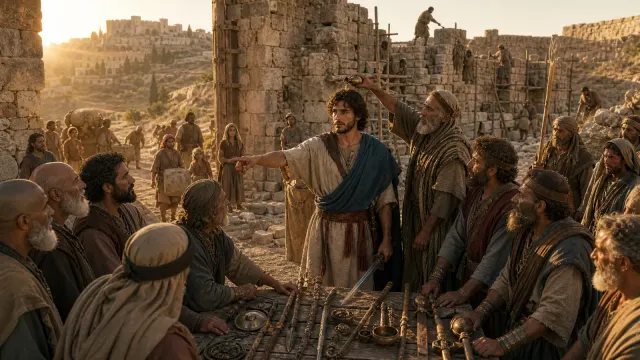
A Kingdom Gathered, a Stronghold Opened
All Israel finally comes to Hebron and names why David should rule them: he is their own kin, he led them even during Saul's reign, and the LORD appointed him to shepherd Israel. The covenant and anointing unite what the earlier chapters held apart. David then takes Jerusalem, turns the Jebusite stronghold into the city of David, receives a cedar house through Hiram of Tyre, and recognizes that his kingdom has been exalted "for his people Israel's sake." The chapter also records the growth of his household before returning to war. Philistine pressure does not disappear because the kingdom is now united. David inquires of the LORD before the first battle and receives permission to attack; when the Philistines return to the same valley, he inquires again and receives a different plan. Familiar ground and recent victory do not become a standing order. The chapter closes with David acting on fresh direction, so consolidation is presented as received guidance rather than self-sustaining royal momentum.
One complete chapter pageOpen chapter →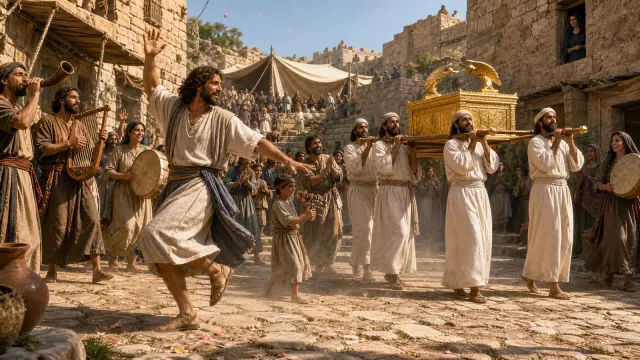
Joy Interrupted, Then Carried Differently
David gathers a vast company to bring the ark to Jerusalem, and the first procession has everything that can look impressive from a distance: a new cart, named attendants, instruments, and public celebration. It ends suddenly when Uzzah reaches toward the shaken ark and dies. David's displeasure turns to fear, the journey stops, and the ark remains three months in Obededom's house, where blessing complicates any idea that its presence is only dangerous. When the procession resumes, the wording has changed. The ark has bearers, sacrifice accompanies the movement, and David dances before the LORD with all his might. The ark reaches the tent prepared for it, and the people receive food before returning home. Then the celebration narrows to David's own household. Michal condemns the king's public conduct as undignified; David answers that it was "before the LORD." The chapter ends not with the crowd's joy but with an unresolved domestic and dynastic quarrel over what royal dignity should look like in worship.
One complete chapter pageOpen chapter →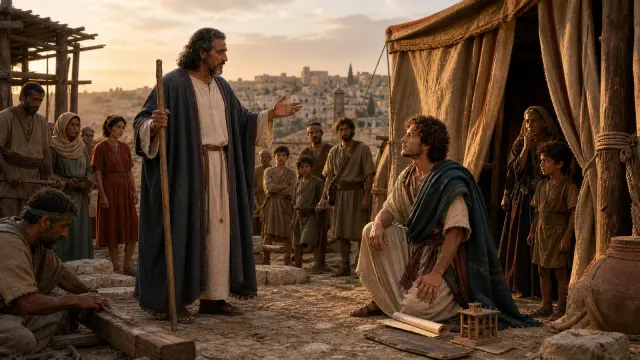
David Proposes a House, and Receives a Dynasty
Rest from surrounding enemies gives David time to notice an uncomfortable contrast: he lives in cedar while the ark remains under curtains. Nathan initially approves the king's desire to build, but that same night the word of the LORD redirects both men. The LORD has not been waiting through Israel's long past for someone to provide him a cedar residence. He recounts bringing Israel from Egypt, traveling with the people, taking David from the sheepcote, preserving him, and making his name. Then the meaning of "house" turns. David wants to build a structure for the LORD; the LORD promises to build David a dynasty. A future son will construct the sanctuary, receive a father-son relationship, face discipline if he sins, and remain within a mercy distinguished from Saul's removal. The promise stretches beyond one reign. David responds by sitting before the LORD, calling himself servant, remembering Israel's redemption, and asking that the word already spoken be established. The prayer grows out of promise rather than negotiation.
One complete chapter pageOpen chapter →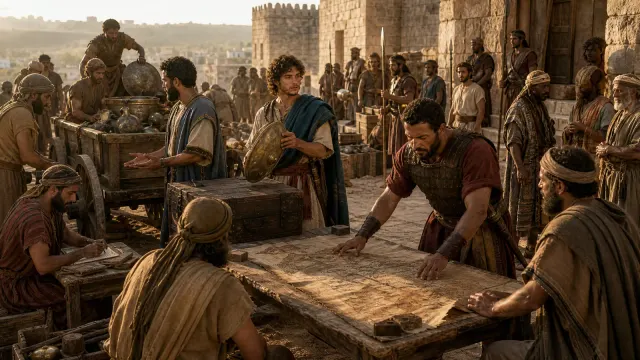
Victories Gathered Around a Governing Center
The Book of 2 Samuel 8 gathers campaigns rather than narrating one continuous battle sequence. Philistines, Moabites, Syrians, Hadadezer's forces, and Edom all appear as David's power expands, while Toi of Hamath approaches through diplomacy because Hadadezer has been his enemy. The chapter does not make every surrounding nation occupy the same relationship to the king. Some are defeated, some become tributary, and some send gifts. It also refuses to polish the violence into a bloodless inventory of success. The treatment of Moab includes captives measured for death and life, and no explanation is supplied that makes the scene easier. Alongside the campaigns, the chapter twice states that "the LORD preserved David whithersoever he went." Captured and gifted metals are dedicated to the LORD, and the military section gives way abruptly to administration. David executes judgment and justice for all his people, while named officers fill military, priestly, scribal, and governmental roles. The established kingdom therefore has both battlefields and desks, conquest and the daily machinery of rule.
One complete chapter pageOpen chapter →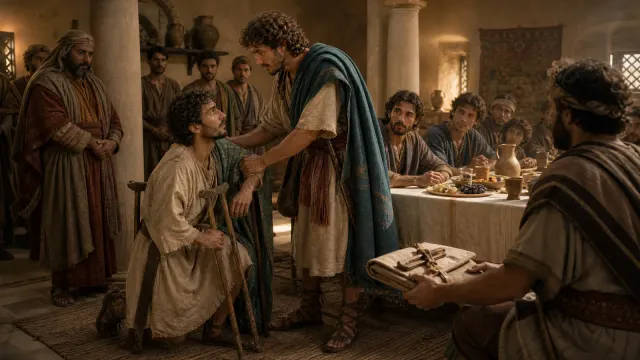
A Place at the Table for Jonathan's Son
David's question begins with remembered loyalty: is anyone left from Saul's house to whom he can show kindness for Jonathan's sake? Ziba identifies Jonathan's son Mephibosheth, whose lameness has already been traced to the flight that followed Saul's defeat. David brings him from Lo-debar, calls him by name, tells him not to fear, restores Saul's land to him, and gives him a continuing place at the royal table. The arrangement is practical as well as personal. Ziba, his sons, and his servants will work the land, while Mephibosheth lives in Jerusalem and eats "as one of the king's sons." The chapter repeats the table until welcome becomes its dominant image. It also repeats Mephibosheth's disability at the end. His circumstances are transformed, but his body is not. David's kindness is shown through provision, residence, restored property, and relationship, not through a miraculous cure. The chapter turns an old covenant bond with Jonathan into daily bread.
One complete chapter pageOpen chapter →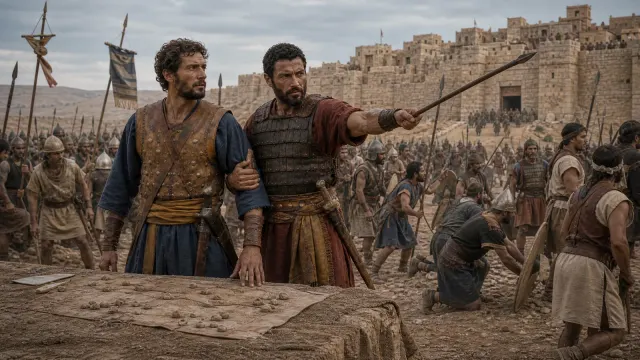
Kindness Misread, Then War Enlarged
David sends servants to comfort Hanun after the death of his father, intending to answer former kindness with kindness. Ammon's princes supply another interpretation, accusing the delegation of espionage, and Hanun humiliates the envoys by shaving part of their beards and cutting their garments. David first protects the men's dignity by letting them remain at Jericho. Then Ammon, recognizing that it has made itself odious, hires Syrian forces and turns a diplomatic insult into a military coalition. Joab finds enemies before and behind, divides the army with Abishai, and arranges mutual support rather than pretending to know which front will prove harder. The first coalition flees, then gathers again with reinforcements from beyond the river. David crosses Jordan for the renewed battle, and the resulting defeat forces Hadarezer's dependent kings into peace with Israel. The final strategic effect is isolation: Syria will no longer help Ammon. Rabbah itself remains, carrying the conflict directly into the next chapter.
One complete chapter pageOpen chapter →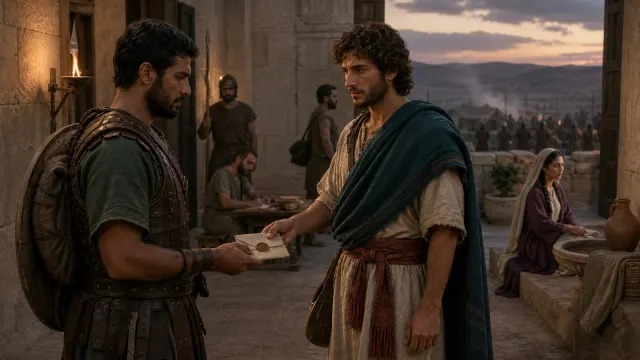
The King Who Sends, and the Man Who Will Not Go Home
The Ammonite campaign continues, but David stays in Jerusalem while Joab and the army besiege Rabbah. From the palace roof he sees Bathsheba, learns that she is Uriah's wife, sends for her, and sleeps with her. Her message, "I am with child," turns a private act into a problem the king cannot dismiss. David recalls Uriah and tries first to manage appearances. Uriah refuses to go home while the ark, Israel, Judah, Joab, and the soldiers remain in the field. Even drunkenness does not move him there. David then changes methods. He writes an order exposing Uriah to deadly combat and sends the letter by Uriah's own hand. Joab's implementation kills Uriah and other servants as well. David receives the casualty report with language about the sword devouring one as well as another, though his letter has already shown the death was selected. Bathsheba mourns, David marries her, and the chapter's final sentence places the whole arrangement under the LORD's displeasure.
One complete chapter pageOpen chapter →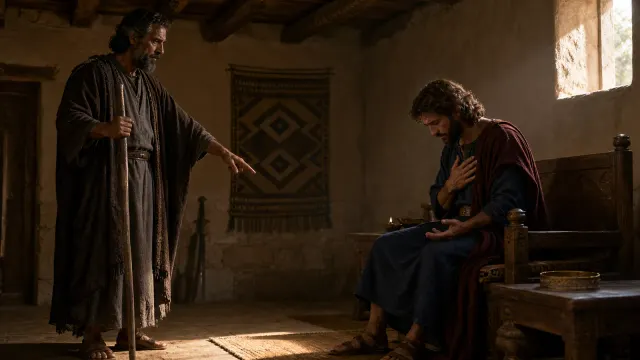
The King Hears His Own Case
Nathan arrives because the LORD sends him, and he begins with a small domestic case rather than an immediate accusation. A rich man with many animals takes the poor man's one beloved ewe lamb, and David pronounces judgment before Nathan says, "Thou art the man." The charge then names David's gifts, Uriah's death, Bathsheba, and the coming consequences inside David's own house. David confesses without a defense, and Nathan announces pardon while also saying the child will die. David fasts and pleads while the child lives, then rises, worships, and eats after the death because the possibility he was seeking has closed. Bathsheba is comforted, Solomon is born, and Nathan brings the name Jedidiah, joining the prophet of confrontation to a word of divine love. The chapter finally returns to Rabbah, where David receives the crown and spoil. Military triumph closes the campaign, but it cannot erase the confrontation that has already exposed what happened during the same war.
One complete chapter pageOpen chapter →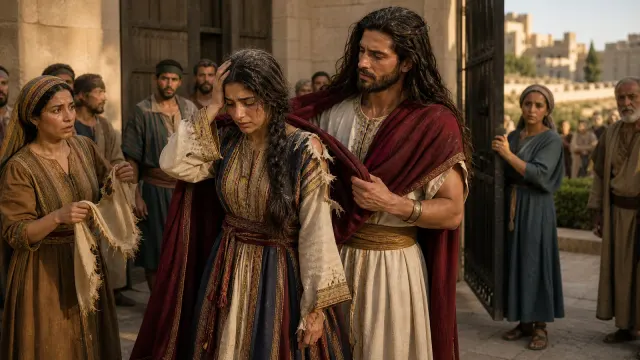
Tamar Speaks, and the Royal House Fails to Answer
The announced sword enters David's own household through Amnon's desire for Tamar. Jonadab turns that desire into a plan using feigned sickness, and David unknowingly sends Tamar into the situation. The account gives unusual space to her work, her reasoned refusal, and her attempt to stop what Amnon intends. He refuses to listen, rapes her, then refuses to listen again when she protests being cast out. Her torn royal garment, ashes, and crying keep her suffering visible after he bolts the door. Absalom houses her and hates Amnon; David becomes very angry, but the chapter records no royal judgment against his firstborn. Two years later Absalom engineers Amnon's presence at a sheep-shearing feast and orders his servants to kill him. The first report falsely tells David all his sons are dead, multiplying the grief before the surviving princes return. Absalom flees to Geshur for three years. The chapter ends with David longing toward him while Tamar's last stated condition remains desolation.
One complete chapter pageOpen chapter →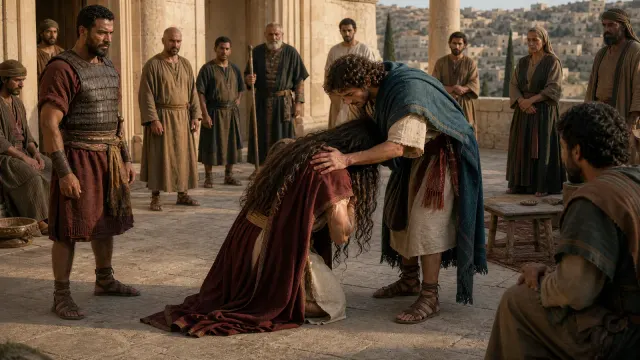
A Return Arranged Without a Reckoning
Joab sees where David's heart has turned and recruits a wise woman from Tekoah to present a carefully constructed case involving a widow, one dead son, and one surviving son threatened by the family avenger. David gives increasingly strong assurances until she applies his own mercy to the banished Absalom. The resemblance is persuasive rather than exact, and David eventually recognizes Joab's hand behind it. He permits Absalom to return to Jerusalem but refuses to see him, creating a settlement that restores geography without restoring relationship. The chapter then pauses over Absalom's celebrated beauty, his heavy hair, and his children before returning to the unresolved exclusion. After two full years Absalom summons Joab twice without success, so he burns Joab's barley field and immediately gets the meeting he wanted. He demands either access to the king or judgment. Joab carries the message, David receives Absalom, and the king kisses him. The gesture restores access, but no confession, charge, or spoken reckoning over Amnon or Tamar is recorded.
One complete chapter pageOpen chapter →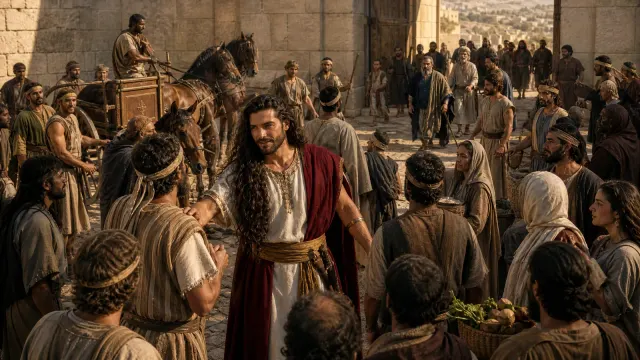
Hearts Won at the Gate, a King Driven Toward the Wilderness
Absalom does not seize Jerusalem first; he works on Israel's imagination at the gate. He gives every petitioner the same flattering verdict, laments the justice they supposedly cannot reach, and turns personal warmth into political capital until the book says he has "stole the hearts" of Israel. David answers the resulting revolt by leaving Jerusalem rather than making the city absorb the first blow. The flight strips kingship down to loyalties that cannot be staged. Ittai, the recent foreign arrival, refuses permission to leave. David sends the ark back instead of carrying it as proof that God must restore him. He then prays that Ahithophel's counsel be defeated, and Hushai appears at the summit as a practical answer taking human form. By the time Absalom enters Jerusalem, David's crown is absent from the city, but his network of faithfulness is already inside it.
One complete chapter pageOpen chapter →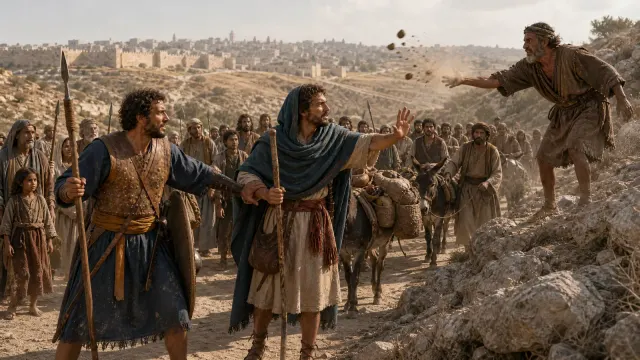
Gifts, Curses, and Counsel on a Conquered Roof
David's road out of Jerusalem is crowded with claims he cannot immediately verify. Ziba arrives with food, transport, and an accusation against the absent Mephibosheth, and David transfers the estate before hearing the other side. Shimei then pelts the king with stones and supplies his own theology of the crisis, calling it repayment for Saul's blood. David does not certify that explanation, but neither does he let Abishai answer the insult with a severed head. Inside Jerusalem, Hushai survives Absalom's suspicion by speaking in language that can be heard more than one way. Then Ahithophel gives counsel designed to make reconciliation publicly impossible: Absalom takes David's concubines on the palace roof. The act fulfills the shape of Nathan's earlier warning without becoming morally approved by it. The occupied palace now displays both political calculation and the human cost imposed on women who are treated as instruments of power.
One complete chapter pageOpen chapter →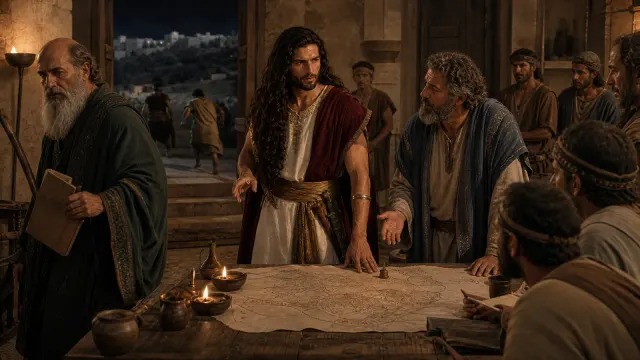
The Dangerous Counsel Loses, and the Fugitives Cross
Ahithophel understands David's weakest moment with frightening clarity: strike tonight, while the fugitives are exhausted, scatter the company, and kill the king. Hushai cannot merely offer a different tactic. He must make delay sound more impressive than urgency, so he fills Absalom's imagination with enraged warriors, all Israel gathered like sand, and a campaign led personally by the new claimant. The Book of 2 Samuel states why the persuasion succeeds: the LORD has appointed the defeat of Ahithophel's effective counsel. Yet divine purpose moves through a very human chain. Priests relay the plan, a young woman carries word, messengers hide in a well, and a household conceals them long enough for David's people to cross Jordan before dawn. Ahithophel dies after his counsel is rejected. At Mahanaim, the chapter ends not with grand strategy but with beds, grain, beans, honey, butter, sheep, and cheese for people who are hungry, weary, and thirsty.
One complete chapter pageOpen chapter →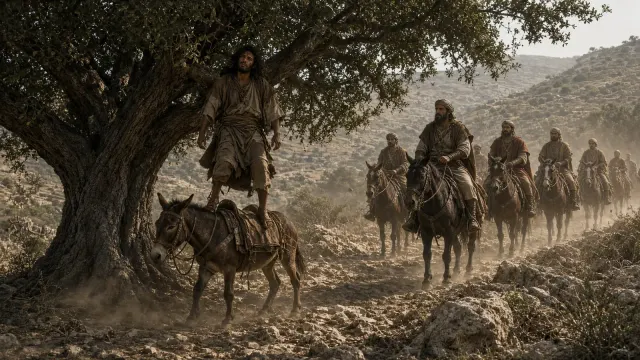
A Victory the Father Cannot Receive as Good News
The battle is framed by a command everyone can hear: David wants Absalom treated gently. That instruction survives every later excuse because the army itself knows it. When Absalom is caught by his head in an oak, an unnamed soldier refuses even a rich reward rather than violate the king's charge. Joab chooses differently, and Absalom dies while still suspended in the tree. The military victory therefore arrives already divided from David's deepest personal desire. Even the messengers embody that split. Ahimaaz races with news of deliverance but hesitates before the question that matters to the king. Cushi answers more directly, and the language of enemies collapses into one dead son. David leaves the gate for the chamber above it and repeats Absalom's name until triumph has no vocabulary left. The reign has been preserved, but 2 Samuel closes the chapter inside a father's grief rather than on a field of victory.
One complete chapter pageOpen chapter →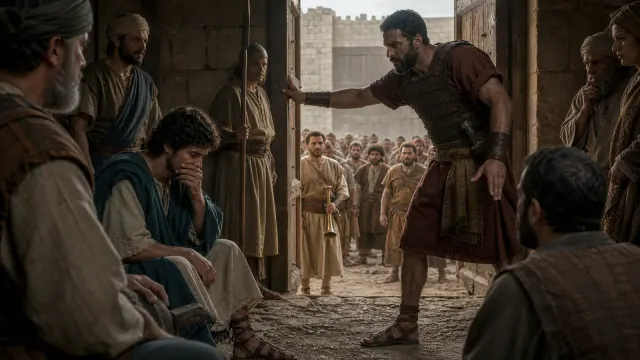
The King Returns Through an Unsettled People
David's mourning is so public that victorious soldiers enter Mahanaim like men ashamed after defeat. Joab's confrontation drives the king back to the gate, where restoration begins as a political negotiation rather than a victory parade. Israel debates recalling David; Judah must be persuaded; Amasa, recently Absalom's commander, is promised Joab's office. At Jordan, the returning king meets the unresolved human claims left along the road. Shimei now bows and confesses where he once cursed. Mephibosheth appears in prolonged neglect and answers the accusation Ziba made in his absence, though David gives no full judicial explanation before dividing the land. Barzillai, by contrast, brings a gentler problem: he is too old to pretend palace life is a prize, so David lets gratitude take the form Barzillai actually wants. The chapter ends with Judah and Israel arguing over shares in the king. David is homeward bound, but the people carrying him there are not yet one.
One complete chapter pageOpen chapter →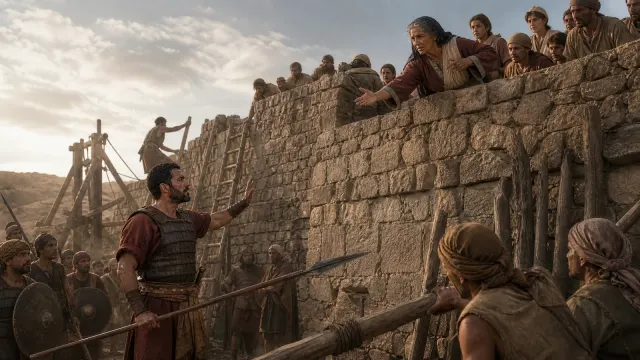
One Rebellion Ends, and Joab Remains
The quarrel at the end of David's return immediately becomes fuel for another rebellion. Sheba turns Israel's complaint about having ten shares in the king into the cry that they have "no part in David," while Judah remains attached to him. Jerusalem itself offers no clean restoration: the ten concubines Absalom violated are confined for life, fed but never returned to their former place. Amasa then misses the deadline for mobilizing Judah, and Joab reenters events with the same combination of effectiveness and bloodshed that has marked him before. He kills Amasa beneath the gesture of a greeting and resumes the pursuit. At Abelbethmaachah, however, force finally has to listen. A wise woman stops the battering long enough to narrow Joab's demand to Sheba alone, and the city survives. The closing list puts Joab back over the army. Administrative order has returned, but 2 Samuel leaves the means of that order morally untidied.
One complete chapter pageOpen chapter →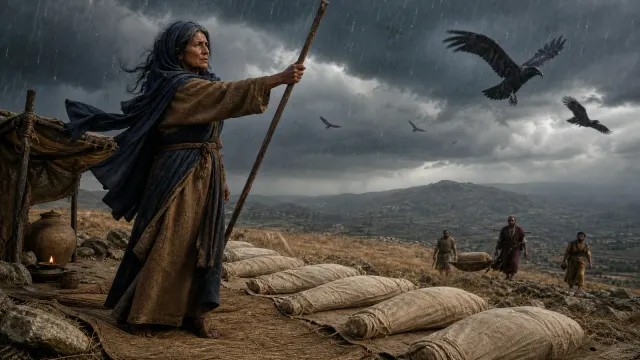
An Old Oath, a Mother's Watch, and a King Who Needs Rescue
This chapter reaches backward and sideways across David's reign rather than continuing in a simple line. A three-year famine is traced to Saul's bloodguilt against the Gibeonites, a people protected by Israel's oath. David asks what reparation they will accept, and seven descendants of Saul are handed over, while Jonathan's son Mephibosheth is spared because another oath still binds the king. The episode refuses easy neatness. The seven are named by family relation, but their individual participation in Saul's violence is not supplied. Rizpah then keeps watch over the exposed bodies through day, night, and changing weather until her endurance reaches David. His response broadens the burial to include Saul and Jonathan as well. The chapter next turns to Philistine battles in which David himself grows faint and must be rescued. The "light of Israel" is protected by servants, and the closing victories belong to named warriors as well as to the king whose reign contains them.
One complete chapter pageOpen chapter →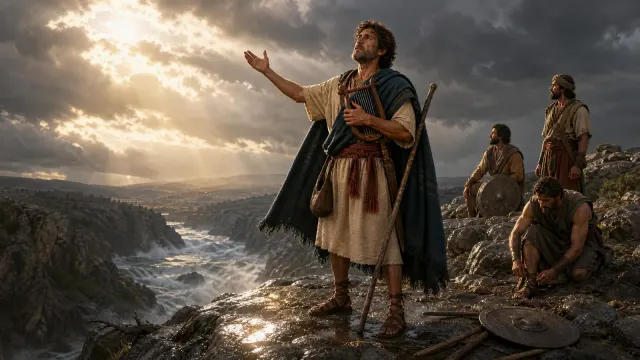
The Rescued King Gives the Praise a Larger Horizon
David's song makes the Book of 2 Samuel sound suddenly larger than the court, the battlefield, or the family crisis. He remembers danger as waves, snares, darkness, violent men, and enemies too strong for him, then answers every enclosure with a LORD who is rock, fortress, shield, tower, refuge, and savior. One cry sets earth and heaven trembling in the poem's imagery, and the same God who seems to bend the skies reaches down to draw David into a "large place." The song is intensely personal without making David self-sufficient. God lights his darkness, steadies his feet, teaches his hands, gives him strength, and makes victory possible. Even the hard military language remains framed by dependence. The difficult claims of righteousness stand beside the sins the book has already exposed, so they cannot be read as a claim of flawless life. The song ends by carrying mercy beyond completed battles to David's seed and the enduring promise attached to his house.
One complete chapter pageOpen chapter →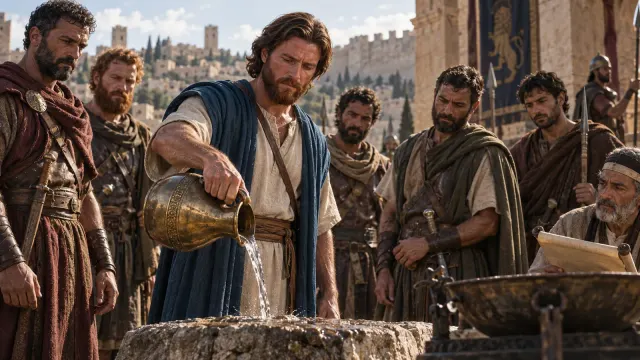
The Final Oracle and the Names Behind the Reign
The chapter begins with an oracle and then fills the page with names. David's "last words" describe just rule as morning light after rain and place the future of his house in an everlasting covenant. The ideal is luminous, but the Book of 2 Samuel has already shown how far royal households can fall short of their ideals, which gives the covenant language its weight. The mighty men then refuse to let David's greatness become solitary. Eleazar's hand clings to his sword, Shammah stands in a lentil field others have abandoned, and Benaiah's exploits are remembered with enough specificity to include snow in a pit. Three men risk their lives to bring David water from Bethlehem, and he refuses to drink what has become too costly for an ordinary thirst. The final list widens the reign into a network of service, then ends with Uriah the Hittite. That last name will not let honor erase betrayal.
One complete chapter pageOpen chapter →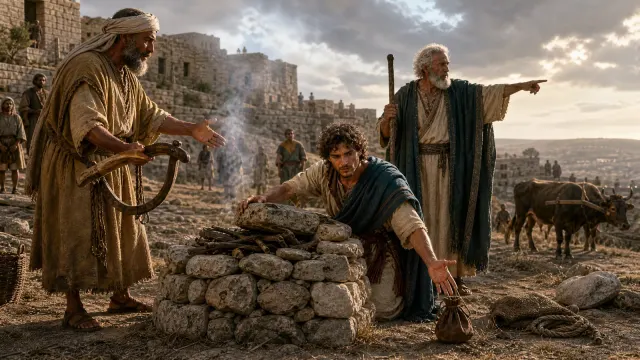
The Count Ends at an Altar, Not a Throne
David's census begins under the shadow of the LORD's anger and proceeds even though Joab objects. For nine months and twenty days, the command travels through the land until Israel and Judah are reduced to impressive military totals. Then David's own heart turns against what he has done. His confession arrives before Gad's message, but confession does not erase consequence. The offered judgments place David in "a great strait," and he chooses to fall into the LORD's hand because of divine mercy. Pestilence turns the national count into another number, this time seventy thousand dead, until the destroying hand is restrained at Araunah's threshingfloor. Only then does David ask that the blow fall on him and his house rather than on the people he now calls sheep. The final movement is purchase, altar, sacrifice, and answered prayer. The Book of 2 Samuel ends where counting stops: not with a statistic or throne, but with mercy shown to the land.
One complete chapter pageOpen chapter →Source: eBible.org · eng-kjv2006