The big picture
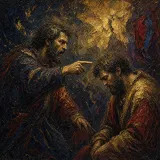
Nathan, a prophet who speaks for God, comes to David, Israel's king, after the death of Uriah, a soldier. He tells of a rich man taking a poor man's beloved lamb. David condemns the act before learning that the charge points to him. Nathan names the killing of Uriah and the taking of Bath-sheba, his wife. David admits his sin. He is spared death, but the child dies and trouble is promised within his house. Later, another son receives God's love.
In this chapter
- A Stolen Lamb Stirs David’s Anger 2 Samuel 12:1-6
Nathan describes two men in one city.
- The Charge Turns Toward David 2 Samuel 12:7-12
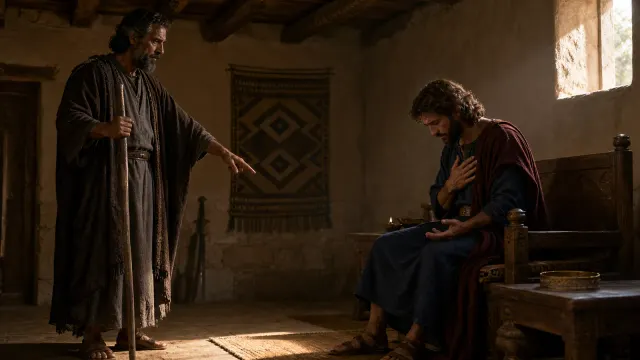
Nathan tells David that he is the guilty man.
- David Confesses but the Child Will Die 2 Samuel 12:13-15
David admits that he has sinned against God.
- David Pleads Until the Child Dies 2 Samuel 12:16-23
David prays for the child, refuses food, and lies on the ground.
- Another Son Receives God’s Love 2 Samuel 12:24-25
David comforts Bath-sheba, now his wife, and sleeps with her.
- Rabbah Falls Under David’s Rule 2 Samuel 12:26-31
Joab captures the water city at Rabbah and calls David to finish the victory.
Central truth
God exposes David's sin through Nathan, spares his life after confession, and announces consequences that reach into his family.
Scripture beside the summary
2 Samuel · King James Version · 312 Samuel 12:1-6
A Stolen Lamb Stirs David’s Anger
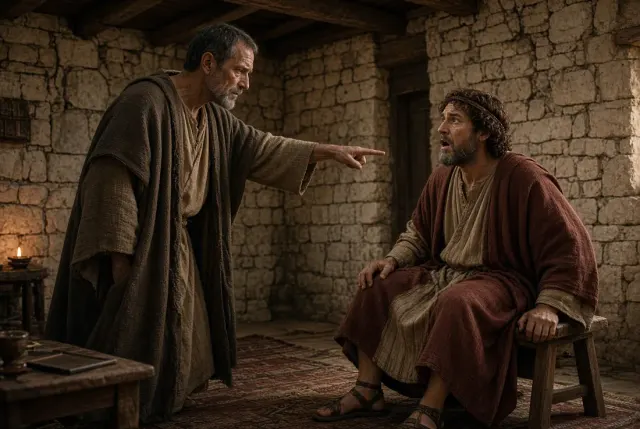
Nathan describes two men in one city. The rich man owns many animals, but the poor man has one small lamb. It eats with his family and is loved like a daughter. When a visitor arrives, the rich man takes that lamb for the meal instead of using his own flock. David is furious. He says the man deserves death and must repay four lambs because he showed no pity. He sees the cruelty of taking from the weak before seeing himself in the charge.
In everyday life
A magistrate sits at her own kitchen table hearing how a landlord took a tenant's only heater. She demands repayment, then learns that the complaint mirrors her decision about a relative's belongings. The accusation changes direction before she can dismiss it. Nathan is sent by God to expose David's killing and taking of a wife.
Notice
2 Samuel 12:6 David names the lack of pity as grounds for repayment. His own judgement prepares him to hear the same charge directed at himself.
2 Samuel 12:1-6
King James Version1And the LORD sent Nathan unto David. And he came unto him, and said unto him, There were two men in one city; the one rich, and the other poor.
2The rich man had exceeding many flocks and herds:
3But the poor man had nothing, save one little ewe lamb, which he had bought and nourished up: and it grew up together with him, and with his children; it did eat of his own meat, and drank of his own cup, and lay in his bosom, and was unto him as a daughter.
4And there came a traveller unto the rich man, and he spared to take of his own flock and of his own herd, to dress for the wayfaring man that was come unto him; but took the poor man’s lamb, and dressed it for the man that was come to him.
5And David’s anger was greatly kindled against the man; and he said to Nathan, As the LORD liveth, the man that hath done this thing shall surely die:
6And he shall restore the lamb fourfold, because he did this thing, and because he had no pity.
2 Samuel 12:7-12
The Charge Turns Toward David
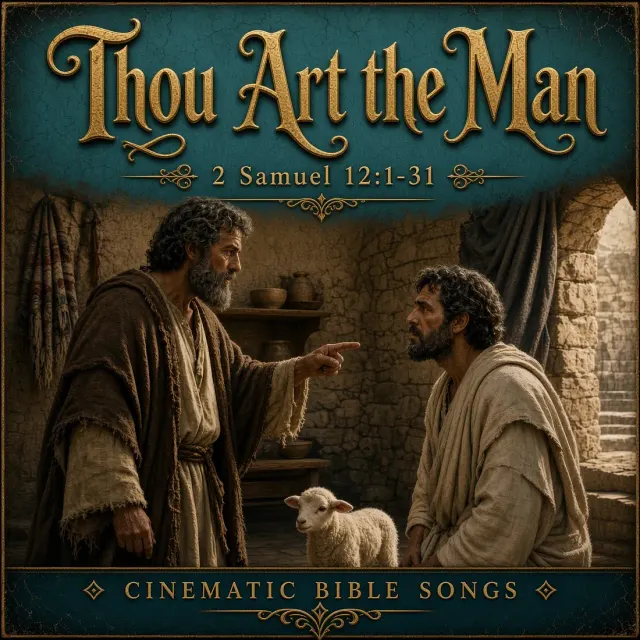
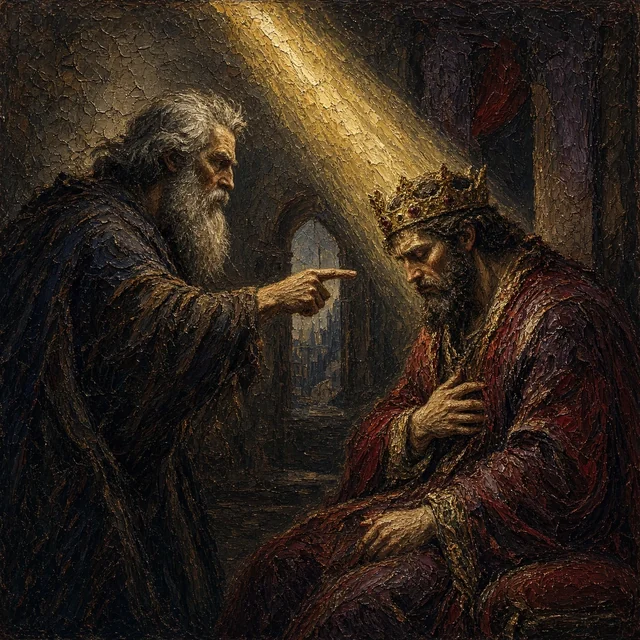
Nathan tells David that he is the guilty man. God gave him rescue, kingship and a royal household, and would have given more. Yet he killed Uriah through Ammon's sword and took his wife. Violence will remain in David's house. Trouble will rise from within it, and another man will sleep with his wives in public. David acted secretly, but the announced disgrace will happen before Israel. Royal gifts have not excused his abuse of power; they make his ingratitude plain.
In everyday life
A standards investigator lays an executive's benefits beside proof that he stole from a dependent worker. The contrast removes his claim of need. She then names consequences that his private actions have made public. Abundant gifts did not prevent his choice to harm. Nathan announces God's judgement, including violence and sexual disgrace within David's house.
Notice
2 Samuel 12:9 Nathan attributes Uriah's death to David even though Ammon's weapons killed him. Using another army does not remove the king's responsibility for the order.
2 Samuel 12:7-12
King James Version7And Nathan said to David, Thou art the man. Thus saith the LORD God of Israel, I anointed thee king over Israel, and I delivered thee out of the hand of Saul;
8And I gave thee thy master’s house, and thy master’s wives into thy bosom, and gave thee the house of Israel and of Judah; and if that had been too little, I would moreover have given unto thee such and such things.
9Wherefore hast thou despised the commandment of the LORD, to do evil in his sight? thou hast killed Uriah the Hittite with the sword, and hast taken his wife to be thy wife, and hast slain him with the sword of the children of Ammon.
10Now therefore the sword shall never depart from thine house; because thou hast despised me, and hast taken the wife of Uriah the Hittite to be thy wife.
11Thus saith the LORD, Behold, I will raise up evil against thee out of thine own house, and I will take thy wives before thine eyes, and give them unto thy neighbour, and he shall lie with thy wives in the sight of this sun.
12For thou didst it secretly: but I will do this thing before all Israel, and before the sun.
2 Samuel 12:13-15
David Confesses but the Child Will Die
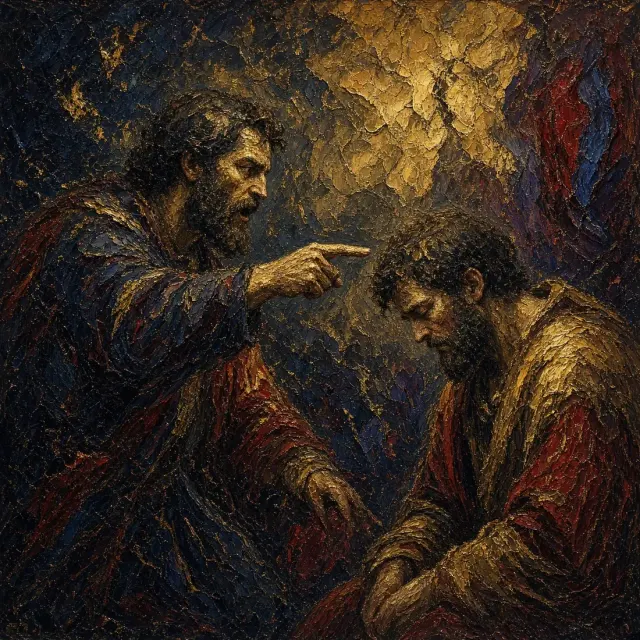
David admits that he has sinned against God. Nathan says God has put away his sin and that David will not die. Yet the child born to him will die because his deed has given God's enemies grounds for contempt. Nathan leaves, and God strikes the child with severe sickness. The spared father and suffering child stand together in this hard account. Forgiveness does not undo all the consequences announced here, and the child bears a loss caused by the king's acts.
In everyday life
The foster-care caseworker sits with parents whose wrongdoing has harmed their child. An admission has ended their denial, but it cannot remove the child's present suffering. She keeps both facts in view while arranging care. God directly strikes David's child under an announced judgement, unlike ordinary consequences handled by support services.
Notice
2 Samuel 12:13 David's confession receives an answer that spares his life. The next words still announce the child's death, so pardon and painful consequences appear together.
2 Samuel 12:13-15
King James Version13And David said unto Nathan, I have sinned against the LORD. And Nathan said unto David, The LORD also hath put away thy sin; thou shalt not die.
14Howbeit, because by this deed thou hast given great occasion to the enemies of the LORD to blaspheme, the child also that is born unto thee shall surely die.
15And Nathan departed unto his house. And the LORD struck the child that Uriah’s wife bare unto David, and it was very sick.
2 Samuel 12:16-23
David Pleads Until the Child Dies
David prays for the child, refuses food, and lies on the ground. His household cannot persuade him to rise. When the child dies on the seventh day, they fear telling him. David notices their whispers and asks directly. After hearing the answer, he washes, changes clothes, worships and eats. He explains that while the child lived, he hoped God would show mercy. Now fasting cannot bring the child back. He will go to the child in death, but the child will not return to him.
In everyday life
A grief counsellor watches a father leave a hospital room and ask for food after days of refusing it. Relatives are puzzled by the change. He explains that waiting for a recovery has ended, though his love has not. David also worships after a child's death that Nathan had announced as God's judgement.
Notice
2 Samuel 12:22 David explains his earlier fasting as hope for God's mercy. His later meal does not erase his grief; it answers the fact that the child has died.
2 Samuel 12:16-23
King James Version16David therefore besought God for the child; and David fasted, and went in, and lay all night upon the earth.
17And the elders of his house arose, and went to him, to raise him up from the earth: but he would not, neither did he eat bread with them.
18And it came to pass on the seventh day, that the child died. And the servants of David feared to tell him that the child was dead: for they said, Behold, while the child was yet alive, we spake unto him, and he would not hearken unto our voice: how will he then vex himself, if we tell him that the child is dead?
19But when David saw that his servants whispered, David perceived that the child was dead: therefore David said unto his servants, Is the child dead? And they said, He is dead.
20Then David arose from the earth, and washed, and anointed himself, and changed his apparel, and came into the house of the LORD, and worshipped: then he came to his own house; and when he required, they set bread before him, and he did eat.
21Then said his servants unto him, What thing is this that thou hast done? thou didst fast and weep for the child, while it was alive; but when the child was dead, thou didst rise and eat bread.
22And he said, While the child was yet alive, I fasted and wept: for I said, Who can tell whether GOD will be gracious to me, that the child may live?
23But now he is dead, wherefore should I fast? can I bring him back again? I shall go to him, but he shall not return to me.
2 Samuel 12:24-25
Another Son Receives God’s Love
David comforts Bath-sheba, now his wife, and sleeps with her. She gives birth to another son, named Solomon. God loves him and sends word through Nathan. The prophet gives him the name Jedidiah because of God. The brief account brings a new birth after the earlier child's death. It does not say that the loss was unreal or has been reversed. It states that this son is loved by God, with a name that makes that welcome known to his parents.
In everyday life
A midwife places a newborn in a mother's arms after the family has suffered a previous loss. A written welcome from relatives names this child as loved in his own right. Joy enters a home where grief still has a place. Solomon's welcome includes God's declared love and a name delivered through a prophet.
Notice
2 Samuel 12:25 Nathan returns as the bearer of a name linked to God's love. The same prophet who brought judgement now carries a message about the new son.
2 Samuel 12:24-25
King James Version24And David comforted Bath-sheba his wife, and went in unto her, and lay with her: and she bare a son, and he called his name Solomon: and the LORD loved him.
25And he sent by the hand of Nathan the prophet; and he called his name Jedidiah, because of the LORD.
2 Samuel 12:26-31
Rabbah Falls Under David’s Rule
Joab captures the water city at Rabbah and calls David to finish the victory. He does not want the conquest credited to his own name. David comes, takes the city, and receives its king's costly crown. He carries off large spoils. The people are put under saws, iron tools and axes, and made to pass through a brickkiln. The wording given here is harsh and describes brutal treatment of the conquered. The same is done in Ammon's other cities before David returns to Jerusalem.
In everyday life
A conflict researcher walks through a preserved brickkiln and reads the names of people once forced through its gates. She sets their treatment beside photographs of the ruler's treasures. The fine objects cannot tell the human cost alone. David's conquest also follows a prophet's direct announcement of God's judgement against the king himself.
Notice
2 Samuel 12:28 Joab calls David to complete the capture so the victory bears the king's name. Public credit is carefully managed even while the army controls the outcome.
2 Samuel 12:26-31
King James Version26And Joab fought against Rabbah of the children of Ammon, and took the royal city.
27And Joab sent messengers to David, and said, I have fought against Rabbah, and have taken the city of waters.
28Now therefore gather the rest of the people together, and encamp against the city, and take it: lest I take the city, and it be called after my name.
29And David gathered all the people together, and went to Rabbah, and fought against it, and took it.
30And he took their king’s crown from off his head, the weight whereof was a talent of gold with the precious stones: and it was set on David’s head. And he brought forth the spoil of the city in great abundance.
31And he brought forth the people that were therein, and put them under saws, and under harrows of iron, and under axes of iron, and made them pass through the brickkiln: and thus did he unto all the cities of the children of Ammon. So David and all the people returned unto Jerusalem.
Details worth noticing
The opening image
2 Samuel 12:1 begins with “And the LORD sent Nathan unto David. And he came unto him, and said unto him, There were two men in one city; the one rich, and the other poor.”
Where the chapter turns
2 Samuel 12:18 forms a natural hinge: “And it came to pass on the seventh day, that the child died. And the servants of David feared to tell him that the child was dead: for they said, Behold…”
The final note
2 Samuel 12:31 leaves the reader with “And he brought forth the people that were therein, and put them under saws, and under harrows of iron, and under axes of iron, and made them pass through…”
A word trail through the chapter
The words David, child, LORD, house, dead, Nathan help reveal the chapter’s repeated concerns.
KJV words made clear
- behold
- look, or pay close attention
- unto
- to
- thee
- you
- thou
- you
- thy
- your
Music and video connected to the passage
Related media appears when its Scripture reference overlaps this study. Music and video can illuminate a theme while the biblical text remains the foundation.