The big picture
Three visions come to Amos, God's messenger to Israel, the northern people. Twice he pleads for the small, weak people, and God holds back the announced harm. The third vision brings a firm measure and a warning against the royal house. Amaziah, a priest at Beth-el, a royal worship site, reports Amos to the king and orders him away. Amos answers that God took him from tending flocks and sent him to speak. The priest's ban cannot cancel that call.
In this chapter
- A Plea Stops the Threat of Locusts Amos 7:1-3
God shows Amos a swarm forming as the later crop begins to grow.
- Fire Is Held Back After Another Plea Amos 7:4-6
God next shows Amos a judgement by fire.
- A Measuring Line Ends the Passing Over Amos 7:7-9
Amos sees the Lord beside a wall with a weighted measuring line in his hand.
- A Royal Priest Orders Amos to Leave Amos 7:10-13
Amaziah sends word to Jeroboam that Amos is plotting against him.
- God’s Call Outweighs the Priest’s Order Amos 7:14-17
Amos says he was neither a prophet by occupation nor a member of a prophetic group.
Central truth
Amos pleads for mercy but cannot withdraw the warning God gives him, even when royal religion orders him to stop speaking.


Scripture beside the summary
Amos · King James Version · 17Amos 7:1-3
A Plea Stops the Threat of Locusts
God shows Amos a swarm forming as the later crop begins to grow. This growth comes after the king has taken his cutting. In the vision the insects consume the grass of the land. Amos asks God to forgive. He calls the people Jacob, using the name of their forefather, and asks how they can rise because they are so small. His plea rests on their weakness, not a claim that they have done no wrong. God turns from the announced disaster and says it will not happen. The vision ends with mercy in response to the plea.

In everyday life
A crop-insurance advocate sets a tenant's tiny remaining harvest beside a proposed seizure notice. She asks the claimant to stop because the household has nothing left with which to recover. She does not pretend there is no debt. Amos asks God to forgive and avert a vision of judgement, not a claimant to adjust a payment demand.
Notice
Amos 7:2 Amos calls the people small while asking for forgiveness. Their need for mercy rests on frailty rather than on the grand claims their leaders make about strength.
Amos 7:1-3
King James Version1Thus hath the Lord GOD shewed unto me; and, behold, he formed grasshoppers in the beginning of the shooting up of the latter growth; and, lo, it was the latter growth after the king’s mowings.
2And it came to pass, that when they had made an end of eating the grass of the land, then I said, O Lord GOD, forgive, I beseech thee: by whom shall Jacob arise? for he is small.
3The LORD repented for this: It shall not be, saith the LORD.
Amos 7:4-6
Fire Is Held Back After Another Plea
God next shows Amos a judgement by fire. It consumes the great deep and begins to consume the land. The scale is larger than a field fire and leaves no ordinary means of resistance. Amos again asks God to stop, using the same plea about the people's smallness. He does not offer a plan for surviving the fire. He appeals to the one who commands it. God again turns from the announced harm and says this too will not happen. The second vision repeats both the people's helplessness and God's willingness to hear the prophet's request.

In everyday life
A hospice advocate asks a review panel to halt another disruptive transfer for a frail resident. She brings no claim that the resident can withstand the strain. His weakness is the reason for her plea. Amos intercedes before God against consuming fire, not before a panel weighing the burdens of a care move.
Notice
Amos 7:6 The second withdrawal is stated as an additional act of mercy. Amos has not controlled the threat himself; God answers the plea and stops it.
Amos 7:4-6
King James Version4Thus hath the Lord GOD shewed unto me: and, behold, the Lord GOD called to contend by fire, and it devoured the great deep, and did eat up a part.
5Then said I, O Lord GOD, cease, I beseech thee: by whom shall Jacob arise? for he is small.
6The LORD repented for this: This also shall not be, saith the Lord GOD.
Amos 7:7-9
A Measuring Line Ends the Passing Over
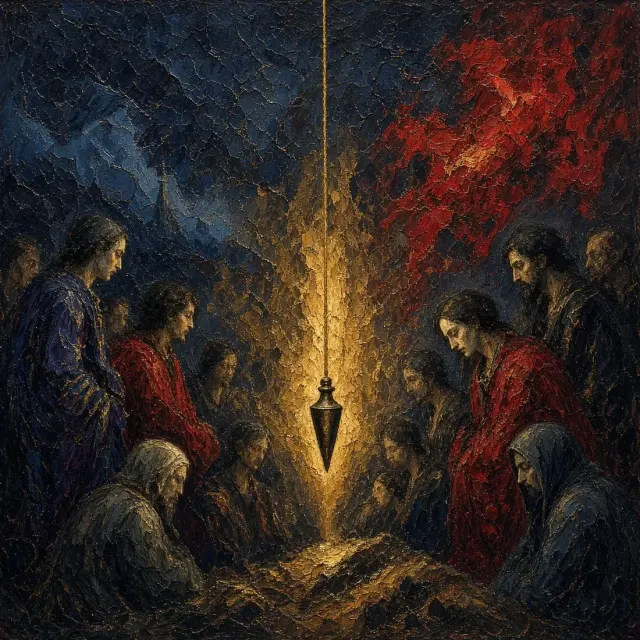
Amos sees the Lord beside a wall with a weighted measuring line in his hand. God asks what he sees, and Amos names the line. God will set that measure among Israel and will no longer pass over the people's wrongs. Places of worship linked with Isaac, their forefather, will be ruined. God will rise with the sword against the house of Jeroboam, Israel's king. Unlike the first two visions, this one ends without a plea that turns judgement away. The people are now measured, and their shrines and royal family face the result.

In everyday life
A bricklayer lowers a weighted cord beside a wall that the owner insists is sound. The gap between cord and masonry remains visible despite his assurances. She leaves the cord still so the difference can be seen. God measures a people's conduct and announces judgement, not a wall's angle for a repair estimate.
Notice
Amos 7:8 God asks Amos to identify the line before explaining its use among the people. The ordinary tool becomes a measure that royal claims cannot alter.
Amos 7:7-9
King James Version7Thus he shewed me: and, behold, the Lord stood upon a wall made by a plumbline, with a plumbline in his hand.
8And the LORD said unto me, Amos, what seest thou? And I said, A plumbline. Then said the Lord, Behold, I will set a plumbline in the midst of my people Israel: I will not again pass by them any more:
9And the high places of Isaac shall be desolate, and the sanctuaries of Israel shall be laid waste; and I will rise against the house of Jeroboam with the sword.
Amos 7:10-13
A Royal Priest Orders Amos to Leave
Amaziah sends word to Jeroboam that Amos is plotting against him. He says the land cannot bear the prophet's words. His report says the king will die by the sword and Israel will be exiled. Amaziah then tells Amos to flee to Judah, the southern kingdom, and earn his bread by speaking there. He forbids any further message at Beth-el because it is the king's sanctuary and royal court. The priest treats the place as territory controlled by the crown. The warning is answered with removal of the speaker instead of a response to the charge.
In everyday life
A theatre chaplain tells a visiting critic to leave after she questions how the owner treats unpaid workers. He points to the owner's name above the stage and suggests she find an audience elsewhere. Access to the room becomes his answer to the complaint. Amaziah bans a prophet sent by God, not a critic invited to discuss working conditions.
Notice
Amos 7:13 Amaziah defends the site by calling it the king's place. Royal ownership becomes his stated reason to refuse a message that claims authority from God.
Amos 7:10-13
King James Version10Then Amaziah the priest of Beth-el sent to Jeroboam king of Israel, saying, Amos hath conspired against thee in the midst of the house of Israel: the land is not able to bear all his words.
11For thus Amos saith, Jeroboam shall die by the sword, and Israel shall surely be led away captive out of their own land.
12Also Amaziah said unto Amos, O thou seer, go, flee thee away into the land of Judah, and there eat bread, and prophesy there:
13But prophesy not again any more at Beth-el: for it is the king’s chapel, and it is the king’s court.
Amos 7:14-17
God’s Call Outweighs the Priest’s Order
Amos says he was neither a prophet by occupation nor a member of a prophetic group. He tended herds and gathered sycomore fruit. God took him from the flock and sent him to speak to Israel. Because Amaziah orders him to stop, Amos gives a direct warning. The priest's wife will become a prostitute in the city, his children will die by the sword, and his land will be divided. He will die in an unclean foreign land. Israel will indeed be exiled. The reply names a harsh fate for the household without granting anyone permission to carry it out.
In everyday life
A witness-support officer helps a rural worker explain why he gave evidence despite pressure to keep quiet. The worker points to the summons, not a wish to earn his living through public accusations. The officer records who required his testimony. Amos claims God's personal call and announces severe judgement, not the protection of a legal summons.
Notice
Amos 7:15 Amos locates his call while he was following the flock. His authority to speak rests on God's instruction, not on Amaziah granting him a place at the shrine.
Amos 7:14-17
King James Version14Then answered Amos, and said to Amaziah, I was no prophet, neither was I a prophet’s son; but I was an herdman, and a gatherer of sycomore fruit:
15And the LORD took me as I followed the flock, and the LORD said unto me, Go, prophesy unto my people Israel.
16Now therefore hear thou the word of the LORD: Thou sayest, Prophesy not against Israel, and drop not thy word against the house of Isaac.
17Therefore thus saith the LORD; Thy wife shall be an harlot in the city, and thy sons and thy daughters shall fall by the sword, and thy land shall be divided by line; and thou shalt die in a polluted land: and Israel shall surely go into captivity forth of his land.
Details worth noticing
The opening image
Amos 7:1 begins with “Thus hath the Lord GOD shewed unto me; and, behold, he formed grasshoppers in the beginning of the shooting up of the latter growth; and, lo, it was the…”
Where the chapter turns
Amos 7:8 forms a natural hinge: “And the LORD said unto me, Amos, what seest thou? And I said, A plumbline. Then said the Lord, Behold, I will set a plumbline in the midst of my people…”
The final note
Amos 7:17 leaves the reader with “Therefore thus saith the LORD; Thy wife shall be an harlot in the city, and thy sons and thy daughters shall fall by the sword, and thy land shall be…”
A word trail through the chapter
The words LORD, Israel, land, Amos, plumbline, prophesy help reveal the chapter’s repeated concerns.
KJV words made clear
- plumbline
- A cord with a weight used to test whether a wall stands straight.
- seer
- A person who receives visions and speaks messages from God.
- herdman
- A worker who tends a herd or flock.
Music and video connected to the passage
Related media appears when its Scripture reference overlaps this study. Music and video can illuminate a theme while the biblical text remains the foundation.