
Daniel

12 Chapters
Daniel: The Whole Book, Chapter by Chapter
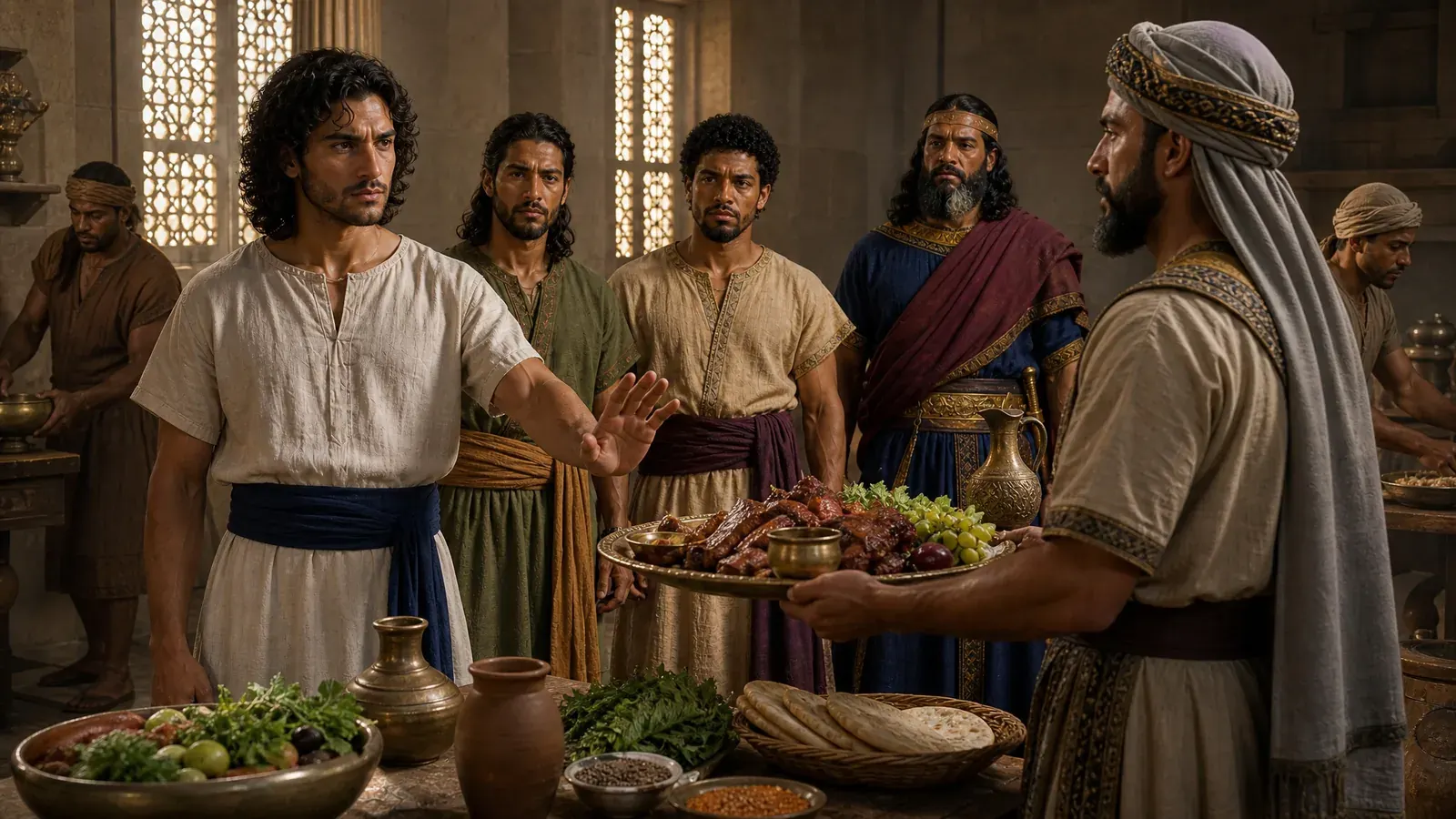
Babylon Changes Their Names, but Not Their Allegiance
Jerusalem falls, sacred vessels cross into Babylon, and four young Judeans are absorbed into an imperial program designed to reshape language, education, diet, and identity. Yet the Book of Daniel quietly refuses Babylon's preferred explanation of events. The same God who gave Jehoiakim into Nebuchadnezzar's hand also gives Daniel favor and gives the four captives unusual knowledge and skill. Their distinction therefore develops inside Babylon's institutions without belonging to Babylon. Daniel's refusal of the royal provisions is firm but not theatrical. He asks, negotiates, proposes a test, and leaves an official room to inspect the result. By the end, the king himself examines the four and finds them far beyond the established experts of his realm. The chapter closes by stretching Daniel's service all the way to Cyrus, so the first king who appears enormous on the page is already placed inside a future that will outlast him.
One complete chapter pageOpen chapter →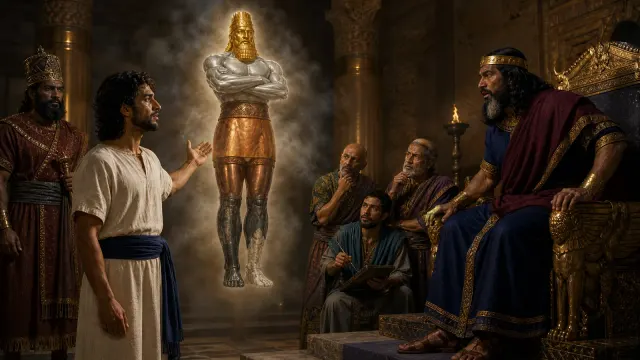
A Secret the Empire Cannot Command
Nebuchadnezzar demands an impossible performance from Babylon's experts: tell him the dream and then explain it. The resulting death sentence exposes the boundary of court wisdom, because the specialists finally admit that no person on earth can provide what the king requires. Daniel does not answer that crisis with superior technique. He asks for time, gathers his companions to seek mercy, and receives the secret in a night vision. Before entering the throne room, he praises the God who "removeth kings, and setteth up kings," language that already contains the interpretation in miniature. The dream itself moves from a dazzling image of human kingdoms to a stone "without hands" that reduces the whole structure to chaff and becomes a mountain filling the earth. Daniel refuses to claim the revelation as evidence of personal brilliance. Nebuchadnezzar responds with extraordinary honor, but even his confession still sounds like the speech of a king whose religious categories have not yet finished changing.
One complete chapter pageOpen chapter →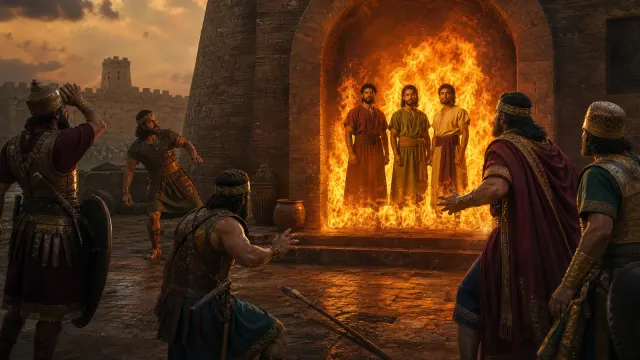
The Music Stops at Three Men Who Will Not Bow
A golden image and a musical cue turn worship into a public test of obedience. Every level of the empire is gathered, every instrument has its place, and the furnace waits for anyone whose body does not move with the crowd. Shadrach, Meshach, and Abednego are denounced precisely because men promoted by the king refuse the worship he demands. Their answer separates God's ability to deliver from their obligation to obey him: rescue is possible, but their allegiance is not conditional on receiving it. Nebuchadnezzar's attempt to make the punishment more certain kills the soldiers carrying out his command, while the three intended victims are seen walking loose with a fourth figure in the flames. The inspection afterward reaches down to hair, garments, and even the smell of smoke. Nebuchadnezzar blesses their God and recognizes a deliverance he had challenged, yet his next decree still uses the violent language of dismemberment. His old governing habits survive inside his new confession.
One complete chapter pageOpen chapter →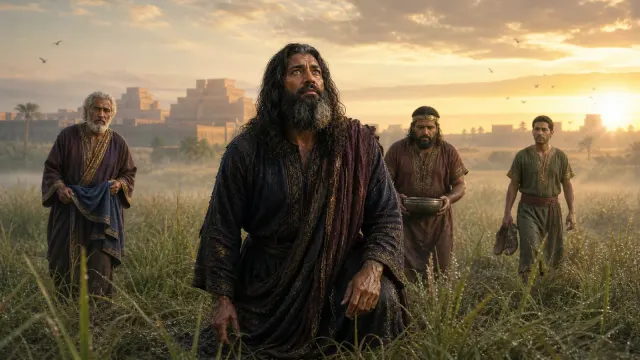
The King Who Must Learn What His Kingdom Cannot Teach
Nebuchadnezzar tells this chapter as the account of what the Most High did to him. A vast tree pictures a kingship that shelters and feeds others, but a heavenly decree orders it cut down while preserving the stump. Daniel interprets the dream with visible reluctance, names the king as the tree, and urges him toward righteousness and mercy to the poor. Twelve months pass before the warning meets Nebuchadnezzar in the middle of a boast about Babylon, his power, and his majesty. The announced humiliation follows, reducing the ruler who saw himself at the center of a great city to a life exposed among the beasts. Restoration begins when his understanding returns and he looks toward heaven. His kingdom and honor come back, but his explanation of greatness has changed. The final praise does not abolish earthly government. It places the restored king beneath a dominion he now confesses no earthly ruler can restrain.
One complete chapter pageOpen chapter →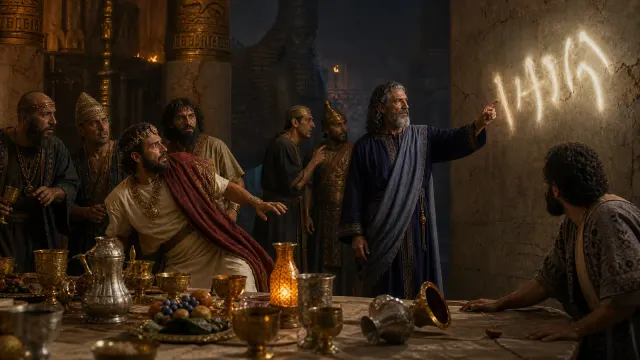
The Feast Is Weighed, and the Kingdom Is Wanting
Belshazzar's feast turns captured temple vessels into drinking cups while the room praises gods made of gold, silver, brass, iron, wood, and stone. A hand appears and writes where the king can see it, collapsing the confidence of a ruler whose court still possesses wealth, ceremony, and titles but cannot read the message. Daniel is summoned from outside the immediate circle of the feast and refuses to let the interpretation look purchased by royal reward. Before explaining the inscription, he places Belshazzar beside Nebuchadnezzar's humiliation and makes one fact decisive: "thou knewest all this." The king's failure is not innocent ignorance. He has repeated self-exaltation in the presence of remembered warning. The words on the wall announce that the kingdom has been numbered, the king weighed, and the realm divided. Belshazzar still awards Daniel's promised honors, but the gesture has almost no future. The same night the king dies and the kingdom passes to another ruler.
One complete chapter pageOpen chapter →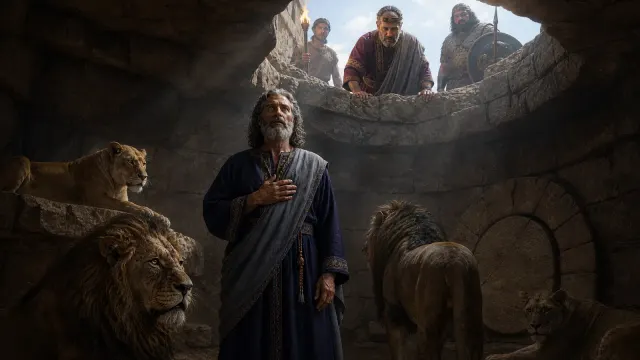
A Law That Catches the King as Well as Daniel
Daniel's excellence under Darius creates a political problem because his rivals can find no administrative fault worth prosecuting. Their solution is to turn his established devotion to God into the offense. The decree they secure flatters the king by making him the only permitted recipient of petitions for thirty days, yet the supposedly unchangeable law soon traps Darius more effectively than Daniel. Daniel does nothing theatrical when the law changes. He continues praying as he had before, and the accusers use that continuity to force the king's hand. A sealed stone closes the den while Darius spends a sleepless night in the palace. At dawn the answer comes from inside: God has sent an angel and shut the lions' mouths. The violence that follows Daniel's rescue is not softened, as the accusers and their families are thrown to the same animals. Darius then proclaims an enduring divine kingdom, while Daniel continues through another change of rulers.
One complete chapter pageOpen chapter →
The Beasts Meet a Court They Cannot Intimidate
Daniel's visions begin by recasting imperial succession as a sequence of beasts rising from a stormy sea. The view from below is not polished metal but appetite, teeth, trampling, and speech that grows arrogant enough to challenge heaven. Then the scene moves to an ordered court. The Ancient of days sits, the books are opened, and the loud horn keeps talking while judgment proceeds without needing its permission. One "like the Son of man" receives an everlasting dominion, and the interpretation links that kingdom with the saints of the Most High. Yet the promise is not given by denying the reality of persecution. The horn makes war, prevails for a time, and wears the holy people down before its authority is removed. Daniel asks questions, receives answers, and still ends disturbed enough for his appearance to change. The chapter allows final judgment to be certain while the human recipient remains deeply unsettled by what comes before it.
One complete chapter pageOpen chapter →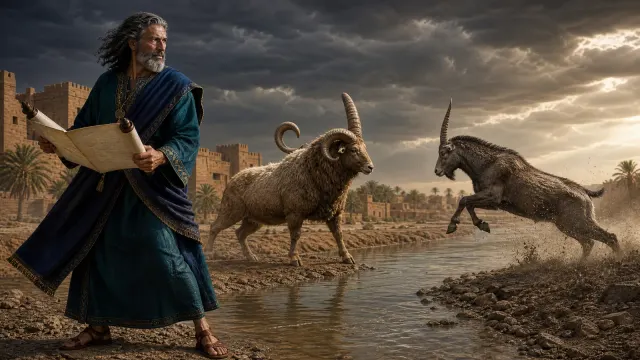
The Sanctuary Under the Shadow of a Growing Horn
Daniel's next vision names some of the kingdoms that earlier visions left symbolic. A ram represents Media and Persia, a swift goat represents Greece, and the goat's great horn breaks at the height of strength rather than after visible decline. The vision then narrows from international conquest to an arrogant power that attacks the holy people, removes the daily sacrifice, and tramples the sanctuary. Heavenly voices ask how long the desecration will last, making duration itself part of the answer. Gabriel is sent to explain what Daniel cannot master on his own, and Daniel must be touched and raised in order to receive the explanation. The later ruler prospers through force and deceit but finally is broken "without hand." Daniel ends physically affected, sick for days, then returns to the king's business while remaining astonished. The chapter combines named political sequence, sacred desecration, and a deliberate refusal to turn revelation into effortless comprehension.
One complete chapter pageOpen chapter →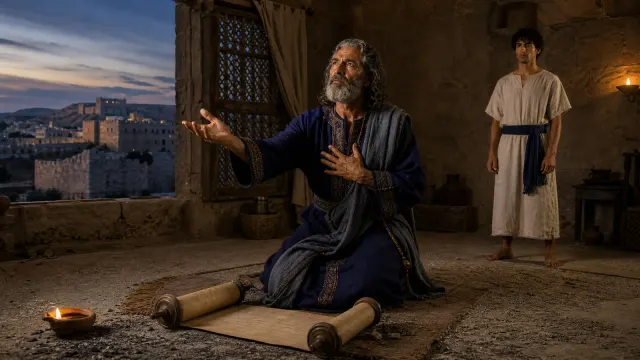
A Prayer for the Ruined City Receives a Larger Horizon
Daniel reads Jeremiah's prophecy about seventy years of Jerusalem's desolation and responds not by building a chart first, but by praying. His confession places himself inside Israel's guilt, names the justice of the covenant judgment, and repeatedly appeals to God's mercy, reputation, city, sanctuary, and name. Gabriel arrives while Daniel is still speaking and explains that the command to answer went out at the beginning of the prayer. The answer then stretches far beyond the immediate question of return from exile. Seventy weeks concern transgression, sin, reconciliation, everlasting righteousness, rebuilding, an anointed figure, interrupted sacrifice, and further desolation. The chapter therefore moves from a known prophetic period into a much larger and more disputed horizon. Daniel receives real information without being handed an uncontested timetable. Through all the interpretive difficulty, one line remains steady: the desolating power does not determine its own duration. The end is repeatedly described as something already determined beyond it.
One complete chapter pageOpen chapter →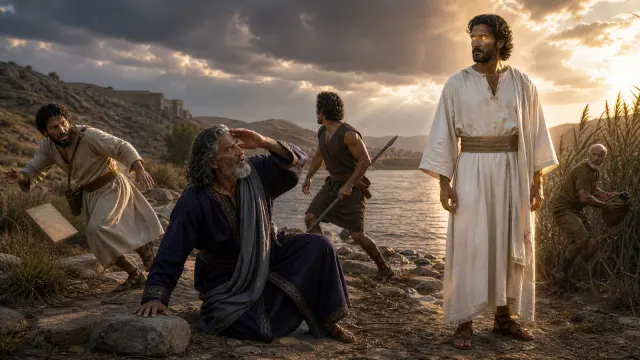
Heard on the First Day, Strengthened for What Follows
Daniel's final major revelation begins not with triumphant mastery but with mourning, bodily weakness, and repeated assistance. After three weeks without rich food, meat, wine, or anointing, he sees a radiant figure whose presence leaves him without strength. A touch brings him to his hands and knees, then to a trembling stand. The messenger tells him that his words were heard from the first day, even though resistance associated with the prince of Persia delayed the arrival until Michael came to help. The chapter thus opens a heavenly dimension behind earthly kingdoms without giving a complete map of invisible powers. Daniel loses strength and speech again, and again he is touched and strengthened before more can be said. The coming disclosure is described as written in "the scripture of truth," suggesting that conflict does not make the outcome improvised. The chapter prepares the long sequence of kings in Daniel 11 by showing first how dependent the receiver is on strength supplied to him.
One complete chapter pageOpen chapter →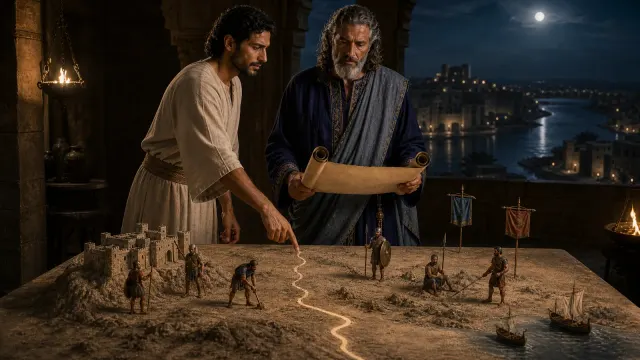
Kings Make Plans, and the Covenant Bears the Pressure
The long disclosure of Daniel 11 moves through Persian and Greek power, dynastic fracture, marriage alliances, invasions, betrayals, taxation, deceit, and persecution. The details can feel like a parade of rulers, but the repeated pattern is more important than any one name: strength does not secure succession, diplomacy does not guarantee peace, victory does not create permanence, and schemes repeatedly fail to control the appointed end. The land of Daniel's people is not merely scenery between larger empires. It becomes the place where rival powers collide and where hostility toward the holy covenant finally concentrates. The wise teach under pressure, and some of them die by sword, flame, captivity, and spoil, preventing earlier miraculous rescues from becoming a promise of physical immunity. The final ruler magnifies himself, rewards power, and reaches an imposing camp near the holy mountain. Yet the chapter ends him in a single severe phrase: he comes to his end, and nobody helps him.
One complete chapter pageOpen chapter →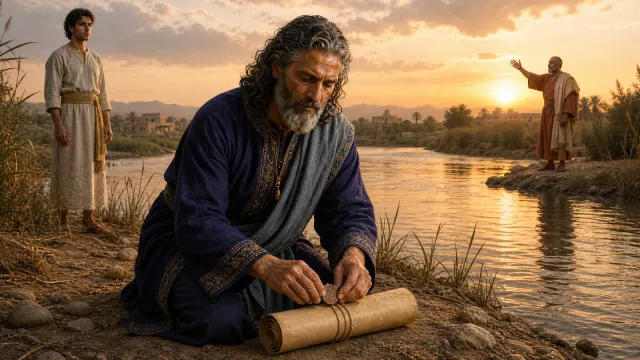
Beyond the Dust, a Place Still Appointed
Daniel's final chapter carries the revelation beyond persecution into deliverance, resurrection, and the lasting brightness of the wise. Michael stands for Daniel's people during a time of extraordinary trouble, and those written in the book are not reduced to casualties in the struggle of empires. The vision then reaches into the dust itself: some awaken to everlasting life, others to shame, while the wise shine like the firmament. Daniel is told to seal the book for its appointed horizon, and a solemn oath gives another bounded period for the breaking of the holy people's power. Yet even near the end, Daniel can say plainly, "I heard, but I understood not." More numbers are given, but not every chronological correspondence is explained. The final word therefore does not turn him into a calculator who has solved every date. He is told to go his way, rest, and one day stand in his allotted place. The book ends with a future portion no earthly king assigns.
One complete chapter pageOpen chapter →Source: eBible.org · eng-kjv2006