
The big picture
The local provision for poor people is followed by laws about debt and service. Moses, the leader addressing Israel, the people God freed from slavery, commands a recurring release. Lenders must not use the approaching release year as a reason to deny help. Israelites sold into service must leave with supplies when their term ends. The chapter also returns to firstborn animals, distinguishing sacred offerings from meat eaten in ordinary homes.
In this chapter
- The Seventh Year Releases Debts Deuteronomy 15:1-6
Every seventh year, lenders must release what fellow Israelites owe them.
- The Approaching Release Cannot Excuse Refusal Deuteronomy 15:7-11
Moses warns against closing one's hand to a poor neighbour.
- Freed Servants Must Leave with Supplies Deuteronomy 15:12-18
A Hebrew man or woman sold into service must be freed after six years.
- Firstborn Animals Have a Sacred Claim Deuteronomy 15:19-23
Firstborn males from cattle and flocks must be set apart for God.
Central truth
God requires release from debt and service to bring real help, not grudging refusal or freedom without means to live.


Scripture beside the summary
Deuteronomy · King James Version · 23Deuteronomy 15:1-6
The Seventh Year Releases Debts
Every seventh year, lenders must release what fellow Israelites owe them. They must stop pressing their claims against their own people. The same rule does not apply to debts owed by foreigners. Moses links this release with God's blessing in the land. If the people obey, they will have enough to lend to other nations rather than borrow from them. Poverty is not the aim of life in the land God gives. Owners must loosen their hold on debts instead of keeping neighbours bound to them without end.

In everyday life
A repair-shop owner cancels the remaining balance on a worker's tool loan at the agreed review date. He closes the account instead of carrying the claim forward under another label. The release changes what he can demand. Israel's seventh-year release is imposed by God's law and distinguishes insiders from foreigners.
Notice
Deuteronomy 15:3 The rule explicitly treats the foreigner differently from the fellow Israelite. The chapter limits a creditor's claim within the people without making every debt identical.
Deuteronomy 15:1-6
King James Version1At the end of every seven years thou shalt make a release.
2And this is the manner of the release: Every creditor that lendeth ought unto his neighbour shall release it; he shall not exact it of his neighbour, or of his brother; because it is called the LORD’s release.
3Of a foreigner thou mayest exact it again: but that which is thine with thy brother thine hand shall release;
4Save when there shall be no poor among you; for the LORD shall greatly bless thee in the land which the LORD thy God giveth thee for an inheritance to possess it:
5Only if thou carefully hearken unto the voice of the LORD thy God, to observe to do all these commandments which I command thee this day.
6For the LORD thy God blesseth thee, as he promised thee: and thou shalt lend unto many nations, but thou shalt not borrow; and thou shalt reign over many nations, but they shall not reign over thee.
Deuteronomy 15:7-11
The Approaching Release Cannot Excuse Refusal
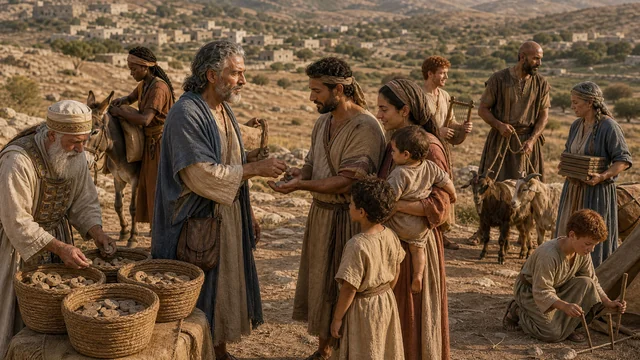
Moses warns against closing one's hand to a poor neighbour. The lender must provide enough for the person's actual need. Knowing that the release year is near must not become an excuse to refuse help. If the poor person appeals to God against such refusal, the lender is guilty. Giving must not be grudging. Moses recognises that poor people will remain in the land, and makes their continuing presence a reason for open-handed help rather than indifference.
In everyday life
A bicycle-shop manager lends a replacement bike to a worker even though the lending scheme ends next week. She does not leave him stranded merely because she will not recover the usual hire fee. His present need still matters. Moses commands support under God's release law, not a shop's temporary promotion.
Notice
Deuteronomy 15:9 Calculating a loan's likely return can turn the release law against the poor. A rule meant to help them must not become the lender's excuse to withhold help.
Deuteronomy 15:7-11
King James Version7If there be among you a poor man of one of thy brethren within any of thy gates in thy land which the LORD thy God giveth thee, thou shalt not harden thine heart, nor shut thine hand from thy poor brother:
8But thou shalt open thine hand wide unto him, and shalt surely lend him sufficient for his need, in that which he wanteth.
9Beware that there be not a thought in thy wicked heart, saying, The seventh year, the year of release, is at hand; and thine eye be evil against thy poor brother, and thou givest him nought; and he cry unto the LORD against thee, and it be sin unto thee.
10Thou shalt surely give him, and thine heart shall not be grieved when thou givest unto him: because that for this thing the LORD thy God shall bless thee in all thy works, and in all that thou puttest thine hand unto.
11For the poor shall never cease out of the land: therefore I command thee, saying, Thou shalt open thine hand wide unto thy brother, to thy poor, and to thy needy, in thy land.
Deuteronomy 15:12-18
Freed Servants Must Leave with Supplies
A Hebrew man or woman sold into service must be freed after six years. This person is a member of Israel, not a hired worker leaving a job. The owner must give food and livestock for the new start. Israel must remember its own rescue from slavery in Egypt. A servant can choose to stay because of love for the household. The owner then pierces the servant's ear at the door, marking service for life. Those who leave must not face resentment after six years of work.


In everyday life
A tailoring-shop owner gives a departing apprentice the promised sewing kit instead of handing over only a farewell card. The completed term has benefited the shop, and the tools make a new start possible. She packs them carefully before the last shift ends. Ancient service involved a person's freedom, not a modern apprenticeship contract.
Notice
Deuteronomy 15:13 Release must include material support. Leaving with nothing would make the formal end of service a much weaker help than the command requires.
Deuteronomy 15:12-18
King James Version12And if thy brother, an Hebrew man, or an Hebrew woman, be sold unto thee, and serve thee six years; then in the seventh year thou shalt let him go free from thee.
13And when thou sendest him out free from thee, thou shalt not let him go away empty:
14Thou shalt furnish him liberally out of thy flock, and out of thy floor, and out of thy winepress: of that wherewith the LORD thy God hath blessed thee thou shalt give unto him.
15And thou shalt remember that thou wast a bondman in the land of Egypt, and the LORD thy God redeemed thee: therefore I command thee this thing to day.
16And it shall be, if he say unto thee, I will not go away from thee; because he loveth thee and thine house, because he is well with thee;
17Then thou shalt take an aul, and thrust it through his ear unto the door, and he shall be thy servant for ever. And also unto thy maidservant thou shalt do likewise.
18It shall not seem hard unto thee, when thou sendest him away free from thee; for he hath been worth a double hired servant to thee, in serving thee six years: and the LORD thy God shall bless thee in all that thou doest.
Deuteronomy 15:19-23
Firstborn Animals Have a Sacred Claim
Firstborn males from cattle and flocks must be set apart for God. The owner must not use the young ox for work or shear the firstborn sheep for profit. The animal is eaten before God at his chosen place. A blind, lame, or otherwise defective animal must not be sacrificed, but can be eaten locally as ordinary meat. Clean and unclean people can share it. In either case blood must be poured onto the ground rather than consumed.

In everyday life
A violin dealer labels an instrument promised as a public gift. A customer offers a large fee to rent it first. She refuses and places the violin in its case for the handover. The promise limits her use of what she still holds. God claims firstborn animals himself; the dealer chose to make her gift.
Notice
Deuteronomy 15:19 The ox must not work, and the sheep must not be shorn. Their owner cannot take routine profit from animals already claimed by God.
Deuteronomy 15:19-23
King James Version19All the firstling males that come of thy herd and of thy flock thou shalt sanctify unto the LORD thy God: thou shalt do no work with the firstling of thy bullock, nor shear the firstling of thy sheep.
20Thou shalt eat it before the LORD thy God year by year in the place which the LORD shall choose, thou and thy household.
21And if there be any blemish therein, as if it be lame, or blind, or have any ill blemish, thou shalt not sacrifice it unto the LORD thy God.
22Thou shalt eat it within thy gates: the unclean and the clean person shall eat it alike, as the roebuck, and as the hart.
23Only thou shalt not eat the blood thereof; thou shalt pour it upon the ground as water.
Details worth noticing
The opening image
Deuteronomy 15:1 begins with “At the end of every seven years thou shalt make a release.”
Where the chapter turns
Deuteronomy 15:8 forms a natural hinge: “But thou shalt open thine hand wide unto him, and shalt surely lend him sufficient for his need, in that which he wanteth.”
The final note
Deuteronomy 15:23 leaves the reader with “Only thou shalt not eat the blood thereof; thou shalt pour it upon the ground as water.”
A word trail through the chapter
The words LORD, brother, hand, poor, release, land help reveal the chapter’s repeated concerns.
KJV words made clear
- aul
- An awl, a pointed tool used here to pierce an ear.
- bondman
- An enslaved man or person held in compulsory service.
Music and video connected to the passage
Related media appears when its Scripture reference overlaps this study. Music and video can illuminate a theme while the biblical text remains the foundation.