The big picture
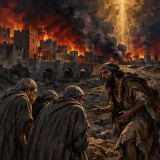
Ezekiel has fallen on his face before the vision of God's glory. The voice now addresses him as a human being and raises him to hear a commission. He will speak to Israel, God's covenant people, whose resistance has continued across generations. Their response is uncertain, but his task is clear. He must not let fear or their stubbornness make him rebellious too. A scroll covered with lament and sorrow is held before him, and he is commanded to receive it in an unusually direct way.
In this chapter
- The Spirit Raises Him for a Difficult Commission Ezekiel 2:1-5
The voice tells Ezekiel to stand so God can speak to him.
- Threatening Words Must Not Silence the Message Ezekiel 2:6-7
God tells Ezekiel not to fear the people, their words, or their looks.
- The Open Scroll Tests the Messenger Too Ezekiel 2:8-10
God turns the command towards Ezekiel himself: he must hear and not become rebellious like the people.
Central truth
God sends Ezekiel to a resistant people and commands him to receive the sorrowful message faithfully, whether or not his hearers accept it.


Scripture beside the summary
Ezekiel · King James Version · 10Ezekiel 2:1-5
The Spirit Raises Him for a Difficult Commission
The voice tells Ezekiel to stand so God can speak to him. As it speaks, the spirit enters and raises him to his feet. He is sent to a people who have rebelled against God along with their ancestors. Their conduct is bold and their hearts stubborn. He must address them with the Lord's own message. Whether they listen or refuse, they will know a prophet has been among them. His commission does not rest on a promise of welcome. God enables him to stand before sending him to speak.

In everyday life
A new safety representative is helped to her feet after being shaken by a major emergency briefing. Her supervisor then sends her to deliver an unwelcome finding to staff who have ignored earlier warnings. The duty is clear even without a welcome. Ezekiel is raised by God's spirit and sent as his prophet, not appointed by a human supervisor.
Notice
Ezekiel 2:2 The spirit sets Ezekiel on his feet as the voice speaks. The command to stand comes with the power to respond, before the difficult commission is explained.
Ezekiel 2:1-5
King James Version1And he said unto me, Son of man, stand upon thy feet, and I will speak unto thee.
2And the spirit entered into me when he spake unto me, and set me upon my feet, that I heard him that spake unto me.
3And he said unto me, Son of man, I send thee to the children of Israel, to a rebellious nation that hath rebelled against me: they and their fathers have transgressed against me, even unto this very day.
4For they are impudent children and stiffhearted. I do send thee unto them; and thou shalt say unto them, Thus saith the Lord GOD.
5And they, whether they will hear, or whether they will forbear, (for they are a rebellious house,) yet shall know that there hath been a prophet among them.
Ezekiel 2:6-7
Threatening Words Must Not Silence the Message
God tells Ezekiel not to fear the people, their words, or their looks. Thorns, briers, and scorpions picture the hostility surrounding him. The images do not turn the hearers into harmless obstacles; they acknowledge that speaking among them will hurt and threaten. Yet he is to deliver God's words whether they hear or refuse. Their rebellion is repeated as a fact he must face. The prophet's duty is not to make their reaction agreeable, but to keep that reaction from deciding whether the message is spoken at all.


In everyday life
A complaints officer enters a tense tenants' meeting where several people interrupt and glare before she opens the report. She steadies her pages and gives the findings without changing them to win approval. The hostility is real but does not decide the content. Ezekiel carries God's word to a rebellious people, not a report open to ordinary administrative revision.
Notice
Ezekiel 2:6 Words and looks are named alongside thorn and scorpion images. The command addresses intimidation through speech and expression, not only the possibility of physical harm.
Ezekiel 2:6-7
King James Version6And thou, son of man, be not afraid of them, neither be afraid of their words, though briers and thorns be with thee, and thou dost dwell among scorpions: be not afraid of their words, nor be dismayed at their looks, though they be a rebellious house.
7And thou shalt speak my words unto them, whether they will hear, or whether they will forbear: for they are most rebellious.
Ezekiel 2:8-10
The Open Scroll Tests the Messenger Too
God turns the command towards Ezekiel himself: he must hear and not become rebellious like the people. He is to open his mouth and eat what is given. A hand holds out a scroll and spreads it before him. Writing covers both sides, and its contents are lamentation, mourning, and woe. The messenger is not placed above the need to obey. Before carrying difficult words to others, he must accept the message presented to him. The chapter ends with the scroll open and the command still before him.

In everyday life
A translator receives a painful witness statement and reads it fully before preparing to convey it to others. She cannot replace the difficult portions with words she would rather hear. Receiving the account is part of faithfully carrying it. Ezekiel is commanded to eat a divine scroll in a vision, not merely to study another person's testimony.
Notice
Ezekiel 2:10 Both sides of the scroll are written on, and the contents are all named as grief. The burden is laid before him. He has not been promised pleasant words.
Ezekiel 2:8-10
King James Version8But thou, son of man, hear what I say unto thee; Be not thou rebellious like that rebellious house: open thy mouth, and eat that I give thee.
9And when I looked, behold, an hand was sent unto me; and, lo, a roll of a book was therein;
10And he spread it before me; and it was written within and without: and there was written therein lamentations, and mourning, and woe.
Details worth noticing
The opening image
Ezekiel 2:1 begins with “And he said unto me, Son of man, stand upon thy feet, and I will speak unto thee.”
Where the chapter turns
Ezekiel 2:8 forms a natural hinge: “But thou, son of man, hear what I say unto thee; Be not thou rebellious like that rebellious house: open thy mouth, and eat that I give thee.”
The final note
Ezekiel 2:10 leaves the reader with “And he spread it before me; and it was written within and without: and there was written therein lamentations, and mourning, and woe.”
A word trail through the chapter
The words rebellious, afraid, hear, house, words, children help reveal the chapter’s repeated concerns.
KJV words made clear
- Son of man
- A form of address identifying Ezekiel as a human being before God.
- forbear
- Decline or refuse, here to refuse to listen.
- roll
- A scroll, a written sheet kept by rolling it up.
Music and video connected to the passage
Related media appears when its Scripture reference overlaps this study. Music and video can illuminate a theme while the biblical text remains the foundation.