New · FreePlay The Witnesses The in-depth puzzle battle quest through Bible history

People of the Bible

Ezekiel

A priest who never served in a temple, given the strangest assignments in Scripture and told to carry them out without explaining.

Ezekiel is among the exiles by the river Chebar when the heavens open. He is a priest by training and thirty years old, the age a priest begins, and he is a thousand miles from the altar. What he is given is mostly performance: lie on one side for three hundred and ninety days, shave his head with a sword and divide the hair three ways, dig through a wall at evening and carry baggage out on his shoulder, and on the day his wife dies, not mourn, because the city will fall and there will be no mourning for it either.

Where he appearsEzekiel 1 to 48

Scroll down to the account
Ezekiel

The movements, in the order the text gives them.

The Account of Ezekiel

  1. 01

    Ezekiel 1:1-28

    Wheels within wheels

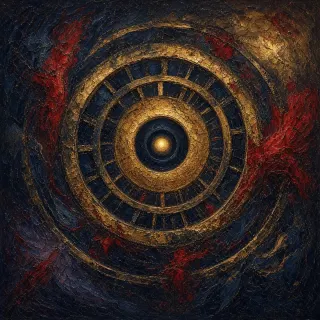
    Four living creatures, four faces each, and wheels whose rims are full of eyes that go straight forward without turning. Above them a firmament, a throne, and the appearance of the likeness of the glory.

    The first astonishment is not the wheels. It is the address. A priest among deportees in the land of the Chaldeans sees the throne of Israel's God, and the throne is not stranded in Jerusalem. Before a single creature is described, the place has already overturned the assumption that exile puts a man beyond the reach of God's presence. The hand of the LORD was there upon him. There matters.

    The vision rises from creatures and wheels to an expanse, then above the expanse to an occupied throne. Its movement is extraordinary but not disorderly: creatures and wheels advance, stop, and rise together because the same spirit directs them. No component has wandered off on its own business. Yet the repeated likeness, appearance, and as it were keep the language carefully short of a technical diagram. Ezekiel reports what something was like, not a set of measurements that would make it manageable.

    Finally the tremendous noise gives way to a voice. The creaturely spectacle does not receive the last word, and neither does the man describing it. The last position occupied by this priest is face down. The last thing he does is listen.

    Verse by verse

    1. 1:1

      The starting point of the thirtieth year is not specified. The fifth year of Jehoiachin's captivity is a separate, explicit chronological marker in verse 2.

    2. 1:3

      Ezekiel is identified as a priest in the land of the Chaldeans. This verse does not establish whether he had previously served in Jerusalem's temple.

    3. 1:5

      Ezekiel 10:20 explicitly identifies the living creatures seen by Chebar as cherubim.

    4. 1:18

      Rings here are the wheel rims, not separate pieces of jewelry. The eyes belong to the vision's description, without an accompanying explanation of each one's significance.

    5. 1:26

      Likeness and appearance qualify the description of the throne and its occupant. The wording should not be silently changed into an unqualified anatomical description of God.

    Ezekiel 1:1-28: Wheels within wheels

    Ezekiel 1:1-28

    King James Version · 28 verses

    1:1Now it came to pass in the thirtieth year, in the fourth month, in the fifth day of the month, as I was among the captives by the river of Chebar, that the heavens were opened, and I saw visions of God.

    1:2In the fifth day of the month, which was the fifth year of king Jehoiachin’s captivity,

    1:3The word of the LORD came expressly unto Ezekiel the priest, the son of Buzi, in the land of the Chaldeans by the river Chebar; and the hand of the LORD was there upon him.

    1:4And I looked, and, behold, a whirlwind came out of the north, a great cloud, and a fire infolding itself, and a brightness was about it, and out of the midst thereof as the colour of amber, out of the midst of the fire.

    1:5Also out of the midst thereof came the likeness of four living creatures. And this was their appearance; they had the likeness of a man.

    1:6And every one had four faces, and every one had four wings.

    1:7And their feet were straight feet; and the sole of their feet was like the sole of a calf’s foot: and they sparkled like the colour of burnished brass.

    1:8And they had the hands of a man under their wings on their four sides; and they four had their faces and their wings.

    1:9Their wings were joined one to another; they turned not when they went; they went every one straight forward.

    1:10As for the likeness of their faces, they four had the face of a man, and the face of a lion, on the right side: and they four had the face of an ox on the left side; they four also had the face of an eagle.

    1:11Thus were their faces: and their wings were stretched upward; two wings of every one were joined one to another, and two covered their bodies.

    1:12And they went every one straight forward: whither the spirit was to go, they went; and they turned not when they went.

    1:13As for the likeness of the living creatures, their appearance was like burning coals of fire, and like the appearance of lamps: it went up and down among the living creatures; and the fire was bright, and out of the fire went forth lightning.

    1:14And the living creatures ran and returned as the appearance of a flash of lightning.

    1:15Now as I beheld the living creatures, behold one wheel upon the earth by the living creatures, with his four faces.

    1:16The appearance of the wheels and their work was like unto the colour of a beryl: and they four had one likeness: and their appearance and their work was as it were a wheel in the middle of a wheel.

    1:17When they went, they went upon their four sides: and they turned not when they went.

    1:18As for their rings, they were so high that they were dreadful; and their rings were full of eyes round about them four.

    1:19And when the living creatures went, the wheels went by them: and when the living creatures were lifted up from the earth, the wheels were lifted up.

    1:20Whithersoever the spirit was to go, they went, thither was their spirit to go; and the wheels were lifted up over against them: for the spirit of the living creature was in the wheels.

    1:21When those went, these went; and when those stood, these stood; and when those were lifted up from the earth, the wheels were lifted up over against them: for the spirit of the living creature was in the wheels.

    1:22And the likeness of the firmament upon the heads of the living creature was as the colour of the terrible crystal, stretched forth over their heads above.

    1:23And under the firmament were their wings straight, the one toward the other: every one had two, which covered on this side, and every one had two, which covered on that side, their bodies.

    1:24And when they went, I heard the noise of their wings, like the noise of great waters, as the voice of the Almighty, the voice of speech, as the noise of an host: when they stood, they let down their wings.

    1:25And there was a voice from the firmament that was over their heads, when they stood, and had let down their wings.

    1:26And above the firmament that was over their heads was the likeness of a throne, as the appearance of a sapphire stone: and upon the likeness of the throne was the likeness as the appearance of a man above upon it.

    1:27And I saw as the colour of amber, as the appearance of fire round about within it, from the appearance of his loins even upward, and from the appearance of his loins even downward, I saw as it were the appearance of fire, and it had brightness round about.

    1:28As the appearance of the bow that is in the cloud in the day of rain, so was the appearance of the brightness round about. This was the appearance of the likeness of the glory of the LORD. And when I saw it, I fell upon my face, and I heard a voice of one that spake.

  2. 02

    Ezekiel 2:1-3:3

    Eat this roll

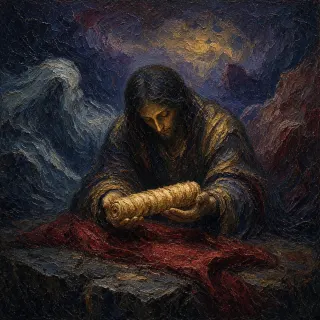
    A hand holds out a scroll written on both sides with lamentations and mourning and woe. He is told to eat it and fill his belly with it, and in his mouth it is as honey for sweetness.

    The mouth that will deliver the message has to receive it first. Before Ezekiel speaks a word to Israel, the spirit puts him on his feet, a hand extends a scroll, and the prophet is told to eat. Even his standing is something he receives. This commission begins with dependence, not a display of natural eloquence.

    Then the warning turns inward. Be not thou rebellious like that rebellious house. The messenger has not been excused from the obedience he will require of others. Israel may refuse to listen; Ezekiel must not make their refusal his own. The scroll is already written on both sides, its contents identified as lamentations, and mourning, and woe. He has not been handed an empty page on which to devise a more agreeable assignment.

    And it tastes like honey. That unexpected sweetness must stay beside the terrible contents, not replace them. The passage does not say that suffering is pleasant, or that Ezekiel enjoys announcing it. His mouth receives sweetness while the document still contains lamentation. Even the following chapter's bitterness of spirit prevents an easy reduction of this calling to a delicious experience. The word is taken in before it is sent out.

    Verse by verse

    1. 2:1

      Son of man translates the Hebrew ben adam, an address identifying Ezekiel as human. Its use here does not by itself give him the royal role of the figure in Daniel 7:13-14.

    2. 2:2

      The spirit raises the prophet who fell on his face in 1:28. The command to stand is accompanied by the means to stand.

    3. 2:8

      The prohibition against rebellion is addressed directly to Ezekiel, not only to the people he is being sent to confront.

    4. 2:10

      Within and without means that the scroll bears writing on both sides. Its contents are named before Ezekiel eats it.

    5. 3:3

      Honey describes the taste in his mouth, not a change in the scroll's message. Ezekiel 3:14 subsequently records bitterness in his spirit.

    Ezekiel 2:1-3:3

    King James Version · 13 verses

    2:1And he said unto me, Son of man, stand upon thy feet, and I will speak unto thee.

    2:2And the spirit entered into me when he spake unto me, and set me upon my feet, that I heard him that spake unto me.

    2:3And he said unto me, Son of man, I send thee to the children of Israel, to a rebellious nation that hath rebelled against me: they and their fathers have transgressed against me, even unto this very day.

    2:4For they are impudent children and stiffhearted. I do send thee unto them; and thou shalt say unto them, Thus saith the Lord GOD.

    2:5And they, whether they will hear, or whether they will forbear, (for they are a rebellious house,) yet shall know that there hath been a prophet among them.

    2:6And thou, son of man, be not afraid of them, neither be afraid of their words, though briers and thorns be with thee, and thou dost dwell among scorpions: be not afraid of their words, nor be dismayed at their looks, though they be a rebellious house.

    2:7And thou shalt speak my words unto them, whether they will hear, or whether they will forbear: for they are most rebellious.

    2:8But thou, son of man, hear what I say unto thee; Be not thou rebellious like that rebellious house: open thy mouth, and eat that I give thee.

    2:9And when I looked, behold, an hand was sent unto me; and, lo, a roll of a book was therein;

    2:10And he spread it before me; and it was written within and without: and there was written therein lamentations, and mourning, and woe.

    3:1Moreover he said unto me, Son of man, eat that thou findest; eat this roll, and go speak unto the house of Israel.

    3:2So I opened my mouth, and he caused me to eat that roll.

    3:3And he said unto me, Son of man, cause thy belly to eat, and fill thy bowels with this roll that I give thee. Then did I eat it; and it was in my mouth as honey for sweetness.

  3. 03

    Ezekiel 4:1-8

    Lie on your side

    A brick with a city drawn on it, an iron pan for a wall, and three hundred and ninety days on his left side and forty on his right, a day for a year.

    Jerusalem is drawn on a brick, and an iron cooking pan becomes a wall. The equipment is ordinary; the sentence it carries is not. A city accustomed to thinking in terms of its own defenses is made small enough to lie in front of one exile, surrounded by the siege works he has been ordered to arrange. The pan does not protect Jerusalem from the prophet's warning. It stands between them while his face is set against the city.

    Ezekiel occupies two positions within this sign. He lays siege to Jerusalem, and he bears Israel's and Judah's iniquity on his own sides. He is not merely pointing at other people's trouble from a comfortable distance. The judgment is put into the posture and duration of his body: Israel on the left, Judah on the right, days carrying the weight of years.

    The arithmetic is stated more clearly than the chronology. Three hundred and ninety days, then forty; each day for a year. No starting dates are supplied for a tidy historical calculation. Nor is this instruction a universal key for converting every prophetic day elsewhere into a year. The explanation belongs to this sign. Its precision does not authorize a precision the passage withholds.

    Verse by verse

    1. 4:1

      Tile is a brick or clay tablet suitable for depicting the city. Pourtray is the KJV spelling of portray.

    2. 4:3

      The passage explicitly calls the arrangement a sign to the house of Israel. The iron barrier is part of that prophetic representation.

    3. 4:5-6

      The KJV's 390 and 40 total 430, also the number of years in Exodus 12:40-41. That numerical correspondence does not supply Ezekiel's missing starting dates.

    4. 4:8

      The instruction specifies restraint and duration, but gives no hour-by-hour description of how Ezekiel carried it out.

    Ezekiel 4:1-8

    King James Version · 8 verses

    4:1Thou also, son of man, take thee a tile, and lay it before thee, and pourtray upon it the city, even Jerusalem:

    4:2And lay siege against it, and build a fort against it, and cast a mount against it; set the camp also against it, and set battering rams against it round about.

    4:3Moreover take thou unto thee an iron pan, and set it for a wall of iron between thee and the city: and set thy face against it, and it shall be besieged, and thou shalt lay siege against it. This shall be a sign to the house of Israel.

    4:4Lie thou also upon thy left side, and lay the iniquity of the house of Israel upon it: according to the number of the days that thou shalt lie upon it thou shalt bear their iniquity.

    4:5For I have laid upon thee the years of their iniquity, according to the number of the days, three hundred and ninety days: so shalt thou bear the iniquity of the house of Israel.

    4:6And when thou hast accomplished them, lie again on thy right side, and thou shalt bear the iniquity of the house of Judah forty days: I have appointed thee each day for a year.

    4:7Therefore thou shalt set thy face toward the siege of Jerusalem, and thine arm shall be uncovered, and thou shalt prophesy against it.

    4:8And, behold, I will lay bands upon thee, and thou shalt not turn thee from one side to another, till thou hast ended the days of thy siege.

    Ezekiel 4:1-8: Lie on your side
  4. 04

    Ezekiel 10:18-19; 11:22-23

    The glory went out by the east gate

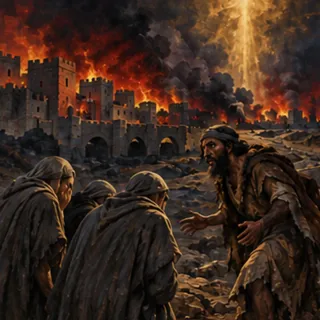
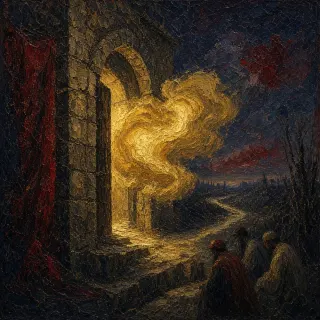
    It leaves in stages. From the cherub to the threshold, then to the east gate, then it stands on the mountain east of the city. Nothing in the account is sudden.

    The departure has stopping places. Threshold, eastern gate, mountain east of the city: the glory does not simply disappear between one sentence and the next. The Book of Ezekiel marks the route, making the loss visible in stages. The building still stands in the vision while the presence that made it a sanctuary leaves it.

    These are the same creatures Ezekiel saw by Chebar, as 10:20 immediately confirms. Their mobility was not ornamental. The throne seen among exiles can also depart from Jerusalem. Nor does an enemy carry it away as captured property. The glory rises above the cherubim and moves on its own terms.

    The intervening words sharpen the contrast. Jerusalem's inhabitants have claimed the land for themselves while treating the exiles as far from the LORD; God answers that he will be a little sanctuary to those scattered abroad, in 11:15-16. Then his glory leaves the city whose residents supposed their address settled the matter. Those near the building are not necessarily near its God. The wheels make that distinction visible.

    Verse by verse

    1. 10:18

      The house is the temple, not Ezekiel's private dwelling. The threshold marks a stage in the departure of the divine glory.

    2. 10:19

      The glory remains above the cherubim. The distinction between God's presence and the creatures carrying the vision's throne is maintained.

    3. 11:22

      The repeated description links the movement in chapter 11 with the departure through the gate in chapter 10.

    4. 11:23

      The mountain is described by its position east of the city, without a name here. Verse 24 identifies Ezekiel's experience as a vision.

    Ezekiel 10:18-19; 11:22-23

    King James Version · 4 verses

    10:18Then the glory of the LORD departed from off the threshold of the house, and stood over the cherubims.

    10:19And the cherubims lifted up their wings, and mounted up from the earth in my sight: when they went out, the wheels also were beside them, and every one stood at the door of the east gate of the LORD’s house; and the glory of the God of Israel was over them above.

    11:22Then did the cherubims lift up their wings, and the wheels beside them; and the glory of the God of Israel was over them above.

    11:23And the glory of the LORD went up from the midst of the city, and stood upon the mountain which is on the east side of the city.

    Ezekiel 10:18-19; 11:22-23: The glory went out by the east gate
  5. 05

    Ezekiel 24:15-24

    The desire of your eyes

    He is told in the morning that his wife will die that evening and that he must not mourn. He speaks to the people in the morning, and at even she dies, and he does as he was commanded.

    His wife is called the desire of thine eyes before she is called his wife. The tenderness is in the text, not something that has to be supplied to make the loss count. Her name, age, and cause of death are not given. Neither is any accusation against her. Nothing in the passage licenses an explanation of her death as punishment for some hidden offense of her own.

    The account measures the event with three small time marks: he speaks in the morning, she dies in the evening, and the next morning he does as commanded. Ordinary signs of mourning are withheld. The head covering stays on; the shoes stay on; the expected public responses do not come. That absence is the sign the people notice. It is not evidence that the marriage meant little, because the description of her has already ruled out such a reading.

    Then the phrase returns. God's sanctuary is the desire of their eyes, and their children left in Jerusalem will fall by the sword. The explanation does not make the personal loss painless or turn his wife into an accused person. It binds his bereavement to the community's approaching bereavement. A chapter can explain what a death signifies without pretending that significance makes it small.

    Verse by verse

    1. 24:16

      With a stroke describes the taking away, but names no medical cause. The text does not charge Ezekiel's wife with wrongdoing.

    2. 24:17

      Tire is a head covering. The retained head covering and shoes, uncovered lips, and refused food belong to the unusual mourning instructions.

    3. 24:18

      The sequence is morning speech, evening death, and obedience the following morning. It supplies no description of his wife's final words or thoughts.

    4. 24:21

      Desire of your eyes repeats the language used of his wife in verse 16, now applied to the sanctuary. The deaths of the children are separately and explicitly announced.

    5. 24:24

      Ezekiel is identified as a sign to this audience. His instructions should not be universalized into rules forbidding ordinary expressions of grief.

    Ezekiel 24:15-24

    King James Version · 10 verses

    24:15Also the word of the LORD came unto me, saying,

    24:16Son of man, behold, I take away from thee the desire of thine eyes with a stroke: yet neither shalt thou mourn nor weep, neither shall thy tears run down.

    24:17Forbear to cry, make no mourning for the dead, bind the tire of thine head upon thee, and put on thy shoes upon thy feet, and cover not thy lips, and eat not the bread of men.

    24:18So I spake unto the people in the morning: and at even my wife died; and I did in the morning as I was commanded.

    24:19And the people said unto me, Wilt thou not tell us what these things are to us, that thou doest so?

    24:20Then I answered them, The word of the LORD came unto me, saying,

    24:21Speak unto the house of Israel, Thus saith the Lord GOD; Behold, I will profane my sanctuary, the excellency of your strength, the desire of your eyes, and that which your soul pitieth; and your sons and your daughters whom ye have left shall fall by the sword.

    24:22And ye shall do as I have done: ye shall not cover your lips, nor eat the bread of men.

    24:23And your tires shall be upon your heads, and your shoes upon your feet: ye shall not mourn nor weep; but ye shall pine away for your iniquities, and mourn one toward another.

    24:24Thus Ezekiel is unto you a sign: according to all that he hath done shall ye do: and when this cometh, ye shall know that I am the Lord GOD.

    Ezekiel 24:15-24: The desire of your eyes
  6. 06

    Ezekiel 37:1-14

    Can these bones live

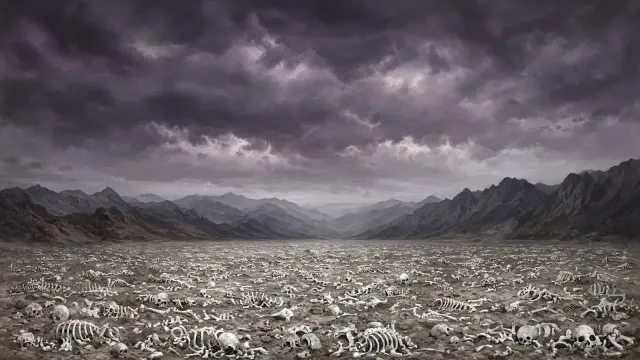
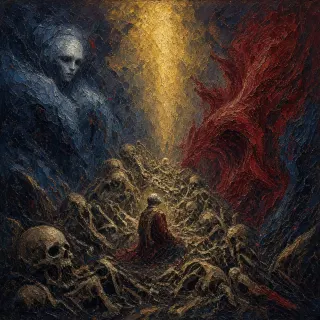
    A valley full of bones, very many and very dry. Asked whether they can live, he answers that God knows. Then the noise, the shaking, the sinews and the skin, and only then the breath.

    The bones are not merely dry. They are very dry, and Ezekiel is made to walk around them before he says anything. The inspection removes the last suggestion that this is a field of people who have only just fallen. His answer, O Lord GOD, thou knowest, does not manufacture confidence from the condition of the remains. The condition offers none.

    The restoration then stops at a startling halfway point. Bones have joined, sinews and flesh have appeared, and skin covers them; there is still no breath. A complete body is not yet a living body. Ezekiel must speak again, now to the wind, and the standing army comes only after the breath enters. The repeated obedience matters as much as the noise: he speaks as commanded, not as someone who has discovered a technique for animating bones.

    Then God supplies the interpretation that governs the vision. These bones are the whole house of Israel. A people still capable of speaking have described themselves as dried remains with no hope, and the answer takes their own image seriously enough to overturn it. The promised result includes God's spirit and return to their land. Later resurrection echoes belong beside that explanation, not in place of it. The vision gives a devastated people more than repaired anatomy. It gives them a future.

    Verse by verse

    1. 37:1

      The passage presents a vision under the hand and spirit of the LORD, not an ordinary journey to identify a particular excavated battlefield.

    2. 37:8

      The gathering of bones and restoration of flesh precede the entrance of breath. Verse 8 explicitly prevents equating bodily reconstruction with completed restoration.

    3. 37:9

      These slain specifies violent death within the vision's imagery. The text does not identify a particular battle or give the dead individual names.

    4. 37:10

      Revelation 11:11 echoes this sequence: the spirit of life enters the witnesses and they stand upon their feet. That later use should not erase Ezekiel's explicit identification in verse 11.

    5. 37:11

      The whole house of Israel is the interpretation supplied within the passage. The promise of life is joined to placement in their own land in verse 14.

    Ezekiel 37:1-14

    King James Version · 14 verses

    37:1The hand of the LORD was upon me, and carried me out in the spirit of the LORD, and set me down in the midst of the valley which was full of bones,

    37:2And caused me to pass by them round about: and, behold, there were very many in the open valley; and, lo, they were very dry.

    37:3And he said unto me, Son of man, can these bones live? And I answered, O Lord GOD, thou knowest.

    37:4Again he said unto me, Prophesy upon these bones, and say unto them, O ye dry bones, hear the word of the LORD.

    37:5Thus saith the Lord GOD unto these bones; Behold, I will cause breath to enter into you, and ye shall live:

    37:6And I will lay sinews upon you, and will bring up flesh upon you, and cover you with skin, and put breath in you, and ye shall live; and ye shall know that I am the LORD.

    37:7So I prophesied as I was commanded: and as I prophesied, there was a noise, and behold a shaking, and the bones came together, bone to his bone.

    37:8And when I beheld, lo, the sinews and the flesh came up upon them, and the skin covered them above: but there was no breath in them.

    37:9Then said he unto me, Prophesy unto the wind, prophesy, son of man, and say to the wind, Thus saith the Lord GOD; Come from the four winds, O breath, and breathe upon these slain, that they may live.

    37:10So I prophesied as he commanded me, and the breath came into them, and they lived, and stood up upon their feet, an exceeding great army.

    37:11Then he said unto me, Son of man, these bones are the whole house of Israel: behold, they say, Our bones are dried, and our hope is lost: we are cut off for our parts.

    37:12Therefore prophesy and say unto them, Thus saith the Lord GOD; Behold, O my people, I will open your graves, and cause you to come up out of your graves, and bring you into the land of Israel.

    37:13And ye shall know that I am the LORD, when I have opened your graves, O my people, and brought you up out of your graves,

    37:14And shall put my spirit in you, and ye shall live, and I shall place you in your own land: then shall ye know that I the LORD have spoken it, and performed it, saith the LORD.

Why it matters

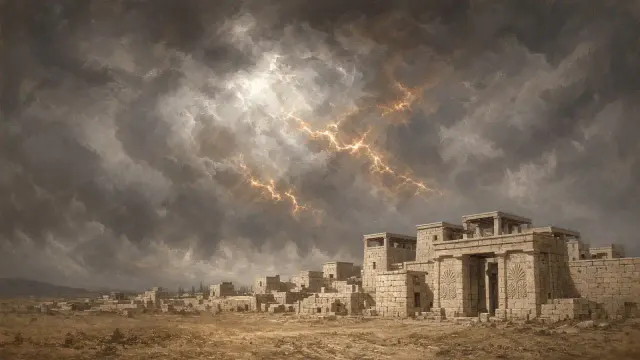
Ezekiel is the answer to the question the exiles were actually asking: whether God was left behind in a burning building. His first vision is a throne on wheels that can go in any direction without turning, and his ninth chapter shows the glory leaving the temple by the east gate, slowly, stopping twice. The last word of the book is the name of a city: the LORD is there. In between are the dry bones, the new heart, and the shepherd who goes after the one that was lost.

18 songs

The music

Every song in the catalogue whose passage falls inside these chapters.

  1. Ezekiel 1:1–48:35

    Ezekiel (Dry Bones Rise)

  2. Ezekiel 1-3

    Wheels Within Wheels

  3. Ezekiel 2:1-3:27

    Eat This Roll

  4. Ezekiel 4:1-5:17

    Set Thy Face against the City

  5. Ezekiel 8:1-18

    Dig Now in the Wall

  6. Ezekiel 9:1-11:25

    The Glory Departed by the East Gate

  7. Ezekiel 12:1-13:23

    Baggage through the Wall

  8. Ezekiel 16:1-63; 17:1-24

    The Faithless City and the Tender Branch

  9. Ezekiel 18:1-32

    The Soul That Sinneth, It Shall Die

  10. Ezekiel 21:1-32; 24:1-27

    The Boiling Pot and the Silent House

  11. Ezekiel 26:1-28:26

    The Merchant City Sank

  12. Ezekiel 33:1-33

    The City Is Smitten

    Play hereOpen song pageRead lyrics
  13. Ezekiel 34:1-31

    I Will Seek That Which Was Lost

    Play hereOpen song pageRead lyrics
  14. Ezekiel 36:1-38

    A New Heart and a New Spirit

  15. Ezekiel 37

    Breathe Upon These Bones

  16. Ezekiel 37:1-28

    Can These Bones Live?

  17. Ezekiel 38:1-39:29

    I Am against Thee, O Gog

  18. Ezekiel 40:1-48:35

    The LORD Is There

    Play hereOpen song pageRead lyrics

The videos

The videos

Every release whose passage falls inside these chapters, playing here.

Nearby

All the people

Report an error on this page