New · FreePlay The Witnesses The in-depth puzzle battle quest through Bible history

People of the Bible

Zedekiah

The last king of Judah, who kept asking the prophet for a word in secret and never once did what it said.

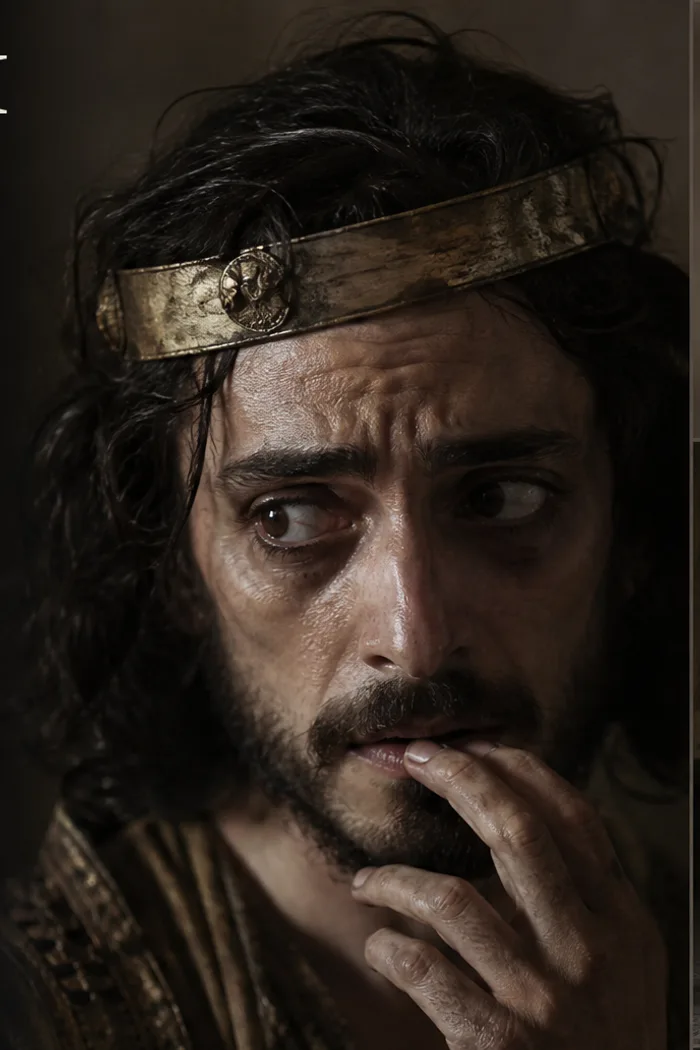
Zedekiah is put on the throne by Nebuchadnezzar, who changes his name from Mattaniah as a way of saying who owns him, and he is twenty-one. He rebels anyway, and the siege lasts a year and a half until there is no bread in the city. Through all of it he sends privately for Jeremiah, asks whether there is any word from the LORD, gets the same answer every time, and does nothing with it because he is afraid of his own officials. When the wall is breached he runs at night by the gate between two walls and is caught in the plains of Jericho.

Where he appears2 Kings 24 to 25 · 2 Chronicles 36

Scroll down to the account
Zedekiah

The movements, in the order the text gives them.

The Account of Zedekiah

  1. 01

    2 Kings 24:17-20

    He changed his name

    Installed by Babylon, renamed by Babylon, twenty-one years old. He does evil according to all that Jehoiakim had done, and rebels against the king who put him there.

    His reign begins with somebody else changing his name. Nebuchadnezzar supplies both the appointment and the new royal name, making the limits of Judah's independence visible in a single sentence. This is not the first arrival of Babylon at Jerusalem. The preceding verses have already taken Jehoiachin, leading men, craftsmen and treasure into exile. Mattaniah receives a throne in a kingdom that has already been stripped of much of what sustained it.

    Yet he belongs to Josiah's family, not Nebuchadnezzar's. His father's brother identifies him as the uncle of the deported Jehoiachin. The dynasty continues, but succession within that dynasty is now being arranged by a foreign king. Permission to occupy the throne is not the same as independence.

    The Book of Second Kings places Zedekiah's eleven years inside a longer account of judgment, and compares his conduct with Jehoiakim's. His rebellion is therefore not presented simply as an isolated military decision with an unfortunate result. Babylon's appointment and the LORD's assessment remain distinct. One explains how he obtained his position. The other supplies the measure of his reign.

    Verse by verse

    1. 24:17

      The Hebrew dod identifies an uncle, here Jehoiachin's. The KJV of Second Chronicles 36:10 uses brother; Second Kings gives the more specific relationship.

    2. 24:17

      This Zedekiah is not the prophet of the same name who confronts Micaiah in First Kings 22:24. Names shared by different people should not merge their accounts.

    3. 24:19

      The comparison is with Jehoiakim, not with Zedekiah's father Josiah. Jeremiah 37:1 expressly identifies Zedekiah as Josiah's son.

    4. 24:20

      Second Chronicles 36:13 adds that Nebuchadnezzar had made Zedekiah swear by God. Ezekiel 17:13-19 treats the rebellion as the violation of an oath, not merely a change of foreign allegiance.

    2 Kings 24:17-20

    King James Version · 4 verses

    24:17And the king of Babylon made Mattaniah his father’s brother king in his stead, and changed his name to Zedekiah.

    24:18Zedekiah was twenty and one years old when he began to reign, and he reigned eleven years in Jerusalem. And his mother’s name was Hamutal, the daughter of Jeremiah of Libnah.

    24:19And he did that which was evil in the sight of the LORD, according to all that Jehoiakim had done.

    24:20For through the anger of the LORD it came to pass in Jerusalem and Judah, until he had cast them out from his presence, that Zedekiah rebelled against the king of Babylon.

    2 Kings 24:17-20: He changed his name
  2. 02

    Jeremiah 38:14-23

    Is there any word from the LORD

    He sends for the prophet in secret at a third entry of the house and swears he will not kill him. He is told to go out and surrender and live, and answers that he is afraid of the Jews who have already deserted.

    The king wants nothing withheld, but the prophet first needs assurance that telling the truth will not get him killed. That is the condition of this private consultation. Zedekiah can promise to spare Jeremiah's life; Jeremiah carries a word about how Zedekiah's own life may be spared. The oath invokes the LORD as the giver of life, and the answer immediately turns on the possibility of living.

    The alternatives are explicit. Surrender to Babylon's princes, and the king, his household and the city are spared the announced destruction. Refuse, and the city burns while he is captured anyway. Zedekiah does not say the answer is unclear. He names a fear: the Judeans who have already defected might receive him and mock him. Jeremiah answers that particular fear directly, then repeats the appeal to obey. This is not a passage in which every available choice has already been declared equally hopeless.

    The warning ends by giving a voice to the palace women who would be carried out. Their words turn the king's attention toward the trusted friends who have urged him on and then abandoned him. The private consultation concerns more than the safety of one man. His household and the city's houses stand inside the answer.

    Verse by verse

    1. 38:16

      The oath is expressly secret and invokes the LORD who gives life. The language of life links the king's guarantee to the conditional promise Jeremiah then delivers.

    2. 38:17-18

      The preservation of the city is conditional upon surrender. These verses should not be paraphrased as an announcement that the city must burn regardless of Zedekiah's response.

    3. 38:19

      Those fallen to the Chaldeans are Judeans who have gone over to the Babylonian side. Zedekiah identifies them, rather than the Babylonian princes alone, as the object of his stated fear.

    4. 38:22

      Friends renders a Hebrew expression describing men bound to the king in peace, his trusted associates. The contrast is that the very men expected to support him have urged him on and withdrawn.

    Jeremiah 38:14-23

    King James Version · 10 verses

    38:14Then Zedekiah the king sent, and took Jeremiah the prophet unto him into the third entry that is in the house of the LORD: and the king said unto Jeremiah, I will ask thee a thing; hide nothing from me.

    38:15Then Jeremiah said unto Zedekiah, If I declare it unto thee, wilt thou not surely put me to death? and if I give thee counsel, wilt thou not hearken unto me?

    38:16So Zedekiah the king sware secretly unto Jeremiah, saying, As the LORD liveth, that made us this soul, I will not put thee to death, neither will I give thee into the hand of these men that seek thy life.

    38:17Then said Jeremiah unto Zedekiah, Thus saith the LORD, the God of hosts, the God of Israel; If thou wilt assuredly go forth unto the king of Babylon’s princes, then thy soul shall live, and this city shall not be burned with fire; and thou shalt live, and thine house:

    38:18But if thou wilt not go forth to the king of Babylon’s princes, then shall this city be given into the hand of the Chaldeans, and they shall burn it with fire, and thou shalt not escape out of their hand.

    38:19And Zedekiah the king said unto Jeremiah, I am afraid of the Jews that are fallen to the Chaldeans, lest they deliver me into their hand, and they mock me.

    38:20But Jeremiah said, They shall not deliver thee. Obey, I beseech thee, the voice of the LORD, which I speak unto thee: so it shall be well unto thee, and thy soul shall live.

    38:21But if thou refuse to go forth, this is the word that the LORD hath shewed me:

    38:22And, behold, all the women that are left in the king of Judah’s house shall be brought forth to the king of Babylon’s princes, and those women shall say, Thy friends have set thee on, and have prevailed against thee: thy feet are sunk in the mire, and they are turned away back.

    38:23So they shall bring out all thy wives and thy children to the Chaldeans: and thou shalt not escape out of their hand, but shalt be taken by the hand of the king of Babylon: and thou shalt cause this city to be burned with fire.

  3. 03

    2 Kings 25:1-3

    Eighteen months, and no bread

    Forts built round the city on every side, and the famine prevailed so that there was no bread for the people of the land. The ninth day of the fourth month is given exactly.

    The last measurement before the breach is not the height of the wall. It is the absence of bread. Babylon's army surrounds the city, the siege reaches into another regnal year, and the force explicitly said to prevail is famine. The gates have not yet given way in the account when the city's ability to feed its people has already failed.

    The dates stretch across roughly eighteen months, but the Book of Second Kings gives that duration only three verses. Their restraint is not emptiness. Outside are troops and siegeworks; inside is a lack that no description of royal authority can remedy. Jeremiah 37:21 brings that shortage down to a daily ration: the king ordered bread for the imprisoned prophet until the city's bread was spent. This passage names the same limit at the scale of the whole population. The walls have delayed the army. They have not supplied a loaf.

    Verse by verse

    1. 25:1

      The forts are the attackers' siegeworks around Jerusalem, not new defenses built for the city. The direction of the threat is explicit.

    2. 25:2

      Jeremiah 37:5-11 records a temporary Babylonian withdrawal when an Egyptian army approached. The overall siege period should not be described as an entirely uninterrupted encirclement.

    3. 25:3

      Jeremiah 52:6 repeats the ninth day of the fourth month and the absence of bread. Roughly eighteen months describes the interval between the stated siege dates without assigning an exact modern calendar conversion.

    2 Kings 25:1-3

    King James Version · 3 verses

    25:1And it came to pass in the ninth year of his reign, in the tenth month, in the tenth day of the month, that Nebuchadnezzar king of Babylon came, he, and all his host, against Jerusalem, and pitched against it; and they built forts against it round about.

    25:2And the city was besieged unto the eleventh year of king Zedekiah.

    25:3And on the ninth day of the fourth month the famine prevailed in the city, and there was no bread for the people of the land.

    2 Kings 25:1-3: Eighteen months, and no bread
  4. 04

    2 Kings 25:4-7

    The gate between two walls

    He goes out by night towards the plain and the army scatters from him. Taken at Jericho, his sons are killed in front of him, his eyes are put out, and he is bound in bronze fetters.

    The offered way out had been surrender. The chosen way out is a gate. That difference matters beside Jeremiah 38:17-18: the king had been told that going out to Babylon's princes could preserve his life and household. Here he goes out by night to escape them. Leaving the city is not, by itself, the promised act of obedience.

    The king's garden locates the route, but a royal landmark gives no protection beyond the wall. The military company scatters, and the man still called king is brought before another king to receive judgment. The title survives the loss of power. At Riblah the account becomes terribly exact about sequence: his sons are killed before his eyes, and then his eyes are put out. Their deaths are not merely reported to him afterward. He is made to witness them.

    The text gives no speech from Zedekiah at this point, and no imagined cry is needed to make the words heavier. Bronze fetters and the journey to Babylon complete the sentence. He is taken alive. That does not make the ending gentle.

    Verse by verse

    1. 25:4

      The Chaldees here are the Babylonian forces surrounding Jerusalem. The parenthetical reminder means the night flight begins through an encircled city, not an unguarded landscape.

    2. 25:6

      Jeremiah 39:5 identifies Riblah as being in the land of Hamath. Zedekiah's judgment takes place there, not at the point of his capture near Jericho.

    3. 25:7

      The sons' ages are not stated. The account should not be illustrated in words as though it had identified all of them as small children.

    4. 25:7

      Jeremiah 52:11 adds that Zedekiah remained in prison until his death. It does not give the later release described for Jehoiachin in Second Kings 25:27-30 to Zedekiah instead.

    2 Kings 25:4-7

    King James Version · 4 verses

    25:4And the city was broken up, and all the men of war fled by night by the way of the gate between two walls, which is by the king’s garden: (now the Chaldees were against the city round about:) and the king went the way toward the plain.

    25:5And the army of the Chaldees pursued after the king, and overtook him in the plains of Jericho: and all his army were scattered from him.

    25:6So they took the king, and brought him up to the king of Babylon to Riblah; and they gave judgment upon him.

    25:7And they slew the sons of Zedekiah before his eyes, and put out the eyes of Zedekiah, and bound him with fetters of brass, and carried him to Babylon.

    2 Kings 25:4-7: The gate between two walls
  5. 05

    2 Kings 25:8-21

    The house burned, the pillars broken

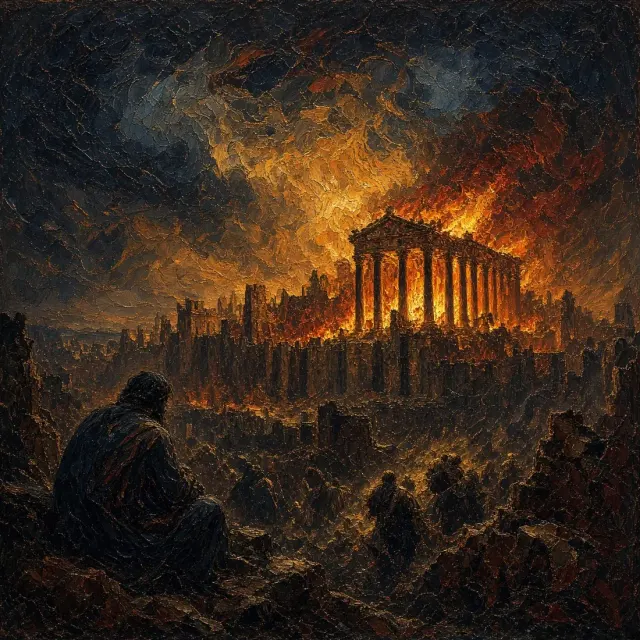
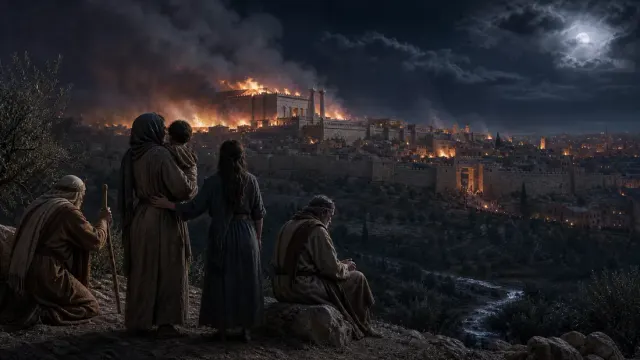
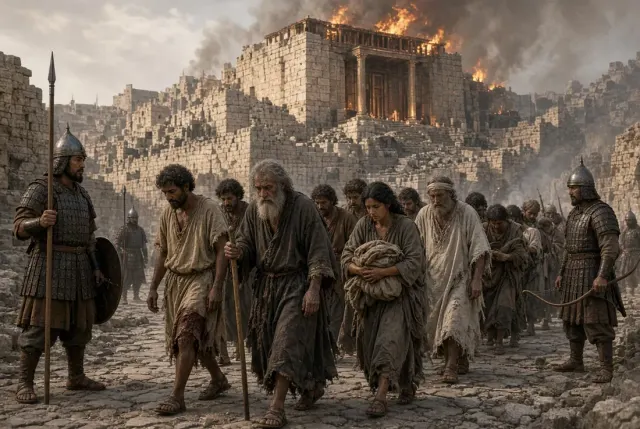
    The temple, the palace and every great house burned, the walls broken down, and the bronze of the two pillars and the sea carried to Babylon because it was without weight.

    The pillars keep their measurements and lose their place. The Book of First Kings once described the making of the temple's great bronze furnishings; the Book of Second Kings now pauses over the same kind of detail as those furnishings are broken up and removed. Height, capitals and pomegranates remain in the record. Their setting has become an inventory of plunder.

    The repeated taking is not only about valuable metal. The vessels are still described as those wherewith they ministered. That small phrase preserves their use even as gold is grouped with gold and silver with silver. Worship's instruments are being carried away from a burned house. Solomon is named in the middle of the dismantling, making the distance between construction and destruction painfully visible without adding an imagined witness to the scene.

    People follow the objects into the account of loss. Some of the poor remain to work vineyards and fields, so the passage does not describe an absolutely empty land. But priests, doorkeepers, military and court officials are taken to Riblah and killed. The place where Zedekiah received judgment becomes the destination of another condemned group. The closing words move beyond the fall of a palace or a dynasty: Judah was carried away out of their land. The losses have names and measurements. Then they have a national name.

    Verse by verse

    1. 25:8

      Second Kings dates Nebuzaradan's arrival to the seventh day of the fifth month; Jeremiah 52:12 gives the tenth day. The difference should be stated rather than replaced with an unstated three-day reconstruction.

    2. 25:12

      The poor left as vinedressers and husbandmen remain in the land. The deportation language must not be expanded into the claim that every inhabitant without exception was removed.

    3. 25:13

      The brasen sea is the great metal basin described in First Kings 7:23-26, not a body of water being transported. Its breaking belongs to the dismantling of the temple's furnishings.

    4. 25:17

      The KJV here gives the capital's height as three cubits. Jeremiah 52:22 gives five; the number in this passage must not be silently changed to match the parallel.

    5. 25:19

      This verse lists five men who had been in the king's presence. Jeremiah 52:25 lists seven in the corresponding group; the two figures should be preserved as written.

    6. 25:21

      The group brought to Riblah in verses 18-20 is killed there, not simply deported. The sentence about Judah's removal follows an explicit record of executions.

    2 Kings 25:8-21

    King James Version · 14 verses

    25:8And in the fifth month, on the seventh day of the month, which is the nineteenth year of king Nebuchadnezzar king of Babylon, came Nebuzar-adan, captain of the guard, a servant of the king of Babylon, unto Jerusalem:

    25:9And he burnt the house of the LORD, and the king’s house, and all the houses of Jerusalem, and every great man’s house burnt he with fire.

    25:10And all the army of the Chaldees, that were with the captain of the guard, brake down the walls of Jerusalem round about.

    25:11Now the rest of the people that were left in the city, and the fugitives that fell away to the king of Babylon, with the remnant of the multitude, did Nebuzar-adan the captain of the guard carry away.

    25:12But the captain of the guard left of the poor of the land to be vinedressers and husbandmen.

    25:13And the pillars of brass that were in the house of the LORD, and the bases, and the brasen sea that was in the house of the LORD, did the Chaldees break in pieces, and carried the brass of them to Babylon.

    25:14And the pots, and the shovels, and the snuffers, and the spoons, and all the vessels of brass wherewith they ministered, took they away.

    25:15And the firepans, and the bowls, and such things as were of gold, in gold, and of silver, in silver, the captain of the guard took away.

    25:16The two pillars, one sea, and the bases which Solomon had made for the house of the LORD; the brass of all these vessels was without weight.

    25:17The height of the one pillar was eighteen cubits, and the chapiter upon it was brass: and the height of the chapiter three cubits; and the wreathen work, and pomegranates upon the chapiter round about, all of brass: and like unto these had the second pillar with wreathen work.

    25:18And the captain of the guard took Seraiah the chief priest, and Zephaniah the second priest, and the three keepers of the door:

    25:19And out of the city he took an officer that was set over the men of war, and five men of them that were in the king’s presence, which were found in the city, and the principal scribe of the host, which mustered the people of the land, and threescore men of the people of the land that were found in the city:

    25:20And Nebuzar-adan captain of the guard took these, and brought them to the king of Babylon to Riblah:

    25:21And the king of Babylon smote them, and slew them at Riblah in the land of Hamath. So Judah was carried away out of their land.


Why it matters

Zedekiah closes the history that began with the elders asking for a king like the nations. The last scene is deliberately final: his sons killed in front of him, and that is the last thing he sees, because they put out his eyes and bring him to Babylon in chains. The temple is burned, the pillars broken up and carried off as bronze, and the book ends in a foreign court with a different king of Judah eating at a table. He is the study of a man who knew the right answer and lacked the nerve.

2 songs

The music

Every song in the catalogue whose passage falls inside these chapters.

  1. 2 Kings 23:31-25:30

    Jerusalem Was Broken Up

  2. 2 Kings 24-25; 2 Chronicles 36

    The City Burned

Nearby

All the people

Report an error on this page