New · FreePlay The Witnesses The in-depth puzzle battle quest through Bible history

People of the Bible

Daniel

Served four kings of two empires without ever pretending to belong to either.

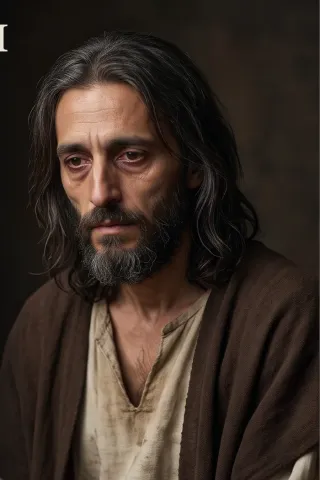
Daniel is taken to Babylon as a teenager, renamed, and enrolled in a three year course in the literature of the Chaldeans. His first recorded act is a negotiation about food, handled so carefully that the steward who could be executed for it is given a ten day trial rather than an order. From there he reads a dream nobody will repeat to him, survives a change of empire, is found out by men who could only convict him by making his prayers illegal, and keeps his windows open toward Jerusalem anyway.

Where he appearsDaniel 1 to 12

Scroll down to the account
Daniel

The movements, in the order the text gives them.

The Account of Daniel

  1. 01

    Daniel 1:8-16

    Ten days, and pulse to eat

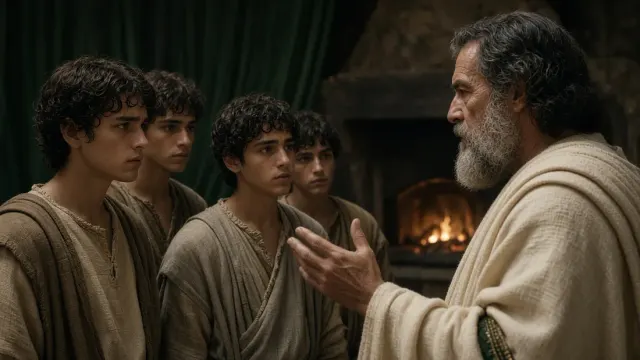
    He purposes in his heart not to defile himself, and then handles the man who has to say yes. The test is his idea, the risk is named out loud, and at the end of ten days their faces are fairer.

    His first recorded refusal is also a request. Daniel has settled the boundary in his heart, but he approaches the official with courtesy rather than a speech about the wickedness of the palace kitchen. The distinction matters. Conviction is firm; the conversation remains possible. The Book of Daniel has already said that God brought him into favour. That favour does not remove the difficult negotiation. It makes room for it.

    The official's objection has a head attached to it, his own. He is responsible for the appearance of the young men under his charge, and Daniel does not pretend that the danger is imaginary. The ten-day proposal answers precisely that concern: inspect the result. Daniel is not demanding that another man accept an unseen outcome on his authority. He offers a limited test with something visible to examine.

    Then comes the detail that does not fit neatly on a modern diet advertisement: fairer and fatter in flesh. The passage describes these particular young men as better nourished; it does not issue a universal nutritional rule or provide a menu beyond pulse and water. Nor does it explain exactly why both the royal food and wine would defile Daniel. The restraint is part of reading the passage well. A boundary holds, the official has evidence, and the altered provision continues. No enemy has had to be manufactured at the table.

    Verse by verse

    1. 1:8

      Both the food and the wine are included in Daniel's concern. The passage does not identify the exact cause of defilement.

    2. 1:10

      Worse liking means looking less healthy or well nourished, not being less agreeable in temperament.

    3. 1:11

      Melzar is the person appointed over the four young men by the chief official; the conversation has moved to their immediate supervisor.

    4. 1:15

      Fatter in flesh describes their observed condition after the test. It is not presented as a medical rule for all diets.

    5. 1:16

      The change in provision continues after the ten-day test; the ten days are the trial period, not the stated duration of their practice.

    Daniel 1:8-16

    King James Version · 9 verses

    1:8But Daniel purposed in his heart that he would not defile himself with the portion of the king’s meat, nor with the wine which he drank: therefore he requested of the prince of the eunuchs that he might not defile himself.

    1:9Now God had brought Daniel into favour and tender love with the prince of the eunuchs.

    1:10And the prince of the eunuchs said unto Daniel, I fear my lord the king, who hath appointed your meat and your drink: for why should he see your faces worse liking than the children which are of your sort? then shall ye make me endanger my head to the king.

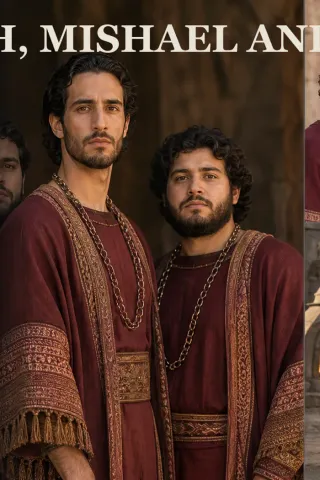
    1:11Then said Daniel to Melzar, whom the prince of the eunuchs had set over Daniel, Hananiah, Mishael, and Azariah,

    1:12Prove thy servants, I beseech thee, ten days; and let them give us pulse to eat, and water to drink.

    1:13Then let our countenances be looked upon before thee, and the countenance of the children that eat of the portion of the king’s meat: and as thou seest, deal with thy servants.

    1:14So he consented to them in this matter, and proved them ten days.

    1:15And at the end of ten days their countenances appeared fairer and fatter in flesh than all the children which did eat the portion of the king’s meat.

    1:16Thus Melzar took away the portion of their meat, and the wine that they should drink; and gave them pulse.

    Daniel 1:8-16: Ten days, and pulse to eat
  2. 02

    Daniel 2:26-45

    A stone cut without hands

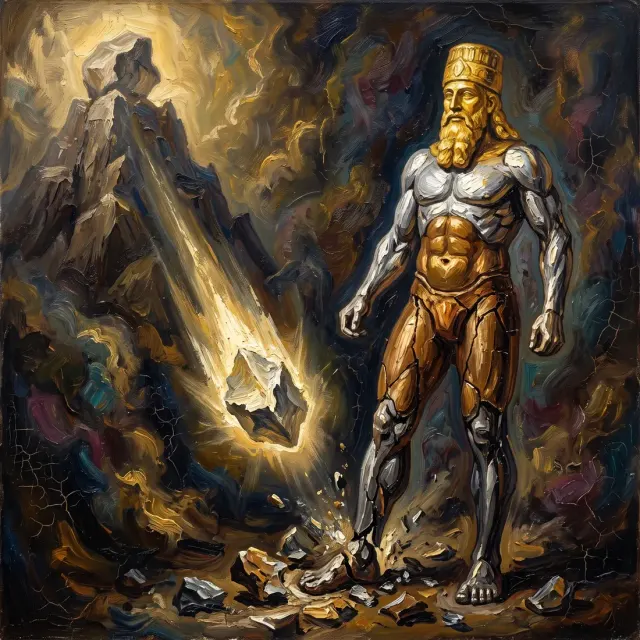
    The king will not say the dream, only demand it. Daniel asks for time, prays with his companions, and comes back with the image of gold, silver, brass, iron and clay, and the stone that fills the earth.

    The king asks whether Daniel is able. Daniel begins by explaining why no human expert is. It is an unusual opening for an interview with a ruler who has already ordered the specialists killed. But the refusal of personal credit is not decoration. The secret came by revelation, not because Daniel possesses more wisdom than any living person. The man who knows the answer insists on identifying its source before giving it.

    The statue offers Nebuchadnezzar a magnificent compliment with a sharp limit attached. He is the head of gold, and God has given him his kingdom. Then comes after thee. Gold does not exempt its owner from succession. As the image descends, its materials become less precious, but the iron is still formidable. Its weakness is not that it cannot crush. It cannot make the clay adhere. Force and coherence are not the same thing.

    The stone strikes the feet, yet every metal goes down together. Even the gold becomes threshing-floor chaff. The picture is not of a fifth ruler acquiring a collection of valuable scraps. Nothing remains for him to inherit. God's kingdom will not be left to other people, a striking departure from the repeated transfers just described. Without hands marks a different source of action; for ever marks a different kind of duration. The interpretation ends the succession, not merely the reign currently at its head.

    Verse by verse

    1. 2:28

      The disclosure has already been identified as a night vision in 2:19. Daniel distinguishes a revealed secret from successful professional deduction.

    2. 2:30

      Ezekiel 14:14, 20 and 28:3 name a righteous and wise Daniel; scholars dispute whether this is the prophet here or an older figure called Danel.

    3. 2:38

      Nebuchadnezzar is the only ruler expressly identified by name in the interpretation of the metals.

    4. 2:40

      The fourth kingdom's identity is disputed. Jerome read it as Rome and records the rival interpretation of the corresponding fourth beast as Hellenistic rule.

    5. 2:44

      Not being left to other people contrasts with the succession of kingdoms in verses 39-43, not merely with one successful military defense.

    6. 2:45

      The stone's crushing action echoes in Jesus' words in Luke 20:18, alongside the rejected cornerstone language of Psalm 118.

    Daniel 2:26-45: A stone cut without hands

    Daniel 2:26-45

    King James Version · 20 verses

    2:26The king answered and said to Daniel, whose name was Belteshazzar, Art thou able to make known unto me the dream which I have seen, and the interpretation thereof?

    2:27Daniel answered in the presence of the king, and said, The secret which the king hath demanded cannot the wise men, the astrologers, the magicians, the soothsayers, shew unto the king;

    2:28But there is a God in heaven that revealeth secrets, and maketh known to the king Nebuchadnezzar what shall be in the latter days. Thy dream, and the visions of thy head upon thy bed, are these;

    2:29As for thee, O king, thy thoughts came into thy mind upon thy bed, what should come to pass hereafter: and he that revealeth secrets maketh known to thee what shall come to pass.

    2:30But as for me, this secret is not revealed to me for any wisdom that I have more than any living, but for their sakes that shall make known the interpretation to the king, and that thou mightest know the thoughts of thy heart.

    2:31Thou, O king, sawest, and behold a great image. This great image, whose brightness was excellent, stood before thee; and the form thereof was terrible.

    2:32This image’s head was of fine gold, his breast and his arms of silver, his belly and his thighs of brass,

    2:33His legs of iron, his feet part of iron and part of clay.

    2:34Thou sawest till that a stone was cut out without hands, which smote the image upon his feet that were of iron and clay, and brake them to pieces.

    2:35Then was the iron, the clay, the brass, the silver, and the gold, broken to pieces together, and became like the chaff of the summer threshingfloors; and the wind carried them away, that no place was found for them: and the stone that smote the image became a great mountain, and filled the whole earth.

    2:36This is the dream; and we will tell the interpretation thereof before the king.

    2:37Thou, O king, art a king of kings: for the God of heaven hath given thee a kingdom, power, and strength, and glory.

    2:38And wheresoever the children of men dwell, the beasts of the field and the fowls of the heaven hath he given into thine hand, and hath made thee ruler over them all. Thou art this head of gold.

    2:39And after thee shall arise another kingdom inferior to thee, and another third kingdom of brass, which shall bear rule over all the earth.

    2:40And the fourth kingdom shall be strong as iron: forasmuch as iron breaketh in pieces and subdueth all things: and as iron that breaketh all these, shall it break in pieces and bruise.

    2:41And whereas thou sawest the feet and toes, part of potters’ clay, and part of iron, the kingdom shall be divided; but there shall be in it of the strength of the iron, forasmuch as thou sawest the iron mixed with miry clay.

    2:42And as the toes of the feet were part of iron, and part of clay, so the kingdom shall be partly strong, and partly broken.

    2:43And whereas thou sawest iron mixed with miry clay, they shall mingle themselves with the seed of men: but they shall not cleave one to another, even as iron is not mixed with clay.

    2:44And in the days of these kings shall the God of heaven set up a kingdom, which shall never be destroyed: and the kingdom shall not be left to other people, but it shall break in pieces and consume all these kingdoms, and it shall stand for ever.

    2:45Forasmuch as thou sawest that the stone was cut out of the mountain without hands, and that it brake in pieces the iron, the brass, the clay, the silver, and the gold; the great God hath made known to the king what shall come to pass hereafter: and the dream is certain, and the interpretation thereof sure.

  3. 03

    Daniel 5:1-31

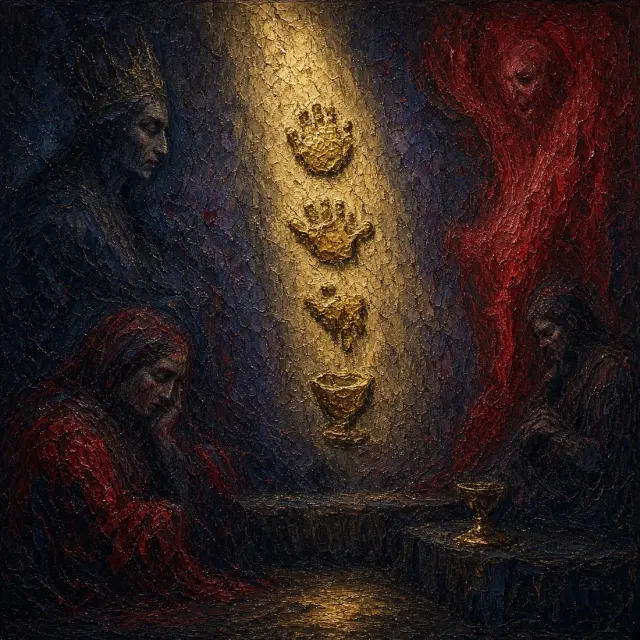
    Mene, mene, tekel, upharsin

    Fingers write on the plaster of the wall opposite the lampstand during a feast using the temple vessels. Daniel refuses the gifts, gives the history first, and then reads four words.

    A hand interrupts the feast. Another hand explains it. Daniel identifies the God in whose hand thy breath is, then says that the writing hand was sent from him. The fingers on the plaster are not an isolated marvel. They make visible the authority Belshazzar has ignored while handling the vessels of that God's house. The banquet praises objects that cannot see, hear, or know; its host owes his next breath to the God he has not glorified.

    Daniel does not move straight to the mysterious words. He first gives the king a history lesson, and its decisive clause is though thou knewest all this. The account of Nebuchadnezzar's humiliation is not new information offered to excuse his successor. It is evidence already available to him. The indictment concerns a known lesson left unused. Even the royal introduction, identifying Daniel as one of the captives, cannot settle who stands under whose authority in this room.

    The offer of clothing, gold, and rank receives a brisk refusal before the interpretation begins. The verdict is not for purchase. Numbered, weighed, divided: the language reduces royal magnificence to an assessment the king cannot amend. He nevertheless orders the promised honors, and the Book of Daniel immediately follows the promotion with the sentence reporting his death that night. Scarlet and gold can still be distributed. Continuance cannot.

    Verse by verse

    1. 5:2

      Nabonidus' cylinder from Ur names Belshazzar as his son. Against that inscription, father here is read in a broader dynastic sense rather than as a direct biological identification with Nebuchadnezzar.

    2. 5:10

      The queen enters after the king's wives are already at the feast. Her name and precise family relationship are not supplied.

    3. 5:17

      Daniel refuses these rewards before speaking, but accepted gifts in 2:48. This scene does not establish a blanket rule that he never received royal gifts.

    4. 5:22

      Though thou knewest all this makes the earlier humiliation of Nebuchadnezzar part of the charge, not merely background information.

    5. 5:23

      The deity whose hand holds the king's breath is identified as the sender of the hand in verse 24.

    6. 5:31

      Threescore and two means sixty-two. This age belongs to Darius, not to Daniel.

    Daniel 5:1-31: Mene, mene, tekel, upharsin

    Daniel 5:1-31

    King James Version · 31 verses

    5:1Belshazzar the king made a great feast to a thousand of his lords, and drank wine before the thousand.

    5:2Belshazzar, whiles he tasted the wine, commanded to bring the golden and silver vessels which his father Nebuchadnezzar had taken out of the temple which was in Jerusalem; that the king, and his princes, his wives, and his concubines, might drink therein.

    5:3Then they brought the golden vessels that were taken out of the temple of the house of God which was at Jerusalem; and the king, and his princes, his wives, and his concubines, drank in them.

    5:4They drank wine, and praised the gods of gold, and of silver, of brass, of iron, of wood, and of stone.

    5:5In the same hour came forth fingers of a man’s hand, and wrote over against the candlestick upon the plaister of the wall of the king’s palace: and the king saw the part of the hand that wrote.

    5:6Then the king’s countenance was changed, and his thoughts troubled him, so that the joints of his loins were loosed, and his knees smote one against another.

    5:7The king cried aloud to bring in the astrologers, the Chaldeans, and the soothsayers. And the king spake, and said to the wise men of Babylon, Whosoever shall read this writing, and shew me the interpretation thereof, shall be clothed with scarlet, and have a chain of gold about his neck, and shall be the third ruler in the kingdom.

    5:8Then came in all the king’s wise men: but they could not read the writing, nor make known to the king the interpretation thereof.

    5:9Then was king Belshazzar greatly troubled, and his countenance was changed in him, and his lords were astonied.

    5:10Now the queen, by reason of the words of the king and his lords, came into the banquet house: and the queen spake and said, O king, live for ever: let not thy thoughts trouble thee, nor let thy countenance be changed:

    5:11There is a man in thy kingdom, in whom is the spirit of the holy gods; and in the days of thy father light and understanding and wisdom, like the wisdom of the gods, was found in him; whom the king Nebuchadnezzar thy father, the king, I say, thy father, made master of the magicians, astrologers, Chaldeans, and soothsayers;

    5:12Forasmuch as an excellent spirit, and knowledge, and understanding, interpreting of dreams, and shewing of hard sentences, and dissolving of doubts, were found in the same Daniel, whom the king named Belteshazzar: now let Daniel be called, and he will shew the interpretation.

    5:13Then was Daniel brought in before the king. And the king spake and said unto Daniel, Art thou that Daniel, which art of the children of the captivity of Judah, whom the king my father brought out of Jewry?

    5:14I have even heard of thee, that the spirit of the gods is in thee, and that light and understanding and excellent wisdom is found in thee.

    5:15And now the wise men, the astrologers, have been brought in before me, that they should read this writing, and make known unto me the interpretation thereof: but they could not shew the interpretation of the thing:

    5:16And I have heard of thee, that thou canst make interpretations, and dissolve doubts: now if thou canst read the writing, and make known to me the interpretation thereof, thou shalt be clothed with scarlet, and have a chain of gold about thy neck, and shalt be the third ruler in the kingdom.

    5:17Then Daniel answered and said before the king, Let thy gifts be to thyself, and give thy rewards to another; yet I will read the writing unto the king, and make known to him the interpretation.

    5:18O thou king, the most high God gave Nebuchadnezzar thy father a kingdom, and majesty, and glory, and honour:

    5:19And for the majesty that he gave him, all people, nations, and languages, trembled and feared before him: whom he would he slew; and whom he would he kept alive; and whom he would he set up; and whom he would he put down.

    5:20But when his heart was lifted up, and his mind hardened in pride, he was deposed from his kingly throne, and they took his glory from him:

    5:21And he was driven from the sons of men; and his heart was made like the beasts, and his dwelling was with the wild asses: they fed him with grass like oxen, and his body was wet with the dew of heaven; till he knew that the most high God ruled in the kingdom of men, and that he appointeth over it whomsoever he will.

    5:22And thou his son, O Belshazzar, hast not humbled thine heart, though thou knewest all this;

    5:23But hast lifted up thyself against the Lord of heaven; and they have brought the vessels of his house before thee, and thou, and thy lords, thy wives, and thy concubines, have drunk wine in them; and thou hast praised the gods of silver, and gold, of brass, iron, wood, and stone, which see not, nor hear, nor know: and the God in whose hand thy breath is, and whose are all thy ways, hast thou not glorified:

    5:24Then was the part of the hand sent from him; and this writing was written.

    5:25And this is the writing that was written, MENE, MENE, TEKEL, UPHARSIN.

    5:26This is the interpretation of the thing: MENE; God hath numbered thy kingdom, and finished it.

    5:27TEKEL; Thou art weighed in the balances, and art found wanting.

    5:28PERES; Thy kingdom is divided, and given to the Medes and Persians.

    5:29Then commanded Belshazzar, and they clothed Daniel with scarlet, and put a chain of gold about his neck, and made a proclamation concerning him, that he should be the third ruler in the kingdom.

    5:30In that night was Belshazzar the king of the Chaldeans slain.

    5:31And Darius the Median took the kingdom, being about threescore and two years old.

  4. 04

    Daniel 6:1-23

    His windows open toward Jerusalem

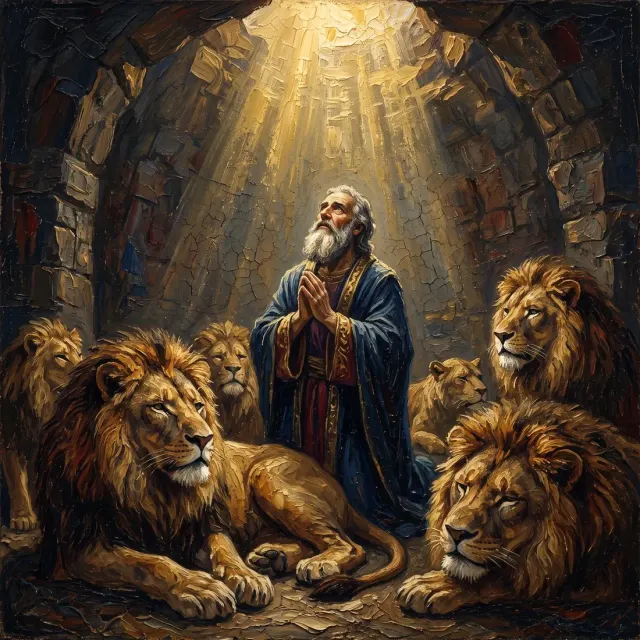
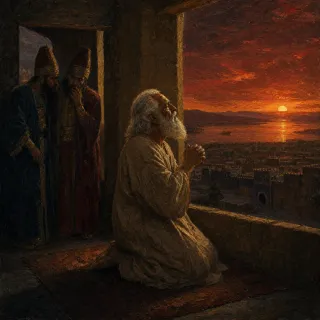
    They can find no fault except concerning the law of his God, so they write a law about prayer. He goes home and kneels three times a day as he did before, with the windows open.

    All the presidents have agreed, the petitioners announce. Daniel is one of the presidents. That all is doing a considerable amount of work. The Book of Daniel has already exposed the object of the proposal: men who cannot find misconduct in his administration intend to make his obedience to God the charge instead. The decree is not an accidental obstacle he happens to meet. It has been fitted to him.

    His response is strikingly undramatic. The windows are already open; the prayers happen three times a day; the closing phrase is as he did aforetime. He is not opening a new public demonstration. Nor does the passage reduce his prayer to a plea for escape. He gives thanks. The decree changes the legal consequence of his practice, not the practice itself.

    The king's predicament supplies the chapter's bitter reversal. He can sign the law that condemns Daniel but cannot find a way to save him from it. The man whom everybody must petition ends the day hoping that Daniel's God can do what he cannot. Inside the palace there is fasting and sleeplessness. Inside the den, the explanation finally given is an angel and closed mouths. Daniel emerges still addressing the king courteously, but his claim is exact: he has done the king no hurt. Refusal of this command has not made him the disloyal servant his accusers describe.

    Verse by verse

    1. 6:7

      The officials claim agreement by all the presidents, although Daniel himself holds that office. Their representation of unanimity should not be mistaken for the book's endorsement of it.

    2. 6:10

      Being open and as he did aforetime mark an existing arrangement and routine, not a new act staged after the decree.

    3. 6:18

      The sleepless person expressly described is the king. The text supplies no account of Daniel sleeping comfortably among the lions.

    4. 6:22

      God's angel also appears in the explanation of the furnace deliverance in 3:28; both royal death sentences meet divine intervention.

    5. 6:23

      Hebrews 11:33 includes stopping lions' mouths among the acts associated with faith, without naming Daniel in that sentence.

    Daniel 6:1-23: His windows open toward Jerusalem

    Daniel 6:1-23

    King James Version · 23 verses

    6:1It pleased Darius to set over the kingdom an hundred and twenty princes, which should be over the whole kingdom;

    6:2And over these three presidents; of whom Daniel was first: that the princes might give accounts unto them, and the king should have no damage.

    6:3Then this Daniel was preferred above the presidents and princes, because an excellent spirit was in him; and the king thought to set him over the whole realm.

    6:4Then the presidents and princes sought to find occasion against Daniel concerning the kingdom; but they could find none occasion nor fault; forasmuch as he was faithful, neither was there any error or fault found in him.

    6:5Then said these men, We shall not find any occasion against this Daniel, except we find it against him concerning the law of his God.

    6:6Then these presidents and princes assembled together to the king, and said thus unto him, King Darius, live for ever.

    6:7All the presidents of the kingdom, the governors, and the princes, the counsellors, and the captains, have consulted together to establish a royal statute, and to make a firm decree, that whosoever shall ask a petition of any God or man for thirty days, save of thee, O king, he shall be cast into the den of lions.

    6:8Now, O king, establish the decree, and sign the writing, that it be not changed, according to the law of the Medes and Persians, which altereth not.

    6:9Wherefore king Darius signed the writing and the decree.

    6:10Now when Daniel knew that the writing was signed, he went into his house; and his windows being open in his chamber toward Jerusalem, he kneeled upon his knees three times a day, and prayed, and gave thanks before his God, as he did aforetime.

    6:11Then these men assembled, and found Daniel praying and making supplication before his God.

    6:12Then they came near, and spake before the king concerning the king’s decree; Hast thou not signed a decree, that every man that shall ask a petition of any God or man within thirty days, save of thee, O king, shall be cast into the den of lions? The king answered and said, The thing is true, according to the law of the Medes and Persians, which altereth not.

    6:13Then answered they and said before the king, That Daniel, which is of the children of the captivity of Judah, regardeth not thee, O king, nor the decree that thou hast signed, but maketh his petition three times a day.

    6:14Then the king, when he heard these words, was sore displeased with himself, and set his heart on Daniel to deliver him: and he laboured till the going down of the sun to deliver him.

    6:15Then these men assembled unto the king, and said unto the king, Know, O king, that the law of the Medes and Persians is, That no decree nor statute which the king establisheth may be changed.

    6:16Then the king commanded, and they brought Daniel, and cast him into the den of lions. Now the king spake and said unto Daniel, Thy God whom thou servest continually, he will deliver thee.

    6:17And a stone was brought, and laid upon the mouth of the den; and the king sealed it with his own signet, and with the signet of his lords; that the purpose might not be changed concerning Daniel.

    6:18Then the king went to his palace, and passed the night fasting: neither were instruments of musick brought before him: and his sleep went from him.

    6:19Then the king arose very early in the morning, and went in haste unto the den of lions.

    6:20And when he came to the den, he cried with a lamentable voice unto Daniel: and the king spake and said to Daniel, O Daniel, servant of the living God, is thy God, whom thou servest continually, able to deliver thee from the lions?

    6:21Then said Daniel unto the king, O king, live for ever.

    6:22My God hath sent his angel, and hath shut the lions’ mouths, that they have not hurt me: forasmuch as before him innocency was found in me; and also before thee, O king, have I done no hurt.

    6:23Then was the king exceeding glad for him, and commanded that they should take Daniel up out of the den. So Daniel was taken up out of the den, and no manner of hurt was found upon him, because he believed in his God.

  5. 05

    Daniel 9:1-19

    We have sinned

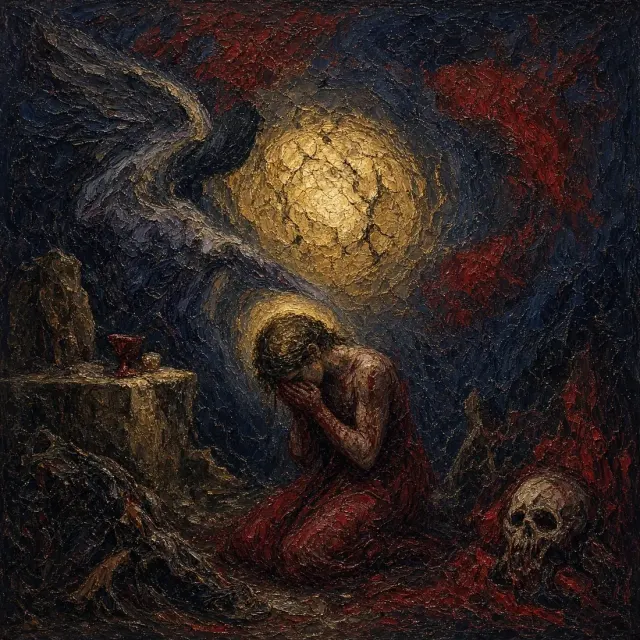
    Reading Jeremiah, he works out that the seventy years are nearly up, and responds not by celebrating but by confessing, using the word we throughout, though nothing in the book accuses him.

    The man who receives visions is reading another prophet. Daniel's discovery comes by books, and the seventy years lead him not to a victory announcement but to fasting, sackcloth, and confession. Jeremiah's promise does not make prayer unnecessary. It gives the prayer its occasion. The movement from a written word to a bent face is the first important movement in the chapter.

    The confession refuses to place Daniel on a clean little island outside his people's history. Kings, princes, fathers, Jerusalem, scattered Israel: the categories widen until there is nowhere convenient to stand apart. Verse 20 will call this confession his own sin as well as his people's. The repeated failure is failure to listen. Prophets spoke; the law stood before them; the warnings came true. Jerusalem's devastation is not offered as evidence that God's words failed, but that his warnings held.

    That makes the petition more exacting than a request to cancel the past. Daniel appeals to the same covenant God whose judgment he has acknowledged. Egypt supplies the memory of deliverance; the sanctuary supplies the place of desolation; God's name supplies the ground for asking. His strongest plea is explicitly not righteousness but great mercies. At the end, the measured confession breaks into short petitions: hear, forgive, hearken and do. The prayer has not discovered a merit hidden in Israel. It has named the mercy on which restoration would have to rest.

    Verse by verse

    1. 9:2

      Jeremiah is named as the source of Daniel's understanding; the seventy years are not introduced here as a new revelation to Daniel.

    2. 9:7

      Confusion of faces means shame or disgrace, not inability to understand an instruction.

    3. 9:11

      The covenant curses include removal of king and people to a foreign nation in Deuteronomy 28:36-37.

    4. 9:17

      The appeal for God's face to shine recalls the priestly blessing in Numbers 6:24-26, now directed toward the desolate sanctuary.

    5. 9:18

      The plea explicitly rejects the people's righteousness as its basis and appeals to God's mercies instead.

    6. 9:19

      The next verses place Gabriel's arrival during this prayer at the time of the evening offering, although the sanctuary is described here as desolate.

    Daniel 9:1-19: We have sinned

    Daniel 9:1-19

    King James Version · 19 verses

    9:1In the first year of Darius the son of Ahasuerus, of the seed of the Medes, which was made king over the realm of the Chaldeans;

    9:2In the first year of his reign I Daniel understood by books the number of the years, whereof the word of the LORD came to Jeremiah the prophet, that he would accomplish seventy years in the desolations of Jerusalem.

    9:3And I set my face unto the Lord God, to seek by prayer and supplications, with fasting, and sackcloth, and ashes:

    9:4And I prayed unto the LORD my God, and made my confession, and said, O Lord, the great and dreadful God, keeping the covenant and mercy to them that love him, and to them that keep his commandments;

    9:5We have sinned, and have committed iniquity, and have done wickedly, and have rebelled, even by departing from thy precepts and from thy judgments:

    9:6Neither have we hearkened unto thy servants the prophets, which spake in thy name to our kings, our princes, and our fathers, and to all the people of the land.

    9:7O Lord, righteousness belongeth unto thee, but unto us confusion of faces, as at this day; to the men of Judah, and to the inhabitants of Jerusalem, and unto all Israel, that are near, and that are far off, through all the countries whither thou hast driven them, because of their trespass that they have trespassed against thee.

    9:8O Lord, to us belongeth confusion of face, to our kings, to our princes, and to our fathers, because we have sinned against thee.

    9:9To the Lord our God belong mercies and forgivenesses, though we have rebelled against him;

    9:10Neither have we obeyed the voice of the LORD our God, to walk in his laws, which he set before us by his servants the prophets.

    9:11Yea, all Israel have transgressed thy law, even by departing, that they might not obey thy voice; therefore the curse is poured upon us, and the oath that is written in the law of Moses the servant of God, because we have sinned against him.

    9:12And he hath confirmed his words, which he spake against us, and against our judges that judged us, by bringing upon us a great evil: for under the whole heaven hath not been done as hath been done upon Jerusalem.

    9:13As it is written in the law of Moses, all this evil is come upon us: yet made we not our prayer before the LORD our God, that we might turn from our iniquities, and understand thy truth.

    9:14Therefore hath the LORD watched upon the evil, and brought it upon us: for the LORD our God is righteous in all his works which he doeth: for we obeyed not his voice.

    9:15And now, O Lord our God, that hast brought thy people forth out of the land of Egypt with a mighty hand, and hast gotten thee renown, as at this day; we have sinned, we have done wickedly.

    9:16O Lord, according to all thy righteousness, I beseech thee, let thine anger and thy fury be turned away from thy city Jerusalem, thy holy mountain: because for our sins, and for the iniquities of our fathers, Jerusalem and thy people are become a reproach to all that are about us.

    9:17Now therefore, O our God, hear the prayer of thy servant, and his supplications, and cause thy face to shine upon thy sanctuary that is desolate, for the Lord’s sake.

    9:18O my God, incline thine ear, and hear; open thine eyes, and behold our desolations, and the city which is called by thy name: for we do not present our supplications before thee for our righteousnesses, but for thy great mercies.

    9:19O Lord, hear; O Lord, forgive; O Lord, hearken and do; defer not, for thine own sake, O my God: for thy city and thy people are called by thy name.

  6. 06

    Daniel 7:9-14

    One like the son of man

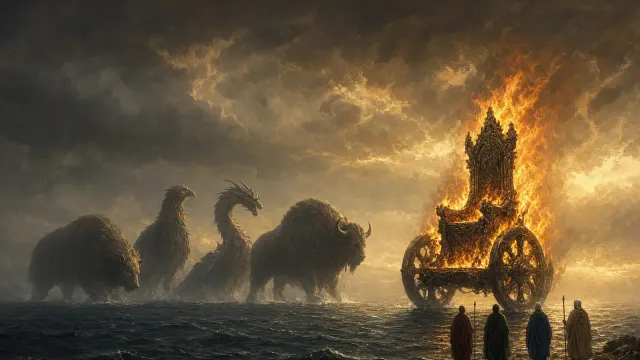
    Thrones set, the Ancient of days seated, and one brought near with the clouds of heaven who is given dominion and glory and a kingdom that shall not pass away.

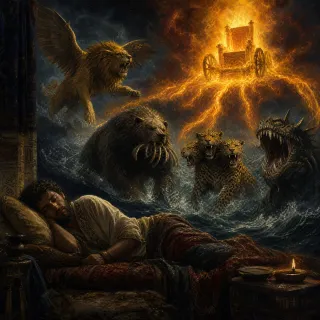
    The horn is still talking when the court sits. Its great words fill the earthly scene; heaven answers with a throne, attendants, and opened books. The contrast is not between one loud ruler and a louder one. The Ancient of days does not compete for the floor. Judgment begins, and the beast's ability to keep speaking cannot preserve its dominion.

    After the beasts comes a human likeness, not a creature with still more teeth. One like the Son of man approaches with the clouds of heaven and is brought to the Ancient of days. The direction is important: this scene describes an approach to the heavenly throne, not an explicitly described descent to earth. Dominion is given to him. Where the earlier beasts devoured and trampled, this figure receives a kingdom whose duration is not measured by the arrival of another predator.

    The chapter's explanation later gives the kingdom to the saints of the most High, linking the figure with the people who share the rule. Readers differ over how to describe that relationship, but neither the individual figure nor the people should disappear from the reading. In Matthew 26:64, Jesus uses the coming-with-clouds language while standing before a human tribunal. The accused identifies himself with the figure who receives heaven's dominion. That is the force of the reference: the court presently questioning him is not the final court.

    Verse by verse

    1. 7:9

      Daniel 7:1 dates this vision to Belshazzar's first year. It belongs before the banquet of chapter 5, despite appearing later in the book.

    2. 7:9

      The Aramaic verb behind cast down can mean to place or set. The context describes thrones arranged for a heavenly court, not necessarily thrones demolished.

    3. 7:10

      Opened books belong to the judicial setting; this verse does not identify each book or supply its contents.

    4. 7:13

      The figure comes to the Ancient of days. The passage's stated direction should not be replaced by a different scene of descent.

    5. 7:13

      Matthew 26:64 uses this cloud-coming language of Jesus; Matthew 24:15 also expressly names Daniel as a prophet in referring to his desolation passages.

    6. 7:14

      Verses 18 and 27 identify the saints as recipients of the kingdom, a major basis for readings that link the individual figure and the people he represents.

    Daniel 7:9-14

    King James Version · 6 verses

    7:9I beheld till the thrones were cast down, and the Ancient of days did sit, whose garment was white as snow, and the hair of his head like the pure wool: his throne was like the fiery flame, and his wheels as burning fire.

    7:10A fiery stream issued and came forth from before him: thousand thousands ministered unto him, and ten thousand times ten thousand stood before him: the judgment was set, and the books were opened.

    7:11I beheld then because of the voice of the great words which the horn spake: I beheld even till the beast was slain, and his body destroyed, and given to the burning flame.

    7:12As concerning the rest of the beasts, they had their dominion taken away: yet their lives were prolonged for a season and time.

    7:13I saw in the night visions, and, behold, one like the Son of man came with the clouds of heaven, and came to the Ancient of days, and they brought him near before him.

    7:14And there was given him dominion, and glory, and a kingdom, that all people, nations, and languages, should serve him: his dominion is an everlasting dominion, which shall not pass away, and his kingdom that which shall not be destroyed.

    Daniel 7:9-14: One like the son of man

Why it matters

Daniel is the model for living under a government that is not yours. He is unfailingly useful to Babylon and unfailingly not Babylonian, and the book keeps both. The visions push further than anything before them: four beasts, one like a son of man coming with the clouds and given a kingdom that shall not be destroyed, and a resurrection of many that sleep in the dust, some to everlasting life. Jesus quotes the son of man passage at his own trial.

21 songs

The music

Every song in the catalogue whose passage falls inside these chapters.

  1. Daniel 1:1-12:13

    Daniel (Kingdoms Fall, God Reigns)

    Play here
    Open song pageRead lyrics
  2. Daniel 1:1-21

    Daniel Purposed in His Heart

  3. Daniel 1

    Ten Times Better

  4. Daniel 2:1-49

    A Stone Cut without Hands

  5. Daniel 2

    The Stone Without Hands

  6. Daniel 3:16-30

    Gold in the Fire

    Play here
    Open song pageRead lyrics
  7. Daniel 3:1-30

    In the Midst of the Fire

    Play here
    Open song pageRead lyrics
  8. Daniel 3

    Through the Fire

  9. Daniel 3:1-30

    We Will Not Serve Thy Gods

  10. Daniel 4

    The King Ate Grass

  11. Daniel 4:1-37

    Till Seven Times Pass over Thee

  12. Daniel 5:1-31

    Mene, Mene, Tekel, Upharsin

  13. Daniel 5

    Weighed in the Balances

  14. Daniel 6:1-28

    His Windows Open toward Jerusalem

  15. Daniel 6

    The Lions Closed Their Mouths

  16. Daniel 7

    One Like the Son of Man

  17. Daniel 8:1-27

    The Ram and the He-Goat

  18. Daniel 9:1-27

    We Have Sinned and Done Wickedly

  19. Daniel 10:12-13

    Delayed, but Not Denied

    Play here
    Open song pageRead lyrics
  20. Daniel 10:1-21

    The Prince of Persia Withstood Me

  21. Daniel 11:1-12:13

    Many Shall Awake

Nearby

All the people

Report an error on this page