New · FreePlay The Witnesses The in-depth puzzle battle quest through Bible history

People of the Bible

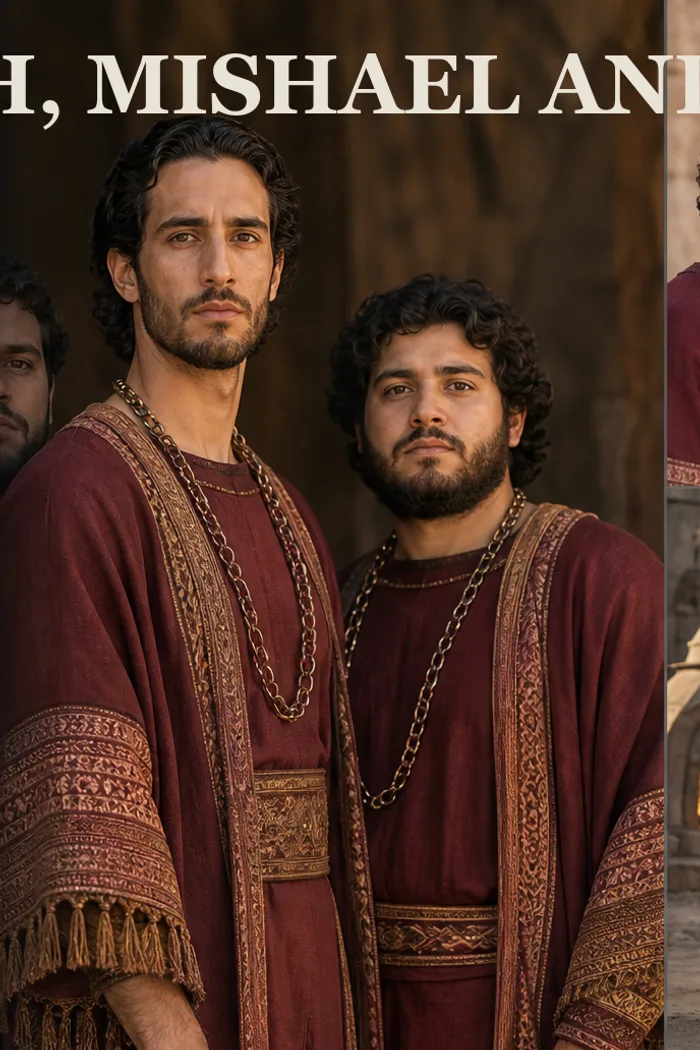
Hananiah, Mishael and Azariah

Said God is able to deliver us, and then said but if not, we still will not serve your gods.

Also called Shadrach, Meshach and Abednego

Three young men from Judah are taken with Daniel, renamed after Babylonian gods, and trained for the king’s service. They keep the food arrangement with him and are found ten times better than all the magicians. Years later a golden image sixty cubits high is set up on the plain of Dura, and every official in the province is summoned to fall down when the music plays. They do not, they are reported by name, and the king gives them one more chance in front of everyone.

Where they appearDaniel 1 to 3

Scroll down to the account
Hananiah, Mishael and Azariah

The movements, in the order the text gives them.

The Account of Hananiah, Mishael and Azariah

  1. 01

    Daniel 1:6-7, 17-20

    Renamed and tested

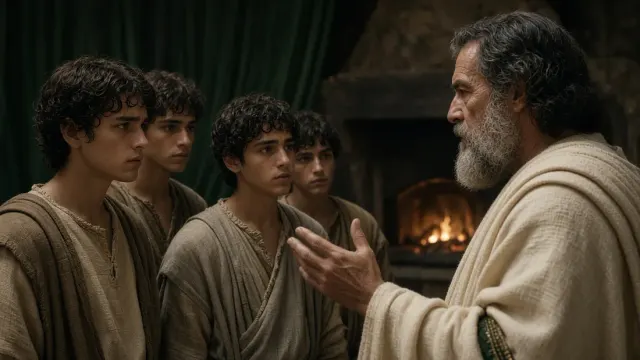
    Given names honouring Babylonian gods and three years of Chaldean learning. At the end the king finds them ten times better than all the magicians in his realm.

    The palace can issue new names. It cannot claim to have issued the wisdom. Verse 7 assigns the renaming to the chief official; verse 17 assigns knowledge and skill to God. Those are two different acts of giving, and the Book of Daniel keeps their sources separate. Hananiah, Mishael, and Azariah enter the royal system under names that make them more at home on its registers, but their abilities are not credited to the system as their ultimate source.

    The account does not say that the four refuse to learn Babylon's language or literature. Their distinction is not produced by avoiding the education altogether. They complete the appointed period and answer the king's questions. The earlier ten-day food test and this examination are not the same occasion: verse 5 has specified a three-year preparation. The scale changes from a supervisor inspecting their faces to a king testing their understanding.

    At that final interview, the book uses their Hebrew names again. The administrative labels have not erased the identities first given. All four receive knowledge, while understanding visions and dreams is especially attributed to Daniel. The three are neither interchangeable assistants nor men to whom the text gives every gift Daniel has. They stand before the king with a shared distinction and with differences the passage takes care to preserve.

    Verse by verse

    1. 1:6

      These three are named alongside Daniel as members of the Judean group, not introduced for the first time at the furnace.

    2. 1:7

      The name pairs are Hananiah/Shadrach, Mishael/Meshach, and Azariah/Abednego; the order is consistent here.

    3. 1:17

      Knowledge and skill are given to all four; the additional understanding of visions and dreams is specifically assigned to Daniel.

    4. 1:18

      The appointed period refers back to the three years in 1:5, not merely to the ten-day food trial.

    5. 1:20

      Ten times better is the reported outcome of the king's questioning in wisdom and understanding, not a general measurement of every ability.

    Daniel 1:6-7, 17-20

    King James Version · 6 verses

    1:6Now among these were of the children of Judah, Daniel, Hananiah, Mishael, and Azariah:

    1:7Unto whom the prince of the eunuchs gave names: for he gave unto Daniel the name of Belteshazzar; and to Hananiah, of Shadrach; and to Mishael, of Meshach; and to Azariah, of Abed-nego.

    1:17As for these four children, God gave them knowledge and skill in all learning and wisdom: and Daniel had understanding in all visions and dreams.

    1:18Now at the end of the days that the king had said he should bring them in, then the prince of the eunuchs brought them in before Nebuchadnezzar.

    1:19And the king communed with them; and among them all was found none like Daniel, Hananiah, Mishael, and Azariah: therefore stood they before the king.

    1:20And in all matters of wisdom and understanding, that the king enquired of them, he found them ten times better than all the magicians and astrologers that were in all his realm.

    Daniel 1:6-7, 17-20: Renamed and tested
  2. 02

    Daniel 3:1-12

    The image on the plain of Dura

    Sixty cubits by six, an orchestra, and an instruction to fall down at the sound. Certain Chaldeans come near and accuse the Jews, naming all three and adding that they do not regard the king.

    The dedication has a full administrative attendance list and an orchestra, but the instruction is very short: fall down. The long catalogues make the machinery of the event audible. Officials assemble, the herald commands, the instruments sound, and the gathered peoples move together. By the time the accusers repeat the musical list, the cue is impossible to miss. Ceremony has been organized to produce one visible response.

    The threat belongs to the announcement itself. It is not an unpleasant discovery made after the celebration: refusal brings the furnace in the same hour. That makes the repeated language of worship inseparable from the demand backed by death. The passage does not criticize music as music, nor does it identify the image as a portrait of Nebuchadnezzar. It keeps naming the fact that he set it up. The repeated royal action, rather than an invented description of the statue's face, supplies the emphasis.

    The accusation then chooses its detail carefully: these are men whom the king himself appointed over Babylon's affairs. Their place within the administration is used against them. Service in the province is treated as if it should entail service to the king's gods. But those are the very two things the three have not agreed to combine. The long procession of titles and instruments finally narrows to three names. Their offense is the missing bow.

    Verse by verse

    1. 3:1

      The dimensions are sixty by six cubits, a ten-to-one proportion. The text does not specify whether the height includes a pedestal or identify whose likeness the image bears.

    2. 3:2-3

      The repeated lists give the ceremony its public and administrative scale; the presence of many offices does not tell whether every participant agrees inwardly.

    3. 3:5

      The command demands worship, not merely attendance at a civic event.

    4. 3:6

      The immediate furnace penalty is announced before the three are accused.

    5. 3:12

      Their appointments follow Daniel's request in 2:49. Daniel's own whereabouts during this chapter are not explained.

    Daniel 3:1-12

    King James Version · 12 verses

    3:1Nebuchadnezzar the king made an image of gold, whose height was threescore cubits, and the breadth thereof six cubits: he set it up in the plain of Dura, in the province of Babylon.

    3:2Then Nebuchadnezzar the king sent to gather together the princes, the governors, and the captains, the judges, the treasurers, the counsellors, the sheriffs, and all the rulers of the provinces, to come to the dedication of the image which Nebuchadnezzar the king had set up.

    3:3Then the princes, the governors, and captains, the judges, the treasurers, the counsellors, the sheriffs, and all the rulers of the provinces, were gathered together unto the dedication of the image that Nebuchadnezzar the king had set up; and they stood before the image that Nebuchadnezzar had set up.

    3:4Then an herald cried aloud, To you it is commanded, O people, nations, and languages,

    3:5That at what time ye hear the sound of the cornet, flute, harp, sackbut, psaltery, dulcimer, and all kinds of musick, ye fall down and worship the golden image that Nebuchadnezzar the king hath set up:

    3:6And whoso falleth not down and worshippeth shall the same hour be cast into the midst of a burning fiery furnace.

    3:7Therefore at that time, when all the people heard the sound of the cornet, flute, harp, sackbut, psaltery, and all kinds of musick, all the people, the nations, and the languages, fell down and worshipped the golden image that Nebuchadnezzar the king had set up.

    3:8Wherefore at that time certain Chaldeans came near, and accused the Jews.

    3:9They spake and said to the king Nebuchadnezzar, O king, live for ever.

    3:10Thou, O king, hast made a decree, that every man that shall hear the sound of the cornet, flute, harp, sackbut, psaltery, and dulcimer, and all kinds of musick, shall fall down and worship the golden image:

    3:11And whoso falleth not down and worshippeth, that he should be cast into the midst of a burning fiery furnace.

    3:12There are certain Jews whom thou hast set over the affairs of the province of Babylon, Shadrach, Meshach, and Abed-nego; these men, O king, have not regarded thee: they serve not thy gods, nor worship the golden image which thou hast set up.

  3. 03

    Daniel 3:16-18

    But if not

    They decline even to defend themselves in the matter. Our God is able. And he will deliver us. And if he does not, we still will not serve your gods or worship the image.

    But if not is the sentence that prevents the speech from becoming a bargain. The three affirm God's ability to deliver them, and the KJV also gives their confident statement that he will deliver them from the king's hand. Then they state the boundary that holds even if rescue from the furnace does not come. Their refusal is not payment offered in advance for survival. It does not expire if the outcome is death.

    That distinction answers the king's challenge more deeply than a prediction alone could. In verse 15, he has treated the power to kill as proof that no god can take them from his hands. They deny his claim to ultimate power, but they also deny him something more immediate: the authority to decide whom they will worship. Even the threatened outcome cannot turn the image into a god they will serve.

    Their opening statement about not being careful is not permission to read them as flippant. The Aramaic speaks of having no need to answer in this matter. They do answer, briefly and without asking for another musical cue. The issue has already been settled. The text does not supply a private account of their fear or its absence, and their courage does not need an invented inner calm to make it real. Their stated allegiance remains clear while the result remains outside their control.

    Verse by verse

    1. 3:16

      The Aramaic wording behind not careful concerns having no need to make an answer, not treating the matter carelessly.

    2. 3:17

      The verse affirms God's ability and, in the KJV, confidence in deliverance from the king's hand; it should not be reduced to a hesitant claim about divine power.

    3. 3:18

      But if not makes their refusal of worship independent of rescue from the threatened furnace.

    4. 3:18

      The answer repeats both offenses charged: serving the king's gods and worshipping the image. They do not offer one as a substitute for the other.

    Daniel 3:16-18

    King James Version · 3 verses

    3:16Shadrach, Meshach, and Abed-nego, answered and said to the king, O Nebuchadnezzar, we are not careful to answer thee in this matter.

    3:17If it be so, our God whom we serve is able to deliver us from the burning fiery furnace, and he will deliver us out of thine hand, O king.

    3:18But if not, be it known unto thee, O king, that we will not serve thy gods, nor worship the golden image which thou hast set up.

    Daniel 3:16-18: But if not
  4. 04

    Daniel 3:19-30

    Four men loose in the fire

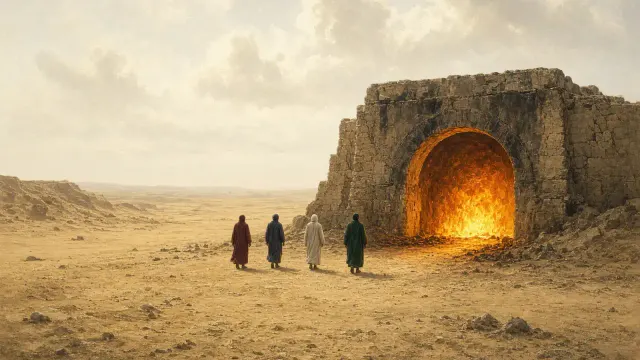
    The furnace is heated seven times more and the men who carry them up are killed by the flame. The king rises in haste and asks whether they did not cast in three.

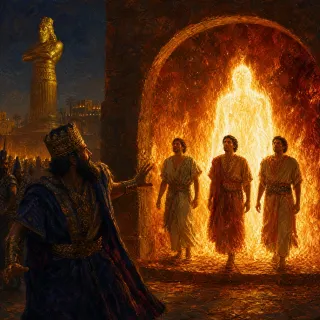
    The clothes receive attention before the fire and after it. Coats, hosen, hats, other garments: what first looks like an inventory becomes part of the evidence. The men were thrown in fully dressed. When the officials inspect them, even their coats are unchanged. The account closes that inspection with a smaller detail than unburned skin and hair, and somehow a more arresting one: no smell of fire.

    The flames have not simply become harmless everywhere. They kill the soldiers carrying out the sentence. Within that same furnace, the three who fell bound are seen walking loose, accompanied by a fourth. The king first checks the number put in. The passage is exact about the changed condition but does not describe the moment or manner in which the bonds came off. The familiar claim that only the ropes burned goes beyond what these verses actually report.

    Nebuchadnezzar's language changes from the challenge of verse 15 to praise of the God who sent his angel. His decrees remain another matter. The new order threatens mutilation and ruined houses for speech against that God; it is not a proclamation of general religious liberty. The rescue is complete without requiring a more complete account of the king's transformation than the chapter gives. He summons the three out as servants of the most high God. They leave with their allegiance unchanged, and their clothes unchanged with it.

    Verse by verse

    1. 3:19

      Seven times describes the commanded intensification; the passage supplies no temperature measurement.

    2. 3:21

      The men's clothes are listed before the fire, then inspected afterward in verse 27.

    3. 3:25

      Jerome records both angelic and Christological readings of the fourth figure. The king himself says angel in verse 28.

    4. 3:25

      The Aramaic phrase behind the Son of God describes a son of the gods or divine being; it is the Babylonian king's description.

    5. 3:27

      The text says the men are loose, not that it watched their ropes burn. Unscorched hair, unchanged clothing, and absence of smoke odor are separately reported.

    6. 3:29

      The new decree threatens violence against speakers; it should not be described as a general grant of freedom of worship.

    Daniel 3:19-30

    King James Version · 12 verses

    3:19Then was Nebuchadnezzar full of fury, and the form of his visage was changed against Shadrach, Meshach, and Abed-nego: therefore he spake, and commanded that they should heat the furnace one seven times more than it was wont to be heated.

    3:20And he commanded the most mighty men that were in his army to bind Shadrach, Meshach, and Abed-nego, and to cast them into the burning fiery furnace.

    3:21Then these men were bound in their coats, their hosen, and their hats, and their other garments, and were cast into the midst of the burning fiery furnace.

    3:22Therefore because the king’s commandment was urgent, and the furnace exceeding hot, the flame of the fire slew those men that took up Shadrach, Meshach, and Abed-nego.

    3:23And these three men, Shadrach, Meshach, and Abed-nego, fell down bound into the midst of the burning fiery furnace.

    3:24Then Nebuchadnezzar the king was astonied, and rose up in haste, and spake, and said unto his counsellors, Did not we cast three men bound into the midst of the fire? They answered and said unto the king, True, O king.

    3:25He answered and said, Lo, I see four men loose, walking in the midst of the fire, and they have no hurt; and the form of the fourth is like the Son of God.

    3:26Then Nebuchadnezzar came near to the mouth of the burning fiery furnace, and spake, and said, Shadrach, Meshach, and Abed-nego, ye servants of the most high God, come forth, and come hither. Then Shadrach, Meshach, and Abed-nego, came forth of the midst of the fire.

    3:27And the princes, governors, and captains, and the king’s counsellors, being gathered together, saw these men, upon whose bodies the fire had no power, nor was an hair of their head singed, neither were their coats changed, nor the smell of fire had passed on them.

    3:28Then Nebuchadnezzar spake, and said, Blessed be the God of Shadrach, Meshach, and Abed-nego, who hath sent his angel, and delivered his servants that trusted in him, and have changed the king’s word, and yielded their bodies, that they might not serve nor worship any god, except their own God.

    3:29Therefore I make a decree, That every people, nation, and language, which speak any thing amiss against the God of Shadrach, Meshach, and Abed-nego, shall be cut in pieces, and their houses shall be made a dunghill: because there is no other God that can deliver after this sort.

    3:30Then the king promoted Shadrach, Meshach, and Abed-nego, in the province of Babylon.

Why it matters

Their answer is the most carefully built sentence in the book, and it turns on two words. Our God is able to deliver us, and he will deliver us out of your hand. But if not, be it known to you that we will not serve your gods. The obedience is not conditional on the rescue. They go into a furnace heated seven times more than usual, and the men who throw them in are killed by the heat, and the king counts four figures walking loose in the fire.

8 songs

The music

Every song in the catalogue whose passage falls inside these chapters.

  1. Daniel 1:1-21

    Daniel Purposed in His Heart

  2. Daniel 1

    Ten Times Better

  3. Daniel 2:1-49

    A Stone Cut without Hands

  4. Daniel 2

    The Stone Without Hands

  5. Daniel 3:16-30

    Gold in the Fire

    Play here
    Open song pageRead lyrics
  6. Daniel 3:1-30

    In the Midst of the Fire

    Play here
    Open song pageRead lyrics
  7. Daniel 3

    Through the Fire

  8. Daniel 3:1-30

    We Will Not Serve Thy Gods

Nearby

All the people

Report an error on this page