
The big picture
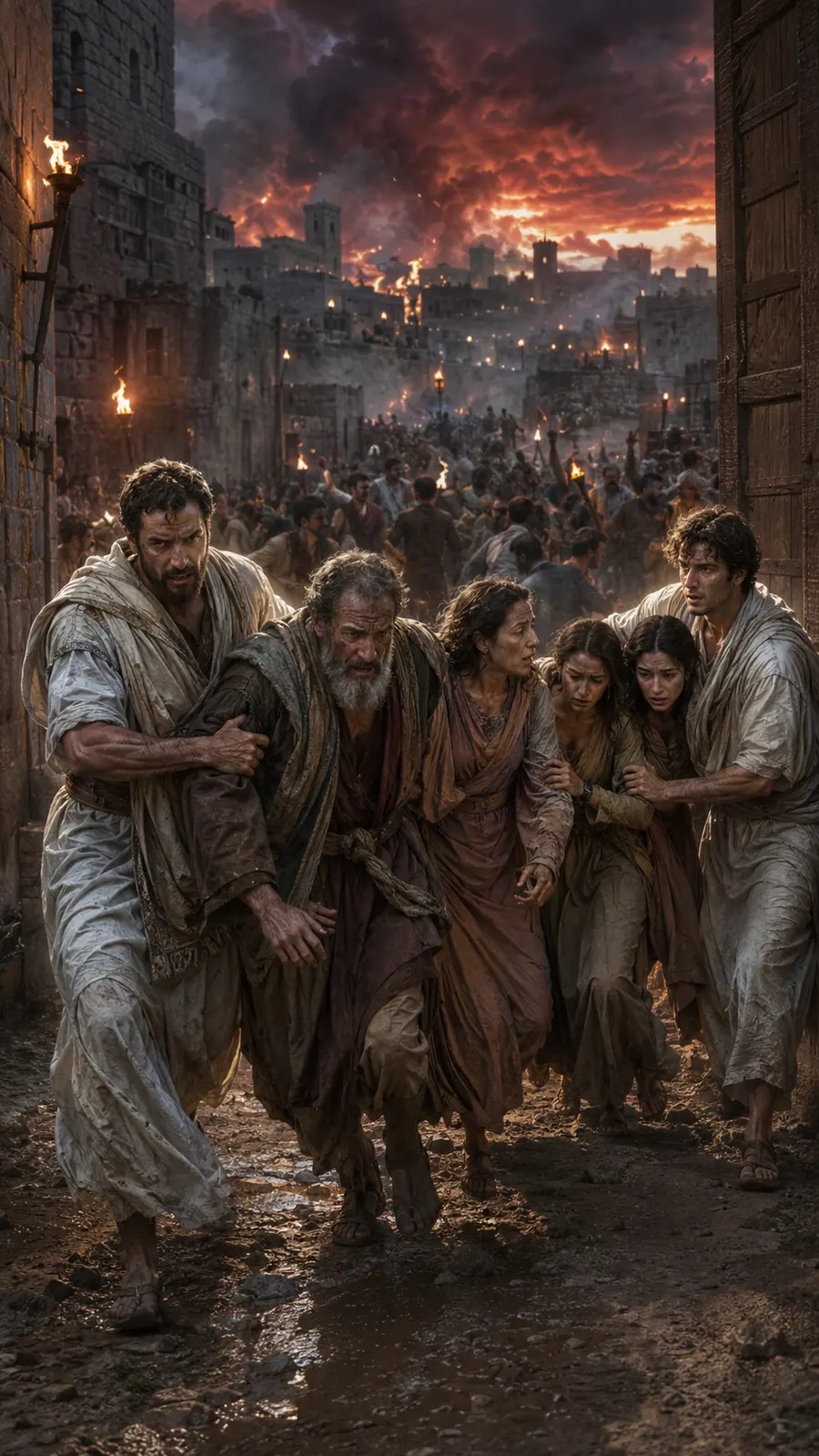
Two messengers reach Sodom, where a violent crowd threatens the visitors. Lot's household is urged to escape before judgment. The chapter ends in an isolated cave, showing that survival does not automatically resolve fear or moral disorder.
Scripture beside the summary
Genesis · King James Version · 38Genesis 19:1-11
Violence at the door
Lot receives the visitors, but the men of the city demand access to them. The scene describes threatened sexual violence and the collapse of protection for guests. Lot's offer of his daughters is itself appalling; the narrative does not make it an ethical example.
Context that brings the passage to life
This block contains 1 explicit questions. They are more than punctuation: they reveal where a voice is searching, challenging, afraid, or trying to understand.
“And there came two angels to Sodom at even; and Lot sat in the gate of Sodom: and Lot seeing them rose up to meet…” The number two makes the report concrete. Ask whether it measures time, people, distance, repetition, or completeness before deciding what weight it carries.
“And he pressed upon them greatly; and they turned in unto him, and entered into his house; and he made them a feast…” The line’s distinctive content terms include bake, bread, entered. Its relationship to verses 2 and 4 shows what work it does in this passage.
“And they called unto Lot, and said unto him, Where are the men which came in to thee this night? bring them out unto…” The question slows the passage down. Notice who is being pressed to answer, what the question assumes, and whether the next lines provide a response.
“And said, I pray you, brethren, do not so wickedly.” The line’s distinctive content terms include brethren, pray, wickedly. Its relationship to verses 8 shows what work it does in this passage.
“And they said, Stand back. And they said again, This one fellow came in to sojourn, and he will needs be a judge: now…” The number one makes the report concrete. Ask whether it measures time, people, distance, repetition, or completeness before deciding what weight it carries.
Genesis 19:1-11
King James Version1And there came two angels to Sodom at even; and Lot sat in the gate of Sodom: and Lot seeing them rose up to meet them; and he bowed himself with his face toward the ground;
2And he said, Behold now, my lords, turn in, I pray you, into your servant’s house, and tarry all night, and wash your feet, and ye shall rise up early, and go on your ways. And they said, Nay; but we will abide in the street all night.
3And he pressed upon them greatly; and they turned in unto him, and entered into his house; and he made them a feast, and did bake unleavened bread, and they did eat.
4But before they lay down, the men of the city, even the men of Sodom, compassed the house round, both old and young, all the people from every quarter:
5And they called unto Lot, and said unto him, Where are the men which came in to thee this night? bring them out unto us, that we may know them.
6And Lot went out at the door unto them, and shut the door after him,
7And said, I pray you, brethren, do not so wickedly.
8Behold now, I have two daughters which have not known man; let me, I pray you, bring them out unto you, and do ye to them as is good in your eyes: only unto these men do nothing; for therefore came they under the shadow of my roof.
9And they said, Stand back. And they said again, This one fellow came in to sojourn, and he will needs be a judge: now will we deal worse with thee, than with them. And they pressed sore upon the man, even Lot, and came near to break the door.
10But the men put forth their hand, and pulled Lot into the house to them, and shut to the door.
11And they smote the men that were at the door of the house with blindness, both small and great: so that they wearied themselves to find the door.
Genesis 19:12-29
A reluctant escape
Lot hesitates, his prospective sons-in-law dismiss the warning, and the messengers lead the family out. Lot's wife looks back and becomes a pillar of salt. Abraham sees the destruction, and the narrator connects Lot's rescue with God remembering Abraham.
Context that brings the passage to life
This block contains 2 explicit questions. They are more than punctuation: they reveal where a voice is searching, challenging, afraid, or trying to understand.
“And the men said unto Lot, Hast thou here any besides? son in law, and thy sons, and thy daughters, and whatsoever…” The question slows the passage down. Notice who is being pressed to answer, what the question assumes, and whether the next lines provide a response.
“And while he lingered, the men laid hold upon his hand, and upon the hand of his wife, and upon the hand of his two…” The number two makes the report concrete. Ask whether it measures time, people, distance, repetition, or completeness before deciding what weight it carries.
“Behold now, this city is near to flee unto, and it is a little one: Oh, let me escape thither, (is it not a little…” The question slows the passage down. Notice who is being pressed to answer, what the question assumes, and whether the next lines provide a response.
“Then the LORD rained upon Sodom and upon Gomorrah brimstone and fire from the LORD out of heaven;” Naming Gomorrah and Sodom keeps the account rooted in particular people or places. Follow where the name returns and what changes around it.
“And he looked toward Sodom and Gomorrah, and toward all the land of the plain, and beheld, and, lo, the smoke of the…” Naming Gomorrah and Sodom keeps the account rooted in particular people or places. Follow where the name returns and what changes around it.
“And it came to pass, when God destroyed the cities of the plain, that God remembered Abraham, and sent Lot out of the…” This familiar narrative signal moves the clock forward. What follows is a new scene, consequence, or answer to an earlier tension.
The movement opens with “And the men said unto Lot, Hast thou here any besides? son in law, and thy sons, and thy…” By verse 14, the text has turned to “And Lot went out, and spake unto his sons in law, which married his daughters, and said, Up…” It lands on “And it came to pass, when they had brought them forth abroad, that he said, Escape for thy…” The distance between those lines matters as much as any isolated phrase. The passage has a voice and pulse of its own, including 3 verses with a speech marker, 1 question, 1 stated contrast, 3 verses naming the LORD or God. Those features reveal where the narrative slows down, speaks directly, or changes direction.
Genesis 19:12-29
King James Version12And the men said unto Lot, Hast thou here any besides? son in law, and thy sons, and thy daughters, and whatsoever thou hast in the city, bring them out of this place:
13For we will destroy this place, because the cry of them is waxen great before the face of the LORD; and the LORD hath sent us to destroy it.
14And Lot went out, and spake unto his sons in law, which married his daughters, and said, Up, get you out of this place; for the LORD will destroy this city. But he seemed as one that mocked unto his sons in law.
15And when the morning arose, then the angels hastened Lot, saying, Arise, take thy wife, and thy two daughters, which are here; lest thou be consumed in the iniquity of the city.
16And while he lingered, the men laid hold upon his hand, and upon the hand of his wife, and upon the hand of his two daughters; the LORD being merciful unto him: and they brought him forth, and set him without the city.
17And it came to pass, when they had brought them forth abroad, that he said, Escape for thy life; look not behind thee, neither stay thou in all the plain; escape to the mountain, lest thou be consumed.
18And Lot said unto them, Oh, not so, my Lord:
19Behold now, thy servant hath found grace in thy sight, and thou hast magnified thy mercy, which thou hast shewed unto me in saving my life; and I cannot escape to the mountain, lest some evil take me, and I die:
20Behold now, this city is near to flee unto, and it is a little one: Oh, let me escape thither, (is it not a little one?) and my soul shall live.
21And he said unto him, See, I have accepted thee concerning this thing also, that I will not overthrow this city, for the which thou hast spoken.
22Haste thee, escape thither; for I cannot do any thing till thou be come thither. Therefore the name of the city was called Zoar.
23The sun was risen upon the earth when Lot entered into Zoar.
24Then the LORD rained upon Sodom and upon Gomorrah brimstone and fire from the LORD out of heaven;
25And he overthrew those cities, and all the plain, and all the inhabitants of the cities, and that which grew upon the ground.
26But his wife looked back from behind him, and she became a pillar of salt.
27And Abraham gat up early in the morning to the place where he stood before the LORD:
28And he looked toward Sodom and Gomorrah, and toward all the land of the plain, and beheld, and, lo, the smoke of the country went up as the smoke of a furnace.
29And it came to pass, when God destroyed the cities of the plain, that God remembered Abraham, and sent Lot out of the midst of the overthrow, when he overthrew the cities in the which Lot dwelt.
Genesis 19:30-38
Fear and a damaged future
Lot's daughters, fearing the end of their family line, make their father drunk and conceive by him. The account explains the origins of Moab and Ammon through a disturbing family story. It records coercion and fear without authorizing them.
Context that brings the passage to life
“And Lot went up out of Zoar, and dwelt in the mountain, and his two daughters with him; for he feared to dwell in…” The number two makes the report concrete. Ask whether it measures time, people, distance, repetition, or completeness before deciding what weight it carries.
“Come, let us make our father drink wine, and we will lie with him, that we may preserve seed of our father.” The command cannot be understood from the verb alone. Its recipient, purpose, and place in the larger covenant or argument define the responsibility.
“And it came to pass on the morrow, that the firstborn said unto the younger, Behold, I lay yesternight with my father…” This familiar narrative signal moves the clock forward. What follows is a new scene, consequence, or answer to an earlier tension.
“Thus were both the daughters of Lot with child by their father.” Naming Lot keeps the account rooted in particular people or places. Follow where the name returns and what changes around it.
“And the younger, she also bare a son, and called his name Ben-ammi: the same is the father of the children of Ammon…” Naming Ammon and Ben keeps the account rooted in particular people or places. Follow where the name returns and what changes around it.
Genesis 19:30-38
King James Version30And Lot went up out of Zoar, and dwelt in the mountain, and his two daughters with him; for he feared to dwell in Zoar: and he dwelt in a cave, he and his two daughters.
31And the firstborn said unto the younger, Our father is old, and there is not a man in the earth to come in unto us after the manner of all the earth:
32Come, let us make our father drink wine, and we will lie with him, that we may preserve seed of our father.
33And they made their father drink wine that night: and the firstborn went in, and lay with her father; and he perceived not when she lay down, nor when she arose.
34And it came to pass on the morrow, that the firstborn said unto the younger, Behold, I lay yesternight with my father: let us make him drink wine this night also; and go thou in, and lie with him, that we may preserve seed of our father.
35And they made their father drink wine that night also: and the younger arose, and lay with him; and he perceived not when she lay down, nor when she arose.
36Thus were both the daughters of Lot with child by their father.
37And the firstborn bare a son, and called his name Moab: the same is the father of the Moabites unto this day.
38And the younger, she also bare a son, and called his name Ben-ammi: the same is the father of the children of Ammon unto this day.
Details worth noticing
The opening image
Genesis 19:1 begins with “And there came two angels to Sodom at even; and Lot sat in the gate of Sodom: and Lot seeing them rose up to meet them; and he bowed himself with his face…”
Where the chapter turns
Genesis 19:20 forms a natural hinge: “Behold now, this city is near to flee unto, and it is a little one: Oh, let me escape thither, (is it not a little one?) and my soul shall live.”
The final note
Genesis 19:38 leaves the reader with “And the younger, she also bare a son, and called his name Ben-ammi: the same is the father of the children of Ammon unto this day.”
A word trail through the chapter
The words father, city, daughters, LORD, door, night help reveal the chapter’s repeated concerns.
What does the narrator emphasize about the rescue?
Mercy amid hesitation and God remembering Abraham, rather than Lot's flawless judgment.
How does the ending resist a simple happy ending?
Fear and abusive choices continue after physical escape.
KJV words made clear
- behold
- look, or pay close attention
- unto
- to
- thee
- you
- thou
- you
- thy
- your
Text first
Where readers differ
The chapter summary begins with what the passage says and how its parts fit together. It does not assume one denomination has already settled every question. Where a conclusion depends on a tradition, literary theory, or historical reconstruction, that dependence is named openly.
The KJV text is presented first. Interpretive conclusions are labeled, and differences are introduced only when they help a reader understand why serious communities do not always reach the same answer.
What is Sodom condemned for?
Genesis 19 depicts a crowd threatening sexual violence against guests, while the wider narrative speaks of grave wickedness and an outcry. Ezekiel also names pride, abundance without care for the poor and abominations; Jude emphasizes sexual wrongdoing. These witnesses should be read together rather than reduced to one convenient political slogan.
Genesis 18:20-21 · Genesis 19:1-11 · Ezekiel 16:49-50 · Jude 7