

The big picture
Who ranks highest in God's kingdom? The disciples, those learning to follow Jesus, bring him that question. Jesus brings a child into their midst and overturns their measure of greatness. He warns against causing the vulnerable to fall, pictures the search for a lost sheep, and explains how to address a brother's wrong. Peter, one of the disciples, then asks how often to forgive. A king's cancelled debt and a servant's harsh response expose the seriousness of receiving mercy while refusing it to another.
In this chapter
- A Child Reverses the Contest for Greatness Matthew 18:1-9
Asked about greatness, Jesus places a child among the disciples.
- One Lost Sheep Receives the Father’s Concern Matthew 18:10-14
None of the little ones is to be despised, Jesus says.
- Correction Seeks a Brother and Involves the Community Matthew 18:15-20
Jesus tells a wronged disciple to speak privately with the brother who sinned.
- A Vast Debt Is Cancelled Through Compassion Matthew 18:21-27
Peter asks whether forgiving a brother seven times is enough.
- Refusing Mercy Brings the Forgiven Servant to Judgement Matthew 18:28-35
The released servant finds a fellow servant owing a far smaller sum, seizes his throat, and demands payment.
Central truth
Humble care for the weak, the search for those who stray, and freely given mercy mark the life Jesus requires of his followers.

Scripture beside the summary
Matthew · King James Version · 35Matthew 18:1-9
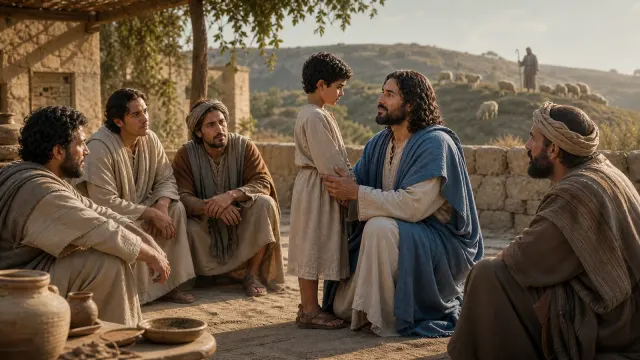
A Child Reverses the Contest for Greatness
Asked about greatness, Jesus places a child among the disciples. Unless they turn and become like children, they will not enter the kingdom. Humbling oneself gives greatness, and receiving such a child in his name receives him. Leading a little believer into sin is so grave that drowning under a millstone is called preferable. Those causing such falls face judgement. Jesus again uses images of removing a hand, foot, or eye rather than entering eternal fire. This is forceful language about renouncing sin, not an instruction for bodily mutilation. Rank is not the aim. Those who are small must be received and kept from harm.
In everyday life
A safeguarding lead pauses a leadership meeting. She reads an overlooked child's account of pressure from a trusted adult. Titles and ambitions are set aside while the child's safety becomes the central concern. She names the breach without recreating the harm. Jesus places the little ones under his care and warns of divine judgement, not only a safeguarding procedure.
Notice
Matthew 18:5 Welcoming the child is described as welcoming Jesus himself. The person seeking high rank must therefore attend to someone who offers little social advantage.
Matthew 18:1-9
King James Version1At the same time came the disciples unto Jesus, saying, Who is the greatest in the kingdom of heaven?
2And Jesus called a little child unto him, and set him in the midst of them,
3And said, Verily I say unto you, Except ye be converted, and become as little children, ye shall not enter into the kingdom of heaven.
4Whosoever therefore shall humble himself as this little child, the same is greatest in the kingdom of heaven.
5And whoso shall receive one such little child in my name receiveth me.
6But whoso shall offend one of these little ones which believe in me, it were better for him that a millstone were hanged about his neck, and that he were drowned in the depth of the sea.
7Woe unto the world because of offences! for it must needs be that offences come; but woe to that man by whom the offence cometh!
8Wherefore if thy hand or thy foot offend thee, cut them off, and cast them from thee: it is better for thee to enter into life halt or maimed, rather than having two hands or two feet to be cast into everlasting fire.
9And if thine eye offend thee, pluck it out, and cast it from thee: it is better for thee to enter into life with one eye, rather than having two eyes to be cast into hell fire.
Matthew 18:10-14
One Lost Sheep Receives the Father’s Concern
None of the little ones is to be despised, Jesus says. Their angels stand before the heavenly Father, and the Son of man, his title for himself, has come to save the lost. He pictures a shepherd with a hundred sheep who leaves ninety-nine to search the mountains for one that strayed. Finding it brings particular joy. The Father's will is not for one of these small ones to perish. The safety of the many does not make one loss small. The shepherd still cares for the missing sheep. The Father cares for each small one too.
In everyday life
A school-trip leader notices one missing pupil. The rest of the group is already safely counted. She arranges care for those present and starts the search instead of calling the overall number good enough. The missing child has not become expendable. Jesus reveals the Father's will for the little ones, not a leader's limited ability to complete a search.
Notice
Matthew 18:14 The conclusion names one little one, keeping the single sheep's value in view. Care is not reduced to preserving a satisfactory proportion of the group.
Matthew 18:10-14
King James Version10Take heed that ye despise not one of these little ones; for I say unto you, That in heaven their angels do always behold the face of my Father which is in heaven.
11For the Son of man is come to save that which was lost.
12How think ye? if a man have an hundred sheep, and one of them be gone astray, doth he not leave the ninety and nine, and goeth into the mountains, and seeketh that which is gone astray?
13And if so be that he find it, verily I say unto you, he rejoiceth more of that sheep, than of the ninety and nine which went not astray.
14Even so it is not the will of your Father which is in heaven, that one of these little ones should perish.
Matthew 18:15-20
Correction Seeks a Brother and Involves the Community
Jesus tells a wronged disciple to speak privately with the brother who sinned. If he listens, the relationship is regained. If not, one or two witnesses should come so the matter is supported by testimony. Continued refusal brings it before the church, the gathered community, and then changes the person's standing among them. Jesus gives authority to bind and release, with heaven involved in those decisions. Christians differ over how to use that authority. He also promises the Father's response to shared prayer and his own presence among two or three gathered in his name. The aim is truth and a brother regained, not his public shame.

In everyday life
A cooperative member raises a disputed act with the colleague involved. When he denies it, she asks two witnesses to help. If the refusal continues, the shared body must decide how membership can continue. The concern is repair as well as evidence. Jesus gives his church authority connected with heaven and his presence, not a voluntary group's rules.
Notice
Matthew 18:15 The first aim is to gain the brother back. Making the wrong public is not the starting point. The private approach gives room to hear and change.
Matthew 18:15-20
King James Version15Moreover if thy brother shall trespass against thee, go and tell him his fault between thee and him alone: if he shall hear thee, thou hast gained thy brother.
16But if he will not hear thee, then take with thee one or two more, that in the mouth of two or three witnesses every word may be established.
17And if he shall neglect to hear them, tell it unto the church: but if he neglect to hear the church, let him be unto thee as an heathen man and a publican.
18Verily I say unto you, Whatsoever ye shall bind on earth shall be bound in heaven: and whatsoever ye shall loose on earth shall be loosed in heaven.
19Again I say unto you, That if two of you shall agree on earth as touching any thing that they shall ask, it shall be done for them of my Father which is in heaven.
20For where two or three are gathered together in my name, there am I in the midst of them.
Matthew 18:21-27
A Vast Debt Is Cancelled Through Compassion
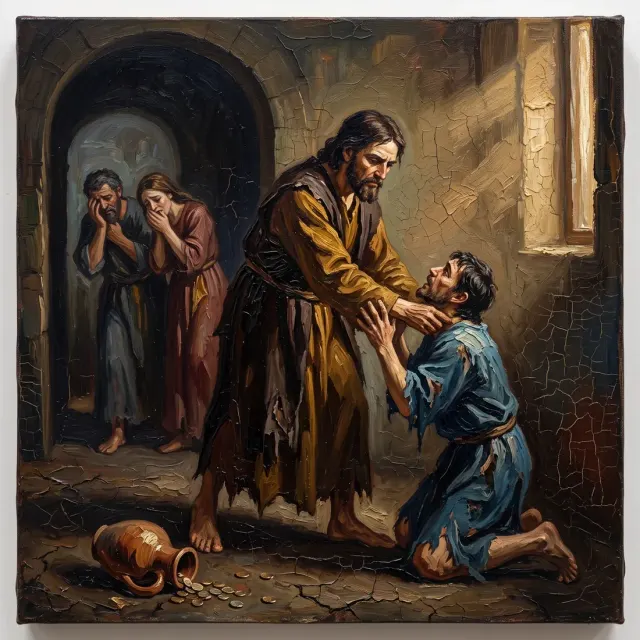
Peter asks whether forgiving a brother seven times is enough. Jesus answers with seventy times seven, breaking the idea of a small allowance to be used up. He compares the kingdom to a king settling accounts. A servant owes ten thousand talents, an immense sum he cannot pay. The king orders him, his wife, children, and goods sold, a severe setting of debt slavery. The servant begs for time and promises repayment. The king responds with compassion and cancels the whole debt. The gift is larger than the delay requested and far larger than the debtor can earn.
In everyday life
A debt-relief adviser sits with a family whose vast debt has been cancelled. The payment is not merely delayed. The parent had arrived asking for another month and now has to absorb a release he had no means to fund. The adviser lets the news settle. Jesus' parable includes royal power over slavery and judgement, not a modern debt programme's lawful remedies.
Notice
Matthew 18:27 The servant asks for patience, but receives release from the debt itself. The king's mercy exceeds the request rather than waiting for the impossible repayment to occur.
Matthew 18:21-27
King James Version21Then came Peter to him, and said, Lord, how oft shall my brother sin against me, and I forgive him? till seven times?
22Jesus saith unto him, I say not unto thee, Until seven times: but, Until seventy times seven.
23Therefore is the kingdom of heaven likened unto a certain king, which would take account of his servants.
24And when he had begun to reckon, one was brought unto him, which owed him ten thousand talents.
25But forasmuch as he had not to pay, his lord commanded him to be sold, and his wife, and children, and all that he had, and payment to be made.
26The servant therefore fell down, and worshipped him, saying, Lord, have patience with me, and I will pay thee all.
27Then the lord of that servant was moved with compassion, and loosed him, and forgave him the debt.
Matthew 18:28-35
Refusing Mercy Brings the Forgiven Servant to Judgement
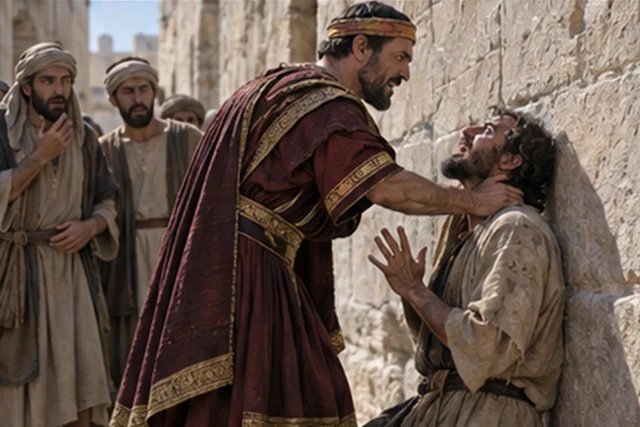
The released servant finds a fellow servant owing a far smaller sum, seizes his throat, and demands payment. The other begs for patience, echoing the earlier plea. He refuses and sends him to prison. Distressed witnesses report this to the king. The king recalls the cancelled debt and asks why similar compassion was not shown. In anger he hands the unforgiving servant to tormentors until payment is made. Jesus applies the severe ending to those who do not forgive a brother from the heart. The servant had received mercy. He was bound to show it to another in need. He could not keep the gift and refuse its claim on him.
In everyday life
A pastoral-care volunteer helps a harmed borrower record coercion by a man whose own crushing debt was recently forgiven. She keeps the contrast visible without staging the threat or the later punishment. Receiving relief has not made his harshness harmless. Jesus ends the parable with divine judgement, not a volunteer's authority to punish a person who refuses mercy.
Notice
Matthew 18:33 The king asks for compassion like the compassion already given. The servant is judged through mercy he personally received, not through an unknown standard imposed afterwards.
Matthew 18:28-35
King James Version28But the same servant went out, and found one of his fellowservants, which owed him an hundred pence: and he laid hands on him, and took him by the throat, saying, Pay me that thou owest.
29And his fellowservant fell down at his feet, and besought him, saying, Have patience with me, and I will pay thee all.
30And he would not: but went and cast him into prison, till he should pay the debt.
31So when his fellowservants saw what was done, they were very sorry, and came and told unto their lord all that was done.
32Then his lord, after that he had called him, said unto him, O thou wicked servant, I forgave thee all that debt, because thou desiredst me:
33Shouldest not thou also have had compassion on thy fellowservant, even as I had pity on thee?
34And his lord was wroth, and delivered him to the tormentors, till he should pay all that was due unto him.
35So likewise shall my heavenly Father do also unto you, if ye from your hearts forgive not every one his brother their trespasses.
Details worth noticing
The opening image
Matthew 18:1 begins with “At the same time came the disciples unto Jesus, saying, Who is the greatest in the kingdom of heaven?”
Where the chapter turns
Matthew 18:16 forms a natural hinge: “But if he will not hear thee, then take with thee one or two more, that in the mouth of two or three witnesses every word may be established.”
The final note
Matthew 18:35 leaves the reader with “So likewise shall my heavenly Father do also unto you, if ye from your hearts forgive not every one his brother their trespasses.”
A word trail through the chapter
The words heaven, little, lord, brother, Father, hear help reveal the chapter’s repeated concerns.
KJV words made clear
- millstone
- A heavy stone used to grind grain into flour.
- talents
- Large units of money; ten thousand represents an immense, unpayable debt here.
- tormentors
- People who inflict pain, named in the parable’s severe punishment.
Music and video connected to the passage
Related media appears when its Scripture reference overlaps this study. Music and video can illuminate a theme while the biblical text remains the foundation.
 The Debt He Would Not ForgiveMatthew 18:21-35Listen to related music →Before the Cock CrowMatthew 26:47-75; Mark 14:43-72; Luke 22:47-62; John 18:1-27Listen to related music →
 Behold the ManMatthew 27:1-31; Mark 15:1-20; Luke 22:63-23:25; John 18:28-19:16Listen to related music →
 Matthew, Part TwoMatthew 14:1-28:20Listen to related music →