
The big picture
The camp of Israel, the people living around God's meeting tent, now has rules for moving and guarding that tent. Moses, their leader, now receives commands about conditions inside the camp. Some people must stay outside because of ritual uncleanness, a state that restricts contact with sacred life. Wrongdoers must repay what they owe. A further law addresses a husband's suspicion of adultery, including cases where his wife is innocent.
In this chapter
- Unclean People Leave the Camp Numbers 5:1-4
God commands Moses to send certain people outside the camp.
- Wrongdoers Must Repay the Loss Numbers 5:5-10
A man or woman who wrongs another person must confess the sin.
- Jealousy Brings a Wife Before God Numbers 5:11-15
God gives this law to Moses for a husband who suspects his wife.
- The Priest Announces the Oath Numbers 5:16-22
The priest places the woman before God with the offering in her hands.
- The Water and the Outcome Numbers 5:23-28
The priest writes the curses and washes the writing into the water.
- The Law Assigns Unequal Responsibilities Numbers 5:29-31
The closing lines gather the jealousy law into a final statement.
Central truth
God's presence shapes the camp's rules about ritual purity, repayment for wrongs, and a husband's unproved suspicion of adultery.


Scripture beside the summary
Numbers · King James Version · 31Numbers 5:1-4
Unclean People Leave the Camp
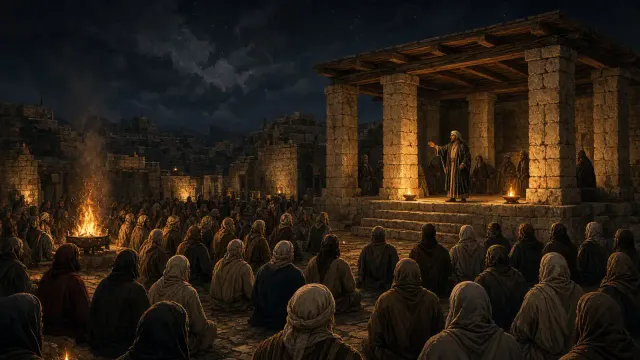
God commands Moses to send certain people outside the camp. Some have leprosy, a term for serious skin conditions. Others have bodily discharges or have touched a dead body. It applies to men and women alike. The reason given is that God lives among the people, so the camp must not be defiled. Israel obeys. These people cannot join in holy life for now. Touching a dead person does not in itself mean someone has done wrong.
In everyday life
A transplant nurse directs a visitor with a fever away from a patient's room. The visitor has done nothing dishonest, but cannot enter under the ward's current rules. The nurse applies the same restriction to relatives and staff. Numbers gives God's presence as the reason for exclusion, rather than a medical explanation.
Notice
Numbers 5:3 Men and women face the same boundary. The stated concern is God's dwelling among the people, not a claim that each affected person has committed a deliberate wrong.
Numbers 5:1-4
King James Version1And the LORD spake unto Moses, saying,
2Command the children of Israel, that they put out of the camp every leper, and every one that hath an issue, and whosoever is defiled by the dead:
3Both male and female shall ye put out, without the camp shall ye put them; that they defile not their camps, in the midst whereof I dwell.
4And the children of Israel did so, and put them out without the camp: as the LORD spake unto Moses, so did the children of Israel.
Numbers 5:5-10
Wrongdoers Must Repay the Loss
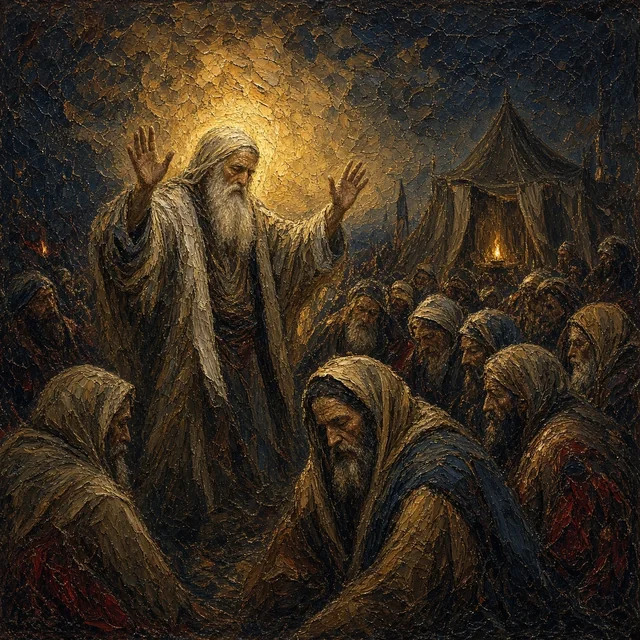
A man or woman who wrongs another person must confess the sin. Repayment includes the full loss plus one fifth, paid to the injured party. If there is no relative able to receive what is owed, the payment goes to the priest as belonging to God. A ram is also offered to deal with the guilt before him. The commands then confirm the priest's right to sacred gifts brought to him. Repairing the harm and seeking restored standing before God belong together.
In everyday life
A jewellery apprentice admits selling a customer's watch without permission. She hands over its full value and an added payment instead of treating an apology as the whole repair. The missing watch leaves a debt that words alone do not settle. This biblical rule also requires an offering to God, unlike ordinary compensation.
Notice
Numbers 5:7 Confession comes with repayment and an added fifth. Admitting the wrong does not cancel the loss suffered by the person who was harmed.
Numbers 5:5-10
King James Version5And the LORD spake unto Moses, saying,
6Speak unto the children of Israel, When a man or woman shall commit any sin that men commit, to do a trespass against the LORD, and that person be guilty;
7Then they shall confess their sin which they have done: and he shall recompense his trespass with the principal thereof, and add unto it the fifth part thereof, and give it unto him against whom he hath trespassed.
8But if the man have no kinsman to recompense the trespass unto, let the trespass be recompensed unto the LORD, even to the priest; beside the ram of the atonement, whereby an atonement shall be made for him.
9And every offering of all the holy things of the children of Israel, which they bring unto the priest, shall be his.
10And every man’s hallowed things shall be his: whatsoever any man giveth the priest, it shall be his.
Numbers 5:11-15
Jealousy Brings a Wife Before God
God gives this law to Moses for a husband who suspects his wife. He thinks she has had sex with another man. There is no witness and she has not been caught. His wife might be guilty, or she might be innocent. Both cases are included. The husband brings her to the priest with barley flour as an offering. No oil or incense is added. Suspicion starts this process, but suspicion alone does not settle whether she has committed the wrong of which she is accused.

In everyday life
The owner of a small bakery suspects her bookkeeper after money goes missing, but she has no witness or clear record. She brings the disputed accounts to an examiner instead of declaring the case proved. The tension is real before the facts are settled. Numbers describes a husband's accusation and a sacred ritual, not an audit.
Notice
Numbers 5:14 The law expressly includes an innocent wife. A jealous husband's certainty is therefore not treated as proof that the suspected act actually happened.
Numbers 5:11-15
King James Version11And the LORD spake unto Moses, saying,
12Speak unto the children of Israel, and say unto them, If any man’s wife go aside, and commit a trespass against him,
13And a man lie with her carnally, and it be hid from the eyes of her husband, and be kept close, and she be defiled, and there be no witness against her, neither she be taken with the manner;
14And the spirit of jealousy come upon him, and he be jealous of his wife, and she be defiled: or if the spirit of jealousy come upon him, and he be jealous of his wife, and she be not defiled:
15Then shall the man bring his wife unto the priest, and he shall bring her offering for her, the tenth part of an ephah of barley meal; he shall pour no oil upon it, nor put frankincense thereon; for it is an offering of jealousy, an offering of memorial, bringing iniquity to remembrance.
Numbers 5:16-22
The Priest Announces the Oath
The priest places the woman before God with the offering in her hands. He mixes sacred water with dust from the tabernacle floor and uncovers her head. He then states an oath: innocence leaves her free, but guilt brings a curse on her body. Her belly will swell and her thigh waste away. What these bodily effects mean is disputed. She accepts the oath. The ritual places the hidden matter before God rather than describing a witness who can prove what happened.

In everyday life
An accused tenant stands in a mobile mediation van as a neutral worker reads the complaint. The landlord speaks angrily from the step. The written charge still needs an answer before a ruling. Those listening hear what is at stake before any decision comes. The woman in Numbers faces a divine oath with bodily consequences, not mediation.
Notice
Numbers 5:19 The oath first states that an innocent woman is free from the curse. That condition matters because the husband's suspicion has not proved her guilt.
Numbers 5:16-22
King James Version16And the priest shall bring her near, and set her before the LORD:
17And the priest shall take holy water in an earthen vessel; and of the dust that is in the floor of the tabernacle the priest shall take, and put it into the water:
18And the priest shall set the woman before the LORD, and uncover the woman’s head, and put the offering of memorial in her hands, which is the jealousy offering: and the priest shall have in his hand the bitter water that causeth the curse:
19And the priest shall charge her by an oath, and say unto the woman, If no man have lain with thee, and if thou hast not gone aside to uncleanness with another instead of thy husband, be thou free from this bitter water that causeth the curse:
20But if thou hast gone aside to another instead of thy husband, and if thou be defiled, and some man have lain with thee beside thine husband:
21Then the priest shall charge the woman with an oath of cursing, and the priest shall say unto the woman, The LORD make thee a curse and an oath among thy people, when the LORD doth make thy thigh to rot, and thy belly to swell;
22And this water that causeth the curse shall go into thy bowels, to make thy belly to swell, and thy thigh to rot: And the woman shall say, Amen, amen.
Numbers 5:23-28
The Water and the Outcome
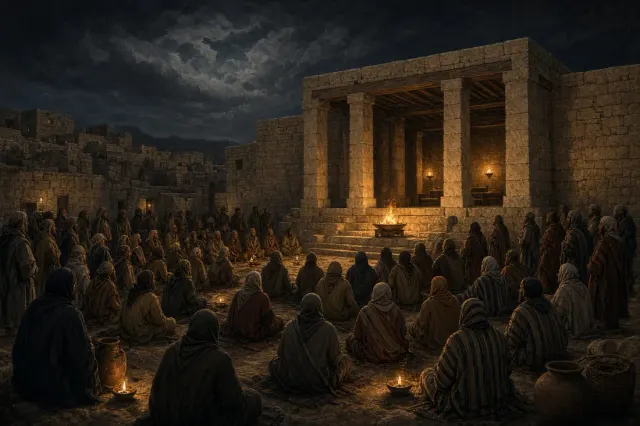
The priest writes the curses and washes the writing into the water. He takes the woman's barley offering, presents it before God and burns a handful on the altar. She drinks the water. The law says that guilt brings the stated bodily curse and shame among her people. Innocence leaves her free and able to bear children. No actual case is reported here. The command describes the expected outcome of the ritual without giving a medical account of how it works.
In everyday life
A falsely accused school caretaker waits while a formal inquiry reaches its finding. When the charge fails, the written decision clears his name instead of leaving him under permanent suspicion. His accuser's fear does not become the final verdict. This inquiry depends on evidence, whereas the ritual in Numbers entrusts the hidden matter to God.
Notice
Numbers 5:28 An innocent woman is described as free and able to conceive. The ritual's stated result distinguishes innocence from guilt rather than treating every accused wife alike.
Numbers 5:23-28
King James Version23And the priest shall write these curses in a book, and he shall blot them out with the bitter water:
24And he shall cause the woman to drink the bitter water that causeth the curse: and the water that causeth the curse shall enter into her, and become bitter.
25Then the priest shall take the jealousy offering out of the woman’s hand, and shall wave the offering before the LORD, and offer it upon the altar:
26And the priest shall take an handful of the offering, even the memorial thereof, and burn it upon the altar, and afterward shall cause the woman to drink the water.
27And when he hath made her to drink the water, then it shall come to pass, that, if she be defiled, and have done trespass against her husband, that the water that causeth the curse shall enter into her, and become bitter, and her belly shall swell, and her thigh shall rot: and the woman shall be a curse among her people.
28And if the woman be not defiled, but be clean; then she shall be free, and shall conceive seed.
Numbers 5:29-31
The Law Assigns Unequal Responsibilities
The closing lines gather the jealousy law into a final statement. It applies when a wife has been unfaithful or when a husband becomes jealous and brings her before God. The priest must carry out the whole procedure. The husband is described as free from guilt, while the woman bears her guilt. The rule puts unequal burdens on the two spouses. No matching test is given for a wife who suspects her husband. The law does not explain why.
In everyday life
The workshop manager files a complaint against an employee under a policy that exposes only the employee to discipline. She follows the required process, but the worker bears the burden of the investigation. The imbalance remains visible even when the rules are followed. This modern policy neither invokes God nor threatens a bodily curse.
Notice
Numbers 5:31 Responsibility falls differently on husband and wife. The final wording does not provide an equivalent procedure for testing a husband's faithfulness when his wife suspects him.
Numbers 5:29-31
King James Version29This is the law of jealousies, when a wife goeth aside to another instead of her husband, and is defiled;
30Or when the spirit of jealousy cometh upon him, and he be jealous over his wife, and shall set the woman before the LORD, and the priest shall execute upon her all this law.
31Then shall the man be guiltless from iniquity, and this woman shall bear her iniquity.
Details worth noticing
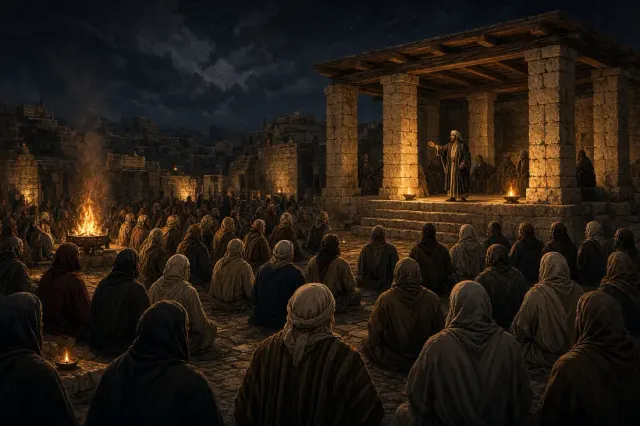
The opening image
Numbers 5:1 begins with “And the LORD spake unto Moses, saying,”
Where the chapter turns
Numbers 5:15 forms a natural hinge: “Then shall the man bring his wife unto the priest, and he shall bring her offering for her, the tenth part of an ephah of barley meal; he shall pour no oil…”
The final note
Numbers 5:31 leaves the reader with “Then shall the man be guiltless from iniquity, and this woman shall bear her iniquity.”
A word trail through the chapter
The words priest, LORD, woman, water, offering, curse help reveal the chapter’s repeated concerns.
KJV words made clear
- unto
- to
- thee
- you
- thou
- you
- thy
- your
- hath
- has
Music and video connected to the passage
Related media appears when its Scripture reference overlaps this study. Music and video can illuminate a theme while the biblical text remains the foundation.