
The big picture
Every part of this life is already known to God, as the speaker freely admits. Sitting, rising, thinking, and speaking lie open before him. No height, depth, distance, or darkness offers a place beyond God's presence. Even the speaker's formation before birth was seen. Awe at this care is followed by fierce opposition to God's enemies. The ending turns the search inward again, asking God to uncover any wicked path in the speaker and lead him into lasting life.
In this chapter
- Daily Acts and Unspoken Thoughts Are Known Psalms 139:1-6
God has searched the speaker and knows him.
- No Distance or Darkness Ends God’s Presence Psalms 139:7-12
Where can anyone go beyond God's spirit or presence?
- Hidden Formation Was Never Hidden from God Psalms 139:13-18
The speaker praises God for forming his inner life and covering him within his mother's womb.
- Loyalty Speaks in Fierce Rejection of Enemies Psalms 139:19-22
The prayer suddenly asks God to kill the wicked and orders violent people away.
- The Search Is Invited Within Psalms 139:23-24
After speaking about wicked people, the speaker asks God to search his own heart and test his thoughts.
Central truth
God knows and surrounds the speaker completely, so the prayer ends by inviting a search of the heart and guidance away from evil.


Scripture beside the summary
Psalms · King James Version · 24Psalms 139:1-6
Daily Acts and Unspoken Thoughts Are Known
God has searched the speaker and knows him. Ordinary changes of posture, thoughts formed at a distance, walking, and resting all lie within that knowledge. A word need not be spoken before God knows it fully. He surrounds the speaker on every side and lays a hand on him. The response is wonder at knowledge too high to grasp. The prayer does not start by asking God to notice an unknown life. It begins with the startling claim that no part of this life has escaped his attention.

In everyday life
A long-time carer notices a man's pause before he says that he is in pain. She knows his daily patterns and brings the cushion he usually needs. He looks up, surprised that she understood before the request came. Years of attention have made small signs clear. God's knowledge in the psalm reaches thoughts and words without needing learned clues.
Notice
Psalms 139:4 God knows the word before it is fully spoken. The claim reaches beyond observing actions to understanding speech before anyone else can hear it.
Psalms 139:1-6
King James Version1O LORD, thou hast searched me, and known me.
2Thou knowest my downsitting and mine uprising, thou understandest my thought afar off.
3Thou compassest my path and my lying down, and art acquainted with all my ways.
4For there is not a word in my tongue, but, lo, O LORD, thou knowest it altogether.
5Thou hast beset me behind and before, and laid thine hand upon me.
6Such knowledge is too wonderful for me; it is high, I cannot attain unto it.
Psalms 139:7-12
No Distance or Darkness Ends God’s Presence
Where can anyone go beyond God's spirit or presence? Heaven and the realm of the dead both fail as hiding places. So do the far edges of the sea, reached in an image of flight with the morning. Even there, God's hand leads and holds him. Darkness also fails to conceal him, because night and daylight are alike to God. The images run through height, depth, distance, and sight. No change of location can turn the known person into someone beyond God's reach.

In everyday life
A research diver descends beneath the boat and sees daylight fade while the support line remains in her hand. The crew's voice reaches her through the headset as she checks the seabed. Depth has changed her surroundings without ending contact. She reports that she is ready to return. The psalm's God needs no cable and is present even beyond death.
Notice
Psalms 139:12 Darkness and light are alike to God. The verse denies that the limits of human sight place a limit on his knowledge or presence.
Psalms 139:7-12
King James Version7Whither shall I go from thy spirit? or whither shall I flee from thy presence?
8If I ascend up into heaven, thou art there: if I make my bed in hell, behold, thou art there.
9If I take the wings of the morning, and dwell in the uttermost parts of the sea;
10Even there shall thy hand lead me, and thy right hand shall hold me.
11If I say, Surely the darkness shall cover me; even the night shall be light about me.
12Yea, the darkness hideth not from thee; but the night shineth as the day: the darkness and the light are both alike to thee.
Psalms 139:13-18
Hidden Formation Was Never Hidden from God
The speaker praises God for forming his inner life and covering him within his mother's womb. His making was hidden from human eyes, but not from God. Images of skilled work and depths express the mystery of a body taking shape. God saw the unfinished substance, with its parts recorded before they were formed. The speaker then marvels at God's thoughts, too many to count like grains of sand. Waking does not end this closeness. The life known now was already seen before anyone else could meet its owner.

In everyday life
A prenatal sonographer turns the monitor so expectant parents can see the developing child. She points out a forming hand that their own eyes cannot see through the body. They sit quietly as hidden growth becomes visible for a moment. The scan gives only a limited view. The psalm credits God with making and fully knowing the whole person.
Notice
Psalms 139:16 God sees the speaker while still unfinished. The claim places divine knowledge before the visible completion of the body, not only after birth.
Psalms 139:13-18
King James Version13For thou hast possessed my reins: thou hast covered me in my mother’s womb.
14I will praise thee; for I am fearfully and wonderfully made: marvellous are thy works; and that my soul knoweth right well.
15My substance was not hid from thee, when I was made in secret, and curiously wrought in the lowest parts of the earth.
16Thine eyes did see my substance, yet being unperfect; and in thy book all my members were written, which in continuance were fashioned, when as yet there was none of them.
17How precious also are thy thoughts unto me, O God! how great is the sum of them!
18If I should count them, they are more in number than the sand: when I awake, I am still with thee.
Psalms 139:19-22
Loyalty Speaks in Fierce Rejection of Enemies
The prayer suddenly asks God to kill the wicked and orders violent people away. They speak against God and misuse his name. The speaker says he hates those who hate the Lord and counts them as his own enemies. These are severe words of loyalty, not a mild dislike of their choices. The poem does not describe an attack carried out by the speaker. It voices a sharp break with people whose bloodshed and defiance he rejects. That outward judgement will soon be followed by a request to examine his own heart.

In everyday life
A witness to a violent group's crimes closes the door to an old associate who asks her to stay silent. She says their actions have ended her allegiance and places the case papers with her lawyer. The break costs a relationship she once valued. She refuses to help conceal the harm. The psalm also asks God to kill the wicked.
Notice
Psalms 139:22 The speaker calls God's enemies his own. His hatred is stated without dilution, making the following request for self-examination especially important.
Psalms 139:19-22
King James Version19Surely thou wilt slay the wicked, O God: depart from me therefore, ye bloody men.
20For they speak against thee wickedly, and thine enemies take thy name in vain.
21Do not I hate them, O LORD, that hate thee? and am not I grieved with those that rise up against thee?
22I hate them with perfect hatred: I count them mine enemies.
Psalms 139:23-24
The Search Is Invited Within
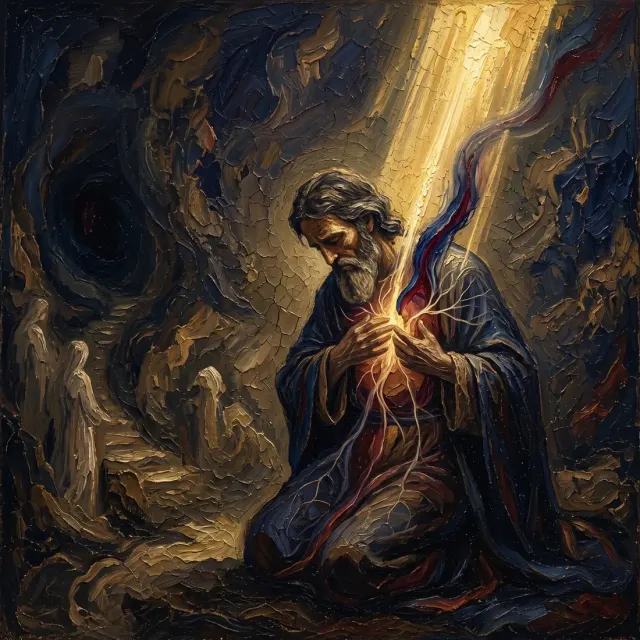
After speaking about wicked people, the speaker asks God to search his own heart and test his thoughts. The God who already knows everything is invited to expose any wicked way within him. He then asks to be led along the lasting way. The closing request keeps him from placing himself beyond examination. His opposition to evil elsewhere does not settle what is in his own life. Knowledge that first seemed too great to grasp now becomes the basis of a plea for correction and guidance.
In everyday life
A safety inspector finishes listing faults in a contractor's work, then hands her own sign-off sheets to a colleague for review. She asks him to identify anything she has missed or allowed. Finding errors elsewhere does not make her record untouchable. She stays while he opens the first page. The psalm asks God to search hidden motives as well as conduct.
Notice
Psalms 139:24 Any wicked path within him is open to the search. After condemning enemies, the speaker asks for correction rather than claiming to need none.
Psalms 139:23-24
King James Version23Search me, O God, and know my heart: try me, and know my thoughts:
24And see if there be any wicked way in me, and lead me in the way everlasting.
Details worth noticing
The opening image
Psalms 139:1 begins with “O LORD, thou hast searched me, and known me.”
Where the chapter turns
Psalms 139:7 forms a natural hinge: “Whither shall I go from thy spirit? or whither shall I flee from thy presence?”
The final note
Psalms 139:24 leaves the reader with “And see if there be any wicked way in me, and lead me in the way everlasting.”
A word trail through the chapter
The words darkness, hand, hate, LORD, count, enemies help reveal the chapter’s repeated concerns.
KJV words made clear
- reins
- The kidneys, used here for the inner parts of a person.
- curiously wrought
- Intricately formed or skilfully put together, not made with curiosity.
Music and video connected to the passage
Related media appears when its Scripture reference overlaps this study. Music and video can illuminate a theme while the biblical text remains the foundation.