
The big picture
Paul describes a ministry that refuses manipulation precisely because its content is not the messenger. He renounces craftiness and deceitful handling of God's word, preaching "Christ Jesus the Lord" while calling the ministers servants. The light belongs to God, yet it is carried in "earthen vessels" whose fragility makes the source of the power easier, not harder, to identify. Pressure, perplexity, persecution, and bodily exposure to death are real, but they do not have the final effect they threaten. Paul speaks because he believes in resurrection, and even that hope includes the Corinthians: God will "present us with you." The chapter closes by setting visible loss against an unseen future. Outward decay and inward renewal occur together, while present affliction is called "light" only beside the "eternal weight of glory" with which Paul compares it. The suffering is not denied. Its scale is changed.
In this chapter
- The Preacher Is Not the Light Source 2 Corinthians 4:1-6
Paul's answer to spiritual blindness is not a cleverer disguise.
- The Vessel Is Fragile on Purpose 2 Corinthians 4:7-12
The container is almost aggressively unimpressive: "we have this treasure in earthen vessels." Paul does not suggest polishing the clay until no one can tell treasure from pot.
- Faith Speaks While Deliverance Is Still Needed 2 Corinthians 4:13-15
Paul quotes the old confession, "I believed, and therefore have I spoken," because faith here produces speech while danger is still real.
- The Affliction Is Light Only on This Scale 2 Corinthians 4:16-18
Paul can call his affliction "light" only because he has changed the scale on which it is being weighed.


Scripture beside the summary
2 Corinthians · King James Version · 182 Corinthians 4:1-6
The Preacher Is Not the Light Source
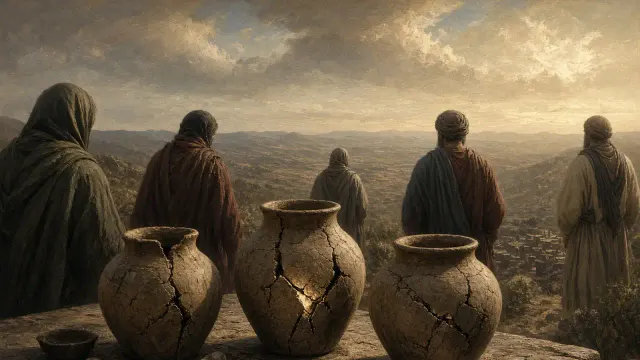
Paul's answer to spiritual blindness is not a cleverer disguise. Because the ministry has been received through mercy, he renounces "the hidden things of dishonesty," craftiness, and deceitful handling of God's word. His method is almost stubbornly exposed: the manifestation of truth before human conscience and "in the sight of God." If the gospel remains veiled, Paul does not conclude that manipulation would make it more effective. He locates the blindness elsewhere and keeps the content fixed on Christ. "We preach not ourselves, but Christ Jesus the Lord," with the ministers reduced to servants for Jesus' sake. Then Genesis breaks into the argument. The God who commanded light to shine out of darkness has shone in human hearts to give knowledge of his glory "in the face of Jesus Christ." The preacher carries news of that light. He is not the bulb. That distinction makes the fragile container of the next paragraph make perfect sense.
Deep dive
The refusal to lose heart rests on received mercy and the ministry described in chapter 3. Paul renounces hidden disgrace, craftiness, and the distortion of God’s word. His stated method is the manifestation of truth before conscience and before God. The persistence of unbelief therefore does not persuade him to make deception a more effective ministry technique. He locates the veiling of the gospel within spiritual blindness rather than within a secret message intentionally withheld from ordinary hearers.
The contrast between Christ as Lord and the ministers as servants is decisive. Paul does not merely claim that his personality is unusually modest. He identifies someone else as the content of the proclamation. The God who commanded light from darkness has shone in human hearts to disclose his glory in Christ’s face. The allusion to Genesis 1:3 gives the illumination the character of divine initiative. The messenger carries news of the light; he is not its generator. That distinction prepares the surprising choice of container in the next verse.
Words to trace: Christ, Jesus, light, gospel, shine, believe
Verse-by-verse path
- 2 Corinthians 4:1
“Faint not” is enkakeo, to lose heart, the verb of Luke 18:1, men “ought always to pray, and not to faint”. It frames the chapter, returning in verse 16. “As we have received mercy” reaches back to Paul’s own conversion, the persecutor shown mercy (1 Timothy 1:13).
- 2 Corinthians 4:2
“The hidden things of dishonesty” are literally the hidden things of shame, what people conceal because it is disgraceful. “Handling deceitfully” is doloo, used of merchants who adulterated wine or gold, a close cousin of the watered wine of 2:17.
- 2 Corinthians 4:3
“Hid” is kekalymmenon, covered, which ties the verse to the veil, kalymma, of chapter 3. Paul concedes that his gospel is veiled to some and moves the veil: it lies over “them that are lost”, the same verb as “them that perish” in 1 Corinthians 1:18.
- 2 Corinthians 4:4
“The god of this world” is the only place Paul gives this title to Satan, and “world” is aion, the present age. Jesus calls him “the prince of this world” in John 12:31. “Image” is eikon, the word of Genesis 1:27: Christ is the image Adam was made to bear.
- 2 Corinthians 4:5
“Christ Jesus the Lord” is the confession of Romans 10:9 and 1 Corinthians 12:3, now stated as the content of preaching. “Servants” is douloi, slaves, a startling word for an apostle to use of himself while defending his authority to a church that doubted it.
- 2 Corinthians 4:6
The first clause recalls Genesis 1:3, “Let there be light”, and perhaps Isaiah 9:2, “the people that walked in darkness have seen a great light”. Many readers hear the Damascus road behind “shined in our hearts”, where a light from heaven stopped Paul (Acts 9:3), though that is an inference.
2 Corinthians 4:1-6
King James Version1Therefore seeing we have this ministry, as we have received mercy, we faint not;
2But have renounced the hidden things of dishonesty, not walking in craftiness, nor handling the word of God deceitfully; but by manifestation of the truth commending ourselves to every man’s conscience in the sight of God.
3But if our gospel be hid, it is hid to them that are lost:
4In whom the god of this world hath blinded the minds of them which believe not, lest the light of the glorious gospel of Christ, who is the image of God, should shine unto them.
5For we preach not ourselves, but Christ Jesus the Lord; and ourselves your servants for Jesus’ sake.
6For God, who commanded the light to shine out of darkness, hath shined in our hearts, to give the light of the knowledge of the glory of God in the face of Jesus Christ.
2 Corinthians 4:7-12
The Vessel Is Fragile on Purpose
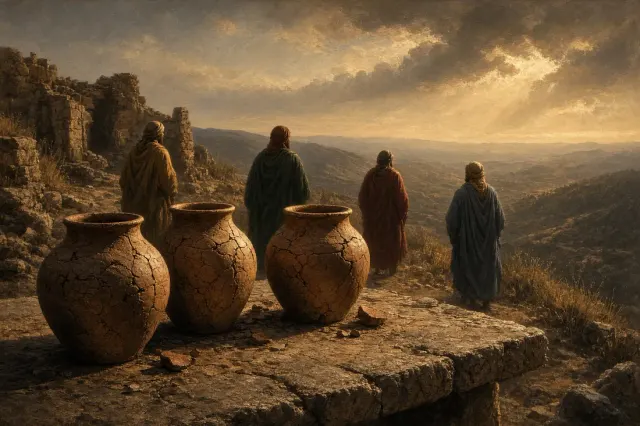
The container is almost aggressively unimpressive: "we have this treasure in earthen vessels." Paul does not suggest polishing the clay until no one can tell treasure from pot. Its fragility is part of the point, "that the excellency of the power may be of God, and not of us." The paired descriptions then refuse two equal and opposite lies. He is really troubled, perplexed, persecuted, and cast down, but he is not finally crushed, abandoned, or destroyed. The second half does not erase the first. Paul even carries "the dying of the Lord Jesus" in a mortal body so that Jesus' life may be made visible in that same vulnerable flesh. This is not a claim to repeat Christ's atoning death. It is a pattern of exposed service whose cost flows outward. The blunt conclusion, "death worketh in us, but life in you," tells the reader where the benefit is going.
Deep dive
The clay vessel is ordinary and breakable. Paul does not propose polishing it until observers mistake it for the treasure. The mismatch between contents and container serves the argument: extraordinary power can be distinguished from the messenger’s resources. His sequence of paired descriptions then gives that distinction a lived form. Pressure is real, perplexity is real, persecution is real, and being struck down is real. The second half of each pair denies the final ruin, not the first half’s pain.
The language of bearing Jesus’ dying in the body is not a claim that Paul repeats Christ’s atoning death. It interprets the apostolic exposure to death through the pattern of Jesus’ death and manifested life. Mortal flesh, not an imagined invulnerable body, is the location in which the life becomes visible. The final contrast between death working in the ministers and life in the Corinthians explains the direction of the cost. The passage is about service that benefits others, not about displaying suffering as a superior spiritual achievement.
Words to trace: Jesus, life, body, death, manifest, alway
Verse-by-verse path
- 2 Corinthians 4:7
“Earthen vessels” are ostrakina skeue, cheap clay pots that broke and were thrown out; their shards served as scrap paper for receipts and notes. Coins and scrolls were stored in such jars, as the Dead Sea scrolls were. “Excellency” is hyperbole again, the power that throws beyond.
- 2 Corinthians 4:8
Four pairs run across verses 8 and 9, each denying the worst outcome. “Troubled” is thlibo, pressed, and “distressed” is stenochoreo, squeezed into a narrow place: hard pressed, yet not cornered. The second pair is a pun, at a loss but not at a total loss.
- 2 Corinthians 4:9
“Forsaken” is enkataleipo, the verb of Psalm 22:1 as Jesus cried it from the cross in Mark 15:34. “Cast down” is kataballo, a wrestler’s or soldier’s word for being thrown to the ground. The images escalate from pursuit to a blow that floors a man who then gets up.
- 2 Corinthians 4:10
“The dying” is nekrosis, the process of dying, a rarer word than thanatos, death. Paul carries it “about”, periphero, as one carries a burden from town to town, which suits his travelling life: the dying goes where he goes.
- 2 Corinthians 4:11
“Delivered” is paradidomi, the verb for Jesus being handed over (Romans 4:25, 1 Corinthians 11:23), so Paul’s risks are described in the language of the passion. “Mortal flesh” replaces the “body” of verse 10, pressing the point that the life is shown in what dies.
- 2 Corinthians 4:12
“Worketh” is energeo, the verb of 1:6. There is an edge of irony: the Corinthians who questioned Paul’s weakness were living off its effects, the contrast 1 Corinthians 4:10 had made more sharply, “we are fools for Christ’s sake, but ye are wise in Christ”.
2 Corinthians 4:7-12
King James Version7But we have this treasure in earthen vessels, that the excellency of the power may be of God, and not of us.
8We are troubled on every side, yet not distressed; we are perplexed, but not in despair;
9Persecuted, but not forsaken; cast down, but not destroyed;
10Always bearing about in the body the dying of the Lord Jesus, that the life also of Jesus might be made manifest in our body.
11For we which live are alway delivered unto death for Jesus’ sake, that the life also of Jesus might be made manifest in our mortal flesh.
12So then death worketh in us, but life in you.
2 Corinthians 4:13-15
Faith Speaks While Deliverance Is Still Needed
Paul quotes the old confession, "I believed, and therefore have I spoken," because faith here produces speech while danger is still real. Psalm 116 supplies a voice that speaks inside affliction and rescue, not after all pressure has become a memory. Paul takes that same shape for his ministry: "we also believe, and therefore speak." The reason is resurrection. The God who raised the Lord Jesus will raise the ministers too and, in one small phrase that carries the whole congregation with it, "shall present us with you." Paul is not imagining final vindication on one side and a failed Corinth on the other. His future includes the very people whose relationship with him has become so difficult. Grace spreads through more people, thanksgiving multiplies, and glory returns to God. Even in a defense of his apostleship, Paul's reputation is not allowed to become the final destination. Faith speaks because resurrection is expected, and the expected presentation is communal.

Deep dive
The quotation draws on Psalm 116:10, where faith is voiced within an account of affliction and rescue. Paul does not use the psalm to claim that believing makes speech unnecessary or that suffering proves belief absent. Belief leads to speech precisely in the setting where the ministers’ bodies remain vulnerable. The proclamation continues because the God who raised Jesus will also raise and present them.
The small addition "with you" keeps resurrection hope communal. Paul’s defense of his ministry is not ultimately a wish to stand vindicated at a distance from a failed congregation. The promised presentation includes the people to whom he writes. Grace then reaches more people, producing more thanksgiving to God. The movement resembles the opening chapter’s pattern: a divine gift is received, its effects spread through others, and praise returns to its giver. Even while defending the legitimacy of his own work, Paul repeatedly refuses to let his own reputation be the final destination of the argument.
Words to trace: Jesus, abundant, believe, believed, faith, glory
Verse-by-verse path
- 2 Corinthians 4:13
The quotation is Psalm 116:10 in the Greek Old Testament; the Hebrew of that line is difficult, and English versions of the psalm differ from Paul’s. “The same spirit of faith” is the psalmist’s, a man who had felt “the sorrows of death” compass him (Psalm 116:3).
- 2 Corinthians 4:14
“Present” is paristemi, to bring someone to stand before a king or judge, the verb of 11:2, where Paul would “present you as a chaste virgin to Christ”. For “by Jesus” most manuscripts read “with Jesus”, syn Iesou, raised in his company.
- 2 Corinthians 4:15
“Redound” means overflow back, from the Latin for a wave flowing back. The Greek sentence is crowded with words of increase, grace multiplying through more people and thanks overflowing, so that the syntax itself spills over.
2 Corinthians 4:13-15
King James Version13We having the same spirit of faith, according as it is written, I believed, and therefore have I spoken; we also believe, and therefore speak;
14Knowing that he which raised up the Lord Jesus shall raise up us also by Jesus, and shall present us with you.
15For all things are for your sakes, that the abundant grace might through the thanksgiving of many redound to the glory of God.
2 Corinthians 4:16-18
The Affliction Is Light Only on This Scale
Paul can call his affliction "light" only because he has changed the scale on which it is being weighed. He has already described despair of life, persecution, bodily exposure to death, and an outward person that "perish[es]." None of that is withdrawn. At the same time, "the inward man is renewed day by day," so decay and renewal occupy the same sentence without pretending to be the same process. Then the contrasts stack up: light against "an eternal weight of glory," moment against eternity, visible things against things not seen. The point is not that visible pain is imaginary or that the body should show an uninterrupted upward trend before resurrection. The unseen future is durable enough to keep present loss from becoming the final verdict. Paul is weighing his own affliction against promised glory, not handing other sufferers a slogan for minimizing theirs. The word "light" makes sense only beside the weight on the other side of the scale.
Deep dive
The renewed inward person does not cancel the perishing outward person. Paul names both processes as continuing realities. The daily renewal is therefore not a claim that the body will exhibit an uninterrupted upward course before resurrection. This matters for the description of affliction as light and momentary. The man using those words has already described despair of life, persecution, and exposure to death. He is not withdrawing that account.
The contrast changes the scale on which the suffering is weighed. Light is set against weight, momentary against eternal, and what can be seen against what cannot yet be seen. The phrasing heaps abundance upon the promised glory rather than providing a numerical comparison. Paul describes his own ministry’s affliction within resurrection hope; he is not supplying a casual phrase for minimizing someone else’s grief. The unseen is not defined as unreal. It is the enduring object of attention that permits the visible losses to be acknowledged without being granted the final word about the ministers’ future.
Words to trace: seen, eternal, affliction, cause, exceeding, faint
Verse-by-verse path
- 2 Corinthians 4:16
“Outward man” and “inward man” are Paul’s pair for the visible, ageing self and the self God is renewing, as in Romans 7:22. “Perish” is diaphtheiro, to waste away, as moths ruin cloth (Luke 12:33). “Renewed” is anakainoo, a word Paul seems to have coined.
- 2 Corinthians 4:17
In Hebrew, kabod, glory, also means weight, and Paul sets a light affliction against a heavy glory, a pun that works only if one thinks in both languages. “Far more exceeding” doubles his favourite word: kath’ hyperbolen eis hyperbolen, beyond measure into beyond measure.
- 2 Corinthians 4:18
“Look” is skopeo, to fix the eye on a mark, the root of “scope”. “Temporal” is proskairos, lasting for a season, the word Jesus used of the seed on stony ground that “dureth for a while” (Matthew 13:21). In 1611 “temporal” simply meant temporary.
2 Corinthians 4:16-18
King James Version16For which cause we faint not; but though our outward man perish, yet the inward man is renewed day by day.
17For our light affliction, which is but for a moment, worketh for us a far more exceeding and eternal weight of glory;
18While we look not at the things which are seen, but at the things which are not seen: for the things which are seen are temporal; but the things which are not seen are eternal.
Questions to keep in mind while reading
- Identify the audience, problem, argument, command, and pastoral purpose.
- Follow connecting words so that one sentence remains inside the author’s reasoning.
- Distinguish a universal theological claim from an instruction shaped by a particular situation.
Text first
Where readers differ
The chapter summary begins with what the passage says and how its parts fit together. It does not assume one denomination has already settled every question. Where a conclusion depends on a tradition, literary theory, or historical reconstruction, that dependence is named openly.
The KJV text is presented first. Interpretive conclusions are labeled, and differences are introduced only when they help a reader understand why serious communities do not always reach the same answer.
Comparative interpretive notes for this chapter are in preparation. Until reviewed notes are ready, this page separates the KJV text from summary and application without claiming that serious readers agree on every question.
Questions beneath the surface
- What account of God, human freedom, responsibility, and the good life emerges from 2 Corinthians 4?
- Which tension does the chapter refuse to resolve quickly?
- What changes when the chapter is read as part of the whole canon rather than as an isolated moral lesson?
- Where might a sincere reader confuse a familiar tradition with something the text states directly?
Questions for serious personal contemplation
These open-ended questions make room for tension, honest response, prayer, and conclusions that remain accountable to the chapter.
Observe without rushing
What part of 2 Corinthians 4 makes you stop, feel unsettled, or feel surprised, and why?
Which detail in the passage would be easiest to overlook? How does that detail change your understanding?
Where do you see tension between what happens and this focus: 2 Corinthians 4 develops its own movement around Jesus, light, seen, Christ, glory?
What important question does the passage leave open instead of resolving quickly?
Examine your inner life honestly
Which person, response, fear, or desire in the passage feels most like your own life right now?
What assumption about God, other people, or yourself does this text challenge?
Which part would you rather soften, avoid, or explain away too quickly? What might that reaction reveal?
If this Scripture could ask you one direct question, what do you think it would ask?
Respond with wisdom and courage
What do you need to remember, confess, grieve, thank God for, or trust after reading this passage?
How might another faithful person read this situation differently without ignoring the text?
What obedient response would be costly, uncomfortable, or slow, yet still faithful to Scripture?
What question will you carry into prayer this week, and which verses will you keep in front of you?
Music and video connected to the passage
Related media appears when its Scripture reference overlaps this study. Music and video can illuminate a theme while the biblical text remains the foundation.