
The big picture
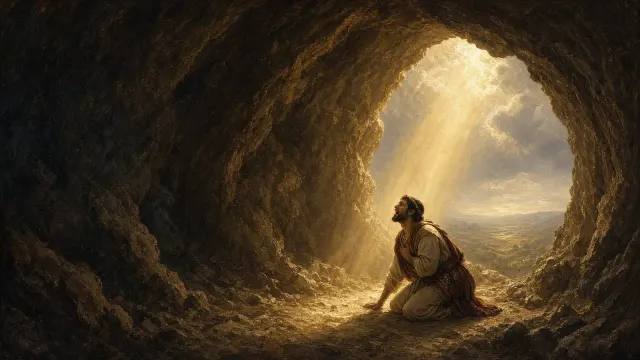
Psalm 142 gives distress a voice before it gives it an exit. The heading associates the prayer with David in a cave, but the poem itself concentrates on what it feels like when the path contains hidden traps and the expected human refuge is empty. The speaker's spirit is overwhelmed, yet God still knows the path that has become dangerous to him. Looking to the right hand reveals no defender and no one willing to acknowledge his need. Against that absence, God is named as refuge and portion in the land of the living. The final request imagines release not as isolated survival, but as freedom to praise while the righteous gather around. The social emptiness of the opening is answered by a hoped for company at the end.
In this chapter
- The Known Path and the Empty Right Hand Psalms 142:1-4
The complaint is poured out aloud.
- From Nobody Beside Him to People Gathered Around Psalms 142:5-7
The word "refuge" returns with its object changed.

Scripture beside the summary
Psalms · King James Version · 7Psalms 142:1-4
The Known Path and the Empty Right Hand
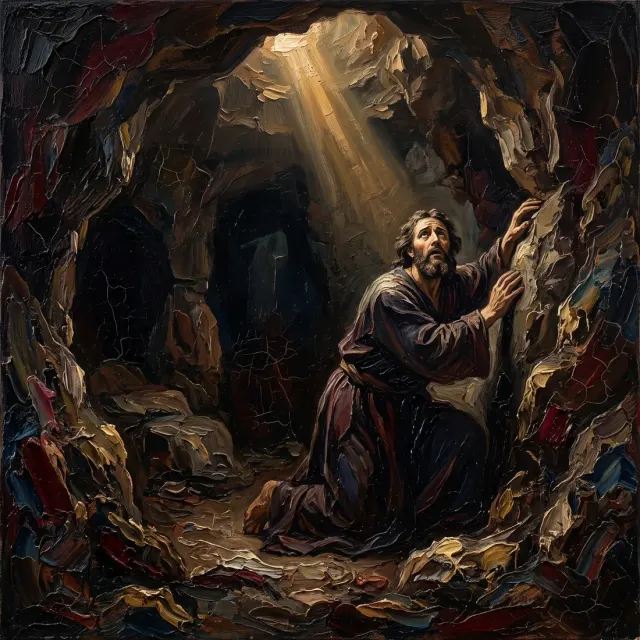
The complaint is poured out aloud. Psalm 142 repeats the speaker's voice because the distress has not reduced him to silence, even though his spirit is overwhelmed. The cave named in the heading supplies a setting of confinement without identifying a particular cave or requiring another episode to explain the prayer. Inside the poem, the more important geography is the path. God knows it while enemies secretly place a snare in it. That contrast makes divine knowledge concrete: the danger can be concealed from the traveler without being concealed from God. Then the speaker looks to his right, the place where a defender might be expected, and finds nobody who will acknowledge him. Refuge has failed at the human level. The section therefore holds two facts together, an unseen trap and an empty side, while insisting that the threatened path is still fully known by the one being addressed.
Deep dive
The repeated references to the voice make this an audible complaint, not a composed description from a safe distance. The heading associates the prayer with David in a cave, but does not name the cave. Neither Adullam nor the encounter with Saul needs to be inserted to make the words intelligible. The emphasis falls on distress brought before God in the very condition that might seem to interrupt speech.
When the spirit is overwhelmed, the path remains known to God. That knowledge stands opposite the absence of anyone at the right hand who acknowledges or cares for the speaker. The contrast is not between a difficult road and an easier road discovered by superior judgment. It is between being seen by God and finding no available human refuge. The concealed snare makes the lack of a defender especially consequential: the danger is not all out in the open.
Words to trace: LORD, voice, beheld, cared, complaint, cried
Verse-by-verse path
- Psalms 142:1
The heading places it “when he was in the cave”, either Adullam (1 Samuel 22:1) or En-gedi (1 Samuel 24:3). “With my voice” is said twice: the prayer is aloud, not silent. The second verb, “make my supplication”, is from chanan, to plead for favour.
- Psalms 142:2
“My complaint” is sichi, the musing or troubled talk that Psalm 119 calls meditation. Hannah said she had “poured out my soul before the LORD” (1 Samuel 1:15). “Shewed” is aggid, to tell or report: he lays out the whole case before God.
- Psalms 142:3
“Overwhelmed” is hitatteph, to grow faint or be wrapped round, the verb of Psalm 143:4 and 77:3. The Hebrew makes “thou” emphatic: then thou, thou knewest my path. The snare is laid “privily”, in secret, on the very road he is taking.
- Psalms 142:4
The right hand was where a defender stood in court (Psalm 109:31). “Know me” is makkir, to acknowledge or recognise, as Ruth asks why Boaz should “take knowledge of me” (Ruth 2:10). “Refuge” is manos, a place to flee to, and it has perished.
Psalms 142:1-4
King James Version1I cried unto the LORD with my voice; with my voice unto the LORD did I make my supplication.
2I poured out my complaint before him; I shewed before him my trouble.
3When my spirit was overwhelmed within me, then thou knewest my path. In the way wherein I walked have they privily laid a snare for me.
4I looked on my right hand, and beheld, but there was no man that would know me: refuge failed me; no man cared for my soul.
Psalms 142:5-7
From Nobody Beside Him to People Gathered Around
The word "refuge" returns with its object changed. Human refuge had failed, but now the speaker says directly to the Lord, "Thou art my refuge." Calling God his portion "in the land of the living" keeps the desired outcome on the side of preserved life. The persecutors are stronger, and Psalm 142 does not disguise that imbalance by pretending the speaker has enough strength of his own. The request for release from prison can fit literal confinement or the enclosing pressure of danger, and the poem does not force a choice between those possibilities. What it does specify is the purpose of freedom: praise. The last image then reverses the loneliness of the earlier right hand. Instead of nobody caring for his life, the righteous are expected to gather around him because of God's generous dealing. Deliverance changes the social picture as well as the physical one.
Deep dive
The title "my refuge" directly answers the earlier report that refuge had failed. The same passage calls God the speaker's portion in the land of the living, locating the hope in preserved life rather than treating death as the requested solution. The admission that the persecutors are stronger does not weaken the prayer's logic. It explains why deliverance must come from beyond the speaker's own capacity.
The request to bring his soul out of prison may describe literal confinement or the enclosing pressure of danger; the poem does not settle the physical circumstances. Its intended outcome is clear: freedom to give thanks. The righteous gathering around him reverses the empty social space of verse 4. The final picture is therefore more than solitary survival. The man for whom nobody seemed to care anticipates a company drawn around the evidence of God's generous dealing.
Words to trace: Attend, bountifully, compass, cried, deal, deliver
Verse-by-verse path
- Psalms 142:5
Two words answer the loss of verse 4. “Refuge” is now machseh, shelter, in place of the manos that failed. “Portion” is chelek, the share of land the Levites never received (Psalm 119:57). “The land of the living” is the phrase of Psalm 116:9 and 27:13.
- Psalms 142:6
“Brought very low” is dalloti me’od, the “brought low” of Psalm 116:6 made stronger. “They are stronger than I” is ki amtsu mimmeni, word for word the line of Psalm 18:17, spoken there of enemies from whom God rescued him.
- Psalms 142:7
The cave has become a prison, masger, a place of confinement; Isaiah 42:7 promises “to bring out the prisoners from the prison”. “Compass me about” is yakhtiru, to surround as a crown surrounds a head, from keter, crown. “Deal bountifully” is gamal, as in Psalm 116:7.
Psalms 142:5-7
King James Version5I cried unto thee, O LORD: I said, Thou art my refuge and my portion in the land of the living.
6Attend unto my cry; for I am brought very low: deliver me from my persecutors; for they are stronger than I.
7Bring my soul out of prison, that I may praise thy name: the righteous shall compass me about; for thou shalt deal bountifully with me.
Questions to keep in mind while reading
- Follow the speaker, images, parallel lines, questions, and emotional movement.
- Notice where tension or suffering resists an easy answer.
- Read a saying as wisdom for faithful discernment, not as a mechanical promise detached from context.
Text first
Where readers differ
The chapter summary begins with what the passage says and how its parts fit together. It does not assume one denomination has already settled every question. Where a conclusion depends on a tradition, literary theory, or historical reconstruction, that dependence is named openly.
The KJV text is presented first. Interpretive conclusions are labeled, and differences are introduced only when they help a reader understand why serious communities do not always reach the same answer.
Comparative interpretive notes for this chapter are in preparation. Until reviewed notes are ready, this page separates the KJV text from summary and application without claiming that serious readers agree on every question.
Questions beneath the surface
- What account of God, human freedom, responsibility, and the good life emerges from Psalms 142?
- Which tension does the chapter refuse to resolve quickly?
- What changes when the chapter is read as part of the whole canon rather than as an isolated moral lesson?
- Where might a sincere reader confuse a familiar tradition with something the text states directly?
Questions for serious personal contemplation
These open-ended questions make room for tension, honest response, prayer, and conclusions that remain accountable to the chapter.
Observe without rushing
What part of Psalms 142 makes you stop, feel unsettled, or feel surprised, and why?
Which detail in the passage would be easiest to overlook? How does that detail change your understanding?
Where do you see tension between what happens and this focus: Psalms 142:1–7 completes a passage that was not covered by the original study-unit map. Its own wording and immediate context supply the focus.?
What important question does the passage leave open instead of resolving quickly?
Examine your inner life honestly
Which person, response, fear, or desire in the passage feels most like your own life right now?
What assumption about God, other people, or yourself does this text challenge?
Which part would you rather soften, avoid, or explain away too quickly? What might that reaction reveal?
If this Scripture could ask you one direct question, what do you think it would ask?
Respond with wisdom and courage
What do you need to remember, confess, grieve, thank God for, or trust after reading this passage?
How might another faithful person read this situation differently without ignoring the text?
What obedient response would be costly, uncomfortable, or slow, yet still faithful to Scripture?
What question will you carry into prayer this week, and which verses will you keep in front of you?
Music and video connected to the passage
Related media appears when its Scripture reference overlaps this study. Music and video can illuminate a theme while the biblical text remains the foundation.