
Places of the Bible

En-gedi

A spring in a desert, full of caves, where the man being hunted got close enough to cut cloth.

The name means spring of the kid, and it is exactly that: a freshwater source in the cliffs above the Dead Sea, in country the account calls the wilderness of En-gedi, among the rocks of the wild goats. It is where you hide if you are being pursued through the Judean desert, and David is there with six hundred men when Saul comes after him with three thousand chosen out of all Israel.

Where it appears1 Samuel 24

Scroll down to the account

The movements, in the order the text gives them.

The Account of En-gedi

  1. 01

    1 Samuel 24:1-3

    Saul went in to cover his feet

    The coincidence is stated without drama. Of all the caves on that hillside he chooses the one the men are sitting in the back of.

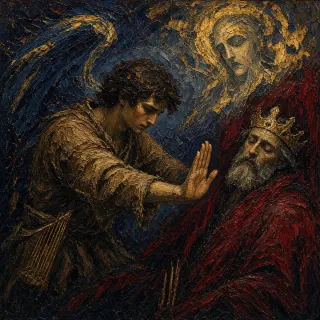
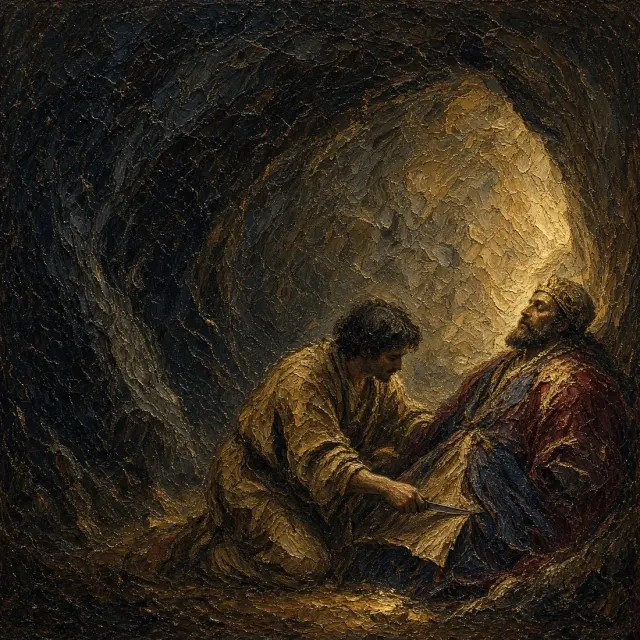
    Three thousand chosen men accompany a search that becomes intimate for an entirely unmilitary reason. Saul enters a cave to cover his feet, the discreet Hebrew expression for relieving himself. This is not a scene of the king sleeping under a convenient blanket. His search for a fugitive has intersected with an ordinary bodily need, and the place selected for privacy is already occupied.

    The reversal depends on positions, not a battle. David and his men are farther inside; Saul comes into the same space without the text reporting that he sees them. Those being hunted have the hunter within reach. A force drawn from all Israel has not made the king less human or the cave less capable of concealment.

    There is a larger reversal in the opening line too. The Philistine emergency in the previous chapter interrupted Saul's pursuit and allowed David to escape. Once that interruption is over, Saul returns to seeking David. National defense and the hunt for one man are not the same undertaking. The Book of First Samuel keeps the distinction visible even when the same king commands both.

    Verse by verse

    1. 24:1

      The return follows the Philistine invasion reported in 23:27-28. Saul's pursuit had been interrupted, not abandoned.

    2. 24:2

      Chosen men describes a selected force. The verse does not give the number of David's men actually occupying this cave.

    3. 24:3

      Brown-Driver-Briggs identifies covering the feet as a euphemism for relieving oneself. The same expression appears in Judges 3:24, where Eglon's servants assume he wants privacy.
    1 Samuel 24:1-3

    King James Version · 3 verses

    24:1And it came to pass, when Saul was returned from following the Philistines, that it was told him, saying, Behold, David is in the wilderness of En-gedi.

    24:2Then Saul took three thousand chosen men out of all Israel, and went to seek David and his men upon the rocks of the wild goats.

    24:3And he came to the sheepcotes by the way, where was a cave; and Saul went in to cover his feet: and David and his men remained in the sides of the cave.

    1 Samuel 24:1-3: Saul went in to cover his feet
  2. 02

    1 Samuel 24:4-6

    His heart smote him

    His men read it as providence and he reads it as a boundary. The regret is over a piece of fabric, which tells you where the line was.

    David's men have supplied the occasion with an interpretation before David has supplied it with an action. This is the day, they say; this is the enemy; this is what the LORD meant. Their words turn access into authorization. The chapter records their claim, but it has not quoted an earlier divine command telling David to kill Saul in a cave. That distinction is small enough to miss and large enough to govern the scene.

    Then comes the remarkable restraint of the report: David's heart smites him over cloth. Not after killing Saul, not after wounding him. After cutting the robe. The sequence matters because it prevents the moment from becoming a neat portrait of a man whose judgment was flawless from the first movement. He acts, is struck by what he has done, and draws the boundary before his men.

    His reason is specific. Saul is still my master and the LORD'S anointed. David does not deny the persecution or pronounce the king innocent. He refuses to make possession of an opportunity equivalent to permission to take the anointed man's life. The hand can reach him. That does not settle what the hand may do.

    Verse by verse

    1. 24:4

      The promise is reported in the speech of David's men. The book has not previously recorded that exact authorization concerning Saul.

    2. 24:5

      Afterward fixes the order: the cutting precedes the pang of conscience. The text explicitly connects the distress with the cut garment.

    3. 24:6

      The repeated description of Saul as the LORD'S anointed gives David's stated reason for restraint. It is not an assertion that Saul's conduct is righteous.

    1 Samuel 24:4-6

    King James Version · 3 verses

    24:4And the men of David said unto him, Behold the day of which the LORD said unto thee, Behold, I will deliver thine enemy into thine hand, that thou mayest do to him as it shall seem good unto thee. Then David arose, and cut off the skirt of Saul’s robe privily.

    24:5And it came to pass afterward, that David’s heart smote him, because he had cut off Saul’s skirt.

    24:6And he said unto his men, The LORD forbid that I should do this thing unto my master, the LORD’s anointed, to stretch forth mine hand against him, seeing he is the anointed of the LORD.

    1 Samuel 24:4-6: His heart smote him
  3. 03

    1 Samuel 24:8-11

    See the skirt of thy robe in my hand

    He shouts the argument up a hillside to a man with three thousand soldiers, and the evidence he holds up is the proof of his restraint.

    The piece of robe proves something words alone could not prove: David had been close enough. His defense is not that killing Saul would have been impossible, but that it was possible and he did not do it. The fabric measures an unused opportunity. He holds the evidence in the very hand accused of intending harm.

    His posture and his argument pull in different directions without contradicting each other. He bows to the ground and calls Saul king, then states the injustice plainly. Respect has not made him mute. Nor does my father turn the danger into a harmless family misunderstanding. The same sentence ends with Saul hunting David's life. The address is tender; the charge is exact.

    David also refuses his men's conclusion without denying that the LORD delivered Saul within reach. That is a finer distinction than pretending nothing providential happened. The encounter was given; the killing was refused. His claim concerns what his hand has done toward Saul, not a proclamation of sinlessness across his entire life. This defense is as concrete as the object he displays: a cut robe and a living king.

    Verse by verse

    1. 24:8

      David emerges after Saul has left the cave. His bow is an act of deference, not an admission that the charge against him is true.

    2. 24:10

      David accepts that Saul was delivered into his hand but rejects killing as the proper response. Opportunity and authorization remain distinct in his own account.

    3. 24:11

      The repeated appeal to seeing attaches the argument to physical evidence. Hunting my soul means seeking David's life, not pursuing something separable from his body.

    1 Samuel 24:8-11

    King James Version · 4 verses

    24:8David also arose afterward, and went out of the cave, and cried after Saul, saying, My lord the king. And when Saul looked behind him, David stooped with his face to the earth, and bowed himself.

    24:9And David said to Saul, Wherefore hearest thou men’s words, saying, Behold, David seeketh thy hurt?

    24:10Behold, this day thine eyes have seen how that the LORD had delivered thee to day into mine hand in the cave: and some bade me kill thee: but mine eye spared thee; and I said, I will not put forth mine hand against my lord; for he is the LORD’s anointed.

    24:11Moreover, my father, see, yea, see the skirt of thy robe in my hand: for in that I cut off the skirt of thy robe, and killed thee not, know thou and see that there is neither evil nor transgression in mine hand, and I have not sinned against thee; yet thou huntest my soul to take it.

  4. 04

    1 Samuel 24:16-19

    Thou art more righteous than I

    Saul weeps and concedes the whole case, including the throne, and then goes home. The next chapter starts the pursuit again anyway.

    Saul's answer restores the word son to a conversation that has already used father. For a moment, the language of relationship can be heard over the language of pursuit. The king weeps, and the Book of First Samuel lets the tears stand without an invented explanation of what lies behind every one of them.

    His admission is unusually direct. David has done him good; he has done David evil. There is no appeal in that sentence to his servants, his circumstances, or a misunderstanding that makes both men equally responsible. More righteous than I is a comparison with an explanation attached, and the explanation is a spared life. David's argument has reached the man whose torn robe supports it.

    Saul also asks the LORD to reward the good he himself has received. That blessing is real speech in the passage, not something to dismiss merely because Saul remains a complicated man. But neither tears nor acknowledgment should be made to say more than the account says. He recognizes the wrong. The chapter does not call the danger permanently finished.

    Verse by verse

    1. 24:16

      My son David answers David's my father in 24:11. The exchange acknowledges a relationship that the pursuit has violated.

    2. 24:17

      More righteous is comparative, not a claim that David has never sinned. Saul immediately defines the contrast as good returned for evil.

    3. 24:18-19

      Saul acknowledges that the LORD delivered him into David's hand and that David did not kill him. His later renewed pursuit in 26:1-2 prevents this acknowledgment from proving lasting peace.

    1 Samuel 24:16-19

    King James Version · 4 verses

    24:16And it came to pass, when David had made an end of speaking these words unto Saul, that Saul said, Is this thy voice, my son David? And Saul lifted up his voice, and wept.

    24:17And he said to David, Thou art more righteous than I: for thou hast rewarded me good, whereas I have rewarded thee evil.

    24:18And thou hast shewed this day how that thou hast dealt well with me: forasmuch as when the LORD had delivered me into thine hand, thou killedst me not.

    24:19For if a man find his enemy, will he let him go well away? wherefore the LORD reward thee good for that thou hast done unto me this day.

Why it matters

Then the chapter hands David everything. Saul goes into a cave to relieve himself, the same cave, in the dark, alone, and David’s men tell him this is the day. He cuts off the skirt of Saul’s robe instead, and the account says his heart smote him even for that. What follows is the strangest scene in the book: he comes out afterwards and shouts up the hill, holding the cloth as evidence that he could have done it and did not, and Saul lifts up his voice and weeps and calls him more righteous than I.

2 songs

The music

Every song in the catalogue whose passage falls inside these chapters.

  1. 1 Samuel 23:1-24:22

    I Will Not Stretch Forth My Hand

  2. 1 Samuel 24; 26

    I Will Not Touch the Lord's Anointed

Nearby

All the places

Report an error on this page