The big picture
Psalm 57 places a frightened person under wings without pretending that the lions have disappeared. The speaker asks for mercy and refuge “until these calamities be overpast,” while enemies around him still possess teeth like spears and tongues like swords. Divine height is not distance from need: the God “most high” is expected to send mercy and truth from heaven into the danger. A prepared net and pit then recoil upon those who made them, while the speaker’s bowed soul gives way to a heart described twice as fixed. Instruments are called awake, and praise becomes as deliberate as the enemy’s trap had been. The song then grows beyond the immediate refuge, reaching toward peoples and nations while mercy and truth are pictured reaching to the heavens. The repeated appeal for God’s glory frames the whole psalm, joining intimate shelter beneath the wings with exaltation above the earth.
In this chapter
- Shelter Does Not Deny the Lions Psalms 57:1-5
The opening refuge is tender, but the danger around it is not.
- The Trap and the Fixed Heart Psalms 57:6-8
The enemies prepare a net and dig a pit, images of harm planned in advance rather than improvised in anger.
- The Song Grows Larger Than the Refuge Psalms 57:9-11
The singer who began under wings now imagines praise among “the people” and “the nations.” The setting expands far beyond the place of refuge without requiring an itinerary through every country named by the language.


Scripture beside the summary
Psalms · King James Version · 11Psalms 57:1-5
Shelter Does Not Deny the Lions
The opening refuge is tender, but the danger around it is not. The speaker trusts “in the shadow of thy wings” until calamities pass, then immediately describes people with teeth like spears and arrows and a tongue like a sharp sword. Psalm 57 refuses to let the image of wings become sentimental insulation from the threat. The shelter is claimed while the lions are still present. God is also called “most high,” yet that height does not create distance from need. The one above the enemies can send mercy and truth from heaven into the speaker’s situation. Those qualities identify the character of the help being expected. The section then rises beyond personal rescue into the refrain, “Be thou exalted, O God, above the heavens.” Safety matters, but the desired outcome is larger than one person getting out alive. Divine glory is asked to become visible across all the earth.

Deep dive
The repeated request for mercy is followed by the image of shelter beneath wings. The refuge is temporary in relation to the danger, lasting until the calamities pass, but it rests on a continuing relationship of trust. The speaker does not have to pretend the storm is over in order to enter the image of protection.
God is then named as most high, and help is expected from heaven. Height does not mean indifference. The one beyond the reach of the enemies can send mercy and truth into their midst. Those two qualities are more than comforting descriptions; they identify the character of the intervention being requested.
The lions and the people whose teeth and tongues are weapons bring the threat sharply back into view. The prayer does not remain inside a soft image of feathers. Refuge is claimed while the surrounding language is still full of appetite and blades. The appeal for God's exaltation above the heavens therefore enlarges the desired outcome. The speaker's safety matters, but the poem also asks that God's glory become visible across the earth.
Words to trace: merciful, send, soul, arrows, calamities, earth
Verse-by-verse path
- Psalms 57:1
The heading’s “Altaschith” means “Destroy not”, probably a tune name; the words are Moses’ plea for Israel in Deuteronomy 9:26 and David’s order about Saul in 1 Samuel 26:9. The cave may be Adullam (1 Samuel 22:1) or the cave at En-gedi where Saul came in unaware (1 Samuel 24:3).
- Psalms 57:2
“God most high” is Elohim Elyon. “That performeth all things for me” is literally “who completes for me”, gamar, the verb of Psalm 138:8, “The LORD will perfect that which concerneth me”: God finishes what he has begun on the speaker’s behalf.
- Psalms 57:3
“Him that would swallow me up” is the snapping, panting verb of 56:1–2. The Selah falls in mid-verse, as in 55:19. Mercy and truth are sent out like the light and truth of 43:3, two messengers dispatched from heaven.
- Psalms 57:4
“I lie” is the verb for lying down to sleep: the speaker proposes to bed down in the lions’ den, as Psalm 4:8 says, “I will both lay me down in peace, and sleep.” “Set on fire” may mean those who are ablaze with rage, or those who devour like flame.
- Psalms 57:5
The refrain divides the psalm into two halves, each ending with these words. “Exalted” is a verb of rising high. Isaiah heard the seraphim sing the second half’s claim as a fact: “the whole earth is full of his glory” (Isaiah 6:3).
Psalms 57:1-5
King James Version1Be merciful unto me, O God, be merciful unto me: for my soul trusteth in thee: yea, in the shadow of thy wings will I make my refuge, until these calamities be overpast.
2I will cry unto God most high; unto God that performeth all things for me.
3He shall send from heaven, and save me from the reproach of him that would swallow me up. Selah. God shall send forth his mercy and his truth.
4My soul is among lions: and I lie even among them that are set on fire, even the sons of men, whose teeth are spears and arrows, and their tongue a sharp sword.
5Be thou exalted, O God, above the heavens; let thy glory be above all the earth.
Psalms 57:6-8
The Trap and the Fixed Heart
The enemies prepare a net and dig a pit, images of harm planned in advance rather than improvised in anger. The speaker’s soul is bowed down under that pressure before the reversal is announced: the plotters fall into the very excavation they made. Then the language of preparation changes hands. “My heart is fixed” is repeated, and the speaker begins preparing praise. The fixed heart is not a claim that distress never touched him. He has already cried for mercy and described a bowed soul. It names a settled direction within that distress, expressed by the decision to sing. Even the instruments are summoned to wake, and the speaker says he himself will “awake early.” The contrast is elegant without being decorative. His enemies deliberately prepared a trap; he deliberately prepares music. Psalm 57 lets two forms of intention face each other, one designed to destroy a life and the other to turn that preserved life toward praise.

Deep dive
The net and pit describe an attack prepared in advance. The speaker's soul is bowed down before the reversal is announced, so the imagery does not make him untouched by the plot. The enemies' fall into their own excavation answers their attempt to control the ground beneath his feet.
The next repetition concerns the heart: it is fixed. That settledness is not simply the opposite of having emotions. The same person has cried for mercy and described a bowed soul. The repeated phrase marks a chosen and sustained orientation expressed through singing. The prayer's inward center is no longer described only in terms of what the enemies have done to it.
The calls to awaken gather the speaker's glory and his instruments into the response. The KJV presents an early awakening, making praise something intentionally begun rather than something that happens only when a favorable mood arrives. The poem moves from an enemy preparing a trap to a singer preparing music. Both preparations are deliberate, but they serve opposite purposes.
Words to trace: awake, fixed, heart, bowed, digged, early
Verse-by-verse path
- Psalms 57:6
“They have prepared” and “my heart is fixed” in the next verse come from the same Hebrew root, kun: they make ready a net, and he makes ready his heart. “Are fallen” is a completed tense, as though the trap has already sprung on its makers.
- Psalms 57:7
Psalm 108 begins with this verse and builds its first half from verses 7 to 11. Psalm 112:7 uses the same phrase of the righteous man who is not afraid of evil tidings: “his heart is fixed, trusting in the LORD.”
- Psalms 57:8
“My glory” may point to the inner self; some read the same consonants as kaved, liver, which Hebrew poetry could use for the seat of feeling. “I myself will awake early” is literally “I will wake the dawn”: the singer will rouse the morning instead of waiting for it to rouse him.
Psalms 57:6-8
King James Version6They have prepared a net for my steps; my soul is bowed down: they have digged a pit before me, into the midst whereof they are fallen themselves. Selah.
7My heart is fixed, O God, my heart is fixed: I will sing and give praise.
8Awake up, my glory; awake, psaltery and harp: I myself will awake early.
Psalms 57:9-11
The Song Grows Larger Than the Refuge
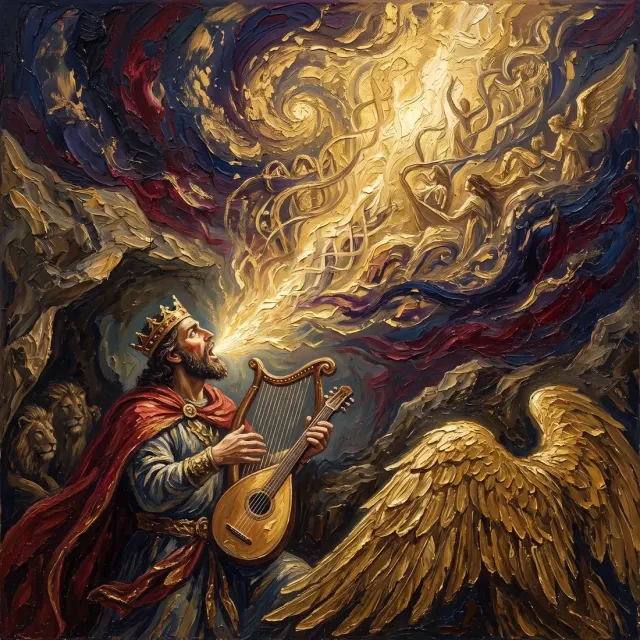
The singer who began under wings now imagines praise among “the people” and “the nations.” The setting expands far beyond the place of refuge without requiring an itinerary through every country named by the language. The point is reach. Deliverance appropriate to a God this great deserves a song that does not stay private. Mercy and truth, which were earlier expected to be sent down from heaven, are now pictured as reaching up “unto the heavens” and clouds. The directions meet: what belongs to God’s exalted character descends into the speaker’s need, and what the speaker has received rises into public praise. The final refrain repeats exactly the appeal heard while danger was still in view. Its words have not changed, but their setting has moved from lions and calamity to awakened thanksgiving. The refuge beneath the wings and the glory above the heavens belong to one continuous picture of God.
Deep dive
The setting of praise expands dramatically. The speaker who sought shelter now imagines giving thanks among peoples and nations. The change is not a report that he has already traveled to each of them. It expresses the public reach appropriate to the deliverance and to the God being praised.
Mercy and truth, earlier sent from heaven, are now described as reaching to the heavens and clouds. The upward and downward movements belong together. God's character is both beyond the enemies' scale and actively involved in the speaker's need. The prayer refuses to choose between divine greatness and particular care.
The final refrain repeats the appeal made while the lions were still in view. Its words are unchanged, but its setting has shifted from danger to awakened thanksgiving. Psalm 108:1–5 will reuse this closing material in another arrangement, preserving its movement into public praise. Within Psalm 57, the repetition closes a circle: the refuge beneath the wings and the glory above the heavens belong to the same God.
Words to trace: heavens, clouds, earth, exalted, glory, Lord
Verse-by-verse path
- Psalms 57:9
The vow is made, if the heading is followed, from a cave by a man in hiding, and it promises the widest audience there is: peoples and nations. “O Lord” is Adonai, master. Psalm 108:3 repeats the line word for word.
- Psalms 57:10
Where this line has “great unto the heavens”, the version in Psalm 108:4 has “great above the heavens”, a change of one preposition that pushes the mercy past the sky. The clouds are the shechaqim, the thin high skies of 36:5.
- Psalms 57:11
The refrain of verse 5 returns unchanged, closing both halves on the same words. In Psalm 108 this line is followed by verses taken from Psalm 60, joining a cave prayer to a war oracle.
Psalms 57:9-11
King James Version9I will praise thee, O Lord, among the people: I will sing unto thee among the nations.
10For thy mercy is great unto the heavens, and thy truth unto the clouds.
11Be thou exalted, O God, above the heavens: let thy glory be above all the earth.
Questions to keep in mind while reading
- Follow the speaker, images, parallel lines, questions, and emotional movement.
- Notice where tension or suffering resists an easy answer.
- Read a saying as wisdom for faithful discernment, not as a mechanical promise detached from context.
Text first
Where readers differ
The chapter summary begins with what the passage says and how its parts fit together. It does not assume one denomination has already settled every question. Where a conclusion depends on a tradition, literary theory, or historical reconstruction, that dependence is named openly.
The KJV text is presented first. Interpretive conclusions are labeled, and differences are introduced only when they help a reader understand why serious communities do not always reach the same answer.
Comparative interpretive notes for this chapter are in preparation. Until reviewed notes are ready, this page separates the KJV text from summary and application without claiming that serious readers agree on every question.
Questions beneath the surface
- What account of God, human freedom, responsibility, and the good life emerges from Psalms 57?
- Which tension does the chapter refuse to resolve quickly?
- What changes when the chapter is read as part of the whole canon rather than as an isolated moral lesson?
- Where might a sincere reader confuse a familiar tradition with something the text states directly?
Questions for serious personal contemplation
These open-ended questions make room for tension, honest response, prayer, and conclusions that remain accountable to the chapter.
Observe without rushing
What part of Psalms 57 makes you stop, feel unsettled, or feel surprised, and why?
Which detail in the passage would be easiest to overlook? How does that detail change your understanding?
Where do you see tension between what happens and this focus: Psalms 57 develops its own movement around awake, glory, heavens, soul, earth?
What important question does the passage leave open instead of resolving quickly?
Examine your inner life honestly
Which person, response, fear, or desire in the passage feels most like your own life right now?
What assumption about God, other people, or yourself does this text challenge?
Which part would you rather soften, avoid, or explain away too quickly? What might that reaction reveal?
If this Scripture could ask you one direct question, what do you think it would ask?
Respond with wisdom and courage
What do you need to remember, confess, grieve, thank God for, or trust after reading this passage?
How might another faithful person read this situation differently without ignoring the text?
What obedient response would be costly, uncomfortable, or slow, yet still faithful to Scripture?
What question will you carry into prayer this week, and which verses will you keep in front of you?
Music and video connected to the passage
Related media appears when its Scripture reference overlaps this study. Music and video can illuminate a theme while the biblical text remains the foundation.