New · FreePlay The Witnesses The in-depth puzzle battle quest through Bible history

People of the Bible

Isaiah

Saw the throne, said he was a man of unclean lips, and volunteered before he was asked.

Isaiah prophesies in Jerusalem through four reigns, from Uzziah to Hezekiah, and his book is the longest sustained argument in the Old Testament. He is a court prophet with access to kings, and he is the one who stands with Hezekiah against Assyria and tells him the city will not be entered. His call is in chapter six rather than chapter one, which puts the vision after the indictment. Asked whom shall I send, he answers here am I, send me, and is then told that the people will hear and not understand.

Where he appearsIsaiah 1 to 66 · 2 Kings 19 to 20

Scroll down to the account
Isaiah

The movements, in the order the text gives them.

The Account of Isaiah

  1. 01

    Isaiah 6:1-8

    Here am I, send me

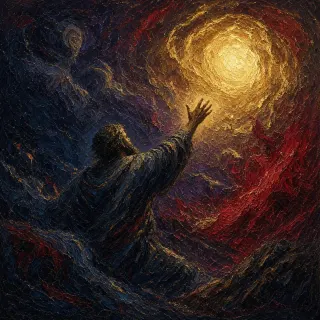
    In the year that king Uzziah died he sees the throne and the train filling the temple. His first words are woe is me, and the coal touches his lips before the question is asked.

    A king has died, but the throne Isaiah sees is occupied. That contrast is built into the opening sentence: Uzziah belongs to the date, while the Lord fills the vision. Even the robe's train fills the temple; the glory fills the whole earth. The scale refuses to stay inside the building.

    The mouth is the unexpected centre of this encounter. The seraphim proclaim holiness, Isaiah confesses unclean lips, and the coal touches precisely those lips before he offers to speak. The Book of Isaiah has just pronounced a succession of woes against others in chapter 5. Here the prophet's own name, so to speak, reaches the list. He does not stand outside the people whose speech he condemns. Nor does the answer tell him that the impurity was imaginary: the announcement is that it has been removed.

    Here am I; send me comes after cleansing and before the terms of the commission. Those terms, in verses 9-13, include unhearing ears and devastated cities. This is not the appointment of a naturally impressive speaker to an appreciative audience. The mouth that could not survive its own confession is made ready to carry God's words.

    Verse by verse

    1. 6:1

      The death of Uzziah dates the vision; the passage does not describe Isaiah witnessing the king die.

    2. 6:2

      Seraphim is connected with the Hebrew root for burning. The passage specifies six wings, but does not supply every detail of their appearance.

    3. 6:7

      The coal comes from the altar, and the accompanying declaration identifies its significance as removal of guilt and purification of sin.

    4. 6:8

      Isaiah responds to the Lord's question before hearing the difficult commission in 6:9-13. Acts 28:25-27 later quotes that commission.

    Isaiah 6:1-8

    King James Version · 8 verses

    6:1In the year that king Uzziah died I saw also the Lord sitting upon a throne, high and lifted up, and his train filled the temple.

    6:2Above it stood the seraphims: each one had six wings; with twain he covered his face, and with twain he covered his feet, and with twain he did fly.

    6:3And one cried unto another, and said, Holy, holy, holy, is the LORD of hosts: the whole earth is full of his glory.

    6:4And the posts of the door moved at the voice of him that cried, and the house was filled with smoke.

    6:5Then said I, Woe is me! for I am undone; because I am a man of unclean lips, and I dwell in the midst of a people of unclean lips: for mine eyes have seen the King, the LORD of hosts.

    6:6Then flew one of the seraphims unto me, having a live coal in his hand, which he had taken with the tongs from off the altar:

    6:7And he laid it upon my mouth, and said, Lo, this hath touched thy lips; and thine iniquity is taken away, and thy sin purged.

    6:8Also I heard the voice of the Lord, saying, Whom shall I send, and who will go for us? Then said I, Here am I; send me.

    Isaiah 6:1-8: Here am I, send me
  2. 02

    Isaiah 5:1-7

    The song of the vineyard

    He sings a love song about a friend’s vineyard that was dug, cleared, planted and watched, and yielded wild grapes. The last line names the vineyard as the house of Israel.

    The love song turns into a court hearing before the audience has quite settled into it. Jerusalem and Judah are invited to judge between the owner and his vineyard. The evidence is uncomfortably thorough: stones removed, a choice vine, a tower, a winepress. Nothing about the crop can be blamed on an owner who could not be bothered. The winepress was ready for a harvest worth pressing.

    Then the owner announces that he will command the clouds. That is rather more authority than the average vineyard keeper possesses. His identity is becoming clear before verse 7 names it, and the people invited to judge turn out to be the vineyard under judgment. The loss of hedge and wall is the withdrawal of protection, not an admission that the planting was a mistake.

    The last line delivers the real harvest. In Hebrew, mishpat, justice, gives way to mispach, bloodshed or oppression; tsedaqah, righteousness, gives way to tseaqah, a cry. The sounds nearly match. The realities do not. The song has not been complaining about agricultural disappointment after all. Its final sound is somebody being hurt.

    Verse by verse

    1. 5:2

      The Hebrew beushim, translated wild grapes, denotes worthless or stinking fruit. The contrast concerns the quality of the harvest, not merely the existence of uncultivated vines.

    2. 5:3

      The appeal asks Judah and Jerusalem to judge before verse 7 identifies them within the vineyard image.

    3. 5:6

      The command to the clouds discloses a divine owner before the explicit explanation in verse 7.

    4. 5:7

      Mishpat/mispach and tsedaqah/tseaqah are pairs of similar-sounding Hebrew words with sharply different meanings. The KJV preserves the contrast in sense rather than reproducing the sound.

    Isaiah 5:1-7

    King James Version · 7 verses

    5:1Now will I sing to my wellbeloved a song of my beloved touching his vineyard. My wellbeloved hath a vineyard in a very fruitful hill:

    5:2And he fenced it, and gathered out the stones thereof, and planted it with the choicest vine, and built a tower in the midst of it, and also made a winepress therein: and he looked that it should bring forth grapes, and it brought forth wild grapes.

    5:3And now, O inhabitants of Jerusalem, and men of Judah, judge, I pray you, betwixt me and my vineyard.

    5:4What could have been done more to my vineyard, that I have not done in it? wherefore, when I looked that it should bring forth grapes, brought it forth wild grapes?

    5:5And now go to; I will tell you what I will do to my vineyard: I will take away the hedge thereof, and it shall be eaten up; and break down the wall thereof, and it shall be trodden down:

    5:6And I will lay it waste: it shall not be pruned, nor digged; but there shall come up briers and thorns: I will also command the clouds that they rain no rain upon it.

    5:7For the vineyard of the LORD of hosts is the house of Israel, and the men of Judah his pleasant plant: and he looked for judgment, but behold oppression; for righteousness, but behold a cry.

    Isaiah 5:1-7: The song of the vineyard
  3. 03

    Isaiah 9:1-7

    The government upon his shoulder

    To a people walking in darkness, a child is born and a son is given, and the titles run in a line: Wonderful, Counsellor, the mighty God, the everlasting Father, the Prince of Peace.

    There are two shoulders in this passage, and the difference between them carries its weight. In verse 4 the shoulder bears the oppressor's staff; in verse 6 the child's shoulder bears the government. The Hebrew uses the same word, shekhem. Authority is not simply replaced by a more impressive display of authority. The burden on the people is broken, and responsibility rests on the promised ruler.

    The light first reaches named places, Zebulun and Naphtali, not an unspecified landscape of spiritual darkness. The comparison with Midian recalls the victory in the Book of Judges 7, where deliverance was not explained by the size of Israel's army. Then bloodstained garments meet fire. Peace is announced against the concrete wreckage of war.

    The child's titles are correspondingly immense. The mighty God is no ordinary compliment, and the same expression occurs of God in Isaiah 10:21. Yet the last sentence does not credit the ingenuity of David's dynasty with making the promise happen. The zeal of the LORD of hosts will perform this. The throne bears David's name; the future does not depend on David's descendants manufacturing it.

    Verse by verse

    1. 9:3

      The KJV's not increased the joy follows the written Hebrew reading, lo, not. The traditional marginal reading has lo, for it, which explains the positive wording in many translations.

    2. 9:4

      The day of Midian points to Gideon's deliverance in Judges 7, not to a battle fought by the child in this passage.

    3. 9:6

      El gibbor is the Hebrew behind The mighty God; compare Isaiah 10:21. Discussion of the royal titles must reckon with their full force, not reduce them to decorative names.

    4. 9:7

      The assurance about the LORD's zeal recurs in Isaiah 37:32, where the survival of Jerusalem's remnant is at issue.

    Isaiah 9:1-7

    King James Version · 7 verses

    9:1Nevertheless the dimness shall not be such as was in her vexation, when at the first he lightly afflicted the land of Zebulun and the land of Naphtali, and afterward did more grievously afflict her by the way of the sea, beyond Jordan, in Galilee of the nations.

    9:2The people that walked in darkness have seen a great light: they that dwell in the land of the shadow of death, upon them hath the light shined.

    9:3Thou hast multiplied the nation, and not increased the joy: they joy before thee according to the joy in harvest, and as men rejoice when they divide the spoil.

    9:4For thou hast broken the yoke of his burden, and the staff of his shoulder, the rod of his oppressor, as in the day of Midian.

    9:5For every battle of the warrior is with confused noise, and garments rolled in blood; but this shall be with burning and fuel of fire.

    9:6For unto us a child is born, unto us a son is given: and the government shall be upon his shoulder: and his name shall be called Wonderful, Counsellor, The mighty God, The everlasting Father, The Prince of Peace.

    9:7Of the increase of his government and peace there shall be no end, upon the throne of David, and upon his kingdom, to order it, and to establish it with judgment and with justice from henceforth even for ever. The zeal of the LORD of hosts will perform this.

    Isaiah 9:1-7: The government upon his shoulder
  4. 04

    Isaiah 36:1-37:38

    The letter before the LORD

    Assyria at the wall and a speech in Hebrew meant for the people on it. Isaiah sends word not to be afraid of the words, and the answer is a taunt song and an empty camp by morning.

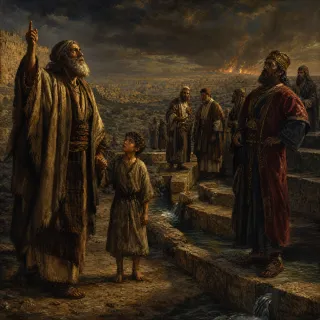
    Before an arrow enters Jerusalem, an argument is aimed at the wall. The officials request the Syrian language, which they understand; Rabshakeh deliberately speaks the people's language instead. His audience is the population that would endure a siege. The threat about eating dung and drinking urine is meant for them. So is the offer of vines, fig trees and cisterns. The pleasant inventory comes with an until: they can enjoy these things until they are removed to another country. A land like their own is still not their own land.

    The crucial contest is over who has spoken for God. Rabshakeh claims the LORD sent him, then places the LORD among national gods that Assyria has already defeated. Hezekiah's prayer does not deny the victories. Of a truth, he says: the destroyed countries and burned images are real. What he denies is the comparison between manufactured gods and the maker of heaven and earth. The letter is spread before the LORD as evidence of the insult, not treated as an object with mysterious power. Its words are heard by the one they dismiss.

    Isaiah's answer changes the direction of the gaze. The conqueror lists what he has cut down and dried up; God names the purpose he has unknowingly served and the movements already known to him. The nose receives a hook; the lips receive a bridle. Judah, meanwhile, is pictured taking root downward and bearing fruit upward. The ending makes the contrast mercilessly concrete: Jerusalem is defended, while Sennacherib dies in his own god's house. The text gives no interval between his return and his death. It does give the location.

    Verse by verse

    1. 36:10

      Rabshakeh's claim to have been sent by the LORD belongs to his speech; it is not an unqualified statement from Isaiah endorsing all his claims.

    2. 36:11

      The Syrian language is Aramaic; the Jews' language is the local language understood by the people on the wall. Refusing the requested switch broadens the intended audience.

    3. 37:18-19

      Hezekiah acknowledges the destruction of other countries rather than building his prayer on denial of Assyria's military record.

    4. 37:30-32

      The repeated language of remnant, roots and fruit describes continued life in Judah, not merely the removal of the immediate enemy.

    5. 37:36

      The passage attributes the deaths to the angel of the LORD. It does not name a disease or explain a medical mechanism.

    6. 37:38

      The account places Sennacherib's death after his return and residence at Nineveh, but does not say he was killed immediately upon arriving.

    Isaiah 36:1-37:38: The letter before the LORD

    Isaiah 36:1-37:38

    King James Version · 60 verses

    36:1Now it came to pass in the fourteenth year of king Hezekiah, that Sennacherib king of Assyria came up against all the defenced cities of Judah, and took them.

    36:2And the king of Assyria sent Rabshakeh from Lachish to Jerusalem unto king Hezekiah with a great army. And he stood by the conduit of the upper pool in the highway of the fuller’s field.

    36:3Then came forth unto him Eliakim, Hilkiah’s son, which was over the house, and Shebna the scribe, and Joah, Asaph’s son, the recorder.

    36:4And Rabshakeh said unto them, Say ye now to Hezekiah, Thus saith the great king, the king of Assyria, What confidence is this wherein thou trustest?

    36:5I say, sayest thou, (but they are but vain words) I have counsel and strength for war: now on whom dost thou trust, that thou rebellest against me?

    36:6Lo, thou trustest in the staff of this broken reed, on Egypt; whereon if a man lean, it will go into his hand, and pierce it: so is Pharaoh king of Egypt to all that trust in him.

    36:7But if thou say to me, We trust in the LORD our God: is it not he, whose high places and whose altars Hezekiah hath taken away, and said to Judah and to Jerusalem, Ye shall worship before this altar?

    36:8Now therefore give pledges, I pray thee, to my master the king of Assyria, and I will give thee two thousand horses, if thou be able on thy part to set riders upon them.

    36:9How then wilt thou turn away the face of one captain of the least of my master’s servants, and put thy trust on Egypt for chariots and for horsemen?

    36:10And am I now come up without the LORD against this land to destroy it? the LORD said unto me, Go up against this land, and destroy it.

    36:11Then said Eliakim and Shebna and Joah unto Rabshakeh, Speak, I pray thee, unto thy servants in the Syrian language; for we understand it: and speak not to us in the Jews’ language, in the ears of the people that are on the wall.

    36:12But Rabshakeh said, Hath my master sent me to thy master and to thee to speak these words? hath he not sent me to the men that sit upon the wall, that they may eat their own dung, and drink their own piss with you?

    36:13Then Rabshakeh stood, and cried with a loud voice in the Jews’ language, and said, Hear ye the words of the great king, the king of Assyria.

    36:14Thus saith the king, Let not Hezekiah deceive you: for he shall not be able to deliver you.

    36:15Neither let Hezekiah make you trust in the LORD, saying, The LORD will surely deliver us: this city shall not be delivered into the hand of the king of Assyria.

    36:16Hearken not to Hezekiah: for thus saith the king of Assyria, Make an agreement with me by a present, and come out to me: and eat ye every one of his vine, and every one of his fig tree, and drink ye every one the waters of his own cistern;

    36:17Until I come and take you away to a land like your own land, a land of corn and wine, a land of bread and vineyards.

    36:18Beware lest Hezekiah persuade you, saying, The LORD will deliver us. Hath any of the gods of the nations delivered his land out of the hand of the king of Assyria?

    36:19Where are the gods of Hamath and Arphad? where are the gods of Sepharvaim? and have they delivered Samaria out of my hand?

    36:20Who are they among all the gods of these lands, that have delivered their land out of my hand, that the LORD should deliver Jerusalem out of my hand?

    36:21But they held their peace, and answered him not a word: for the king’s commandment was, saying, Answer him not.

    36:22Then came Eliakim, the son of Hilkiah, that was over the household, and Shebna the scribe, and Joah, the son of Asaph, the recorder, to Hezekiah with their clothes rent, and told him the words of Rabshakeh.

    37:1And it came to pass, when king Hezekiah heard it, that he rent his clothes, and covered himself with sackcloth, and went into the house of the LORD.

    37:2And he sent Eliakim, who was over the household, and Shebna the scribe, and the elders of the priests covered with sackcloth, unto Isaiah the prophet the son of Amoz.

    37:3And they said unto him, Thus saith Hezekiah, This day is a day of trouble, and of rebuke, and of blasphemy: for the children are come to the birth, and there is not strength to bring forth.

    37:4It may be the LORD thy God will hear the words of Rabshakeh, whom the king of Assyria his master hath sent to reproach the living God, and will reprove the words which the LORD thy God hath heard: wherefore lift up thy prayer for the remnant that is left.

    37:5So the servants of king Hezekiah came to Isaiah.

    37:6And Isaiah said unto them, Thus shall ye say unto your master, Thus saith the LORD, Be not afraid of the words that thou hast heard, wherewith the servants of the king of Assyria have blasphemed me.

    37:7Behold, I will send a blast upon him, and he shall hear a rumour, and return to his own land; and I will cause him to fall by the sword in his own land.

    37:8So Rabshakeh returned, and found the king of Assyria warring against Libnah: for he had heard that he was departed from Lachish.

    37:9And he heard say concerning Tirhakah king of Ethiopia, He is come forth to make war with thee. And when he heard it, he sent messengers to Hezekiah, saying,

    37:10Thus shall ye speak to Hezekiah king of Judah, saying, Let not thy God, in whom thou trustest, deceive thee, saying, Jerusalem shall not be given into the hand of the king of Assyria.

    37:11Behold, thou hast heard what the kings of Assyria have done to all lands by destroying them utterly; and shalt thou be delivered?

    37:12Have the gods of the nations delivered them which my fathers have destroyed, as Gozan, and Haran, and Rezeph, and the children of Eden which were in Telassar?

    37:13Where is the king of Hamath, and the king of Arphad, and the king of the city of Sepharvaim, Hena, and Ivah?

    37:14And Hezekiah received the letter from the hand of the messengers, and read it: and Hezekiah went up unto the house of the LORD, and spread it before the LORD.

    37:15And Hezekiah prayed unto the LORD, saying,

    37:16O LORD of hosts, God of Israel, that dwellest between the cherubims, thou art the God, even thou alone, of all the kingdoms of the earth: thou hast made heaven and earth.

    37:17Incline thine ear, O LORD, and hear; open thine eyes, O LORD, and see: and hear all the words of Sennacherib, which hath sent to reproach the living God.

    37:18Of a truth, LORD, the kings of Assyria have laid waste all the nations, and their countries,

    37:19And have cast their gods into the fire: for they were no gods, but the work of men’s hands, wood and stone: therefore they have destroyed them.

    37:20Now therefore, O LORD our God, save us from his hand, that all the kingdoms of the earth may know that thou art the LORD, even thou only.

    37:21Then Isaiah the son of Amoz sent unto Hezekiah, saying, Thus saith the LORD God of Israel, Whereas thou hast prayed to me against Sennacherib king of Assyria:

    37:22This is the word which the LORD hath spoken concerning him; The virgin, the daughter of Zion, hath despised thee, and laughed thee to scorn; the daughter of Jerusalem hath shaken her head at thee.

    37:23Whom hast thou reproached and blasphemed? and against whom hast thou exalted thy voice, and lifted up thine eyes on high? even against the Holy One of Israel.

    37:24By thy servants hast thou reproached the Lord, and hast said, By the multitude of my chariots am I come up to the height of the mountains, to the sides of Lebanon; and I will cut down the tall cedars thereof, and the choice fir trees thereof: and I will enter into the height of his border, and the forest of his Carmel.

    37:25I have digged, and drunk water; and with the sole of my feet have I dried up all the rivers of the besieged places.

    37:26Hast thou not heard long ago, how I have done it; and of ancient times, that I have formed it? now have I brought it to pass, that thou shouldest be to lay waste defenced cities into ruinous heaps.

    37:27Therefore their inhabitants were of small power, they were dismayed and confounded: they were as the grass of the field, and as the green herb, as the grass on the housetops, and as corn blasted before it be grown up.

    37:28But I know thy abode, and thy going out, and thy coming in, and thy rage against me.

    37:29Because thy rage against me, and thy tumult, is come up into mine ears, therefore will I put my hook in thy nose, and my bridle in thy lips, and I will turn thee back by the way by which thou camest.

    37:30And this shall be a sign unto thee, Ye shall eat this year such as groweth of itself; and the second year that which springeth of the same: and in the third year sow ye, and reap, and plant vineyards, and eat the fruit thereof.

    37:31And the remnant that is escaped of the house of Judah shall again take root downward, and bear fruit upward:

    37:32For out of Jerusalem shall go forth a remnant, and they that escape out of mount Zion: the zeal of the LORD of hosts shall do this.

    37:33Therefore thus saith the LORD concerning the king of Assyria, He shall not come into this city, nor shoot an arrow there, nor come before it with shields, nor cast a bank against it.

    37:34By the way that he came, by the same shall he return, and shall not come into this city, saith the LORD.

    37:35For I will defend this city to save it for mine own sake, and for my servant David’s sake.

    37:36Then the angel of the LORD went forth, and smote in the camp of the Assyrians a hundred and fourscore and five thousand: and when they arose early in the morning, behold, they were all dead corpses.

    37:37So Sennacherib king of Assyria departed, and went and returned, and dwelt at Nineveh.

    37:38And it came to pass, as he was worshipping in the house of Nisroch his god, that Adrammelech and Sharezer his sons smote him with the sword; and they escaped into the land of Armenia: and Esar-haddon his son reigned in his stead.


  5. 05

    Isaiah 40:1-31

    Comfort ye my people

    The book turns. A voice in the wilderness, grass that withers, a shepherd carrying lambs in his bosom, and the promise that those who wait shall mount up with wings as eagles.

    The arm that rules in verse 10 gathers lambs in verse 11. Isaiah does not interrupt the announcement of divine power to add a gentler, unrelated thought. The same arm does both jobs. Its strength is large enough for government and careful enough for creatures that cannot keep the pace.

    The opening comfort is addressed to Jerusalem, with the announcement that punishment has reached its end. Chapter 39 has named Babylon as the destination of loss; chapter 40 speaks into that horizon with my people and your God still intact. Grass withers, rulers wither, and the word stands. The contrast then acquires a dry edge: an image needs a craftsman to make sure it will not move, while God stretches out the heavens. One requires competent installation. The other measures the world.

    All that cosmic scale has a specific destination. Verse 27 names Israel's complaint that its case has escaped God's notice. The stars are counted and called by name; none is missing. The God who does not grow weary gives strength to those who do. Even youth is not an inexhaustible resource here. The final sequence moves from eagles' wings to running and then walking, without treating walking as a failed version of flight. The promise has room for that pace too.

    Verse by verse

    1. 40:2

      Comfortably translates speech directed to Jerusalem's heart, not a claim that her circumstances have always been comfortable.

    2. 40:3

      The road is prepared for the LORD. The Gospels apply the wilderness voice to John the Baptist in relation to Jesus, rather than merely describing a desert traveller.

    3. 40:10-11

      The repeated arm connects rule with the physical gathering and carrying of lambs.

    4. 40:20

      The craftsman is commissioned to produce an image that will stay secure; the contrast concerns dependence on human manufacture.

    5. 40:27

      The immediate complaint is explicitly attributed to Jacob and Israel. The closing promise answers that complaint rather than floating free of the chapter.

    Isaiah 40:1-31: Comfort ye my people

    Isaiah 40:1-31

    King James Version · 31 verses

    40:1Comfort ye, comfort ye my people, saith your God.

    40:2Speak ye comfortably to Jerusalem, and cry unto her, that her warfare is accomplished, that her iniquity is pardoned: for she hath received of the LORD’s hand double for all her sins.

    40:3The voice of him that crieth in the wilderness, Prepare ye the way of the LORD, make straight in the desert a highway for our God.

    40:4Every valley shall be exalted, and every mountain and hill shall be made low: and the crooked shall be made straight, and the rough places plain:

    40:5And the glory of the LORD shall be revealed, and all flesh shall see it together: for the mouth of the LORD hath spoken it.

    40:6The voice said, Cry. And he said, What shall I cry? All flesh is grass, and all the goodliness thereof is as the flower of the field:

    40:7The grass withereth, the flower fadeth: because the spirit of the LORD bloweth upon it: surely the people is grass.

    40:8The grass withereth, the flower fadeth: but the word of our God shall stand for ever.

    40:9O Zion, that bringest good tidings, get thee up into the high mountain; O Jerusalem, that bringest good tidings, lift up thy voice with strength; lift it up, be not afraid; say unto the cities of Judah, Behold your God!

    40:10Behold, the Lord GOD will come with strong hand, and his arm shall rule for him: behold, his reward is with him, and his work before him.

    40:11He shall feed his flock like a shepherd: he shall gather the lambs with his arm, and carry them in his bosom, and shall gently lead those that are with young.

    40:12Who hath measured the waters in the hollow of his hand, and meted out heaven with the span, and comprehended the dust of the earth in a measure, and weighed the mountains in scales, and the hills in a balance?

    40:13Who hath directed the Spirit of the LORD, or being his counsellor hath taught him?

    40:14With whom took he counsel, and who instructed him, and taught him in the path of judgment, and taught him knowledge, and shewed to him the way of understanding?

    40:15Behold, the nations are as a drop of a bucket, and are counted as the small dust of the balance: behold, he taketh up the isles as a very little thing.

    40:16And Lebanon is not sufficient to burn, nor the beasts thereof sufficient for a burnt offering.

    40:17All nations before him are as nothing; and they are counted to him less than nothing, and vanity.

    40:18To whom then will ye liken God? or what likeness will ye compare unto him?

    40:19The workman melteth a graven image, and the goldsmith spreadeth it over with gold, and casteth silver chains.

    40:20He that is so impoverished that he hath no oblation chooseth a tree that will not rot; he seeketh unto him a cunning workman to prepare a graven image, that shall not be moved.

    40:21Have ye not known? have ye not heard? hath it not been told you from the beginning? have ye not understood from the foundations of the earth?

    40:22It is he that sitteth upon the circle of the earth, and the inhabitants thereof are as grasshoppers; that stretcheth out the heavens as a curtain, and spreadeth them out as a tent to dwell in:

    40:23That bringeth the princes to nothing; he maketh the judges of the earth as vanity.

    40:24Yea, they shall not be planted; yea, they shall not be sown: yea, their stock shall not take root in the earth: and he shall also blow upon them, and they shall wither, and the whirlwind shall take them away as stubble.

    40:25To whom then will ye liken me, or shall I be equal? saith the Holy One.

    40:26Lift up your eyes on high, and behold who hath created these things, that bringeth out their host by number: he calleth them all by names by the greatness of his might, for that he is strong in power; not one faileth.

    40:27Why sayest thou, O Jacob, and speakest, O Israel, My way is hid from the LORD, and my judgment is passed over from my God?

    40:28Hast thou not known? hast thou not heard, that the everlasting God, the LORD, the Creator of the ends of the earth, fainteth not, neither is weary? there is no searching of his understanding.

    40:29He giveth power to the faint; and to them that have no might he increaseth strength.

    40:30Even the youths shall faint and be weary, and the young men shall utterly fall:

    40:31But they that wait upon the LORD shall renew their strength; they shall mount up with wings as eagles; they shall run, and not be weary; and they shall walk, and not faint.

  6. 06

    Isaiah 52:13-53:12

    Wounded for our transgressions

    No form nor comeliness, despised and rejected, led as a lamb to the slaughter and silent. He was numbered with the transgressors, and bare the sin of many.

    The speakers have changed their minds about the man they rejected. That is the turn inside the confession. His suffering had looked like proof that God was against him; now those speaking recognise their own transgressions in what he carried. The passage does not merely describe pain. It overturns an interpretation of pain, and the people making the correction are implicated in the correction.

    The servant's silence is set against an extraordinary amount of speech about him: divine announcement, public dismissal, confession, and finally divine vindication. The lamb before the shearers is not accused of the violence and deceit expressly denied in verse 9. The sacrificial vocabulary then sharpens. Offering for sin translates asham, the term associated with a guilt or reparation offering. His life is poured out to death, yet the announcement continues with offspring, prolonged days and a portion among the great. Death is not omitted to make the triumph easier. It stands inside the account of the triumph.

    The Book of Acts 8:32-35 explicitly reads the slaughtered sheep passage in relation to Jesus. First Peter 2:22-25 brings together the absence of deceit, bearing sins, wounds and straying sheep in its account of Christ. These are particular New Testament readings of particular lines, not permission to erase the movement of Isaiah's own passage. It begins with the servant's exaltation and ends with God's verdict. Between them, the human verdict has to be taken apart.

    Verse by verse

    1. 52:13

      The servant's identification is disputed: Isaiah 41:8 calls Israel God's servant, while 49:3-6 also presents a servant commissioned to restore Israel. Acts 8:32-35 explicitly connects this passage with Jesus.

    2. 53:4

      Matthew 8:17 applies the bearing of infirmities and sicknesses to Jesus' healing ministry. It is not presented there solely as a description of the crucifixion.

    3. 53:7-8

      Acts 8:32-33 quotes this section in wording reflecting the Greek scriptural tradition, so its phrasing is not identical to the KJV wording in Isaiah.

    4. 53:9

      The denial of violence and deceit distinguishes the servant's character from the treatment he receives. First Peter 2:22 takes up the absence of deceit in speaking of Christ.

    5. 53:10

      Asham is the Hebrew noun rendered offering for sin; compare the guilt or trespass offerings of Leviticus 5:14-19. Its sacrificial force is more specific than a general reference to sadness.

    6. 53:12

      Jesus explicitly invokes being reckoned among the transgressors in Luke 22:37, before his arrest. The passage also ends with the servant interceding for transgressors.

    Isaiah 52:13-53:12

    King James Version · 15 verses

    52:13Behold, my servant shall deal prudently, he shall be exalted and extolled, and be very high.

    52:14As many were astonied at thee; his visage was so marred more than any man, and his form more than the sons of men:

    52:15So shall he sprinkle many nations; the kings shall shut their mouths at him: for that which had not been told them shall they see; and that which they had not heard shall they consider.

    53:1Who hath believed our report? and to whom is the arm of the LORD revealed?

    53:2For he shall grow up before him as a tender plant, and as a root out of a dry ground: he hath no form nor comeliness; and when we shall see him, there is no beauty that we should desire him.

    53:3He is despised and rejected of men; a man of sorrows, and acquainted with grief: and we hid as it were our faces from him; he was despised, and we esteemed him not.

    53:4Surely he hath borne our griefs, and carried our sorrows: yet we did esteem him stricken, smitten of God, and afflicted.

    53:5But he was wounded for our transgressions, he was bruised for our iniquities: the chastisement of our peace was upon him; and with his stripes we are healed.

    53:6All we like sheep have gone astray; we have turned every one to his own way; and the LORD hath laid on him the iniquity of us all.

    53:7He was oppressed, and he was afflicted, yet he opened not his mouth: he is brought as a lamb to the slaughter, and as a sheep before her shearers is dumb, so he openeth not his mouth.

    53:8He was taken from prison and from judgment: and who shall declare his generation? for he was cut off out of the land of the living: for the transgression of my people was he stricken.

    53:9And he made his grave with the wicked, and with the rich in his death; because he had done no violence, neither was any deceit in his mouth.

    53:10Yet it pleased the LORD to bruise him; he hath put him to grief: when thou shalt make his soul an offering for sin, he shall see his seed, he shall prolong his days, and the pleasure of the LORD shall prosper in his hand.

    53:11He shall see of the travail of his soul, and shall be satisfied: by his knowledge shall my righteous servant justify many; for he shall bear their iniquities.

    53:12Therefore will I divide him a portion with the great, and he shall divide the spoil with the strong; because he hath poured out his soul unto death: and he was numbered with the transgressors; and he bare the sin of many, and made intercession for the transgressors.

Why it matters

No book outside the gospels is quoted more often in the New Testament. The child called Immanuel, the government upon his shoulder, the shoot from the stump of Jesse, the servant despised and rejected who was wounded for our transgressions, the year of the LORD’s favour that Jesus reads in Nazareth and then sits down. Isaiah also contains the widest vision of the nations in the Old Testament, a house of prayer for all peoples and a feast on the mountain where death is swallowed up forever.

22 songs

The music

Every song in the catalogue whose passage falls inside these chapters.

  1. Isaiah 1:1–39:8

    Isaiah Pt. 1, The Prophet's Vision

  2. Isaiah 1:1-2:5

    Though Your Sins Be Scarlet

  3. Isaiah 5:1-30

    The Song of the Vineyard

  4. Isaiah 6

    Here Am I

  5. Isaiah 6:1-13

    Here Am I, Send Me

  6. Isaiah 7:1-8:18

    God Is with Us

  7. Isaiah 7:14; 9:1-7; 11:1-10; 52:13-53:12

    Wounded for Our Transgressions

  8. Isaiah 9:1-11:16

    The Government upon His Shoulder

  9. Isaiah 13:1-14:27

    How Art Thou Fallen

  10. Isaiah 24:1-27:13

    Death Swallowed Up

  11. Isaiah 36:1-37:38

    The Letter before the LORD

  12. Isaiah 38:1-39:8

    The Shadow Went Back

  13. Isaiah 40:1–66:24

    Isaiah Pt. 2, The Mountain of the Lord

  14. Isaiah 40:1-31

    They That Wait upon the LORD

  15. Isaiah 42:1-9

    A Light of the Gentiles

  16. Isaiah 44:6-46:13

    I Have Called Thee by Thy Name

  17. Isaiah 55:1-13

    My Word Shall Not Return unto Me Void

  18. Isaiah 60:1-3; 61:1-11; 65:17-25; 66:18-23

    Behold, I Create New Heavens

  19. 2 Kings 18-19

    Hezekiah and Sennacherib

  20. 2 Kings 18-19; Isaiah 36-37

    The Angel in the Night

  21. 2 Kings 18:1-19:37

    The Angel Smote the Camp

  22. 2 Kings 20:1-21

    The Shadow Went Backward

The videos

The videos

Every release whose passage falls inside these chapters, playing here.

Nearby

All the people

Report an error on this page