The big picture
Genesis moves from individual violence to a world described as corrupt and filled with violence. God's grief and judgment introduce the flood, while Noah receives a concrete commission to preserve his household and living creatures.
Central truth
God confronts an earth filled with corruption and violence, yet grants Noah favor and directs him to build an ark that will preserve his household and living creatures.

The study notes have a page of their own
The movement by movement analysis, the words to trace, the verse by verse notes and where readers differ are written for someone studying alone. They are on the Deep Personal Reflections page for this chapter. This page is the lesson.
A chapter-specific teaching brief
These anchors come from this chapter itself. They help a teacher use the Level 1 overview, the Level 2 study, and the Scripture text as one lesson.
Open with the chapter’s first image
Genesis 6:1: “And it came to pass, when men began to multiply on the face of the earth, and daughters were born unto them,”
Slow down at the turning point
Genesis 6:8: “But Noah found grace in the eyes of the LORD.”
Keep this word trail visible
earth, Noah, flesh, sons, LORD, thing
What to explain, in order
Teach the passage in this order. Each step names the verses it rests on, so every point can be shown in the text before it is applied.
Genesis 6:1-4
A strange opening to name and move past
Begin with the hardest verses so they do not hang over the lesson. Read 6:1-4 and say plainly that readers disagree about the sons of God: angelic beings, the godly line of Seth, or powerful rulers. Present each in a sentence and say you will not settle it. Explain verse 3 as either a limit on human lifespan or a countdown to the flood, and "giants" as the Nephilim, mighty men of old. Teach this first and briefly, because the chapter itself moves on quickly to the stated reason for the flood.
Genesis 6:5-7
What God sees and feels
Now read the indictment. God sees wickedness that is "great in the earth" and a heart whose every imagination is "only evil continually". Put the words "every", "only" and "continually" on the board so the totality is visible. Then read verse 6 slowly. Explain "repented" as God's sorrow and change of course toward humanity, and note that 1 Samuel 15:29 says God does not repent as a man does, so the word describes grief, not regret over a blunder. This step must come before the ark so the room understands why judgement comes.
Genesis 6:8-10
But Noah
Let the word "But" in verse 8 stand out after the indictment. Noah found grace. Then read the new heading, "These are the generations of Noah", and the three descriptions: just, perfect in his generations, and walking with God. Explain "perfect" as blameless or whole, a man of integrity among his contemporaries, not sinless and not genetically pure. Link "walked with God" to Enoch in 5:24. Teach this here because the rescue is grounded in God's grace and shown in Noah's life before any instruction is given.
Genesis 6:11-13
Violence fills the earth
Return to the earth and read verses 11-13 as God's explanation to Noah. Show that violence is named twice and corruption three times, and that God's words "I will destroy them with the earth" use the same root as "corrupt": the earth that people have ruined will be ruined. Teach this as moral cause and effect. Keep it sober, because the next verses are full of measurements and it is easy to forget that the subject is the death of a world.
Genesis 6:14-22
Build, gather, and obey
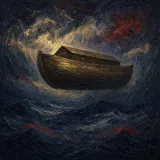
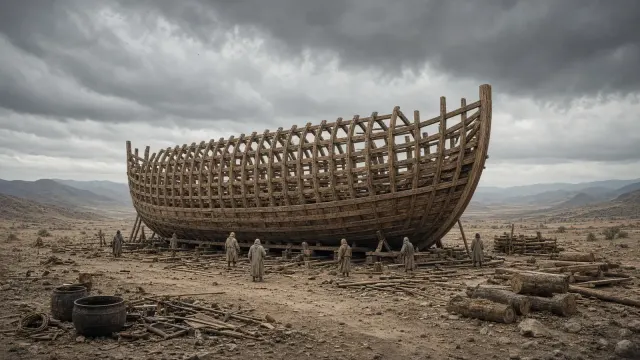
Walk through the instructions: gopher wood, rooms, pitch, the dimensions in cubits, a window, a door, three decks. Give an approximate modern size, around 135 metres long, and say it is approximate. Then read 6:17-21 and show that the purpose is to keep life alive: household, animals, food. Read verse 18 as the first time the word covenant appears in the Bible. End on verse 22 and let it sit. The lesson closes with faith shown by doing what God said.
Where learners get stuck
The misreadings this passage tends to produce, and how to answer each from the text.
"The sons of God were definitely angels who had children with women."
This is one of the oldest readings, found in some Jewish writings and in early Christian ones, and Jude 6 and 2 Peter 2:4 are often brought in. Others read the sons of God as Seth's godly line marrying Cain's, or as kings claiming divine status. The chapter does not explain itself. Present the readings fairly and keep the lesson's weight on verses 5 and 11-13, where the reason for the flood is given plainly.
"God changed his mind, so he must have made a mistake creating people."
Verse 6 speaks of God's grief in human words so that we feel his heart. Numbers 23:19 and 1 Samuel 15:29 say God does not change his mind as humans do. The verse tells us God is deeply affected by evil, not that he was surprised. Let the tension stand and teach what it shows: God cares what his creatures do.
"Noah was saved because he was a good man and earned it."
Verse 8 comes first: "Noah found grace". Verse 9 then describes the kind of man he was, and verse 22 shows his obedience. Hebrews 11:7 says he acted "by faith". Grace and righteousness belong together in Noah, as they do throughout the Bible; teach both without making the ark a payment. Genesis 9:21 will show Noah was not perfect in every way.
Learning objectives
- Identify the chapter's repeated charges against the earth.
- Distinguish God's grief from indifference toward human evil.
- Locate Noah's favor, character, and obedient response.
- Describe the ark's stated purpose and basic design.
- Identify the household and creatures included in preservation.
- Separate debated identities from the chapter's explicit indictment.
Teacher preparation
- Read Genesis 5:28–32 and 7:1–5 to connect Lamech's hope with Noah's assignment and response.
- Prepare brief alternatives for the "sons of God" in 6:2; do not let the opening controversy consume the lesson.
- Explain "repented" through the grief stated in 6:6, without pretending this settles every question about divine knowledge.
- Keep "perfect in his generations" in 6:9 connected to upright conduct; reject claims of racial or genetic purity.
- Sketch the ark using the stated cubit proportions, three levels, door, and food storage; label any modern measurement approximate.
Evidence and interpretation checks
Explicit
Underline Genesis 6:5 and 11–13: pervasive wickedness, corruption, and violence supply the stated grounds for judgment.
Scripture-supported
Pair Genesis 6:22 with Hebrews 11:7; preparation of the ark is presented as faith responding to God's warning.
Strong inference
Observe Genesis 6:8 before 6:14–22: favor is announced before the construction assignment, so the ark is not Noah's method of buying grace.
Possible or traditional reading
Distinguish angelic, Sethite, and ruler readings of Genesis 6:2; also identify lifespan-limit and judgment-countdown interpretations of 6:3 as disputed.
Limit
State that Genesis 6:1–22 does not identify gopher wood botanically, give the construction's duration, or provide a genetic explanation of Noah's righteousness.
Discussion with answer guidance
1. Which accusation is repeated when God explains the coming destruction?
What a good answer contains
Violence: "the earth was filled with violence" in verse 11, and again in verse 13 God tells Noah "the earth is filled with violence through them". Alongside it stands corruption, repeated three times in 11-12: the earth "was corrupt", "it was corrupt", "all flesh had corrupted his way". A good answer names both words and notices that the charge is moral and public: people harming people. A weak answer fixes on the giants and the sons of God in verses 1-4 and leaves the stated reason for judgement unread.
Show teacher guidance
Locate violence in verses 11 and 13 alongside corruption. Refuse to replace this explicit indictment with speculation about mysterious ancestry.
2. What does God's grief add to the description of judgment?
What a good answer contains
That God is not indifferent or cold. Verse 6 says "it repented the LORD that he had made man on the earth, and it grieved him at his heart". The judgement comes from a God who is pained by what his creatures have done, after seeing that "every imagination of the thoughts of his heart was only evil continually" (6:5). A strong answer keeps grief and judgement together. A weak answer either makes God a detached destroyer or uses "repented" to claim God made a mistake, a question the verse raises but does not settle.
Show teacher guidance
Read verses 5–7 carefully. Expect personal opposition to evil and sorrow over it, not boredom or a detached experiment.
3. What do verses 8–9 say about Noah before he builds anything?
What a good answer contains
Three things, in this order: "Noah found grace in the eyes of the LORD" (6:8), "Noah was a just man and perfect in his generations" (6:9), and "Noah walked with God" (6:9). Grace comes first in the text, before his character is described and long before any building. A good answer keeps both grace and righteousness, without letting either cancel the other. A weak answer says Noah earned his place by building the ark, or that his conduct did not matter.
Show teacher guidance
Name favor, righteousness, integrity, and walking with God. Do not turn the passage into either earned rescue or moral indifference.
4. How does the ark's design serve its stated purpose?
What a good answer contains
Everything in verses 14-21 serves keeping life alive. The ark has rooms and three storeys (6:14, 16), it is sealed with pitch "within and without", it has a window and a door, and Noah must gather "all food that is eaten" for himself and the animals (6:21). The animals come "to keep them alive" (6:19-20). A good answer reads the dimensions as a vessel built to carry and feed, not to sail anywhere. A weak answer turns the session into an engineering puzzle the chapter does not pose.
Show teacher guidance
Match rooms, levels, food, and creature pairs in verses 14–21 with keeping life alive. Avoid imaginary engineering specifications.
5. Who belongs inside the promise of preservation?
What a good answer contains
Noah, "thy sons, and thy wife, and thy sons' wives with thee" (6:18), and two of every sort of living thing, male and female (6:19-20). The covenant is first mentioned here: "with thee will I establish my covenant". A good answer sees that the rescue is for a household and for the animal world, so the ark carries a remnant of the whole creation. A weak answer makes the ark one righteous man's escape pod.
Show teacher guidance
Read verses 18–20. Include Noah's household and living creatures rather than reducing the ark to a private escape for one man.
6. Why does Genesis 6 close with Noah's doing rather than a recorded speech?
What a good answer contains
Because the point of the chapter's end is obedience, not eloquence. After nine verses of detailed instruction, the response is a single line: "Thus did Noah; according to all that God commanded him, so did he" (6:22). Hebrews 11:7 calls this faith. A good answer sees that Noah's doing is his answer to God and that it is complete, "according to all". A weak answer invents conversations, doubts or mocking neighbours that the chapter does not report.
Show teacher guidance
Read verse 22 after the long instructions. Its quiet report of doing carries more weight than an invented speech from Noah.
Responsible application
Heart and habits
Ask learners to turn one fictional good intention into a concrete task, using Noah's move from hearing to doing.
Relationships and community
Evaluate a fictional institution that celebrates achievement while ignoring violence; compare its priorities with verses 11–13.
Care within responsibility
Use the food provision in verse 21 to discuss planning for dependent lives rather than merely securing one's own safety.
Session plans
Two timings of the same lesson. The shorter keeps the reading, the central discussion and one response; the longer gives the confusions and the application their own time.
45 minutes
The strange opening
Read 6:1-4 aloud. Name the three readings of the sons of God in two minutes using confusion one.
God's grief
Read 6:5-7. Take question two and confusion two.
But Noah
Read 6:8-10. Take question three and confusion three.
Violence and corruption
Read 6:11-13. Take question one, writing violence and corrupt on the board.
The ark and the response
Read 6:14-22. Take questions four and six, read the key verse together and give out the handout.
90 minutes
Opening question
Ask what it would take for the world to be called filled with violence. Read 6:1-4 and name the readings of the sons of God.
The indictment
Read 6:5-7 and 6:11-13 together. Take question one and mark every, only and continually.
God's heart
Read 6:6 again with 1 Samuel 15:29. Take question two and confusion two.
Grace and character
Read 6:8-10 with 5:24. Take question three and confusion three.
The ark
Read 6:14-16. Measure out part of the length in a corridor or car park. Take question four.
Covenant and household
Read 6:17-21. Take question five and use the third application on caring for dependent lives.
Thus did Noah
Read 6:22 and Hebrews 11:7. Take question six and the first application on turning intention into action.
Handout and prayer
Read the key verse together and pray for faith that obeys.
Adapting the lesson
Children
Tell the children that the world had become full of people hurting each other and that this made God very sad. Keep the coming flood gentle and do not dwell on death. Spend the time on Noah listening to God and building, and let them help draw or build a simple ark with three floors. Do not use the sons of God verses with this age.
Youth
Ask young people what they think a world filled with violence would look like and how much of that they see already. Read 6:5-13 and talk about God's grief rather than anger alone. Mention that people read 6:1-4 in different ways without spending long on it. Ask what it would cost to obey God when everyone else is going a different way, and let 6:22 answer.
Adults
Adults can handle the readings of 6:1-4 and the language of God's repenting. Give both a fair and short treatment. Spend time on the moral cause in 6:11-13 and on grace before obedience in 6:8-22. Ask how they live faithfully in a corrupt setting at work or in public life, and what quiet obedience looks like in their week.
One to one
Read the chapter together and pause at verse 6. Ask what it means to them that God grieves. If they feel overwhelmed by the evil around them, show them verse 8 and the ark: God makes a way to keep life. If they want to argue about the giants, give the readings briefly and return to the heart of the chapter.
Song and video learning lab
A song or video may interpret, compress, or dramatize the text. Its value becomes clearer when its choices are compared with Scripture.
- Before the media: the exact passage and its central movement.
- During the media: the words, people, events, and emotions the artist emphasizes.
- After the media: what it clarifies, what it leaves out, and what belongs back in the biblical text.
Handout
One page for learners to take home. The print button prints this section alone.
Genesis 6:1-22
The passage in brief
In Genesis 6 the earth has become full of wickedness and violence, and God is grieved that he made humanity. He decides to bring a flood. But Noah finds grace with God; he is a righteous man who walks with God. God tells Noah to build an ark of wood with rooms, three decks, a window and a door, and to bring his family, pairs of every kind of animal, and food. God promises to make a covenant with him, and Noah does everything God commands.
A verse to keep
But Noah found grace in the eyes of the LORD.
Genesis 6:8 · King James Version
Questions to take home
What two words does God use in 6:11-13 to describe the state of the earth?
What is said about Noah in 6:8-9 before he builds anything?
What does 6:22 tell you about how Noah answered God?
This week
Choose one thing you know God is asking of you and do it this week, as Noah did.
Music and video connected to the passage
Related media appears when its Scripture reference overlaps this study. Music and video can illuminate a theme while the biblical text remains the foundation.