New · FreePlay The Witnesses The in-depth puzzle battle quest through Bible history

Objects of the Bible

The ark of Noah

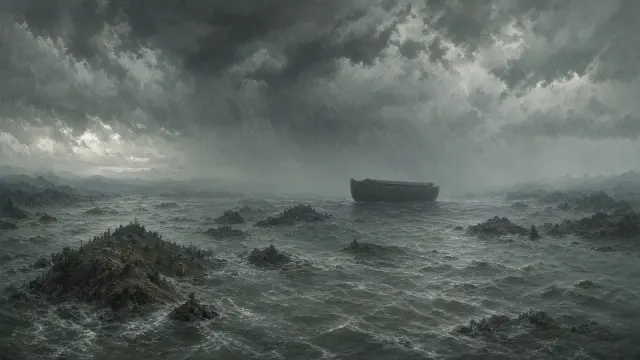
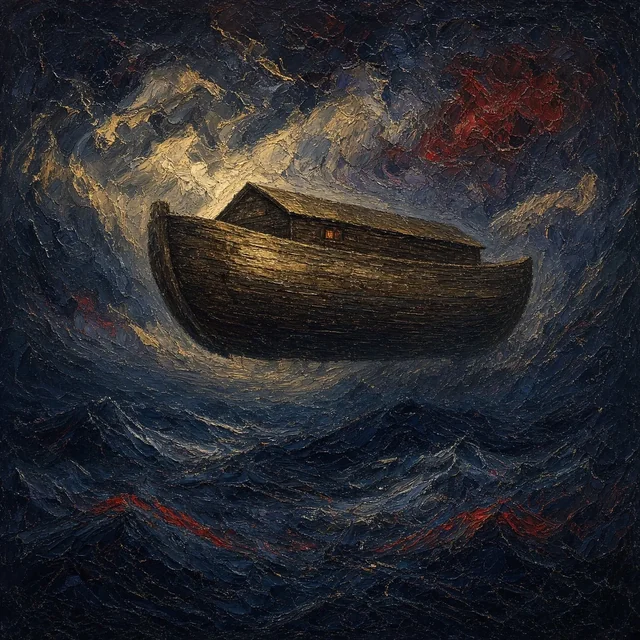
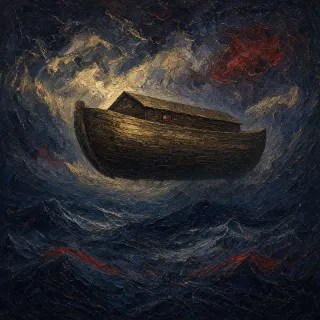
A box with a door and a window, built to float rather than to sail.

The ark is given dimensions, three decks, a door in the side and one opening for light, and nothing else. It has no bow, no rudder, no sail and no keel, which is to say it is not a ship. It is a container that keeps what is inside it alive while the outside is unmade, and it goes where the water takes it. The account returns twice to the door, first to say where it is and later to say who shut it.

Where it appearsGenesis 6 to 9

Scroll down to the account
The ark of Noah

The movements, in the order the text gives them.

The Account of The ark of Noah

  1. 01

    Genesis 6:14-16

    The specification

    Measurements, materials and two openings. The instructions are practical to the point of being dull, which is what makes them convincing.

    The instructions are remarkably interested in keeping water out and say nothing about choosing a course. Rooms, pitch on both sides, three decks, a door in the side: this is a place for living creatures to survive, not a vessel commissioned to discover somewhere. No sail or rudder appears in the specification. The ark has a purpose before it has a destination.

    That purpose is built into the ordinary work. Noah must make compartments and seal timber. The announced judgment does not make craftsmanship irrelevant; it makes the joints matter. Even the measurements refuse the small, cheerful boat of familiar pictures. Three hundred cubits long, fifty wide, thirty high. Whatever precise cubit is assumed, the proportions belong to a substantial structure, six times as long as it is broad.

    Hebrews 11:7 singles out this building as the work of faith: Noah prepared an ark in response to warning about things not seen as yet. The faith is not a feeling supplied between the lines. It has dimensions. Genesis 6:22 closes the instructions by saying that Noah did what God commanded. The extraordinary promise receives a thoroughly practical answer.

    Verse by verse

    1. 6:14

      Gopher is the Hebrew wood-name carried into English. Its precise botanical identification is uncertain.

    2. 6:14

      The Hebrew word rendered rooms is literally nests, used here for compartments.

    3. 6:16

      The Hebrew tsohar is difficult; window and an opening or feature near the roof are discussed. Genesis 8:6 uses the ordinary word for window, hallon.

    Genesis 6:14-16

    King James Version · 3 verses

    6:14Make thee an ark of gopher wood; rooms shalt thou make in the ark, and shalt pitch it within and without with pitch.

    6:15And this is the fashion which thou shalt make it of: The length of the ark shall be three hundred cubits, the breadth of it fifty cubits, and the height of it thirty cubits.

    6:16A window shalt thou make to the ark, and in a cubit shalt thou finish it above; and the door of the ark shalt thou set in the side thereof; with lower, second, and third stories shalt thou make it.

    Genesis 6:14-16: The specification
  2. 02

    Genesis 7:7-16

    The door

    They go in, the creatures come, and the account states who closed the door behind them. Nobody inside could have.

    The door gets its most important sentence after everyone has entered: the LORD shut him in. Noah built the vessel and obeyed the instructions, but Genesis gives this final act of enclosure to God. The distinction is small enough to miss and large enough to govern the passage. The occupants do not secure their own future merely by having arrived on time.

    The repeated lists are not ornamental. Sons, wife, sons' wives; beasts, cattle, creeping things, birds. The chapter keeps naming the life preserved while water breaks over the world outside. After his kind recalls the ordered abundance of Genesis 1. Here that abundance is compressed into a refuge. The rain is only half the description: the fountains of the great deep break open while the windows of heaven open above. The waters held apart in the creation account now threaten the inhabited earth from both directions.

    There is no scene here of Noah arguing at the door, and no account of an angry crowd trying the handle. Those familiar additions should remain outside the commentary. The text's own ending needs no improvement. A catalogue of vulnerable life ends with a shut door and the name of the one who shut it.

    Verse by verse

    1. 7:9

      Two and two describes paired entry. It does not cancel the larger number of clean animals specified in Genesis 7:2-3.

    2. 7:11

      The flood is dated to the seventeenth day of the second month in Noah's six hundredth year.

    3. 7:13

      The household totals eight people, the number explicitly given in 1 Peter 3:20.

    4. 7:16

      God, not Noah, is the stated subject of shut him in.

    Genesis 7:7-16

    King James Version · 10 verses

    7:7And Noah went in, and his sons, and his wife, and his sons’ wives with him, into the ark, because of the waters of the flood.

    7:8Of clean beasts, and of beasts that are not clean, and of fowls, and of every thing that creepeth upon the earth,

    7:9There went in two and two unto Noah into the ark, the male and the female, as God had commanded Noah.

    7:10And it came to pass after seven days, that the waters of the flood were upon the earth.

    7:11In the six hundredth year of Noah’s life, in the second month, the seventeenth day of the month, the same day were all the fountains of the great deep broken up, and the windows of heaven were opened.

    7:12And the rain was upon the earth forty days and forty nights.

    7:13In the selfsame day entered Noah, and Shem, and Ham, and Japheth, the sons of Noah, and Noah’s wife, and the three wives of his sons with them, into the ark;

    7:14They, and every beast after his kind, and all the cattle after their kind, and every creeping thing that creepeth upon the earth after his kind, and every fowl after his kind, every bird of every sort.

    7:15And they went in unto Noah into the ark, two and two of all flesh, wherein is the breath of life.

    7:16And they that went in, went in male and female of all flesh, as God had commanded him: and the LORD shut him in.


    Genesis 7:7-16: The door
  3. 03

    Genesis 8:13-19

    The covering removed

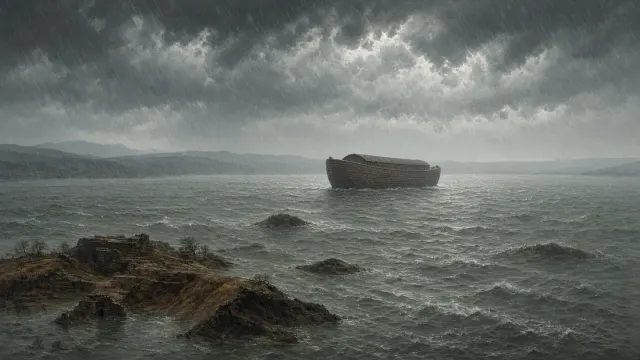
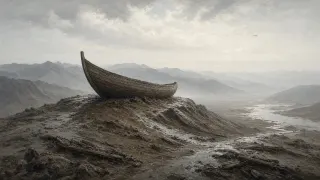
    Noah takes off the covering and looks. The ark ends not with a landing but with a man checking.

    Seeing dry ground is not yet the same thing as stepping onto it. Noah removes the covering on the first day of the first month; the next date is the twenty-seventh day of the second month. Genesis leaves that interval standing. A glimpse of the surface and the departure of the whole living company are distinct moments, not one brisk scene.

    The command to leave answers the command to enter. The ark has done its work, and God does not turn temporary shelter into the permanent address of creation. The creatures are to breed abundantly, be fruitful, and multiply. Those are opening-chapter words. They make the exit more than the end of confinement: the life preserved in compartments is released to fill the earth again.

    The final list has the measured pace of the entry list. Noah is not presented as a captain claiming a new territory. He goes out with his household, and the animals follow in their groups. The emphasis stays on what has survived and what it is now permitted to do. The ark's success is not that everything remains safely inside. Its success is that, at the appointed word, everything living can leave.

    Verse by verse

    1. 8:13-14

      The two dates distinguish the exposed dry surface from the later notice that the earth was dried. The passage does not describe Noah leaving on the first date.

    2. 8:17

      Be fruitful, and multiply repeats the blessing on creatures in Genesis 1:22; it is spoken to Noah and his sons in Genesis 9:1.

    3. 8:19

      The Hebrew behind after their kinds here is literally according to their families, a grouping expression different from the word for kind in Genesis 7:14.

    Genesis 8:13-19

    King James Version · 7 verses

    8:13And it came to pass in the six hundredth and first year, in the first month, the first day of the month, the waters were dried up from off the earth: and Noah removed the covering of the ark, and looked, and, behold, the face of the ground was dry.

    8:14And in the second month, on the seven and twentieth day of the month, was the earth dried.

    8:15And God spake unto Noah, saying,

    8:16Go forth of the ark, thou, and thy wife, and thy sons, and thy sons’ wives with thee.

    8:17Bring forth with thee every living thing that is with thee, of all flesh, both of fowl, and of cattle, and of every creeping thing that creepeth upon the earth; that they may breed abundantly in the earth, and be fruitful, and multiply upon the earth.

    8:18And Noah went forth, and his sons, and his wife, and his sons’ wives with him:

    8:19Every beast, every creeping thing, and every fowl, and whatsoever creepeth upon the earth, after their kinds, went forth out of the ark.

    Genesis 8:13-19: The covering removed

Why it matters

The ark is the first object in the Bible built entirely on a word about the future. Nothing in the sky supported the project for a hundred years. It also sets the shape of rescue that Scripture keeps reusing: a way through judgment rather than around it, with a door that someone else closes.

3 songs

The music

Every song in the catalogue whose passage falls inside these chapters.

  1. Genesis 6:1-9:29

    The Ark Above the Deep

  2. Genesis 6-8

    Waters Over the Earth

  3. Genesis 9:1-17

    The Bow in the Cloud

Nearby

All the objects

Report an error on this page