New · FreePlay The Witnesses The in-depth puzzle battle quest through Bible history

Objects of the Bible

The bow in the cloud

A weapon hung up in the sky, pointed away, as the sign of a promise made to everything that breathes.

The word the account uses is the ordinary word for a war bow, not a special word for a rainbow. It is set in the cloud, and the covenant it signs is not made with Noah alone but with every living creature and with the earth itself. The most striking line is about who the sign is for. It is not hung there so that people will remember. The text says that when the bow appears, God will look at it and remember.

Where it appearsGenesis 9

Scroll down to the account
The bow in the cloud

The movements, in the order the text gives them.

The Account of The bow in the cloud

  1. 01

    Genesis 9:1-7

    Fill the earth again

    The blessing given at creation is given a second time, with new terms about life and blood attached to it.

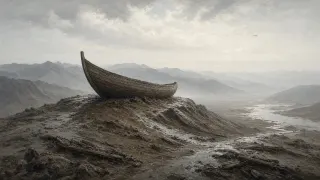
    The first command after the flood sounds like the first blessing before it: be fruitful, and multiply. Genesis has not abandoned the purpose announced in chapter 1. But the renewed beginning is no simple return to Eden. Fear and dread enter the description of the animals' relationship to humanity, and permission to eat flesh arrives with a boundary concerning blood. Life continues in a changed world.

    The boundary is not an incidental dietary footnote. The passage moves directly from the blood of an animal to the blood of a human being, and three times God says that an account will be required. The earth was filled with violence before the flood, according to Genesis 6:11. Its survivors do not receive permission to build the same world again without reckoning.

    The reason given for the special gravity of human bloodshed is startlingly old: in the image of God made he man. Neither the fall nor the flood has erased that stated basis of human worth. The passage places its severe sentence about killing inside two commands to multiply, in verses 1 and 7. The purpose is a populated earth, not an earth where surviving the waters gives anyone unrestricted possession of another life.

    Verse by verse

    1. 9:1

      Replenish here means fill. The same English verb appears in the creation blessing of Genesis 1:28.

    2. 9:3-4

      The permission to eat animal flesh is followed immediately by the restriction concerning blood as the life.

    3. 9:6

      The text states a death penalty for human bloodshed and gives the divine image as its reason. It does not supply a complete system of judicial procedure here.
    Genesis 9:1-7

    King James Version · 7 verses

    9:1And God blessed Noah and his sons, and said unto them, Be fruitful, and multiply, and replenish the earth.

    9:2And the fear of you and the dread of you shall be upon every beast of the earth, and upon every fowl of the air, upon all that moveth upon the earth, and upon all the fishes of the sea; into your hand are they delivered.

    9:3Every moving thing that liveth shall be meat for you; even as the green herb have I given you all things.

    9:4But flesh with the life thereof, which is the blood thereof, shall ye not eat.

    9:5And surely your blood of your lives will I require; at the hand of every beast will I require it, and at the hand of man; at the hand of every man’s brother will I require the life of man.

    9:6Whoso sheddeth man’s blood, by man shall his blood be shed: for in the image of God made he man.

    9:7And you, be ye fruitful, and multiply; bring forth abundantly in the earth, and multiply therein.

    Genesis 9:1-7: Fill the earth again
  2. 02

    Genesis 9:8-11

    Never again by water

    The promise is stated as a limit on judgment, and it is given without conditions on the other side.

    The animals are not background scenery at this covenant. God names them among its beneficiaries, alongside Noah, his sons, and descendants not yet born. Birds, cattle, and every beast of the earth are included with deliberate repetition. The promise is wider than the household that can hear it spoken.

    Its force comes from who undertakes it: I establish my covenant. The preceding verses contain commands for human conduct, but this promise is not phrased as a bargain in which the animals must behave well enough to keep the water away. Genesis 8:21 has already acknowledged the continuing evil of the human heart. The covenant is not a congratulation on a species now cured of wrongdoing. It secures the continuation of life despite that unresolved condition.

    The promise is also specific. No flood will again destroy the earth and cut off all flesh. It does not say that no river will overflow, that no creature will die, or that all divine judgment has ended. Second Peter 3:6-7 distinguishes the former destruction by water from a future judgment. The exactness matters: the world receives a firm undertaking, not an assurance that nothing painful can ever happen beneath its sky.

    Verse by verse

    1. 9:9

      Seed means descendants; the promise reaches beyond the people presently standing with Noah.

    2. 9:10

      Every living creature is expressly included. The covenant is not limited to humanity or to Israel.

    3. 9:11

      The promised exclusion is another flood that destroys the earth and all flesh, not the absence of every local flood or every later judgment.

    Genesis 9:8-11

    King James Version · 4 verses

    9:8And God spake unto Noah, and to his sons with him, saying,

    9:9And I, behold, I establish my covenant with you, and with your seed after you;

    9:10And with every living creature that is with you, of the fowl, of the cattle, and of every beast of the earth with you; from all that go out of the ark, to every beast of the earth.

    9:11And I will establish my covenant with you; neither shall all flesh be cut off any more by the waters of a flood; neither shall there any more be a flood to destroy the earth.

    Genesis 9:8-11: Never again by water
  3. 03

    Genesis 9:12-17

    I will look upon it

    The sign faces the wrong way to be a reminder for people. It is described as something God sees.

    The striking observer of the bow is God himself: I will look upon it. The sign is visible to the earth, but the sentence locates the covenant's security in the attention of its maker. Noah is not instructed to keep the promise alive by remembering hard enough. God speaks of remembering it.

    Remembering here belongs with the opening of Genesis 8, where God remembered Noah and the waters began to recede. In both places, remembrance is expressed through faithful action, not the recovery of a misplaced fact. The bow declares an undertaking that will remain effective through perpetual generations, including generations that never saw the ark.

    The Hebrew word is the ordinary word for a bow, including a weapon. That gives substance to the reading of the rainbow as a bow set aside after judgment. But the passage does not mention an arrow, explain a direction of aim, or describe God hanging up military equipment. The safe observation is still a rich one: what can name a weapon now names a sign of preservation. Clouds will return. The promise does not require a permanently empty sky; it places the sign in the cloud.

    Verse by verse

    1. 9:13

      Qesheth is used for both the rainbow and a bow as a weapon; Psalm 7:12 uses bow in a scene of judgment.

    2. 9:13

      I do set appoints the bow as a covenant sign. The verse does not explain the origin of its optical properties or explicitly state that no rainbow had existed before.

    3. 9:15-16

      God is the subject of remember and look. The language emphasizes his continuing covenant commitment.

    4. 9:17

      Covenant occurs seven times in Genesis 9:8-17, at verses 9, 11, 12, 13, 15, 16, and 17.

    Genesis 9:12-17

    King James Version · 6 verses

    9:12And God said, This is the token of the covenant which I make between me and you and every living creature that is with you, for perpetual generations:

    9:13I do set my bow in the cloud, and it shall be for a token of a covenant between me and the earth.

    9:14And it shall come to pass, when I bring a cloud over the earth, that the bow shall be seen in the cloud:

    9:15And I will remember my covenant, which is between me and you and every living creature of all flesh; and the waters shall no more become a flood to destroy all flesh.

    9:16And the bow shall be in the cloud; and I will look upon it, that I may remember the everlasting covenant between God and every living creature of all flesh that is upon the earth.

    9:17And God said unto Noah, This is the token of the covenant, which I have established between me and all flesh that is upon the earth.

    Genesis 9:12-17: I will look upon it

Why it matters

This is the first covenant in Scripture with a visible sign attached, and it establishes the pattern: a promise, a sign, and the sign belonging to the one who made the promise rather than to the one who received it. Every later sign of covenant, in circumcision, in a Sabbath, in bread and a cup, is standing on this.

1 song

The music

Every song in the catalogue whose passage falls inside these chapters.

  1. Genesis 9:1-17

    The Bow in the Cloud

Nearby

All the objects

Report an error on this page